
Global Veterinary Stereotactic Radiosurgery Market Size, Growth Trends, and Forecast 2032

Veterinary Stereotactic Radiosurgery Market By Product (CyberKnife, Gamma Knife, Linear Accelerator (LINAC), Proton Beam Radiation Therapy (PBRT)/Flash-RT, and Others), By Application (Brain Tumours, Spinal Tumours, Head & Neck Tumours, Soft-Tissue, and Other Tumours), By End Use (Veterinary Hospitals, Veterinary Clinics, and Academic & Research Institutions), and By Region - Global and Regional Industry Overview, Market Intelligence, Comprehensive Analysis, Historical Data, and Forecasts 2024 - 2032
| Market Size in 2023 | Market Forecast in 2032 | CAGR (in %) | Base Year |
|---|---|---|---|
| USD 3.09 Billion | USD 7.40 Billion | 10.2% | 2023 |
Veterinary Stereotactic Radiosurgery Industry Perspective
What will be the global veterinary stereotactic radiosurgery market size during the forecast period?
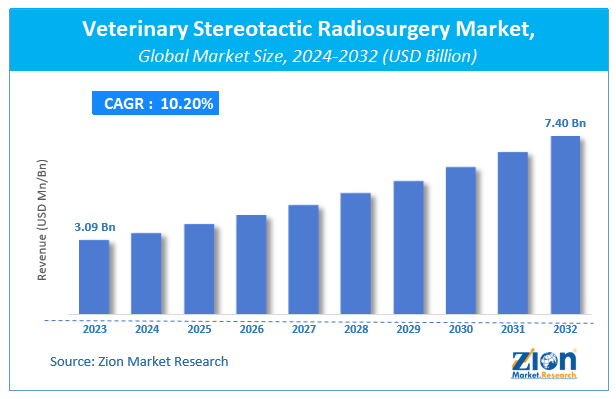
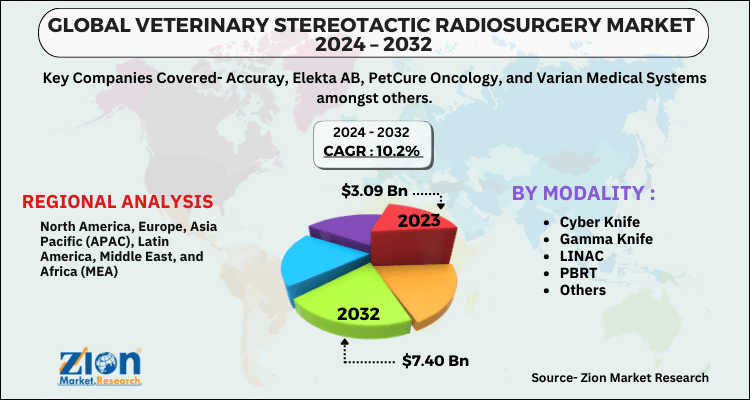
The global veterinary stereotactic radiosurgery market size was worth around USD 3.09 billion in 2023 and is predicted to grow to around USD 7.40 billion by 2032 with a compound annual growth rate (CAGR) of roughly 10.2% between 2024 and 2032.
The report provides a comprehensive analysis of the growth drivers, restraints, and challenges shaping demand across the global veterinary stereotactic radiosurgery market throughout the forecast period, while highlighting high-potential emerging opportunities within the industry.
Key Insights
- As per the analysis shared by our research analyst, the global veterinary stereotactic radiosurgery market is estimated to grow annually at a CAGR of around 10.2% over the forecast period (2024-2032).
- In terms of revenue, the global veterinary stereotactic radiosurgery market size was valued at around USD 3.09 billion in 2023 and is projected to reach USD 7.40 billion by 2032.
- The veterinary stereotactic radiosurgery market is projected to grow at a significant rate due to the increasing incidence of cancer in pets, rising pet companionship, greater willingness to spend on advanced pet care, and the clinical advantages of precise radiation delivery with reduced impact on healthy tissue.
- Based on the product segment, proton beam radiation therapy (PBRT) held the largest revenue share in 2023 owing to advantages such as reduced irradiation of healthy tissue and effective treatment at optimized doses.
- Based on the application segment, brain tumours represent a leading clinical application due to the high clinical need for precise, non-invasive treatment of intracranial lesions in companion animals.
- Based on the end-use segment, veterinary hospitals account for a dominant share as they typically house advanced radiation equipment and specialized oncology teams capable of delivering stereotactic treatments.
- Based on region, North America is expected to dominate the veterinary stereotactic radiosurgery market over the forecast period due to the high incidence of pet cancer, strong pet ownership trends, willingness to invest in advanced care, and supportive research and organizational activity.
Veterinary Stereotactic Radiosurgery Market: Overview
Veterinary stereotactic radiosurgery (SRS) is a highly precise radiation therapy treatment designed for animals. It delivers a focused, high dose of radiation to a tumor or abnormal tissue while minimizing damage to surrounding healthy tissue. This advanced technique is used to treat various cancers in pets, including brain tumors, spinal cord tumors, head and neck tumors, and certain soft-tissue tumors, offering a non-invasive or minimally invasive option that supports better tumor control and reduced treatment-related toxicity.
Veterinary Stereotactic Radiosurgery Market: Dynamics
Growth Drivers
What factors are propelling the expansion of the veterinary stereotactic radiosurgery market?
The increasing incidence of cancer in the pet population is a primary driver of demand for advanced treatment options such as stereotactic radiosurgery. Rising pet companionship and a growing willingness among owners to spend on sophisticated veterinary care further support market expansion. Modalities that deliver precise radiation while limiting exposure to surrounding healthy tissue offer clear clinical benefits, including improved tumor control and reduced toxicity.
Expanding research studies evaluating the safety and efficacy of stereotactic radiation therapy in animals, along with the development of specialized veterinary oncology centers, continue to strengthen adoption. Government initiatives related to advanced pet cancer treatment and the involvement of non-profit organizations focused on pet health products and services also contribute to regional and global market growth.
Restraints
What factors are limiting the growth of the veterinary stereotactic radiosurgery market?
High capital costs associated with acquiring and maintaining advanced radiosurgery systems can limit adoption, particularly among smaller veterinary clinics and in cost-sensitive markets. The need for specialized training, infrastructure, and ongoing technical support further raises barriers to entry for many facilities.
Limited awareness of stereotactic options in certain regions and variability in pet insurance coverage or owner ability to pay for advanced therapies may also moderate uptake. In some areas, economic and access constraints continue to influence treatment decisions, including higher rates of alternative or palliative approaches.
Opportunities
What opportunities are emerging in the veterinary stereotactic radiosurgery market?
Increasing awareness of advanced pet treatment methods, rising willingness to invest in veterinary health, and the expansion of animal health awareness programs create significant opportunities, particularly in the Asia Pacific region. Continued technological refinement of systems such as LINAC-based platforms and proton therapy, along with growing clinical evidence, supports broader indication expansion and new center development.
Challenges
What challenges does the veterinary stereotactic radiosurgery market face?
Ensuring consistent access to specialized equipment and trained radiation oncology teams remains a challenge outside major urban and academic centers. The relatively small number of dedicated veterinary radiosurgery facilities globally can limit patient referral pathways and treatment capacity.
Veterinary Stereotactic Radiosurgery Market: Report Scope
| Report Attributes | Report Details |
|---|---|
| Report Name | Veterinary Stereotactic Radiosurgery Market |
| Market Size in 2023 | USD 3.09 Billion |
| Market Forecast in 2032 | USD 7.40 Billion |
| Growth Rate | CAGR of 10.2% |
| Number of Pages | 230 |
| Key Companies Covered | Accuray, Elekta AB, PetCure Oncology, and Varian Medical Systems, among others. |
| Segments Covered | By Product, By Application, By End Use, and By Region |
| Regions Covered | North America, Europe, Asia Pacific (APAC), Latin America, Middle East, and Africa (MEA) |
| Base Year | 2023 |
| Historical Year | 2018 - 2022 |
| Forecast Year | 2024 - 2032 |
| Customization Scope | Avail customized purchase options to meet your exact research needs. Request For Customization |
Veterinary Stereotactic Radiosurgery Market: Segmentation Analysis
The veterinary stereotactic radiosurgery market is segmented by product, application, end use, and region. All the segments of the veterinary stereotactic radiosurgery market have been analyzed based on present and future trends and the market is estimated from 2024 to 2032.
Based on Product Segment, the veterinary stereotactic radiosurgery market is divided into CyberKnife, Gamma Knife, Linear Accelerator (LINAC), Proton Beam Radiation Therapy (PBRT)/Flash-RT, and Others. In 2023, Particle Beam Radiation Therapy (PBRT) held the largest revenue share in the market. Some of the primary growth drivers for the segment are advantages such as reduced irradiation of healthy tissue and effective treatment even with low radiation doses. According to an article in the Journal of Hematology & Oncology, Proton Beam Therapy for Cancer in the Age of Precision Medicine, PBRT delivers the radiation dose to a tumor cell and delivers it to the surrounding tissue and organs with very little or no irradiation effect. The treatment results in maximum control of the tumor and ultimately reduces the toxicity of the tumor.
The Veterinary CyberKnife Cancer Center constructed a linear Varian accelerator for cancerous tumor treatment of dogs. To irradiate various forms of cancer, the mounted LINAC system supplemented the CyberKnife software. Increasing the use of the LINAC-based radiosurgery system as an animal treatment method fosters the development of the demand for veterinary stereotactic radiosurgery systems.
Based on Application Segment, the veterinary stereotactic radiosurgery market is divided into brain tumours, spinal tumours, head & neck tumours, soft-tissue, and other tumours.
Brain tumours represent a leading application area because of the clinical need for precise, non-invasive or minimally invasive treatment of intracranial lesions where conventional approaches may carry higher risk to surrounding critical structures. Stereotactic techniques enable focused high-dose delivery while limiting exposure to healthy brain tissue, supporting improved local control and quality-of-life considerations for pets and owners. This focus helps drive demand for advanced systems and specialized expertise. Spinal tumours, head and neck tumours, and soft-tissue tumours also benefit from the precision of stereotactic radiosurgery, expanding the range of treatable indications and contributing to broader market utilization.
Based on End Use Segment, the veterinary stereotactic radiosurgery market is divided into veterinary hospitals, veterinary clinics, and academic & research institutions. Veterinary hospitals account for a dominant share of end use. These facilities typically possess the infrastructure, capital capacity, and specialized oncology teams required to install and operate advanced radiosurgery systems. They serve as primary referral centers for complex cancer cases and support both clinical treatment and ongoing protocol development. Academic and research institutions play an important complementary role by advancing safety and efficacy studies and training the next generation of veterinary radiation oncologists, while clinics may participate in referral networks or offer selected services. The concentration of capability in hospitals helps drive market growth through higher procedure volumes and the demonstration of clinical value that encourages further system adoption.
Veterinary Stereotactic Radiosurgery Market: Regional Analysis
The geographical segmentation comprises the current and forecast demand for North America, Europe, Asia Pacific, Latin America, and Middle East & Africa.
Why will North America continue to dominate the global market during the projection period?
North America is projected to dominate the market over the forecast period, owing to the increasing incidence of cancer in the pet population, increasing pet companionship along with an increase in willingness to spend on their pets, and government initiatives to treat SRT. The involvement of non-profit organizations such as APPA catering to pet products and services needs and interests further drives regional market growth.
Increasing research studies to test the safety and efficacy of SRT in animals are also driving North America's market growth. In terms of revenue over the forecast period, Europe's market for veterinary stereotactic radiosurgery systems is expected to be the second-largest regional segment. Government R&D initiatives and the establishment of new centers to carry out veterinary radiation oncology research activities are the factors expected to fuel growth.
Asia Pacific had the third-largest market share in 2023 and is expected to see significant growth over the forecast period due to increased awareness of various pet treatment methods, a willingness to spend more on veterinary health, and an increasing number of animal health awareness programs. Due to the increasing incidence of euthanasia and pet subscriptions, the Middle East and Africa held a very small market share of SRT treatment, and despite economic and political issues in the region, the pet industry has remained resilient over the years.
Recent Developments
- In December 2025, a new robotically accelerated conformal beam radiation platform named Sirius, designed to deliver photon augmented wave stereotactic radiation therapy with human-grade precision, was announced for debut in early 2026 at the PetCure Oncology cancer care center in Seattle through a partnership between Empyrean Medical Systems and Thrive Pet Healthcare.
Veterinary Stereotactic Radiosurgery Market: Competitive Analysis
Some of the major players in the global veterinary stereotactic radiosurgery market include:
- Accuray
- Elekta AB
- PetCure Oncology
- Varian Medical Systems
The global veterinary stereotactic radiosurgery market is segmented as follows;
By Product
- CyberKnife
- Gamma Knife
- Linear Accelerator (LINAC)
- Proton Beam Radiation Therapy (PBRT)/Flash-RT
- Others
By Application
- Brain Tumours
- Spinal Tumours
- Head & Neck Tumours
- Soft-Tissue
- Other Tumours
By End Use
- Veterinary Hospitals
- Veterinary Clinics
- Academic & Research Institutions
By Region
- North America
- The U.S.
- Canada
- Mexico
- Europe
- France
- The UK
- Spain
- Germany
- Italy
- Rest of Europe
- Asia Pacific
- China
- Japan
- India
- Australia
- South Korea
- Rest of Asia Pacific
- The Middle East & Africa
- Saudi Arabia
- UAE
- Egypt
- Kuwait
- South Africa
- Rest of the Middle East & Africa
- Latin America
- Brazil
- Argentina
- Rest of Latin America
Table Of Content
Methodology
FrequentlyAsked Questions
Veterinary stereotactic radiosurgery (SRS) is a highly precise radiation therapy treatment for animals. It involves delivering a focused, high dose of radiation to a tumor or abnormal tissue with minimal damage to surrounding healthy tissue and is used to treat various cancers in pets, including brain tumors, spinal tumors, and certain soft-tissue tumors.
According to a study, the global veterinary stereotactic radiosurgery market size was worth around USD 3.09 billion in 2023 and is expected to reach USD 7.40 billion by 2032.
The global veterinary stereotactic radiosurgery market is expected to grow at a CAGR of 10.2% during the forecast period.
North America is expected to dominate the veterinary stereotactic radiosurgery market over the forecast period.
Leading players in the global veterinary stereotactic radiosurgery market include Accuray, Elekta AB, PetCure Oncology, and Varian Medical Systems, among others.
Key growth drivers include the increasing incidence of cancer in the pet population, rising pet companionship, greater willingness to spend on advanced pet care, clinical advantages of precise radiation with reduced healthy-tissue exposure, expanding research, and supportive organizational and governmental activity.

HappyClients

