
Global Vehicle Security System Market Size, Share, Growth Trends, and Forecast 2032

Vehicle Security System Market By Product (Central Locking System, Alarm, Remote Keyless Entry, Immobilizer, and Others), By Technology (Global Positioning System (GPS), Real-Time Location System (RTLS), Face Detection System, and Others), By Vehicle (Passenger Cars, Off-Highway Vehicles, and Commercial Vehicles), and By Region: Global Industry Perspective, Comprehensive Analysis, and Forecast, 2024-2032
| Market Size in 2023 | Market Forecast in 2032 | CAGR (in %) | Base Year |
|---|---|---|---|
| USD 13.98 Billion | USD 36.65 Billion | 11.3% | 2023 |
Vehicle Security System Industry Perspective
What will be the global Vehicle Security System market size during the forecast period?
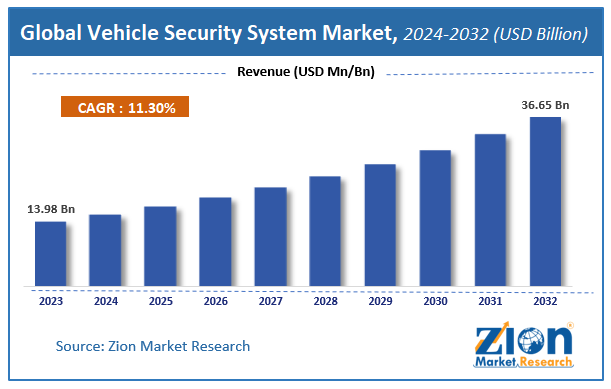
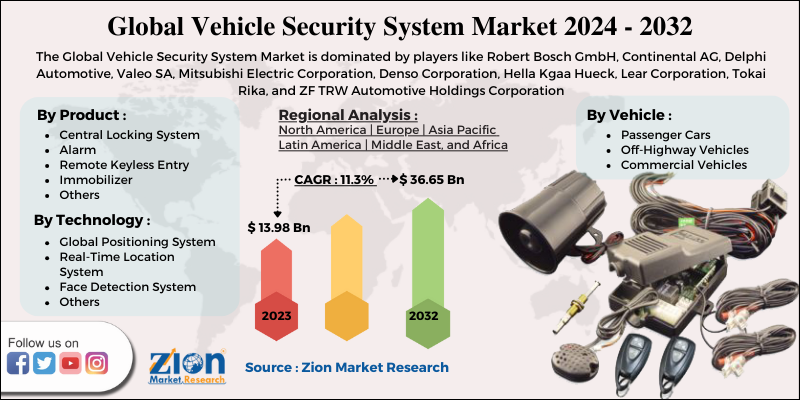
The global vehicle security system market size was worth around USD 13.98 billion in 2023 and is predicted to grow to around USD 36.65 billion by 2032, with a compound annual growth rate (CAGR) of roughly 11.3% between 2024 and 2032.
This report provides a comprehensive analysis of the growth drivers, restraints, and challenges shaping demand across the global vehicle security system market throughout the forecast period, while highlighting high-potential emerging opportunities within the industry.
Key Insights
- According to our research analyst, the global Vehicle Security System market is estimated to grow at a CAGR of around 11.3% over the forecast period (2024-2032).
- In terms of revenue, the global Vehicle Security System market size was valued at around USD 13.98 billion in 2023 and is projected to reach USD 36.65 billion by 2032.
- The market is driven by rising production of commercial vehicles, increasing incidents of vehicle theft, technological developments in the automotive industry, and growing demand for advanced security features.
- Based on the Product, the Central Locking System segment is growing at a high rate and is projected to dominate the global market.
- Based on the Technology, the Global Positioning System (GPS) segment is projected to grow substantially due to rising investments in updating existing tracking technologies.
- Based on the Vehicle, Passenger Cars are anticipated to hold a significant share, supported by increasing demand in developing countries of the Asia Pacific region.
- Based on region, Latin America is expected to grow at a considerable rate, while Europe is estimated to make notable contributions as a global automotive hub.
Vehicle Security System Market: Overview
A vehicle security system is a collection of technologies and devices designed to protect vehicles from theft, unauthorized access, and related security threats. These systems aim to deter potential thieves, alert owners to possible risks, and in some cases enable tracking or disabling of the vehicle if theft occurs. Common components include central locking systems, alarms, remote keyless entry, immobilizers, and supporting technologies such as GPS, real-time location systems, and face detection capabilities.
The vehicle security system market is expected to grow owing to the rising production of commercial vehicles. The total number of commercial vehicles manufactured in 2017 was around 23.8 million units in comparison to 22.8 million units in 2016. The U.S. and China were the prime contributors in terms of production statistics of 2017. Considering the rising investments made in the automotive sector, this number is expected to increase in the upcoming years. Furthermore, technological developments witnessed in the automotive industry are also paving the way for this global market’s growth. Manufacturers are focusing on collaborating with technology providers to automate security processes. For instance, in 2018, BMW announced its extended partnership with “Tencent Keen Security Lab” in China to conduct security tests for its various car models. Thus, the vehicle security system market is expected to witness substantial growth over the estimated timeline.
The rising incidents of vehicle theft have led vehicle manufacturers to use technically advanced security systems. In 2017, the “Federal Bureau of Investigation (FBI)” declared that around 770 thousand vehicles were stolen in the U.S. as compared to 686 thousand in 2014. However, high initial investments to manufacture these systems may adversely affect this market’s growth. Alternatively, adoption of artificial intelligence (AI) and the use of biometric technology in vehicle security systems are expected to open new growth avenues for the market in the future.
Vehicle Security System Market: Dynamics
Growth Drivers
What factors are accelerating the expansion of the Vehicle Security System market?
The vehicle security system market is expected to grow owing to the rising production of commercial vehicles and increasing investments in the automotive sector. Technological developments in the industry are paving the way for more advanced and automated security solutions. Manufacturers are collaborating with technology providers to enhance system capabilities and conduct security testing across vehicle models.
Rising incidents of vehicle theft have led manufacturers to incorporate technically advanced security systems. These factors collectively support stronger demand for comprehensive vehicle protection solutions across passenger and commercial segments.
Restraints
What factors are limiting the growth of the Vehicle Security System market?
High initial investments required to manufacture advanced vehicle security systems may adversely affect market growth. Cost considerations can slow adoption in price-sensitive vehicle segments or regions.
Integration complexity and the need to ensure reliable performance without excessive false alarms also present practical constraints for system designers and vehicle manufacturers.
Vehicle Security System Market: Report Scope
| Report Attributes | Report Details |
|---|---|
| Report Name | Vehicle Security System Market |
| Market Size in 2023 | USD 13.98 Billion |
| Market Forecast in 2032 | USD 36.65 Billion |
| Growth Rate | CAGR of 11.3% |
| Number of Pages | 220 |
| Key Companies Covered | Robert Bosch GmbH, Continental AG, Delphi Automotive, Valeo SA, Mitsubishi Electric Corporation, Denso Corporation, Hella Kgaa Hueck, Lear Corporation, Tokai Rika, and ZF TRW Automotive Holdings Corporation |
| Segments Covered | By Product, By Technology, By Vehicle, and By Region |
| Regions Covered | North America, Europe, Asia Pacific (APAC), Latin America, Middle East, and Africa (MEA) |
| Base Year | 2023 |
| Historical Year | 2018 - 2022 |
| Forecast Year | 2024 - 2032 |
| Customization Scope | Avail customized purchase options to meet your exact research needs. Request For Customization |
Vehicle Security System Market: Segmentation
The study provides a crucial view of the vehicle security system market based on the product, technology, vehicle, and region. All the market segments have been analyzed based on present and future trends, and the market is estimated from 2024 to 2032.
By product, the global vehicle security system market includes central locking system, remote keyless entry, alarm, immobilizer, and others. Central locking systems and immobilisers provide foundational access control and engine protection, while alarms and remote keyless entry enhance convenience and deterrence. These product categories work together to create layered security and drive overall market adoption by addressing both prevention and response needs across vehicle types.
By technology, the market includes global positioning system (GPS), real-time location system (RTLS), face detection system, and others. The global positioning system (GPS) segment is projected to grow substantially in the years ahead, owing to the rising investments made for updating the existing technology. This leadership supports vehicle recovery and monitoring capabilities. Real-time location and face detection systems add complementary layers of awareness and authentication that further strengthen comprehensive security solutions.
Based on vehicle, the global vehicle security system market includes passenger cars, commercial vehicles, and off-highway vehicles. Passenger cars are anticipated to hold a significant market share over the forecast time span, due to the increasing demand for passenger cars in developing countries of the Asia Pacific region.
Vehicle Security System Market: Regional Analysis
Why will Latin America and Europe continue to contribute strongly during the projection period?
By region, Latin America is expected to grow at a considerable rate in the global vehicle security system market over the estimated time period, owing to rising investments by various automotive manufacturers in Brazil. Europe is estimated to make notable contributions to the upsurge of the vehicle security system market globally, as it is the global automotive hub with the presence of renowned manufacturers like Renault, Volkswagen, BMW, Peugeot, Daimler, and Citroën.
Europe is estimated to make notable contributions to the upsurge of the vehicle security system market globally. The region is a global automotive hub with the presence of renowned manufacturers such as Renault, Volkswagen, BMW, Peugeot, Daimler, and Citroën. Strong manufacturing bases and advanced vehicle technology adoption reinforce Europe’s influence on product standards and innovation.
Asia Pacific benefits from rising passenger car demand in developing countries, supporting significant volume growth for security systems. North America maintains steady demand linked to vehicle production, theft prevention priorities, and advanced technology integration. The Middle East and Africa region shows progressive potential as vehicle ownership and security awareness continue to develop.
Vehicle Security System Market: Competitive Players
Some noticeable players in the global vehicle security system market are:
- Robert Bosch GmbH
- Continental AG
- Delphi Automotive
- Valeo SA
- Mitsubishi Electric Corporation
- Denso Corporation
- Hella Kgaa Hueck
- Lear Corporation
- Tokai Rika
- ZF TRW Automotive Holdings Corporation
The Global Vehicle Security System Market is segmented as follows:
By Product
- Central Locking System
- Alarm
- Remote Keyless Entry
- Immobilizer
- Others
By Technology
- Global Positioning System (GPS)
- Real-Time Location System (RTLS)
- Face Detection System
- Others
By Vehicle
- Passenger Cars
- Off-Highway Vehicles
- Commercial Vehicles
By Region
- North America
- The U.S.
- Canada
- Mexico
- Europe
- France
- The UK
- Spain
- Germany
- Italy
- Rest of Europe
- Asia Pacific
- China
- Japan
- India
- Australia
- South Korea
- Rest of Asia Pacific
- The Middle East & Africa
- Saudi Arabia
- UAE
- Egypt
- Kuwait
- South Africa
- Rest of the Middle East & Africa
- Latin America
- Brazil
- Argentina
- Rest of Latin America
Table Of Content
Methodology
FrequentlyAsked Questions
A Vehicle Security System is a collection of technologies and devices designed to protect vehicles from theft, unauthorized access, and other security threats. These systems aim to deter thieves, alert vehicle owners of potential threats, and, in some cases, disable or track the vehicle in the event of theft.
According to study, the Vehicle Security System Market size was worth around USD 13.98 billion in 2023 and is predicted to grow to around USD 36.65 billion by 2032.
The CAGR value of Vehicle Security System Market is expected to be around 11.3% during 2024-2032.
Latin America has been leading the Vehicle Security System Market and is anticipated to continue on the dominant position in the years to come.
The Vehicle Security System Market is led by players like Robert Bosch GmbH, Continental AG, Delphi Automotive, Valeo SA, Mitsubishi Electric Corporation, Denso Corporation, Hella Kgaa Hueck, Lear Corporation, Tokai Rika, and ZF TRW Automotive Holdings Corporation.
Key growth drivers include rising production of commercial vehicles, increasing incidents of vehicle theft, technological developments in the automotive industry, growing investments in the sector, and collaborations aimed at advancing security capabilities.
Major challenges include high initial investments to manufacture advanced systems, integration complexity, and the need to ensure reliable performance with minimal false alarms.
Emerging trends include adoption of artificial intelligence and biometrics, continued investment in GPS and tracking technologies, and closer collaboration between vehicle manufacturers and technology providers to enhance automated security processes.
The value chain typically includes research and development of security technologies, manufacturing of system components, integration into vehicles by OEMs, distribution through aftermarket channels, installation and calibration, and ongoing support and software updates where applicable.
The report explores crucial aspects of the Vehicle Security System market, including a detailed discussion of existing growth factors and restraints, while also examining future growth opportunities and challenges that impact the market. It provides comprehensive segmentation analysis, regional insights, competitive landscape, and forecasts based on historical data.

HappyClients

