
Vehicle Scanner Market Size, Share, Growth, Opportunities 2034

Vehicle Scanner Market By Structure Type (UVSS and Drive Through), By Type (Portable and Fixed), By Application (Private and Government/Critical Infrastructure Protection), and By Region - Global and Regional Industry Overview, Market Intelligence, Comprehensive Analysis, Historical Data, and Forecasts 2025 - 2034
| Market Size in 2024 | Market Forecast in 2034 | CAGR (in %) | Base Year |
|---|---|---|---|
| USD 2.5 Billion | USD 4.1 Billion | 5.2% | 2024 |
Vehicle Scanner Industry Perspective:
What will be the size of the global vehicle scanner market during the forecast period?
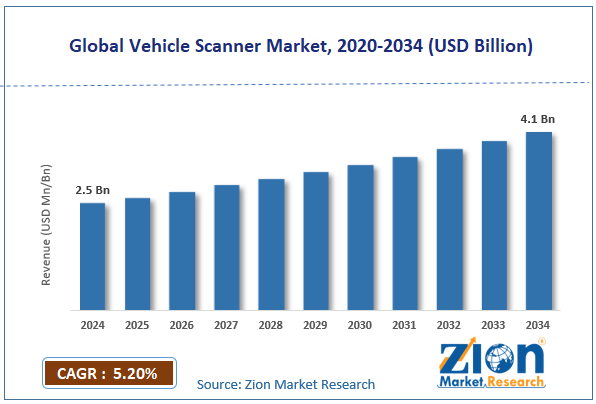
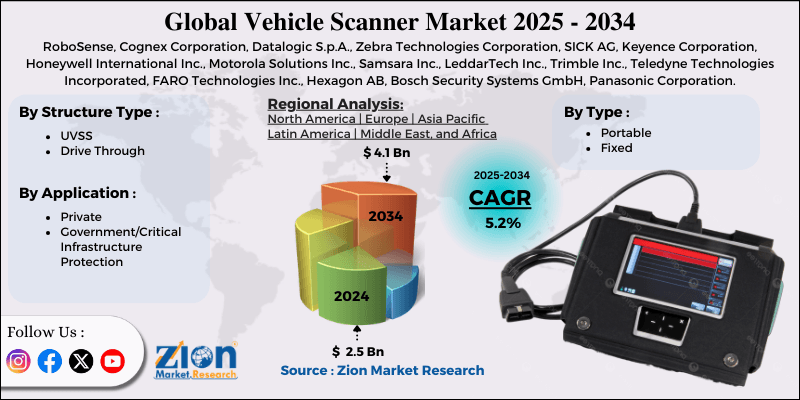
The global vehicle scanner market size was worth around USD 2.5 billion in 2024 and is predicted to grow to around USD 4.1 billion by 2034, with a compound annual growth rate (CAGR) of roughly 5.2% between 2025 and 2034.
Key Insights
- As per the analysis shared by our research analyst, the global vehicle scanner market is estimated to grow annually at a CAGR of around 5.2% over the forecast period (2025-2034).
- In terms of revenue, the global vehicle scanner market size was valued at around USD 2.5 billion in 2024 and is projected to reach USD 4.1 billion by 2034.
- Growth in cross-border trade & logistics volumes is expected to drive the Vehicle Scanner market.
- Based on the structure type, the drive-through is expected to capture the largest market share over the analysis period.
- Based on the type, fixed type holds the largest market share of 65% in 2024.
- Based on the application, the government/critical infrastructure protection segment captures the largest market share of 67% in 2024.
- Based on region, North America holds the largest revenue share of 40% in 2024.
Vehicle Scanner Market: Overview
A vehicle scanner, often called a scan tool, is diagnostic equipment that connects to a car's on-board computer system, usually via the OBD-II (On-Board Diagnostics) connector. It checks how well the car is functioning, identifies problems, and collects sensor data. It changes complicated electronic data into Diagnostic Trouble Codes (DTCs) that technicians or owners can read. This lets them identify problems such as engine misfires or sensor failures. The vehicle scanner market is primarily driven by growing security concerns worldwide and the need for non-intrusive vehicle screening at key infrastructure sites, ports, airports, military bases, and borders. Governments and defense organizations are investing heavily in advanced scanning systems, including under-vehicle inspection systems (UVIS), drive-through portals, and X-ray imaging technology, to detect illegal items such as drugs, explosives, and weapons, as well as unauthorized modifications. The growth of international trade and border traffic has increased the need for vehicle screening equipment that is fast, efficient, and able to meet security standards, while reducing the time required to scan vehicles by hand.
Vehicle Scanner Market: Dynamics
Growth Drivers
Why does the rising security & counter-smuggling requirements drive the vehicle scanner market growth?
The vehicle scanner market is growing faster due to increased security threats and stricter anti-smuggling laws. To stop the illegal movement of guns, explosives, drugs, people, and other contraband, governments and police around the world are making border controls, customs inspections, and protections for important infrastructure stricter. As trade and travel between countries increase, authorities require faster, more reliable non-intrusive inspection technologies that can inspect cars without creating long traffic bottlenecks. Advanced vehicle scanning systems, such as under-vehicle inspection systems (UVIS), drive-through scanners, and high-energy imaging technologies, enable the detection of concealed threats in real time. This makes operations more efficient and improves national security. The rise in geopolitical tensions, terrorist threats, and organized smuggling networks has led to increased investment in automated, AI-enabled scanning technologies. This has made security and anti-smuggling efforts a major factor in market growth.
Restraints
Limited awareness and budget prioritization in some end markets are hampering the industry’s growth.
The vehicle scanner market is struggling to grow because there isn't enough information, and there's a lack of focus on specific end-use areas. People in many developing countries and small enterprises that make decisions may not know about the operational benefits, risk-reduction value, and long-term cost savings that come with modern vehicle-scanning technologies.
Because of this, people often buy more conventional security tools, such as CCTV cameras, access control systems, or perimeter fencing, instead of specialized vehicle inspection gear. It's also challenging to justify the high capital costs of fixed drive-through or imaging-based scanning systems for public-sector and city governments, which typically have modest budgets. This is only true if there are immediate legal obligations. People have a hard time accepting new technology because they don't fully understand it, and their budgets don't always align. This is especially true in local ports, regional checkpoints, private industrial sites, and developing economies. This slows the industry's growth.
Opportunities
Does technological advancement offer a lucrative opportunity for the vehicle scanner market growth?
The vehicle scanner market has strong growth potential due to new technologies that make it easier to generate revenue. Vehicle inspection systems are becoming more accurate, faster, and more reliable all the time through improvements in AI, machine learning, high-resolution imagery, 3D scanning, and sensor fusion. Modern scanners can find hidden dangers, structural faults, and strange patterns on their own. This reduces false positives and speeds up operations. Also, cloud computing, IoT connections, and real-time data analytics work together to help one keep an eye on everything from a single place, identify issues from afar, and communicate with command-and-control centers without any problems. These new technologies not only make things safer but also save money in the long run by enabling better planning for maintenance and software updates.
Also, the development of portable, modular scanning technology enables access to smaller ports, temporary checkpoints, event venues, and countries that aren't particularly developed. As governments and organizations seek data-driven, automated security solutions that scale with their needs, they are finding new ways to generate revenue through hardware upgrades, software subscriptions, AI-based analytics, and system integration. This provides market enterprises with many opportunities to grow.
Challenges
Why do high capital costs and long procurement cycles pose a major challenge to growth in the vehicle scanner market?
The vehicle scanner market is struggling to grow because the systems require a significant upfront investment and a lengthy approval process before they can be used. Advanced vehicle scanning solutions, such as drive-through X-ray portals, under-vehicle inspection systems (UVIS), and integrated command-and-control platforms, often require significant investment in hardware, software, site preparation, radiation shielding (if needed), and infrastructure upgrades. Many government agencies, ports, and businesses have limited budgets, so it can be hard to spend heavily on a single security technology when there are other important needs, such as hiring new staff, upgrading infrastructure, or installing surveillance systems.
In addition, buying security equipment, especially for government and defense applications, often involves lengthy tendering processes, regulatory approvals, compliance checks, technical evaluations, and multi-stage bidding. These steps can take months or even years to complete, which means merchants won't make money right away and the market won't grow as quickly as it could. Changes in politics, security regulations, and budget reapprovals can lead to project delays or cancellations. Because of this, even with strong demand driven by rising security concerns, high starting prices, and long procurement delays, it is very hard for the business to grow quickly and widely.
Vehicle Scanner Market: Report Scope
| Report Attributes | Report Details |
|---|---|
| Report Name | Vehicle Scanner Market |
| Market Size in 2024 | USD 2.5 Billion |
| Market Forecast in 2034 | USD 4.1 Bllion |
| Growth Rate | CAGR of 5.2% |
| Number of Pages | 222 |
| Key Companies Covered | RoboSense, Cognex Corporation, Datalogic S.p.A., Zebra Technologies Corporation, SICK AG, Keyence Corporation, Honeywell International Inc., Motorola Solutions Inc., Samsara Inc., LeddarTech Inc., Trimble Inc., Teledyne Technologies Incorporated, FARO Technologies Inc., Hexagon AB, Bosch Security Systems GmbH, Panasonic Corporation, OMRON Corporation, Leuze electronic GmbH + Co. KG, Siemens AG, and others. |
| Segments Covered | By Structure Type, By Type, By Application, and By Region |
| Regions Covered | North America, Europe, Asia Pacific (APAC), Latin America, Middle East, and Africa (MEA) |
| Base Year | 2024 |
| Historical Year | 2019 to 2023 |
| Forecast Year | 2025 - 2034 |
| Customization Scope | Avail customized purchase options to meet your exact research needs. Request For Customization |
Vehicle Scanner Market: Segmentation
Structure Type Insights
What factor causes the drive-through segment to be in a dominant position in the vehicle scanner market?
The drive through is expected to capture the largest market share over the analysis period. The drive through vehicle scanner category has developed into an efficient scanning system that operates effectively in areas with heavy traffic. The scanners serve dual purposes by inspecting vehicles that drive through their detection systems at high speed. Many businesses choose them because they can accommodate many cars without making people wait too long. New technology has advanced imaging systems that now enable easier identification of prohibited items and security threats. The majority of users prefer drive-through auto scanners because these systems deliver fast results while maintaining reliable performance and superior fault-detection capabilities.
Type Insights
Why does fixed type hold the largest share in the vehicle scanner industry?
Fixed type holds the largest market share of 65% in 2024. Fixed vehicle scanners are the most popular type of scanner because they are widely used at critical infrastructure sites, including military bases, border crossings, and high-security buildings. These scanners can reliably and continuously scan cars, ensuring they are adequately checked for explosives, contraband, and other security threats. Their cutting-edge technology and integration with advanced software enable in-depth analysis and rapid decision-making.
In addition, fixed scanners are well-suited for busy places that need them to be used continuously because they are highly durable and robust. As security concerns remain high worldwide, demand for fixed vehicle scanners is expected to remain strong, keeping them at the top of the market.
Application Insights
Why does the government/critical infrastructure protection capture the largest revenue share in 2024 in the vehicle scanner market?
The government/critical infrastructure protection segment captures the largest market share of 67% in 2024. The government and the critical infrastructure protection category have a big market share because people are more concerned about national security and public safety. To defend vital infrastructure such as airports, seaports, military bases, and government buildings, governments worldwide are spending heavily on advanced scanning equipment. These scanners are very important for detecting potential threats, such as bombs, illegal items, and prohibited items. Adding new technologies like AI, machine learning, and real-time data analytics to car scanners makes them more accurate and efficient, which is why security companies need them.
Regional Insights
Why does North America hold the largest share of the vehicle scanner market?
North America holds the largest revenue share of 40% in 2024. The North American vehicle business is growing as more advanced security systems are adopted across the public and private sectors. The region's significant automotive sector and the need for effective inspection and quality control in factories are both contributing to the expansion of the fuel market. Government actions to make the country safer and more secure are driving up demand for automobile scanners, accelerating market growth.
Vehicle Scanner Market: Competitive Analysis
The global vehicle scanner market is dominated by players like:
- RoboSense
- Cognex Corporation
- Datalogic S.p.A.
- Zebra Technologies Corporation
- SICK AG
- Keyence Corporation
- Honeywell International Inc.
- Motorola Solutions Inc.
- Samsara Inc.
- LeddarTech Inc.
- Trimble Inc.
- Teledyne Technologies Incorporated
- FARO Technologies Inc.
- Hexagon AB
- Bosch Security Systems GmbH
- Panasonic Corporation
- OMRON Corporation
- Leuze electronic GmbH + Co. KG
- Siemens AG
The global vehicle scanner market is segmented as follows:
By Structure Type
- UVSS
- Drive Through
By Type
- Portable
- Fixed
By Application
- Private
- Government/Critical Infrastructure Protection
By Region
- North America
- The U.S.
- Canada
- Mexico
- Europe
- France
- The UK
- Spain
- Germany
- Italy
- Rest of Europe
- Asia Pacific
- China
- Japan
- India
- Australia
- South Korea
- Rest of Asia Pacific
- The Middle East & Africa
- Saudi Arabia
- UAE
- Egypt
- Kuwait
- South Africa
- Rest of the Middle East & Africa
- Latin America
- Brazil
- Argentina
- Rest of Latin America
Table Of Content
Methodology
FrequentlyAsked Questions

HappyClients

