
Ultrasonic Sensors Market Size, Share, Analysis, Trends, Growth, 2032

Ultrasonic Sensors Market - By End-User (Industrial, Healthcare, Aerospace & Defense, Automotive, Consumer Electronics, And Others), By Type (Obstacle Detection, Distance Measurement, Level Measurement, And Others), By Technology (Through-Beam Sensors, Retro-Reflective Sensors, And Others),And By Region - Global And Regional Industry Overview, Market Intelligence, Comprehensive Analysis, Historical Data, And Forecasts 2024 - 2032
| Market Size in 2023 | Market Forecast in 2032 | CAGR (in %) | Base Year |
|---|---|---|---|
| USD 5.84 Billion | USD 12.82 Billion | 9.12% | 2023 |
Description
How big is the Ultrasonic Sensors Market?
According to the report published by Zion Market Research, the global Ultrasonic Sensors Market size was valued at USD 5.84 Billion in 2023 and is predicted to reach USD 12.82 Billion by the end of 2032. The market is expected to grow with a CAGR of 9.12% during the forecast period. The report analyzes the global Ultrasonic Sensors Market's growth drivers, restraints, and impact on demand during the forecast period. It will also help navigate and explore the arising opportunities in the Ultrasonic Sensors industry.
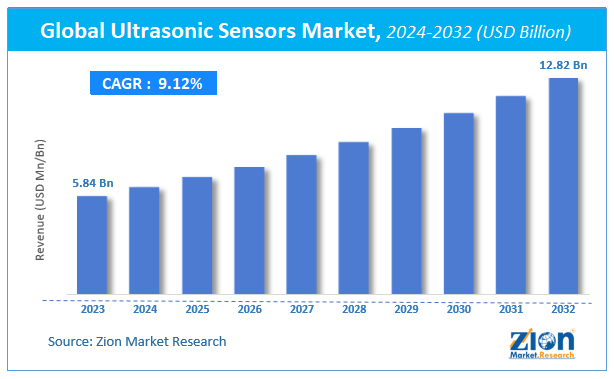
Global Ultrasonic Sensors Market: Overview
The ultrasonic sensor is a device that measures the accurate distance between two stationary and moving objects with the help of ultrasonic waves. The distance is measured by emitting an ultrasonic wave from the reflected source and the sensor transmitter to calculate the input.
Global Ultrasonic Sensors Market: Growth Factors
One of the major factors fueling the growth of the global ultrasonic sensors market is the increasing adoption of ultrasonic sensors for distance measurements, pallet detection, object detection, and many more among the different sectors. The sensors are efficient in fulfilling the requirement from different areas like hygiene detection, material handling & processing, and much more particularly in the food and beverage sector. Moreover, there is a growing demand for these sensors in the medical sector too for echocardiograms, echo graphs, and many others. Such sensors utilize high frequency and produce shorter wavelengths that can be conveniently translated into an image of higher resolutions. They are also adopted in healthcare applications like radiography.
There is a growing demand for parking assistance and collision detection in the market. The manufacturing sector is adopting these sectors widely in their applications like unmanned aerial vehicles, inventory control systems, precision robotics, and many more. Moreover, the increasing investment by the major market players to develop more innovative sensors to facilitate enhanced precision is further boosting the growth of the global ultrasonic sensors market. The size miniaturization and high penetration of MEMS technology in such sensors have boosted their potential and demand in the different sectors across the globe.
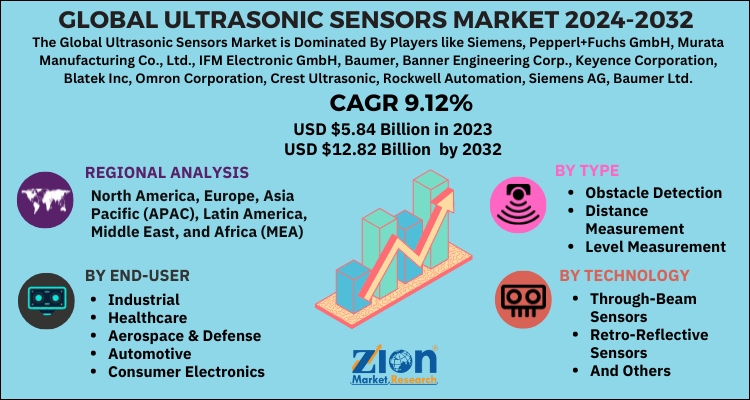
Global Ultrasonic Sensors Market: Segmentation
The global ultrasonic sensors market can be segmented into end-use, type, technology, and region.
By end-use, the market can be segmented into industrial, healthcare, aerospace & defense, automotive, consumer electronics, and others. The automotive segment dominates the global ultrasonic sensors market. These sensors are widely used in applications like collision avoidance and parking assistance systems.
By type, the market can be segmented into obstacle detection, distance measurement, level measurement, and others. The obstacle detection segment holds the largest share in the global ultrasonic sensors market due to the growing adoption of these sensors in collision avoidance systems. Moreover, the stringent rules and regulations of the governments regarding the installation of vehicle safety features like airbags and collision avoidance systems have further propelled the growth of the segment.
By technology, the market can be segmented into through-beam sensors, retro-reflective sensors, and others. The retro-reflective sensor segment accounts for the largest share in the global ultrasonic sensors market due to its added advantage like reliability in the effective detection of transparent objects, lower installation, and maintenance costs. These sensors facilitate simple optical axis wiring and adjustment for easy deployments. The increasing adoption of throttle control and accurate positioning measurement of vehicles will fuel the growth of the segment.
Recent Developments:
- In September 2024, Baumer introduced the UF200 ultrasonic sensor, the flattest front-mount ultrasonic sensor on the market, offering a detection range of up to 2,000 mm and a blind range of just 20.5 mm. Powered by NexSonic technology, the design enhances object detection and distance measurement while providing greater engineering flexibility across applications.
- In August 2023, Balluff launched the BFD ultrasonic position sensor for direct monitoring of hydraulic short-stroke cylinders in workpiece clamping. The sensor delivers real-time clamping status and detects issues such as oil supply faults and contour deviations, improving safety and reliability in metalworking applications while offering cost-effective, flexible integration.
Ultrasonic Sensors Market: Report Scope
| Report Attributes | Report Details |
|---|---|
| Report Name | Ultrasonic Sensors Market |
| Market Size in 2023 | USD 5.84 Billion |
| Market Forecast in 2032 | USD 12.82 Billion |
| Growth Rate | CAGR of 9.12% |
| Number of Pages | 220 |
| Key Companies Covered | Siemens, Pepperl+Fuchs GmbH, Murata Manufacturing Co., Ltd., IFM Electronic GmbH, Baumer, Banner Engineering Corp., Keyence Corporation, Blatek Inc, Omron Corporation, Crest Ultrasonic, Rockwell Automation, Siemens AG, Baumer Ltd, Balluff GmbH, Honeywell International, Optical Scientific, Inc, Nex Flow Air Products Corp, Simtech Process Systems, Jamieson Equipment Co., Inc, SICK AG, Addison Electric, Inc., Endress+Hauser, TE Connectivity Ltd, BeStar Technologies, Inc, IFM Efector, Inc, Hans Turck GmbH & Co. KG, Judd Communication, Hexamite LTD, and Megatron Corporation |
| Segments Covered | By end-use, By type, By technology and By Region |
| Regions Covered | North America, Europe, Asia Pacific (APAC), Latin America, Middle East, and Africa (MEA) |
| Base Year | 2023 |
| Historical Year | 2018 - 2022 |
| Forecast Year | 2024 - 2032 |
| Customization Scope | Avail customized purchase options to meet your exact research needs. Request For Customization |
Global Ultrasonic Sensors Market: Regional analysis
Europe accounts for the largest share in the global ultrasonic sensors market due to the growing need for minimally invasive surgeries in the region. These sensors facilitate the surgeon to operate the patients with high precisions. The region is known as the hubspot for the video game networks and thus created lucrative growth opportunities in the market which in turn further fuels the growth of the regional market.
Asia Pacific is expected to witness huge growth during the forecast period due to the growing demand for factory automation in the region.
Global Ultrasonic Sensors Market: Competitive Players
Some of the significant players in the global ultrasonic sensors market are
- Siemens
- Pepperl+Fuchs GmbH
- Murata Manufacturing Co.Ltd.
- IFM Electronic GmbH
- Baumer
- Banner Engineering Corp.
- Keyence Corporation
- Blatek Inc
- Omron Corporation
- Crest Ultrasonic
- Rockwell Automation
- Siemens AG
- Baumer Ltd
- Balluff GmbH
- Honeywell International
- Optical Scientific. Inc
- Nex Flow Air Products Corp
- Simtech Process Systems
- Jamieson Equipment Co.Inc
- SICK AG
- Addison Electric. Inc.
- Endress+Hauser
- TE Connectivity Ltd
- BeStar Technologies. Inc
- IFM Efector. Inc
- Hans Turck GmbH & Co. KG
- Judd Communication
- Hexamite LTD
- Megatron Corporation.
- And Others
This report segments the global ultrasonic sensors market as follows:
By End-User
- Industrial
- Healthcare
- Aerospace & Defense
- Automotive
- Consumer Electronics
- And Others
By Type
- Obstacle Detection
- Distance Measurement
- Level Measurement
- And Others
By Technology
- Through-Beam Sensors
- Retro-Reflective Sensors
- And Others
By Region
- North America
- The U.S.
- Canada
- Mexico
- Europe
- France
- The UK
- Spain
- Germany
- Italy
- Rest of Europe
- Asia Pacific
- China
- Japan
- India
- Australia
- South Korea
- Rest of Asia Pacific
- The Middle East & Africa
- Saudi Arabia
- UAE
- Egypt
- Kuwait
- South Africa
- Rest of the Middle East & Africa
- Latin America
- Brazil
- Argentina
- Rest of Latin America
What Reports Provides
- Full in-depth analysis of the parent market
- Important changes in market dynamics
- Segmentation details of the market
- Former, on-going, and projected market analysis in terms of volume and value
- Assessment of niche industry developments
- Market share analysis
- Key strategies of major players
- Emerging segments and regional markets
- Testimonials to companies in order to fortify their foothold in the market.
Table Of Content

FrequentlyAsked Questions
Ultrasonic sensors use sound waves to detect distance or objects. They are widely used in automation, robotics, and industrial applications.
The global Ultrasonic Sensors market is expected to be driven by the Driven by rising automation, safety, and proximity sensing needs across automotive, industrial, and consumer electronics. Demand for reliable distance measurement in harsh environments supports wider adoption.
According to study, the global Ultrasonic Sensors market size was worth around USD 5.84 Billion in 2023 and is predicted to grow to around USD 12.82 Billion By 2032.
The global Ultrasonic Sensors market is expected to grow at a Compound Annual Growth Rate (CAGR) of around CAGR 9.12% during the forecast period from 2024-2032.
The global Ultrasonic Sensors industry is projected to be challenged by Challenges include performance limits in harsh environments (dust, temperature, turbulence), interference and accuracy issues at longer ranges, and strong competition from LiDAR and radar in some uses.
The Opportunities include growth in industrial automation, robotics, and ADAS, rising demand in smart manufacturing, and low-cost proximity/level sensing adoption across consumer and IoT devices will offer significant growth opportunities in the Ultrasonic Sensors market.
Smaller, low-power sensors for ADAS/robotics; multi-sensor fusion with AI for better ranging; rugged waterproof designs for harsh industrial use are the emerging trends and innovations impacting the Ultrasonic Sensors market.
The global Ultrasonic Sensors market is expected to be led by APAC during the forecast period.
Some of the prominent players operating in the global Ultrasonic Sensors market are; Siemens, Pepperl+Fuchs GmbH, Murata Manufacturing Co., Ltd., IFM Electronic GmbH, Baumer, Banner Engineering Corp., Keyence Corporation, Blatek Inc, Omron Corporation, Crest Ultrasonic, Rockwell Automation, Siemens AG, Baumer Ltd, Balluff GmbH, Honeywell International, Optical Scientific, Inc, Nex Flow Air Products Corp, Simtech Process Systems, Jamieson Equipment Co., Inc, SICK AG, Addison Electric, Inc., Endress+Hauser, TE Connectivity Ltd, BeStar Technologies, Inc, IFM Efector, Inc, Hans Turck GmbH & Co. KG, Judd Communication, Hexamite LTD, and Megatron Corporation and others.
The report explores crucial aspects of the Ultrasonic Sensors market, including a detailed discussion of existing growth factors and restraints, while also browsing future growth opportunities and challenges that impact the market.
HappyClients

