
Global Ultra-Wideband Chipset (UWB) Market Size, Share, Analysis, Growth, 2030

Ultra-Wideband Chipset (UWB) Market By Positioning System (Outdoor and Indoor), By Application ( Communication, Imaging, RTLS/WNS, and Others), By End-users ( Residential, Retail, Consumer Electronics, manufacturing, automotive & transportation, healthcare, and others), and By Region - Global and Regional Industry Overview, Market Intelligence, Comprehensive Analysis, Historical Data, and Forecasts 2023 - 2030
| Market Size in 2022 | Market Forecast in 2030 | CAGR (in %) | Base Year |
|---|---|---|---|
| USD 1,478.96 Million | USD 6,325.89 Million | 19.92% | 2022 |
Description
What is Ultra-Wideband Chipset (UWB) Market Size?
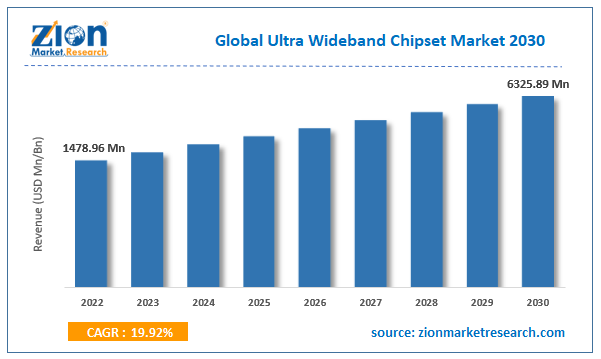
The global ultra-wideband chipset market size was worth around USD 1,478.96 million in 2022 and is predicted to grow to around USD 6,325.89 million by 2030 with a compound annual growth rate (CAGR) of roughly 19.92% between 2023 and 2030.
Ultra-wideband (UWB) is a technology that utilizes low energy for high-bandwidth communication in close proximity. It has the capability to carry large data across a distance of 230 feet. It also carries data efficiently across obstructions like doors or any other barriers owing to its high capacity. It facilitates the broadcast of digital pulses that are accurately scheduled at a different frequency of the channel.
It is used in various areas like wireless high-definition video, paper-to-peer connections, next-generation Bluetooth, wireless printing, and many more. It makes use of radio waves to enable devices to interact with each other. Modern chipsets are small & compact and hence they can easily be placed into various devices including smartphones.
Global Ultra-Wideband Chipset (UWB) Market: Growth Factors
One of the major factors driving the global ultra-wideband chipset market is the increasing demand for UWB technology in different application areas like RTLS along with the surging adoption of the industrial internet of things (IIoT). RTLS is utilized in tracking and locating the people & assets in real-time with the help of UWB technology and the next-generation BLE beacon technology. Moreover, the ongoing advancements in UWB technology in the wireless sensor network and increasing deployment of UWB technology in smartphones have widened the scope of the technology.
Wireless network sensor is a kind of ad hoc network and it has immense importance in transportation, military, and other sectors. Hence the increasing utilization of wireless network sensors has fueled the demand for the ultra-wideband chipset due to the growing application of UWB technology in the wireless sensors network. Researchers are concentrating to develop the UWB technology owing to its unique features like short pulses. Short pulses facilitate reasonable and effective transmission in the wireless sensor network that has huge advantages over other carrier-based technologies. Moreover, the UWB technology is cost-effective, readily available in different sizes, and fulfills the requirements of power consumption for microsensor nodes that are utilized in wireless network sensors.
Global Ultra-Wideband Chipset (UWB) Market: Segmentation
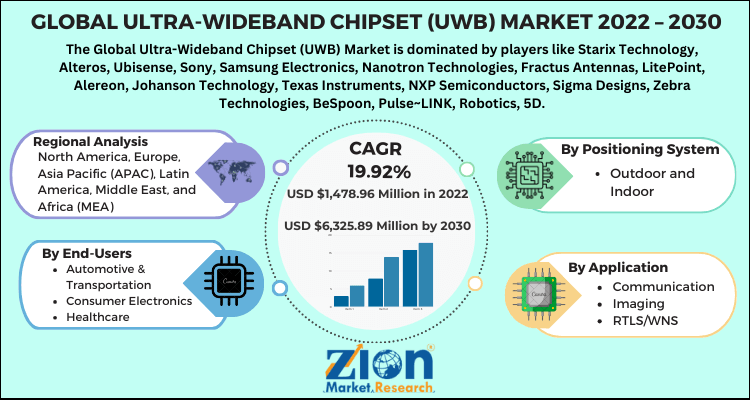
The global ultra-wideband chipset market can be segmented into end-users, positioning systems, applications, and regions.
By End-users, the market can be segmented into residential, retail, consumer electronics, manufacturing, automotive & transportation, healthcare, and others. The consumer electronics segment accounts for the largest share in the global ultra-wideband chipset market due to the growing consumer experience.
By Positioning Systems, the market can be segmented into outdoor and indoor. The indoor positioning segment dominates the market over others.
By Application, the market can be segmented into communication, imaging, RTLS/WNS, and others. The communication segment holds the largest share in the global ultra-wideband chipset market owing to the rising applications like facilitation of data collection with the help of wireless sensors networks and mobile ad hoc. Moreover, it offers various advantages because of its high localization precision and narrow pulses. It is gaining traction due to its low power consumption and high data rates coupled with reduced interference.
Ultra Wideband Chipset (UWB) Market: Report Scope
| Report Attributes | Report Details |
|---|---|
| Report Name | Ultra-Wideband Chipset (UWB) Market Research Report |
| Market Size in 2022 | USD 1,478.96 Million |
| Market Forecast in 2030 | USD 6,325.89 Million |
| Growth Rate | CAGR of 19.92% |
| Number of Pages | 188 |
| Forecast Units | Value (USD Billion), and Volume (Units) |
| Key Companies Covered | Starix Technology, Alteros, Ubisense, Sony, Samsung Electronics, Nanotron Technologies, Fractus Antennas, LitePoint, Alereon, Johanson Technology, Texas Instruments, NXP Semiconductors, Sigma Designs, Zebra Technologies, BeSpoon, Pulse~LINK, Robotics, 5D, Apple, Decawave, Furaxa Inc., Time Domain Corp, TAIYO YUDEN CO., LTD, Sewio Networks, and Realtek. |
| Segments Covered | By Positioning System, By Stay Hours, By Application, By End-users, And By Region |
| Regions Covered | North America, Europe, Asia Pacific (APAC), Latin America, Middle East and Africa (MEA) |
| Countries Covered | North America: U.S and Canada Europe: Germany, Italy, Russia, U.K, Spain, France, Rest of Europe APAC: China, Australia, Japan, India, South Korea, South East Asia, Rest of Asia Pacific Latin America: Brazil, Argentina, Chile The Middle East And Africa: South Africa, GCC, Rest of MEA |
| Base Year | 2022 |
| Historical Year | 2017 - 2021 |
| Forecast Year | 2022 - 2030 |
| Customization Scope | Avail customized purchase options to meet your exact research needs. Request For Customization |
Global Ultra-Wideband Chipset (UWB) Market: Regional Analysis
North America accounts for the largest share of the global ultra-wideband chipset market due to the high manufacturing capability of players in the region. The proliferation of industrial automation sectors in the region has diversified the scope of UWB chipset for logistics & operational management applications, production lines, and many others.
Global Ultra-Wideband Chipset (UWB) Market: Competitive Players
The major companies are focusing on increasing awareness regarding various broad applications like better operational efficiency in workplaces & factories, keyless & secure entry to cars, locating essentials in hospitals, and many others.
Some of the prominent players in the global ultra-wideband chipset (UWB) market are Starix Technology, Alteros, Ubisense, Sony, Samsung Electronics, Nanotron Technologies, Fractus Antennas, LitePoint, Alereon, Johanson Technology, Texas Instruments, NXP Semiconductors, Sigma Designs, Zebra Technologies, BeSpoon, Pulse~LINK, Robotics, 5D, Apple, Decawave, Furaxa Inc., Time Domain Corp, TAIYO YUDEN CO., LTD, Sewio Networks, and Realtek.
The global ultra-wideband chipset (UWB) market is led by players like:
- Starix Technology
- Alteros
- Ubisense
- Sony
- Samsung Electronics
- Nanotron Technologies
- Fractus Antennas
- LitePoint
- Alereon
- Johanson Technology
- Texas Instruments
- NXP Semiconductors
- Sigma Designs
- Zebra Technologies
- BeSpoon
- Pulse~LINK
- Robotics
- 5D
- Apple
- Decawave
- Furaxa Inc.
- Time Domain Corp
- TAIYO YUDEN CO.
- LTD
- Sewio Networks
- and Realtek.
The Global Ultra-Wideband Chipset (UWB) Market Is Segmented As Follows:
By End-users
- Residential
- Retail
- Consumer Electronics
- manufacturing
- automotive & transportation
- healthcare
- and others
By Positioning System
- Outdoor and Indoor
By Application
- Communication
- Imaging
- RTLS/WNS
- and Others
By Region
- North America
- The U.S.
- Canada
- Mexico
- Europe
- France
- The UK
- Spain
- Germany
- Italy
- Rest of Europe
- Asia Pacific
- China
- Japan
- India
- Australia
- South Korea
- Rest of Asia Pacific
- The Middle East & Africa
- Saudi Arabia
- UAE
- Egypt
- Kuwait
- South Africa
- Rest of the Middle East & Africa
- Latin America
- Brazil
- Argentina
- Rest of Latin America
What Reports Provide
- Full in-depth analysis of the parent market
- Important changes in market dynamics
- Segmentation details of the market
- Former, ongoing, and projected market analysis in terms of volume and value
- Assessment of niche industry developments
- Market share analysis
- Key strategies of major players
- Emerging segments and regional markets
- Testimonials to companies in order to fortify their foothold in the market.
Table Of Content

List of Contents
What isMarket Size?Global Ultra-Wideband Chipset (UWB)Growth FactorsGlobal Ultra-Wideband Chipset (UWB)Market:SegmentationUltra Wideband Chipset (UWB)Report ScopeGlobal Ultra-Wideband Chipset (UWB)Market:Regional AnalysisGlobal Ultra-Wideband Chipset (UWB)Market:Competitive PlayersThe GlobalUltra-Wideband Chipset (UWB)Market Is Segmented As Follows:What Reports ProvideFrequentlyAsked Questions
UWB chipsets enable short-range, high-precision wireless communication. They are used for location tracking and secure connectivity
The global Ultra-Wideband Chipset (UWB) market is expected to be driven by the demand for precise location tracking and secure connectivity. Adoption in smartphones, automotive, and smart devices supports growth.
According to study, the global Ultra-Wideband Chipset (UWB) market size was worth around USD 1,478.96 Million in 2022 and is predicted to grow to around USD 6,325.89 Million by 2030.
The global Ultra-Wideband Chipset (UWB) market is expected to grow at a Compound Annual Growth Rate (CAGR) of around CAGR 19.92% during the forecast period from 2023-2030.
The global Ultra-Wideband Chipset (UWB) industry is projected to be challenged by Challenges include limited ecosystem maturity and integration complexity.
The Opportunities include precise location tracking, smart devices, automotive keyless entry, and IoT adoption will offer significant growth opportunities in the Ultra-Wideband Chipset (UWB) market.
Precise indoor positioning and secure ranging; integration in smartphones and IoT; adoption in automotive and smart access systems are the emerging trends and innovations impacting the Ultra-Wideband Chipset (UWB) market.
The global Ultra-Wideband Chipset (UWB) market is expected to be led by North America during the forecast period.
Some of the prominent players operating in the global Ultra-Wideband Chipset (UWB) market are; Starix Technology, Alteros, Ubisense, Sony, Samsung Electronics, Nanotron Technologies, Fractus Antennas, LitePoint, Alereon, Johanson Technology, Texas Instruments, NXP Semiconductors, Sigma Designs, Zebra Technologies, BeSpoon, Pulse~LINK, Robotics, 5D, Apple, Decawave, Furaxa Inc., Time Domain Corp, TAIYO YUDEN CO., LTD, Sewio Networks, and Realtek. and others.
The report explores crucial aspects of the Ultra-Wideband Chipset (UWB) market, including a detailed discussion of existing growth factors and restraints, while also browsing future growth opportunities and challenges that impact the market.
HappyClients

