
TPE Lamination Technology Market Size, Share, Trends, Growth and Forecast 2034

TPE Lamination Technology Market By Technology (Extrusion Lamination, Calendering Lamination, Hot Melt Lamination, Adhesive Free Lamination), By Application (Automotive Interior Components, Medical and Healthcare Packaging, Apparel and Footwear Lining, Industrial and Protective Fabrics), By End-User (Automotive Manufacturers, Medical Device and Packaging Companies, Textile and Apparel Producers, Industrial Equipment Manufacturers), By Material Type (TPE Films, TPE Sheets, TPE Coated Fabrics, TPE Foam Laminates), and By Region - Global and Regional Industry Overview, Market Intelligence, Comprehensive Analysis, Historical Data, and Forecasts 2026 - 2034
| Market Size in 2025 | Market Forecast in 2034 | CAGR (in %) | Base Year |
|---|---|---|---|
| USD 2.61 Billion | USD 4.82 Billion | 6.94% | 2025 |
TPE Lamination Technology Industry Perspective:
What will be the size of the TPE lamination technology market during the forecast period?
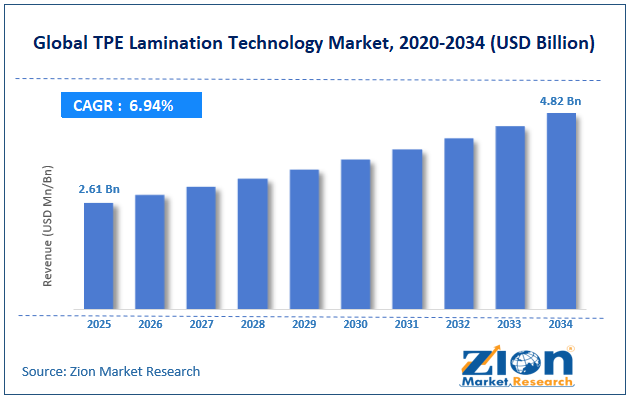
The global TPE lamination technology market size was approximately USD 2.61 billion in 2025 and is projected to reach around USD 4.82 billion by 2034, with a compound annual growth rate of roughly 6.94% between 2026 and 2034.
Key Insights
- As per the analysis shared by our research analyst, the global TPE lamination technology market is estimated to grow annually at a compound annual growth rate of around 6.94% over the forecast period from 2026 to 2034.
- In terms of revenue, the global TPE lamination technology market size was valued at approximately USD 2.61 billion in 2025 and is projected to reach USD 4.82 billion by 2034.
- The TPE lamination technology market is expected to grow steadily, driven by rising automotive production, growing demand for medical-grade laminated films, expanding footwear and apparel manufacturing, and continuous improvements in lamination equipment efficiency.
- Based on technology, extrusion lamination is expected to lead the market, while adhesive-free lamination is anticipated to grow rapidly as manufacturers seek cleaner and more sustainable bonding methods.
- Based on application, automotive interior components are expected to lead the TPE lamination technology market. At the same time, medical and healthcare packaging is anticipated to grow quickly, supported by rising demand for sterile and flexible packaging solutions.
- Based on end-user, automotive manufacturers are the largest current end-user group. At the same time, medical device and packaging companies are expected to grow rapidly during the forecast period as healthcare packaging standards continue to rise.
- Based on material type, TPE films are expected to lead the market, while TPE foam laminates are anticipated to grow steadily as demand for cushioned, comfortable laminated products increases.
- Based on region, Asia Pacific is projected to dominate the global TPE lamination technology market during the estimated period, followed by North America.
TPE Lamination Technology Market: Overview
TPE lamination technology is a manufacturing process that bonds thermoplastic elastomer (TPE) layers to fabrics, films, or foam to create products that are flexible, durable, and wear-resistant. This technology is widely used in the automotive, healthcare, apparel, footwear, and industrial sectors because it combines the softness and flexibility of rubber with the strength and easy processing of plastic. TPE lamination also improves important properties such as water resistance, chemical resistance, durability, and surface finish, often without using traditional adhesives. As industries move toward lightweight, recyclable, and environmentally friendly materials, TPE laminates are becoming a preferred choice because they can often be recycled and reused. Automotive manufacturers use these materials in dashboards, door panels, and vehicle seats, while healthcare companies use them in medical wearables and sterile packaging. The apparel and footwear industries rely on TPE laminates to make waterproof clothing, breathable fabrics, and comfortable footwear. Growing environmental awareness, stricter emissions regulations, and rising demand for high-performance, sustainable materials are driving growth in the TPE lamination technology market worldwide.
The TPE lamination technology market is growing due to rising demand for lightweight, recyclable materials, expanding automotive interior applications, and the increasing use of laminated films in medical and protective packaging.
Impact of the USA-Israel War on Iran on the TPE Lamination Technology Market
Ongoing tensions among the United States, Israel, and Iran may cause short-term disruptions in the supply of petrochemical feedstocks used to produce thermoplastic elastomers, as several raw-material trade routes pass through affected regions. Manufacturers relying on imported resins could face temporary price fluctuations and delivery delays. However, steady demand from the automotive, healthcare, and packaging industries is expected to keep the TPE lamination technology market on a stable growth path despite short-term regional disruptions.
TPE Lamination Technology Market: Technology Roadmap 2025–2034
What is the projected development roadmap for the TPE lamination technology market over the forecast period?
The TPE lamination technology market is progressing through cleaner bonding processes, smarter production automation, and materials designed for easier recycling. The market is expected to grow at a compound annual growth rate of around 6.94% over the forecast period, supported by rising global demand for lightweight materials and sustainable manufacturing practices.
The following roadmap outlines key development phases expected through 2034.
2025–2027: Process Efficiency and Cleaner Bonding Phase
- Manufacturers are expected to shift toward solvent-free and low-emission lamination processes to meet tightening environmental regulations.
- Automated lamination lines are expected to expand, reducing material waste and improving consistency across large production runs.
- Improved resin formulations are expected to enhance bonding strength while lowering the overall processing temperature required during lamination.
2028–2031: Smart Manufacturing and Material Innovation Phase
- Companies are expected to combine lamination equipment with sensor-based quality monitoring systems to detect defects in real time during production.
- Integration between lamination facilities and digital supply chain platforms is expected to grow, helping manufacturers respond faster to changing order volumes.
- Recyclable and bio-based thermoplastic elastomer formulations are expected to gain wider acceptance, especially among automotive and packaging companies aiming to lower their environmental footprint.
2032–2034: Fully Automated and Circular Material Phase
- Lamination facilities are expected to become part of larger automated production ecosystems that combine material sourcing, bonding, and quality control into a single connected system.
- Self-adjusting lamination machines are expected to reduce the need for manual calibration, making large-scale production more consistent and less dependent on skilled operators.
- Closed-loop recycling systems are expected to enable the reprocessing of used TPE-laminated products into new materials, supporting circular economy goals across multiple industries.
TPE Lamination Technology Market: Dynamics
Growth Drivers
How are lightweight automotive materials driving the TPE lamination technology market?
The TPE lamination technology market is growing as manufacturers look for lightweight, durable, and flexible materials for a wide range of products. In the automotive industry, laminated thermoplastic elastomer (TPE) materials are widely used in dashboards, door panels, seats, and steering wheels because they provide a soft feel, high durability, and excellent resistance to everyday wear. As electric vehicle production continues to increase, reducing vehicle weight has become increasingly important for improving battery performance and driving range. Stricter fuel efficiency and environmental regulations are also encouraging automakers to replace heavier materials with lightweight TPE laminates. Beyond the automotive sector, these materials are becoming popular in furniture, consumer electronics, footwear, and other consumer products due to their comfort, flexibility, and long service life. Manufacturers also value TPE laminates because they are easy to process and can support more sustainable production. These trends are driving the demand for reliable, high-performance, and cost-effective solutions, supporting the continued growth of the TPE lamination technology industry across industries worldwide.
Growing demand for flexible medical packaging and protective fabrics is accelerating the TPE lamination technology market.
The TPE lamination technology industry is growing as healthcare providers, packaging companies, and industrial manufacturers demand flexible, durable, and protective materials. In the healthcare sector, laminated TPE films are widely used to package medical devices, pharmaceutical products, and other sensitive equipment, helping protect them from moisture, dust, and contamination during storage and transportation. As healthcare standards continue to improve, companies are adopting advanced lamination technologies that provide stronger barrier protection while maintaining product quality. Material manufacturers are also developing thinner, lighter, and more breathable laminated fabrics for use in medical gowns, wound care products, surgical drapes, and protective clothing. Packaging companies are increasingly using multi-layer TPE laminates because they combine flexibility, strength, and durability, making them ideal for protecting delicate products. Beyond healthcare, industrial companies use laminated TPE materials in protective workwear to improve resistance to chemicals, abrasion, and harsh working conditions. Growing demand for safe, reliable, and high-performance materials across healthcare, packaging, and industrial applications is driving the adoption of TPE lamination technology.
Restraints
High equipment costs and fluctuations in raw material prices are key challenges in the TPE lamination technology market.
The TPE lamination technology market faces several challenges that may affect its growth. One of the biggest challenges is the high cost of advanced lamination equipment needed to produce high-quality laminated materials with consistent performance. Many small and medium-sized manufacturers, especially in developing countries, find it difficult to invest in this expensive machinery. Another challenge is the changing cost of thermoplastic elastomer (TPE) raw materials, as their prices often depend on global crude oil markets. Manufacturers must also maintain consistent product quality, as poor lamination can lead to weak bonding, reduced durability, and product failures, especially in healthcare and automotive applications. In addition, many regions face a shortage of skilled workers capable of operating advanced lamination equipment and maintaining production quality. These factors increase manufacturing costs and slow production expansion. Despite these challenges, the rising demand for lightweight, durable, and sustainable materials is expected to continue to support the long-term growth of the TPE lamination technology market.
Opportunities
How are sustainability trends and the expansion of footwear and apparel manufacturing driving the TPE lamination technology market?
The TPE lamination technology market offers strong growth opportunities as more industries focus on sustainability and the demand for high-performance materials continues to increase. Growing footwear and apparel production across Asia Pacific, Latin America, and the Middle East is creating higher demand for laminated fabrics used in shoe soles, waterproof jackets, sportswear, and outdoor clothing. Consumers are looking for products that are lightweight, comfortable, durable, and weather-resistant, which is encouraging manufacturers to develop advanced TPE-laminated materials. The automotive industry is also increasing the use of recyclable laminated materials to meet environmental regulations and reduce vehicle weight. At the same time, the rapid growth of e-commerce is driving demand for lightweight and protective laminated films that keep products safe during transportation and storage.
New manufacturing technologies, including extrusion and adhesive-free lamination, are making TPE-laminated materials more affordable, efficient, and easier to produce at scale. These improvements are helping more manufacturers adopt the technology across different industries. Together, rising demand for sustainable materials, continuous product innovation, and expanding industrial applications are expected to support the long-term growth of the TPE lamination technology market worldwide.
Challenges
What challenges does the TPE lamination technology market face in quality consistency and workforce readiness amid rising competition?
The TPE lamination technology industry faces several challenges that may slow its growth. One of the biggest challenges is maintaining consistent product quality during the lamination process. Even small changes in temperature, pressure, or production settings can affect the bonding strength, surface finish, and overall performance of laminated materials. Poor-quality lamination can lead to product defects, higher material waste, and increased manufacturing costs. Manufacturers also need to develop laminated materials that perform well in different climates, working conditions, and industrial applications, which requires continuous research, testing, and investment.
Another challenge is the shortage of skilled workers capable of operating, maintaining, and monitoring advanced lamination equipment. As production systems become more automated and digitally connected, companies need employees with both technical and mechanical expertise. In addition, increasing competition from established manufacturers and new companies is putting pressure on prices and encouraging continuous product innovation.
TPE Lamination Technology Market: Report Scope
| Report Attributes | Report Details |
|---|---|
| Report Name | TPE Lamination Technology Market |
| Market Size in 2025 | USD 2.61 Billion |
| Market Forecast in 2034 | USD 4.82 Billion |
| Growth Rate | CAGR of 6.94% |
| Number of Pages | 227 |
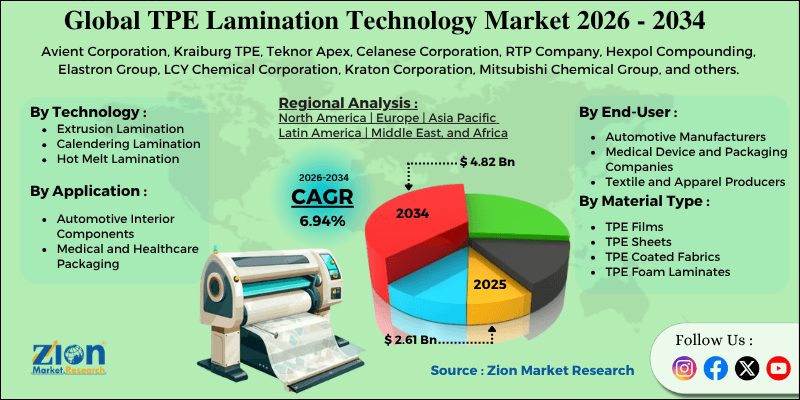
| Key Companies Covered | Avient Corporation, Kraiburg TPE, Teknor Apex, Celanese Corporation, RTP Company, Hexpol Compounding, Elastron Group, LCY Chemical Corporation, Kraton Corporation, Mitsubishi Chemical Group, and others. |
| Segments Covered | By Technology, By Application, By End-User, By Material Type, and By Region |
| Regions Covered | North America, Europe, Asia Pacific (APAC), Latin America, Middle East, and Africa (MEA) |
| Base Year | 2025 |
| Historical Year | 2020 - 2024 |
| Forecast Year | 2026 - 2034 |
| Customization Scope | Avail customized purchase options to meet your exact research needs. Request For Customization |
TPE Lamination Technology Market: Segmentation
The global TPE lamination technology market is segmented by technology, application, end-user, material type, and region.
Why is extrusion lamination the preferred technology in the TPE lamination technology market?
Based on technology, the global TPE lamination technology market is classified into extrusion lamination, calendering lamination, hot-melt lamination, and adhesive-free lamination. Extrusion lamination holds about 41% of the market share, leading due to its ability to produce strong, consistent bonds at high production speeds across large volumes of material. Adhesive-free lamination holds around 21% of the market share. It is one of the fastest-growing segments, driven by increasing demand for cleaner production processes that avoid solvent-based adhesives.
How does the automotive interior components application segment maintain its leading position in the TPE lamination technology market?
Based on application, the TPE lamination technology market is divided into automotive interior components, medical and healthcare packaging, apparel and footwear lining, and industrial and protective fabrics. The automotive interior components segment accounts for about 36% of the global TPE lamination technology market, driven by rising vehicle production and growing demand for soft-touch, durable interior surfaces. The medical and healthcare packaging segment holds around 26% of the market share. It is one of the fastest-growing segments, driven by rising healthcare spending and increasing demand for sterile, flexible packaging solutions.
Which end-user segment dominates the TPE lamination technology market?
Based on end-user, the market is categorized into automotive manufacturers, medical device and packaging companies, textile and apparel producers, and industrial equipment manufacturers. Automotive manufacturers lead with about a 35% share, driven by their continuous need for lightweight, durable interior materials across multiple vehicle models. Medical device and packaging companies hold around 24% of the market share. It is growing rapidly as more healthcare providers demand reliable, protective packaging solutions.
How do TPE films dominate the material type landscape in the TPE lamination technology market?
Based on material type, the TPE lamination technology industry is segregated into TPE films, TPE sheets, TPE-coated fabrics, and TPE foam laminates. TPE films account for about 39% of the market, due to their versatility, lightweight nature, and wide use across packaging and automotive applications. TPE foam laminates hold around 20% share. They are growing steadily as demand increases for cushioned, comfortable laminated products used in footwear and seating applications.
TPE Lamination Technology Market: Regional Analysis
What is driving Asia Pacific's leadership in the TPE lamination technology market?
Asia Pacific accounts for around 40% of the global TPE lamination technology market, making it the largest regional market. The region leads because of its strong automotive industry, growing textile and footwear manufacturing, and expanding healthcare packaging sector. China holds the largest market share due to its large manufacturing base, strong export industry, and rising demand for automotive, consumer, and industrial products. Manufacturers across China, Japan, South Korea, and India are increasingly using TPE lamination technology to produce durable vehicle interior parts, protective fabrics, waterproof materials, and high-quality consumer goods. The growing demand for sportswear, athletic footwear, and outdoor clothing is also increasing the use of laminated TPE materials across the region. India is supporting market growth through the rapid expansion of its automotive, textile, and manufacturing industries, as well as rising domestic demand and foreign investment. Healthcare companies are also adopting advanced laminated packaging materials to better protect medical devices and pharmaceutical products during storage and transportation. Strong collaboration between material suppliers, equipment manufacturers, and end-use industries is driving product innovation and improving manufacturing quality. Expanding industrial infrastructure, increasing investments in advanced production technologies, and growing demand for lightweight, durable, and sustainable materials continue to strengthen the Asia Pacific TPE lamination technology market.
What factors are supporting the expansion of the TPE lamination technology market across North America?
North America accounts for around 27% of the global TPE lamination technology market, making it the second-largest regional market. The region is growing because of its strong automotive industry, advanced healthcare sector, and increasing demand for sustainable materials. The United States holds the largest market share due to its high vehicle production, well-developed healthcare infrastructure, and continuous investment in advanced material technologies. Manufacturers widely use TPE-laminated materials in automotive interiors, medical packaging, protective fabrics, and consumer products. Canada is also contributing to market growth as companies adopt laminated materials for vehicle components, industrial applications, and healthcare packaging. Mexico is becoming an important manufacturing hub with expanding automotive production and increasing demand for affordable, high-quality laminated materials.
Governments across North America are encouraging environmentally friendly manufacturing by supporting the use of recyclable materials and low-emission production processes. Material manufacturers are working closely with automotive companies, healthcare providers, and industrial businesses to develop stronger, lighter, and more durable laminated products. Growing awareness of sustainability, rising demand for lightweight automotive materials, expanding industrial production, and continuous improvements in lamination technology are expected to drive the long-term growth of the North America TPE lamination technology market.
Recent Market Developments
- In March 2026, Covestro AG announced it would showcase new thermoplastic polyurethane (TPU) films, adhesive film technologies, and textile coating solutions at Techtextil 2026, with a focus on improved durability, recyclability, and manufacturing efficiency for automotive, protective apparel, and technical textile applications.
- In 2026, Avient Corporation continued expanding its GLS™ thermoplastic elastomer portfolio, supporting applications in automotive interiors, consumer products, and industrial components with advanced TPE materials designed for durability, flexibility, and improved processing performance.
TPE Lamination Technology Market: Competitive Analysis
The leading players in the global TPE lamination technology market are:
- Avient Corporation
- Kraiburg TPE
- Teknor Apex
- Celanese Corporation
- RTP Company
- Hexpol Compounding
- Elastron Group
- LCY Chemical Corporation
- Kraton Corporation
- Mitsubishi Chemical Group
The global TPE lamination technology market is segmented as follows:
By Technology
- Extrusion Lamination
- Calendering Lamination
- Hot Melt Lamination
- Adhesive Free Lamination
By Application
- Automotive Interior Components
- Medical and Healthcare Packaging
- Apparel and Footwear Lining
- Industrial and Protective Fabrics
By End-User
- Automotive Manufacturers
- Medical Device and Packaging Companies
- Textile and Apparel Producers
- Industrial Equipment Manufacturers
By Material Type
- TPE Films
- TPE Sheets
- TPE Coated Fabrics
- TPE Foam Laminates
By Region
- North America
- The U.S.
- Canada
- Mexico
- Europe
- France
- The UK
- Spain
- Germany
- Italy
- Rest of Europe
- Asia Pacific
- China
- Japan
- India
- Australia
- South Korea
- Rest of Asia Pacific
- The Middle East & Africa
- Saudi Arabia
- UAE
- Egypt
- Kuwait
- South Africa
- Rest of the Middle East & Africa
- Latin America
- Brazil
- Argentina
- Rest of Latin America
Table Of Content
Methodology
FrequentlyAsked Questions
TPE lamination technology is the process of bonding thermoplastic elastomer layers onto fabrics, films, or foams, creating materials that are flexible, durable, and wear-resistant for use across multiple industries.
The global TPE lamination technology market is expected to grow, driven by rising automotive light-weighting efforts, expanding medical packaging demand, growing footwear and apparel manufacturing, and continuous improvements in lamination process efficiency.
According to research, the global TPE lamination technology market size was approximately USD 2.61 billion in 2025 and is projected to reach approximately USD 4.82 billion by 2034.
The compound annual growth rate value of the TPE lamination technology market is expected to be around 6.94% during 2026 to 2034.
Asia Pacific is expected to lead the global TPE lamination technology market during the forecast period, driven by robust automotive manufacturing, expanding textile production, and rising demand for healthcare packaging.
The major players in the global TPE lamination technology market include Avient Corporation, Kraiburg TPE, Teknor Apex, Celanese Corporation, RTP Company, Hexpol Compounding, Elastron Group, LCY Chemical Corporation, Kraton Corporation, and Mitsubishi Chemical Group.
The report examines key aspects of the TPE lamination technology market, including growth drivers, restraints, emerging opportunities, challenges, a competitive landscape analysis, regional breakdowns, and a detailed future outlook across all major technologies, applications, end users, and geographies.
The TPE lamination technology market faces challenges, including high equipment and raw material costs, the need for consistent product quality, limited availability of skilled technicians, and increasing competition. These factors can slow technology adoption, particularly among small and medium-sized manufacturers.
Industrial growth, manufacturing investments, raw material prices, trade policies, and rising demand from the automotive, healthcare, and textile industries will drive the TPE lamination technology market.
Companies in the TPE lamination technology market should invest in sustainable materials, improve production efficiency, develop recyclable, adhesive-free lamination solutions, strengthen partnerships with end-use industries, and expand manufacturing capabilities, all while focusing on innovation, product quality, and cost optimization.

HappyClients

