
Global Thermal Printing Market Size, Share, Trends and Forecast, 2032

Thermal Printing Market By Printer Type (Barcode Printer, POS Printer, RFID Printer, Kiosk & Ticket Printer, and Card Printer), By End-User (Transportation & Logistics, Healthcare, Retail, Manufacturing Industries, and Others), and By Region: Global Industry Analysis, Size, Share, Growth, Trends, and Forecast, 2024 - 2032
| Market Size in 2023 | Market Forecast in 2032 | CAGR (in %) | Base Year |
|---|---|---|---|
| USD 8.64 Billion | USD 30.17 Billion | 14.9% | 2023 |
Description
What is the projected value for the Thermal Printing Market during 2024 to 2032?
According to the report published by Zion Market Research, the global Thermal Printing Market size was valued at USD 8.64 Billion in 2023 and is predicted to reach USD 30.17 Billion by the end of 2032. The market is expected to grow with a CAGR of 14.9% during the forecast period. The report analyzes the global Thermal Printing Market's growth drivers, restraints, and impact on demand during the forecast period. It will also help navigate and explore the rising opportunities in the Thermal Printing industry.
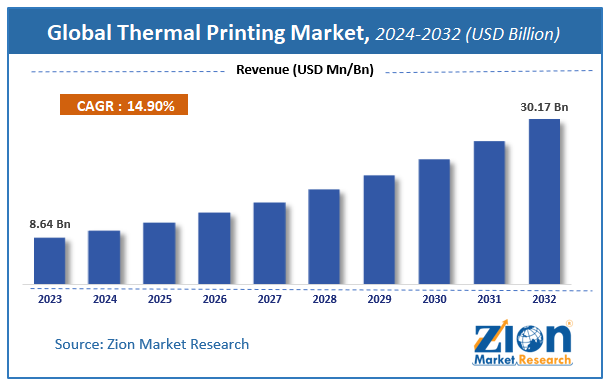
Global Thermal Printing Market: Overview
Thermal printing is the process that creates a thermal impression on selectively coated thermochromic paper when passed through the thermal print head. The paper which is used in the process is also known as thermal paper. Thermal printing has a wide range of applications including heavily labeled items, shipping labels, barcodes, wayfinding markers, and many more.
Global Thermal Printing Market: Growth Factors
The global thermal printing market is growing at a lucrative rate. The rise in the use of thermal printing in the retail industry, the growing adoption of barcode & RFID thermal printing in the e-commerce sector, and the rapidly expanding transport industry are some of the major factors that are augmenting the growth of the global market. Thermal printing is widely used in the logistics & transportation industry especially railroads, package & freight delivery, mail, distribution, and airlines. This is supported by an increase in tourism across the world for leisure, business, or education. In addition to this, the healthcare & hospitality industry is also adopting the use of thermal printing for smart labels on a large scale to keep track of medical equipment and patients in case of emergencies.
All such factors coupled with the growing demand for cost-effective labeling solutions are fostering the growth of the global thermal printing market. In addition to this, the strong geographic presence of key players, strong product portfolio & brand name are also some of the key features that are equally contributing to the growth of the global market. Moreover, wireless technology majorly used in mobile printers and the growing use of data capture technologies & automatic identification are also some of the factors that are boosting the growth of the market. Furthermore, technological advancements and the growing use of portable thermal printing will lead to ample opportunities that may be beneficial for the growth of the global thermal printing market over the forecast period. However, stringent regulations associated with printing may restrain the growth of the global thermal printing market.
Current COVID-19 pandemic conditions put breaks on the growth of the global thermal printing market. Some of the key factors that hindered the market growth during the pandemic period include strict lockdowns, restrictions on personnel movement, and disruption of the supply chain & distributor network. Due to strict lockdowns and restrictions on personnel movement, many end-use industries stopped their manufacturing process. Also, the impact on the distribution network resulted in the overall sale of the products and caused low revenue generation in the year 2020. However, with the growing demand for thermal printing, the market is expected to bounce back and register healthy growth over the forecast period.
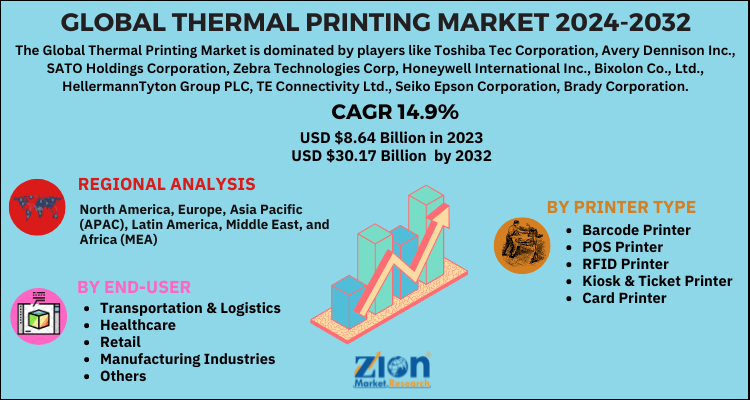
Thermal Printing Market: Report Scope
| Report Attributes | Report Details |
|---|---|
| Report Name | Thermal Printing Market |
| Market Size in 2023 | USD 8.64 Billion |
| Market Forecast in 2032 | USD 30.17 Billion |
| Growth Rate | CAGR of 14.9% |
| Number of Pages | 191 |
| Key Companies Covered | Toshiba Tec Corporation, Avery Dennison Inc., SATO Holdings Corporation, Zebra Technologies Corp, Honeywell International Inc., Bixolon Co., Ltd., HellermannTyton Group PLC, TE Connectivity Ltd., Seiko Epson Corporation, Brady Corporation, and TSC Auto ID Technology Co., Ltd. among other |
| Segments Covered | By Printer Type, By End-User, and By Region |
| Regions Covered | North America, Europe, Asia Pacific (APAC), Latin America, Middle East, and Africa (MEA) |
| Base Year | 2023 |
| Historical Year | 2018 - 2022 |
| Forecast Year | 2024 - 2032 |
| Customization Scope | Avail customized purchase options to meet your exact research needs. Request For Customization |
Global Thermal Printing Market: Segmentation
The global thermal printing market is segmented based on printer type, end-user, and region.
Based on printer type, the global thermal printing market is characterized by barcode printer, POS printer, RFID printer, kiosk & ticket printer, and card printer.
The end-user segment is bifurcated into transportation & logistics, healthcare, retail, manufacturing industries, and others.
Recent Developments:
- In April 2025, Source Technologies acquired AMT Datasouth's printer assets, expanding its thermal printing portfolio. The acquisition strengthens Source Technologies’ offerings in label, barcode, and receipt printing solutions.
- In March 2025, Distribution Management (DM) expanded its product portfolio through a partnership with Brother, adding Brother’s thermal desktop and industrial printers. The collaboration strengthens DM’s thermal printing, mobile, and labeling solutions while enabling Brother to broaden its market reach, including in state and local government.
- In April 2024, Kite Packaging expanded its offerings with the launch of a new range of thermal labels and printers, including direct thermal and thermal transfer options. The portfolio features desktop and mobile printers from multiple brands, as well as Kite’s own entry-level models.
Global Thermal Printing Market: Regional Analysis
North America is expected to hold the largest share of the global thermal printing market during the overcast period. Some of the key factors contributing to the growth of the market in the regions include the large demand for thermal printers in well-developed retail, manufacturing, logistics, and healthcare industries. Europe is expected to be the significant revenue contributor in the market over the forecast period.
Asia Pacific is expected to register rapid growth in the global thermal printing market over the forecast period. Factors such as rapidly growing industrialization, logistics, and healthcare sectors are expected to contribute to the growth of the market in this region, while China is anticipated to hold the largest share of the Asia Pacific market.
Global Thermal Printing Market: Competitive Players
Major players in the market are constantly focusing on research and new product launches to stay ahead in the competitive market. Key players operating in the global thermal printing market include;
- Toshiba Tec Corporation
- Avery Dennison Inc.
- SATO Holdings Corporation
- Zebra Technologies Corp
- Honeywell International Inc.
- Bixolon Co., Ltd.
- HellermannTyton Group PLC
- TE Connectivity Ltd.
- Seiko Epson Corporation
- Brady Corporation
- TSC Auto ID Technology Co., Ltd.
The global thermal printing market is segmented as follows;
By Printer Type
- Barcode Printer
- POS Printer
- RFID Printer
- Kiosk & Ticket Printer
- Card Printer
By End-User
- Transportation & Logistics
- Healthcare
- Retail
- Manufacturing Industries
- Others
By Region
- North America
- The U.S.
- Canada
- Mexico
- Europe
- France
- The UK
- Spain
- Germany
- Italy
- Rest of Europe
- Asia Pacific
- China
- Japan
- India
- Australia
- South Korea
- Rest of Asia Pacific
- The Middle East & Africa
- Saudi Arabia
- UAE
- Egypt
- Kuwait
- South Africa
- Rest of the Middle East & Africa
- Latin America
- Brazil
- Argentina
- Rest of Latin America
What Reports Provide
- Full in-depth analysis of the parent market
- Important changes in market dynamics
- Segmentation details of the market
- Former, ongoing, and projected market analysis in terms of volume and value
- Assessment of niche industry developments
- Market share analysis
- Key strategies of major players
- Emerging segments and regional markets
- Testimonials to companies in order to fortify their foothold in the market.
Table Of Content

FrequentlyAsked Questions
Thermal printing is a printing method that uses heat to produce images on special paper or labels. It is commonly used for receipts, barcodes, and shipping labels due to its speed and low maintenance.
The global Thermal Printing market is expected to be driven by the Market growth is fueled by rising demand for barcode labels and receipts in retail, logistics, and healthcare. Growth of e-commerce shipping, inventory tracking, and cost-effective, low-maintenance printing supports adoption.
According to study, the global Thermal Printing market size was worth around USD 8.64 Billion in 2023 and is predicted to grow to around USD 30.17 Billion By 2032.
The global Thermal Printing market is expected to grow at a Compound Annual Growth Rate (CAGR) of around CAGR 14.9% during the forecast period from 2024-2032.
The global Thermal Printing industry is projected to be challenged by Challenges include competition from inkjet/laser alternatives, regulatory pressure on receipt paper chemicals, and hardware commoditization.
The Opportunities include growth in logistics labeling, POS expansion, e-commerce shipping needs, and demand for mobile and compact printers will offer significant growth opportunities in the Thermal Printing market.
Linerless labels and eco-friendly media; higher-speed, higher-resolution compact printers; cloud-connected fleet management and predictive maintenance are the emerging trends and innovations impacting the Thermal Printing market.
The global Thermal Printing market is expected to be led by APAC during the forecast period.
Some of the prominent players operating in the global Thermal Printing market are; Toshiba Tec Corporation, Avery Dennison Inc., SATO Holdings Corporation, Zebra Technologies Corp, Honeywell International Inc., Bixolon Co., Ltd., HellermannTyton Group PLC, TE Connectivity Ltd., Seiko Epson Corporation, Brady Corporation, and TSC Auto ID Technology Co., Ltd. among other and others.
The report explores crucial aspects of the Thermal Printing market, including a detailed discussion of existing growth factors and restraints, while also browsing future growth opportunities and challenges that impact the market.
HappyClients

