
Global Structured Cabling Market Size, Share, Growth Trends & Forecast 2032

Structured Cabling Market By Component (Products and Services), By End Use Industry (IT & Telecom, BFSI, Government, Healthcare, Energy, and Others): Global Industry Perspective, Comprehensive Analysis and Forecast, 2024 - 2032
| Market Size in 2023 | Market Forecast in 2032 | CAGR (in %) | Base Year |
|---|---|---|---|
| USD 11.59 Billion | USD 29.22 Billion | 10.82% | 2023 |
What is the Structured Cabling Market Size?
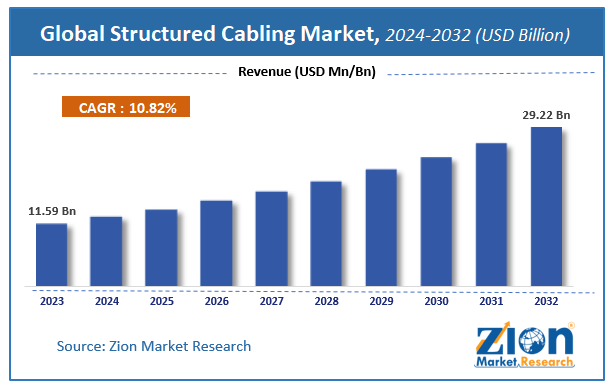
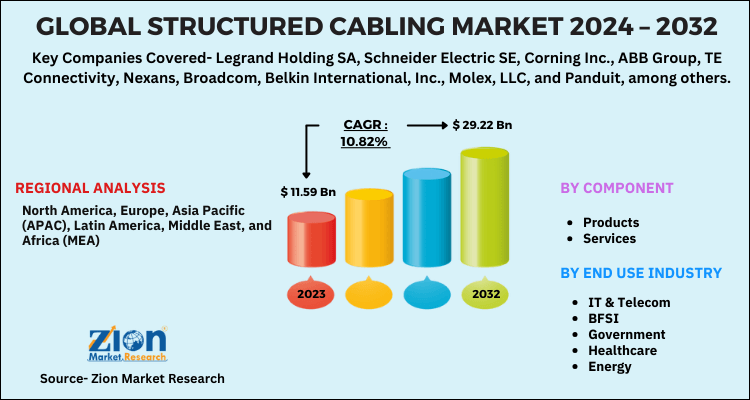
According to a report from Zion Market Research, the global structured cabling market was valued at USD 11.59 billion in 2023 and is projected to hit USD 29.22 billion by 2032, with a compound annual growth rate (CAGR) of 10.82% during the forecast period 2024-2032.
This report provides a comprehensive analysis of the growth drivers, restraints, and challenges shaping demand across the global structured cabling market throughout the forecast period, while highlighting high-potential emerging opportunities within the industry.
Key Insights
- According to our research analyst, the global Structured Cabling market is estimated to grow at a CAGR of around 10.82% over the forecast period (2024-2032).
- In terms of revenue, the global Structured Cabling market size was valued at around USD 11.59 billion in 2023 and is projected to reach USD 29.22 billion by 2032.
- The market is driven by the increasing number of data centers, rising adoption of high-speed internet such as 5G, growing demand for cloud computing, and expanding digitalization across industries.
- Based on the Component, the Products segment is growing at a high rate and is projected to dominate the global market.
- Based on the End Use Industry, the IT & Telecom segment is expected to dominate the global market during the forecast period.
- Based on region, North America held the largest share and is expected to continue its dominance, with the United States as the major revenue contributor supported by the presence of leading companies.
Structured Cabling Market: Overview
Structured cabling is defined as a cabling infrastructure that comprises standardized elements (structured). Structured cabling is a standardized architecture designed for cabling specified by the Telecommunications Industry Association (TIA) and used as a regulation by manufacturers to ensure interoperability. This organized approach supports reliable data, voice, and video transmission within buildings and data centers by providing a consistent, scalable, and manageable physical connectivity framework.
Structured Cabling Market: Growth Factors
What factors are accelerating the expansion of the Structured Cabling market?
The increasing number of data centers is anticipated to fuel the growth of the global structured cabling market over the forecast period. The demand for structured cabling in data centers is increasing owing to the increasing amount of data generated and used by companies from various sectors. Companies such as Facebook and Google require a huge amount of data to be stored, owing to which the necessity to have a highly organized data center is essential.
Increasing adoption of high-speed internet such as 5G coupled with the growing demand for cloud computing is anticipated to augment the demand for structured cabling over the forecast period. According to the GSM Association (GSMA), 5G networks are likely to cover one third of the global population. Owing to this, the amount of data generated and managed by companies in the telecom sector will increase. Moreover, the outbreak of the COVID-19 pandemic has led to the adoption of telehealth services. This, in turn, has led an increase in the demand for structured cabling in the healthcare sector.
Structured Cabling Market: Restraints
What factors are limiting the growth of the Structured Cabling market?
Large-scale structured cabling deployments can involve significant upfront investment and complex planning, which may slow adoption in cost-sensitive environments or smaller organizations. The requirement for specialized design, installation, and maintenance expertise can also constrain faster rollout in certain regions.
Ensuring long-term compatibility with rapidly evolving network technologies and bandwidth demands adds further planning complexity for end users and installers.
Structured Cabling Market: Report Scope
| Report Attributes | Report Details |
|---|---|
| Report Name | Structured Cabling Market |
| Market Size in 2023 | USD 11.59 Billion |
| Market Forecast in 2032 | USD 29.22 Billion |
| Growth Rate | CAGR of 10.82% |
| Number of Pages | 220 |
| Key Companies Covered | Legrand Holding SA, Schneider Electric SE, Corning Inc., ABB Group, TE Connectivity, Nexans, Broadcom, Belkin International, Inc., Molex, LLC, and Panduit, among others |
| Segments Covered | By Component, By End Use Industry And By Region |
| Regions Covered | North America, Europe, Asia Pacific (APAC), Latin America, Middle East, and Africa (MEA) |
| Base Year | 2023 |
| Historical Year | 2018 - 2022 |
| Forecast Year | 2024 - 2032 |
| Customization Scope | Avail customized purchase options to meet your exact research needs. Request For Customization |
Structured Cabling Market: Segmentation
The global structured cabling market is bifurcated on the basis of component, end-use industry, and region.
Based on the component, the market is further bifurcated into products and services. Products form a foundational element of the market, encompassing cables, patch panels, and related hardware that enable physical network connectivity. This segment drives core infrastructure deployment across data centers and enterprise environments. Services, including installation and consultation, support proper design, deployment, and ongoing management, ensuring systems meet performance and standardization requirements and helping expand overall market value.
Based on end-use industry, the global structured cabling market is classified into IT & telecom, BFSI, government, healthcare, energy, and others. The IT & Telecom segment represents a major demand driver due to extensive data center requirements, network modernization, and the need for high-capacity, standardized connectivity. This leadership supports overall market growth through large-scale projects. BFSI, Government, Healthcare, and Energy sectors contribute additional demand as digitalization, data security needs, telehealth expansion, and operational connectivity requirements increase across these industries.
Structured Cabling Market: Regional Analysis
Why will North America continue to dominate the global market during the projection period?
The North America region held the largest share in 2023 and is expected to continue its dominance over the forecast period. The U.S. is expected to be the major contributor in terms of revenue in this region. This is attributable to the presence of major companies such as Broadcom, Corning Inc., and Molex, LLC, among others.
The Asia Pacific region is projected to grow at a notable rate over the forecast period. This is attributable to the increasing adoption of digitalization in developing economies such as China and India. Digitalization has paved the way for the adoption of data centers in these countries. Additionally, a growing number of smartphone users has led to an increase in data, owing to which organizations from various sectors are opting for structured cabling products and services to ensure a certain level of standardization.
Structured Cabling Market: Competitive Players
Some of the key players in the structured cabling market are:
- Legrand Holding SA
- Schneider Electric SE
- Corning Inc.
- ABB Group
- TE Connectivity
- Nexans
- Broadcom
- Belkin International, Inc.
- Molex, LLC
- Panduit
The global structured cabling market is segmented as follows:
By Component
- Products
- Services
By End Use Industry
- IT & Telecom
- BFSI
- Government
- Healthcare
- Energy
- Others
By Region
- North America
- The U.S.
- Canada
- Mexico
- Europe
- France
- The UK
- Spain
- Germany
- Italy
- Rest of Europe
- Asia Pacific
- China
- Japan
- India
- Australia
- South Korea
- Rest of Asia Pacific
- The Middle East & Africa
- Saudi Arabia
- UAE
- Egypt
- Kuwait
- South Africa
- Rest of the Middle East & Africa
- Latin America
- Brazil
- Argentina
- Rest of Latin America
Table Of Content
Methodology
FrequentlyAsked Questions
Structured cabling is a standardized cabling infrastructure composed of multiple standardized elements. It is a regulated architecture designed for cabling systems as specified by the Telecommunications Industry Association (TIA) and followed by manufacturers to ensure interoperability.
Key growth drivers include the increasing number of data centers, rising adoption of high-speed internet such as 5G, growing demand for cloud computing, expanding digitalization, and higher data traffic across IT, telecom, and other industries.
According to a study, the global Structured cabling Industry size was $11.59 Billion in 2023 and is projected to reach $29.22 Billion by the end of 2032.
The global Structured cabling market is expected to grow at a CAGR of 10.82% during the forecast period.
North America region held the largest share in 2023 and is expected to continue its dominance over the forecast period.
Some of key players in structured cabling market are Legrand Holding SA, Schneider Electric SE, Corning Inc., ABB Group, TE Connectivity, Nexans, Broadcom, Belkin International, Inc., Molex, LLC, and Panduit, among others
The global Structured cabling market report covers the geographical market along with a comprehensive competitive landscape analysis. It also includes cash flow analysis, profit ratio analysis, market basket analysis, market attractiveness analysis, sentiment analysis, PESTEL analysis, trend analysis, SWOT analysis, trade area analysis, demand & supply analysis, Porter’s five force analysis, and value chain analysis.

HappyClients

