
Space Robotics Market Size, Share, Trends, Growth 2032

Space Robotics Market By Solution (Product And Services), By End-User (Commercial And Government), By Application (Ground, Near Space, And Deep Space), And By Region - Global Industry Perspective, Comprehensive Analysis, And Forecast 2024 - 2032
| Market Size in 2023 | Market Forecast in 2032 | CAGR (in %) | Base Year |
|---|---|---|---|
| USD 4.77 Billion | USD 9.88 Billion | 8.42% | 2023 |
How big is the Space Robotics Market?
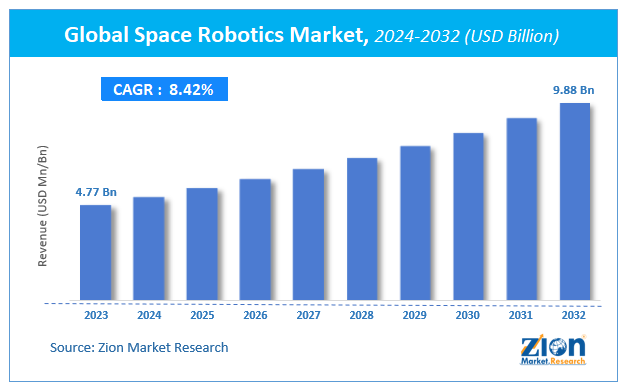
According to a report from Zion Market Research, the global space robotics market was valued at USD 4.77 billion in 2023 and is projected to hit USD 9.88 billion by 2032, with a compound annual growth rate (CAGR) of 8.42% during the forecast period 2024-2032. The Space Robotics Market is driven by the escalating necessity for in-orbit satellite servicing and the rise in space exploration missions.
The report examines the primary drivers, challenges, and restraints shaping global demand for the space robotics market throughout the forecast period and identifies high-growth opportunities across the industry.
Space Robotics Market: Overview
Space robotics deals with the production of general-purpose machines that have the ability to sustain harsh space conditions. They are used for performing exploration, maintenance activities, development, and servicing. In addition to this, space robotics assists in reducing costs and improving schedules, along with minimizing risks and enhancing performance in comparison to human beings.
Key Insights
- As per the analysis shared by our research analyst, the global space robotics market is estimated to grow annually at a CAGR of around 8.42% over the forecast period (2024-2032).
- In terms of revenue, the global space robotics market size was valued at around USD 4.77 billion in 2023 and is projected to reach USD 9.88 billion by 2032.
- The global space robotics market is driven by the escalating necessity for in-orbit satellite servicing along with a rapid rise in complex space exploration missions.
- Based on the Solution, the Services segment dominated the global market with a share of over 55%
- Based on the End User, the Government segment dominated the global market with a share of over 60%
- Based on the Application, the Near Space segment dominated the global market with a share of over 45%
- Based on region, North America dominated the global market with a share of over 40% and is expected to maintain its dominance due to massive funding by major aerospace firms
Space Robotics Market: Growth Drivers
Escalating necessity for in-orbit satellite servicing along with rise in the space exploration missions will embellish the growth of space robotics market in the years ahead. In addition to this, extensive utilization of satellites for regular & routine communications, monitoring of farming activities, climate monitoring, and defense activities will propel the sales of space robotics. A huge proportion of profits involved in the manufacturing of space robots has resulted in manufacturers trying to bring innovations in the product. This is likely to result in market expansion over the years ahead.
Moreover, large-scale utility of space robotics in deep space and on the ground as well as near space will prompt business growth in the forthcoming years. Apparently, the humongous need for space robots in government as well as commercial sectors will impel the market size in the forthcoming years. These products find use in the form of free-flyers, rovers, and large manipulators in various developed countries, including Japan, Canada, and the U.S. Nonetheless, issues like mobility as well as space robot handling will put the brakes on the growth of the space robotics industry in the near future.
Space Robotics Market: Segmentation
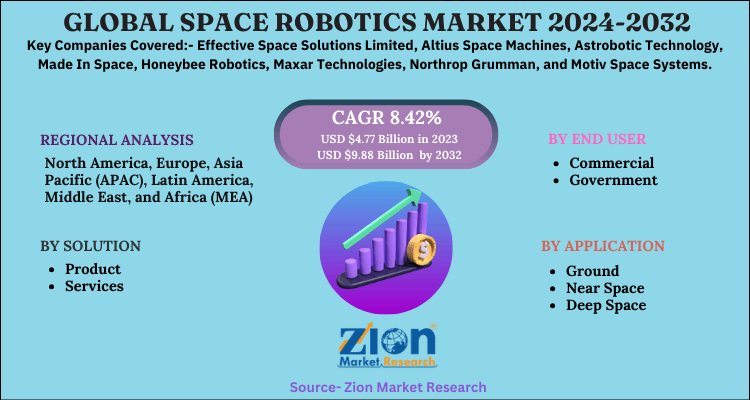
The Space Robotics market is segmented by solution, end user, application, and region.
Based on the Solution, the space robotics market is divided into Product and Services. The Services segment currently dominates the global market landscape. This dominance is intrinsically tied to the surging global demand for in-orbit satellite servicing, active space debris removal, and ongoing life-extension operations that require continuous robotic intervention. Satellite operators recognize that purchasing robotic servicing contracts is vastly more economical than launching entirely new satellites, thereby driving immense recurring revenue streams for service providers. The Product segment is identified as the second most dominant subsegment. It encompasses the critical physical hardware, including complex robotic arms, planetary rovers, and sensor-equipped manipulators, which are absolutely essential for executing the physical demands of any space exploration or orbital assembly mission.
Based on the End User, the space robotics market is divided into Commercial and Government. The Government segment holds the dominant position in the industry. This is primarily fueled by the massive, sustained capital investments from national space agencies directed toward deep space exploration, comprehensive planetary research, and the ambitious establishment of long-term lunar infrastructure. Government entities uniquely possess the robust financial backing and long-term risk tolerance necessary to spearhead highly complex, multi-year robotic missions that push the boundaries of scientific discovery. The Commercial segment emerges as the second most dominant subsegment. It is expanding at a rapid pace due to the intense privatization of space activities, the explosive deployment of commercial satellite constellations, and the rising corporate involvement in space logistics and tourism.
Based on the Application, the space robotics market is divided into Ground, Near Space, and Deep Space. The Near Space segment represents the most dominant application area globally. Its dominance is a direct result of the dense concentration of commercial communication, Earth observation, and navigation satellites operating continuously in low Earth orbit (LEO). The critical necessity to actively maintain, refuel, and eventually de-orbit these specific satellites to prevent dangerous orbital congestion ensures a continuous, high-volume demand for near-space robotic solutions. The Deep Space segment ranks as the second most dominant application category. Driven by high-profile interplanetary scientific missions, prospective asteroid mining explorations, and ambitious expeditions targeting Mars, deep space robotics remain essential for complex tasks where human presence is currently unfeasible or excessively hazardous.
Space Robotics Market: Report Scope
| Report Attributes | Report Details |
|---|---|
| Report Name | Space Robotics Market |
| Market Size in 2023 | USD 4.77 Billion |
| Market Forecast in 2032 | USD 9.88 Billion |
| Growth Rate | CAGR of 8.42% |
| Number of Pages | 210 |
| Key Companies Covered | Effective Space Solutions Limited, Altius Space Machines, Astrobotic Technology, Made In Space, Honeybee Robotics, Maxar Technologies, Northrop Grumman, and Motiv Space Systems |
| Segments Covered | By Solution, By End User, By Application, and By Region |
| Regions Covered | North America, Europe, Asia Pacific (APAC), Latin America, Middle East, and Africa (MEA) |
| Base Year | 2023 |
| Historical Year | 2018 - 2022 |
| Forecast Year | 2024 - 2032 |
| Customization Scope | Avail customized purchase options to meet your exact research needs. Request For Customization |
Space Robotics Market: Regional Analysis
Why will North America continue to dominate the global market during the projection period?
North America is expected to maintain its formidable dominance in the global space robotics market throughout the forecast period, due to massive funding made by major firms in space exploration and a prominent surge in space exploration programs carried out in countries like the U.S. and Canada. Furthermore, the escalating popularity of on-orbit assembly, debris removal, and satellite servicing will create lucrative growth avenues for the market over the ensuing years in the sub-continent. The regional market expansion can be ascribed to the massive need for space robots in defense & military, governments, space agencies, and commercial units in countries like the U.S.
Asia Pacific is rapidly emerging as a formidable region, driven by aggressively expanding national space programs and technological investments in countries like China, India, and Japan. The region's growing focus on lunar exploration and commercial satellite deployments contributes significantly to overall market growth.
Space Robotics Market: Competitive Analysis
The global space robotics market is led by players like:
- Effective Space Solutions Limited
- Altius Space Machines
- Astrobotic Technology
- Made In Space
- Honeybee Robotics
- Maxar Technologies
- Northrop Grumman
- Motiv Space Systems
This research report categorizes the market into the following segments;
By Solution
- Product
- Software
- Sensors and Autonomous Systems
- Subsystems and Robotics
- Others
- Services
- Satellite Servicing
- Surface Mobility
- Launch Support
- Re-supply
- De-orbiting Services
- On-orbit Assembly & Manufacturing
By End User
- Commercial
- Launch Service Providers
- Satellite Owners/Operators
- Others (NewSpace companies, Satellite Manufacturers, etc.)
- Government
- Defense Departments
- Space Agencies
- Others
By Application
- Ground
- Near Space
- In-space 3D Printing
- In-space Maintenance & Inspection
- Space Exploration
- Scientific Experimentation/Space Operations
- Space Deep Space
- Deep Space
- Space Deep Space
- Space Exploration
By Region
- North America
- The U.S.
- Canada
- Mexico
- Europe
- France
- The UK
- Spain
- Germany
- Italy
- Rest of Europe
- Asia Pacific
- China
- Japan
- India
- Australia
- South Korea
- Rest of Asia Pacific
- The Middle East & Africa
- Saudi Arabia
- UAE
- Egypt
- Kuwait
- South Africa
- Rest of the Middle East & Africa
- Latin America
- Brazil
- Argentina
- Rest of Latin America
Table Of Content
Methodology
FrequentlyAsked Questions
The design, development, and application of autonomous systems that are specifically intended for use in space exploration and related activities are referred to as space robotics. These robots are designed to work in the inhospitable environment of space, where conditions such as extreme temperatures, vacuum, and radiation can present significant challenges.
Governments and private organizations are making substantial investments in space exploration initiatives, which encompass missions to the Moon, Mars, and beyond. This investment stimulates the demand for robotic systems that can execute duties in space, including planetary exploration, habitat construction, and sample collection.
According to a report from Zion Market Research, the global Space Robotics Market was valued at USD 4.77 Billion in 2023 and is projected to hit USD 9.88 Billion by 2032.
According to a report from Zion Market Research, the global Space Robotics Market a compound annual growth rate (CAGR) of 8.42% during the forecast period 2024-2032.
The major challenges restraining market growth include the astronomical costs associated with developing and testing radiation-hardened robotic systems, the severe technical complexities of operating in extreme space environments, and the significant risks of mission failure due to communication latency and lack of repair options.
Key players profiled in the report include Effective Space Solutions Limited, Altius Space Machines, Astrobotic Technology, Made In Space, Honeybee Robotics, Maxar Technologies, Northrop Grumman, and Motiv Space Systems.
Emerging trends impacting the market include the rapid integration of artificial intelligence for advanced autonomous navigation, the shift toward modular in-orbit manufacturing and assembly, and the development of highly dexterous robotic arms for complex satellite life-extension missions.
North America is expected to contribute notably to the global market value, driven by massive financial investments from leading national space agencies, a highly robust commercial aerospace sector, and strong collaborative ecosystems advancing orbital and planetary exploration technologies.
The value chain of the space robotics industry includes advanced research and development, the manufacturing of specialized space-grade hardware and software, rigorous environmental testing and validation, system integration with launch vehicles, and finally, deployment and post-launch operational services.
The global space robotics market report provides comprehensive insights into market dynamics, including detailed analyses of growth drivers, restraints, opportunities, and challenges. It also offers segmented market forecasts, regional analysis, competitive landscape assessments, and evaluations of recent technological developments and trends.

HappyClients

