
Global Smart Electric Meter Market Size, Growth, Sales Report 2034

Smart Electric Meter Market By Phase (Single-phase and Three-phase), By Communication Type (Power Line Communication, Radio Frequency and Cellular), By End Use (Residential, Commercial and Industrial), and By Region: Global and Regional Industry Overview, Market Intelligence, Comprehensive Analysis, Historical Data, and Forecasts 2025 - 2034
| Market Size in 2024 | Market Forecast in 2034 | CAGR (in %) | Base Year |
|---|---|---|---|
| USD 26.12 Billion | USD 57.20 Billion | 9.10% | 2024 |
Smart Electric Meter Industry Perspective
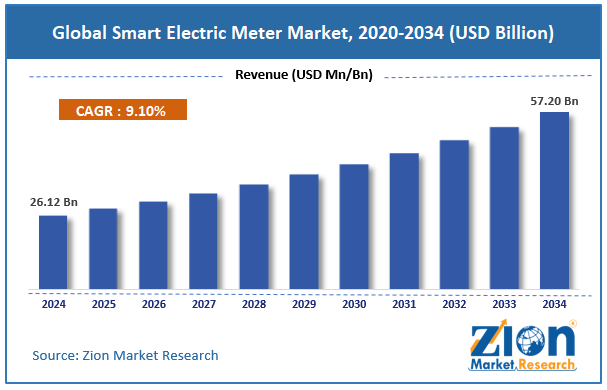
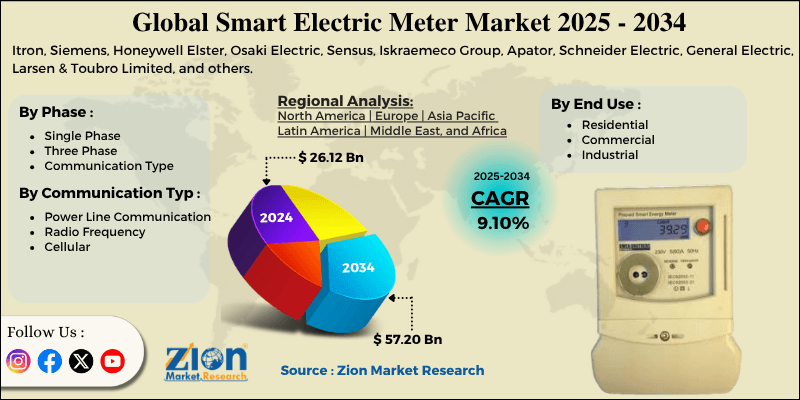
The global smart electric meter market size was worth around USD 26.12 billion in 2024 and is predicted to grow to around USD 57.20 billion by 2034 with a compound annual growth rate (CAGR) of roughly 9.10% between 2025 and 2034. The report analyzes the global smart electric meter market's drivers, restraints/challenges, and the effect they have on the demand during the projection period. In addition, the report explores emerging opportunities in the smart electric meter industry.
Smart Electric Meter Market: Overview
A smart electric meter is an electrical system that records the amount of electricity used over a period of time. These time cycles are usually an hour or less long. The data is then sent back to the utility and energy company for billing and reporting by the smart electric meter. This metre operates on a two-way contact system. The meter and the central system communicate with each other.
Smart energy metering devices are used to reduce peak electricity usage by allowing end-users to quickly track and reduce their power usage. Low power generation eventually leads to unstable energy productivity because renewable energy output changes over time. However, since the metering system is capable of managing intermittent supply, it can compensate for this loss by monitoring the energy usage of different electronic devices.
Key Insights
- As per the analysis shared by our research analyst, the global smart electric meter market is estimated to grow annually at a CAGR of around 9.10% over the forecast period (2025-2034).
- In terms of revenue, the global smart electric meter market size was valued at around USD 26.12 billion in 2024 and is projected to reach USD 57.20 billion by 2034.
- The smart electric meter market is projected to grow significantly, driven by global smart grid initiatives, government mandates for energy efficiency, and rising demand for real-time consumption data and grid management.
- Based on Phase, the three-phase segment is expected to lead the market, while the single-phase electric meters segment is expected to grow considerably.
- Based on End Use, the residential segment is projected to swipe the largest market share.
- Based on region, the Asia Pacific is projected to dominate the global market during the estimated period, followed by Europe.
Smart Electric Meter Market: Growth Factors
One of the major growth drivers for the Smart Electric Meter Market is Government Initiatives. The global smart meter market is expected to develop at a rapid pace, owing to numerous government initiatives in major economies. Furthermore, funds from the American Recovery and Reinvestment Act (ARRA) have played an important role in the market's growth. The demand is also being boosted by the replacement of obsolete traditional meters and upgrades to outdated technology. The early penetration of smart meters, favourable government programmes, and strict regulations mandating smart meters in many states, such as Texas and California, are the factors driving consumer demand in the leading countries.
Another factor for the growth in this market is the development of the Communication Network Infrastructure. The continuing and continual construction of the data network system helps to facilitate the production of advanced smart meters. The implementation of smart meters is aided by the availability of network networks such as 5G, 4G, radio frequency, and others. Manufacturers are continuously engaged in the development of advanced-level smart meters in response to the expanding network infrastructure, thus contributing to the smart meters industry's growth.
Smart Electric Meter Market: Segmentation Analysis
The global smart electric meter market is segmented based on phase, communication type, end use, and region.
Based on Phase, the smart electric meter market is divided into single-phase and three-phase segments based on phase. The three-phase sub-segment is projected to expand more quickly than the single-phase sub-segment. This rise can be due to the fact that it is being used in more industrial and consumer applications. Three-phase electric meters can handle more load and allow you to split the load into three phases.
The construction of three-phase electric meters is expected to increase as the number of industries and commercial buildings grows. Furthermore, the three-phase electric meters' versatility is opening the way for these meters to be used in residential applications. Furthermore, single-phase electric meters are mostly found in residential buildings with lower power loads than industrial buildings because they are less costly and more accessible to residential customers.
In terms of End Use, the smart electric meter market is divided into residential, commercial, and industrial sub-segments. Suburban/urban apartments and detached bungalows are included in the residential end-use category. Among these, the residential segment has led the market with 88% residential customers. The reason is the increasing device requirements to satisfy energy demand. Both commercial buildings and aligned infrastructures, such as hotels, residential lodges, small to large retail malls, and offices, are included in the commercial end-use segment. Drug manufacturing and processing plants are included in the industrial section.
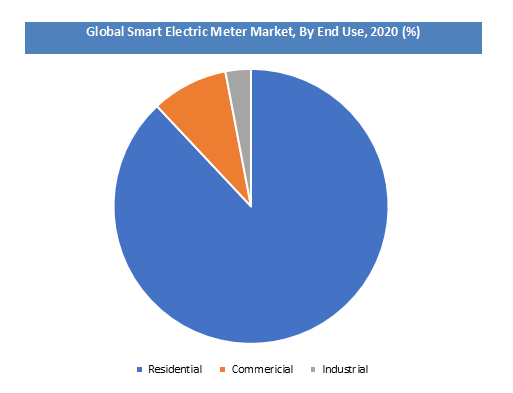
Over the projected era, the commercial end-use segment is expected to expand at a healthy pace. The legislative, administrative structure, and rising awareness of reducing energy use and aligning expenditures are all contributing to this domain's development.
Smart Electric Meter Market: Report Scope
| Report Attributes | Report Details |
|---|---|
| Report Name | Smart Electric Meter Market |
| Market Size in 2024 | USD 26.12 Billion |
| Market Forecast in 2034 | USD 57.20 Billion |
| Growth Rate | CAGR of 9.10% |
| Number of Pages | 215 |
| Key Companies Covered | Itron, Siemens, Honeywell Elster, Osaki Electric, Sensus, Iskraemeco Group, Apator, Schneider Electric, General Electric, Larsen & Toubro Limited, and others |
| Segments Covered | By Phase, By Communication Type, By End Use, and By Region |
| Regions Covered | North America, Europe, Asia Pacific (APAC), Latin America, The Middle East and Africa (MEA) |
| Base Year | 2024 |
| Historical Year | 2020 - 2023 |
| Forecast Year | 2025 - 2034 |
| Customization Scope | Avail customized purchase options to meet your exact research needs. Request For Customization |
Smart Electric Meter Market: Region Analysis
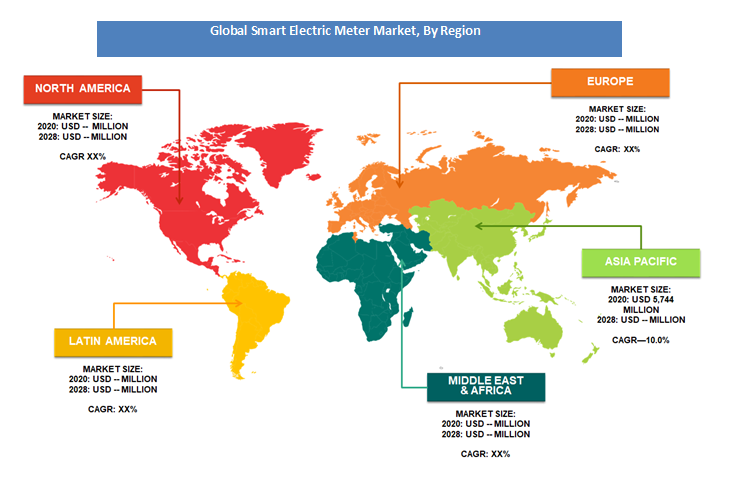
The Smart Electric Meter Market is divided into five regions: North America, Europe, Asia Pacific, Latin America and the Middle East and Africa. Asia Pacific currently has the largest share of the global smart electric meter market with 9.7% CAGR. It is due to the increasing adoption of smart meters to reduce unaccounted energy losses and put in tariff plans based on consumer use.
The installation of smart electric meters has seen a significant increase in Europe. The increased adoption of renewable energy sources has been a significant factor driving demand in this area. New grids are being built in response to the growing use of green energy sources. Smart meters are favoured for modern systems because they are a new system with significant benefits over conventional meters.
Smart Electric Meters have been widely used in the Middle East and Africa, as well as Latin America. In the coming years, big smart meter rollouts are likely in Brazil and Mexico, two major Latin American countries.
Smart Electric Meter Market: Competitive Landscape
Some of the key players in the Smart Electric Meter Market include;
- Itron
- Siemens
- Honeywell Elster
- Osaki Electric
- Sensus
- Iskraemeco Group
- Apator
- Schneider Electric
- General Electric
- Larsen & Toubro Limited
These key players have adopted various strategies such as product portfolio expansion, mergers & acquisitions, agreements, geographical expansion, and collaborations to enhance their smart meter market penetration.
Itron, which offers solutions to measure, control, and evaluate energy and water through smart electric meters and smart meters, acquired Comverge in June 2017, a company known for its automated cloud-based demand response, energy management, and customer service solutions.
Aclara purchased General Electric's power metering company in September 2015. Aclara's presence in the smart electric meters business was improved as a result of the acquisition. In the North American area, Aclara is known for its metering.
The global smart electric meter market is segmented as follows;
By Phase
- Single Phase
- Three Phase
- Communication Type
By Communication Type
- Power Line Communication
- Radio Frequency
- Cellular
By End Use
- Residential
- Commercial
- Industrial
By Region
- North America
- The U.S.
- Canada
- Mexico
- Europe
- France
- The UK
- Spain
- Germany
- Italy
- Rest of Europe
- Asia Pacific
- China
- Japan
- India
- Australia
- South Korea
- Rest of Asia Pacific
- The Middle East & Africa
- Saudi Arabia
- UAE
- Egypt
- Kuwait
- South Africa
- Rest of the Middle East & Africa
- Latin America
- Brazil
- Argentina
- Rest of Latin America
Table Of Content
Methodology
FrequentlyAsked Questions
A smart electric meter is an advanced digital device that replaces traditional analog meters, enabling two-way communication between a household or business and the utility provider; it measures electricity consumption in real-time and transmits this data wirelessly, allowing for accurate billing without manual readings, providing consumers with detailed insights into their energy usage patterns via in-home displays or apps, and empowering utilities to monitor grid performance, manage demand remotely, detect outages instantly, and integrate renewable energy sources more effectively into the power network.
The smart electric meter market is projected to grow significantly, driven by a Global push for modernized energy infrastructure, where government mandates and utility-led smart grid initiatives are facilitating widespread rollouts to enhance grid reliability, integrate renewable energy sources, and empower consumers with real-time usage data for better energy management and efficiency.
According to a study, the Global smart electric meter market size was worth around USD 26.12 billion in 2024 and is expected to reach USD 57.20 billion by 2034.
The Global smart electric meter market is expected to grow at a CAGR of 9.10% during the forecast period.
Emerging trends include the integration of IoT and AI for predictive analytics, the rise of two-way communication for demand response, and the development of advanced metering infrastructure (AMI) for enhanced grid management and cybersecurity.
Asia Pacific is expected to dominate the smart electric meter market over the forecast period.
China is the most significant contributor to the Global smart electric meter market, dominating both production and deployment with a market share that accounts for approximately half of the world's total installed base.
Leading players in the Global smart electric meter market include Itron, Siemens, Honeywell Elster, Osaki Electric, Sensus , Iskraemeco Group, Apator, Schneider Electric, General Electric, Larsen & Toubro Limited and others.
Leading players in the Global smart electric meter market (such as Itron, Landis+Gyr, Siemens, and Schneider Electric) are currently focused on transitioning from hardware-centric sales to data-driven service models.
The report examines key aspects of the smart electric meter market, including a detailed analysis of current growth factors and restraints, as well as future growth opportunities and challenges that will affect the market.

HappyClients

