
Global Single Vision Lenses Market Size, Share, Growth Analysis Report - Forecast 2034

Single Vision Lenses Market By Material (Glass, Plastic (CR-39, Polycarbonate, Trivex), High-Index Plastics), By Coating (Anti-reflective, Scratch-resistant, UV Protection, Blue Light Blocking), By End-user (Children, Adults, Elderly), By Distribution Channel (Optical Stores, Online Retail, Hospitals & Clinics), and By Region: Global and Regional Industry Overview, Market Intelligence, Comprehensive Analysis, Historical Data, and Forecasts 2025 - 2034
| Market Size in 2024 | Market Forecast in 2034 | CAGR (in %) | Base Year |
|---|---|---|---|
| USD 8.16 Billion | USD 12.26 Billion | 3.9% | 2024 |
Single Vision Lenses Market: Industry Perspective
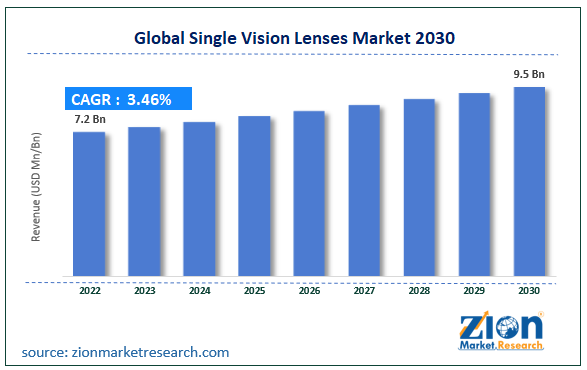
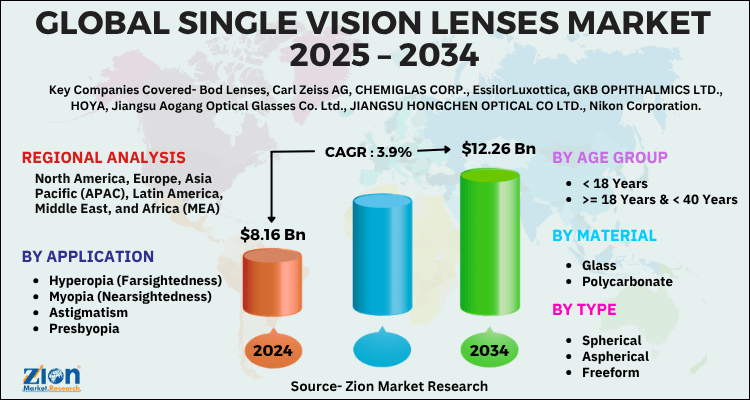
The global single vision lenses market size was worth around USD 8.16 Billion in 2024 and is predicted to grow to around USD 12.26 Billion by 2034 with a compound annual growth rate (CAGR) of roughly 3.9% between 2025 and 2034. The report analyzes the global single vision lenses market's drivers, restraints/challenges, and the effect they have on the demands during the projection period. In addition, the report explores emerging opportunities in the single vision lenses industry.
Single Vision Lenses Market: Overview
Single-vision lenses are used by people with the following eye issues, including myopia, hyperopia astigmatism, and presbyopia. These lenses offer sharper & comfortable vision, with a wider field of view. These lenses have just a single optical prescription correction. Moreover, single-vision lenses distribute focus evenly over the entire surface area. Thereby, these lenses are made for one, consistent focal power to correct a single vision problem.
Myopia, also known as nearsightedness, is a common vision condition in which near targets appear clear but objects with farther distance appear blurry. Hyperopia, also known as farsightedness, is an example of refractive errors, in which far objects appear clear but near objects look blurry. Astigmatism & presbyopia is also an example of refractive errors. These lenses are used by every age group peoples, including, kids, teens, adults, and senior citizens.
Single-vision lenses are, mainly, based on plastic (polycarbonate, etc.) & glass. Single-vision lenses with high-quality coatings are used to prevent strain on the eye, caused by prolonged screen time on digital devices. Moreover, single-vision lenses with an aspheric surface design offer good visual quality and are recommended for lens wearers with high prescriptions. According to Carl Zeiss AG, around 75% of global lens sales accounted for single-vision lenses. Rising eye problems, across the globe, are likely to fuel the demand for the single-vision lens industry.
Key Insights
- As per the analysis shared by our research analyst, the global single vision lenses market is estimated to grow annually at a CAGR of around 3.9% over the forecast period (2025-2034).
- Regarding revenue, the global single vision lenses market size was valued at around USD 8.16 Billion in 2024 and is projected to reach USD 12.26 Billion by 2034.
- The single vision lenses market is projected to grow at a significant rate due to rising prevalence of myopia and hyperopia, increased screen time, and growing demand for affordable vision correction solutions.
- Based on Material, the Glass segment is expected to lead the global market.
- On the basis of Coating, the Anti-reflective segment is growing at a high rate and will continue to dominate the global market.
- Based on the End-user, the Children segment is projected to swipe the largest market share.
- By Distribution Channel, the Optical Stores segment is expected to dominate the global market.
- Based on region, North America is predicted to dominate the global market during the forecast period.
Single Vision Lenses Market: Dynamics
Key Growth Drivers:
The growth of the Single Vision Lenses Market is primarily driven by the increasing prevalence of vision disorders such as myopia, hyperopia, and astigmatism across all age groups. Rising awareness about eye health, coupled with the growing adoption of corrective eyewear among millennials and the elderly population, is further fueling market demand. Additionally, advancements in lens manufacturing technologies, such as digital surfacing and lightweight materials, are enhancing visual comfort and customization, thereby boosting consumer preference. The expanding e-commerce sector and rising disposable incomes also play a significant role in accelerating global market growth.
Restraints:
Despite the positive outlook, the Single Vision Lenses Market faces several restraints, including high costs associated with premium lens materials and advanced coatings. Limited access to quality eye care services in developing regions also hampers market expansion. Moreover, the increasing popularity of alternative vision correction solutions, such as contact lenses and refractive surgeries, is likely to limit the demand for single vision lenses. Price sensitivity among consumers in low-income economies further constrains the market’s overall growth potential.
Opportunities:
The market presents promising opportunities due to rapid urbanization and the rising adoption of digital devices, which have led to increased cases of digital eye strain. This trend opens avenues for innovation in blue light–blocking and anti-fatigue single vision lenses. Expanding distribution networks, particularly through online channels, and the growing demand for fashionable eyewear among younger consumers also create lucrative prospects. Furthermore, strategic collaborations between eyewear brands and optical retailers are expected to enhance product accessibility and brand visibility globally.
Challenges:
The Single Vision Lenses Market faces notable challenges such as intense competition among key players, which pressures profit margins and product pricing. Counterfeit products and the availability of low-quality, unregulated lenses in certain markets pose additional threats to brand reputation and consumer safety. Supply chain disruptions and fluctuating raw material prices also impact manufacturing efficiency. Moreover, maintaining consistent product quality and meeting diverse consumer expectations remain ongoing challenges for industry participants.
Single Vision Lenses Market: Segmentation
The global single-vision lens market is segmented based on type, material, age group, application, and region. All the segments have been analyzed based on present and future trends and the market is estimated from 2025 to 2034.
Based on type, the global market segments are spherical, aspherical, and freeform. Currently, the global market is dominated by spherical single-vision lenses, considering their low price compared to freeform & aspheric lenses.
Based on material, the single-vision lens industry is segmented into glass, polycarbonate, and other material types (urethane-based pre-polymer, etc.). The polycarbonate segment dominated the market share in 2022. According to ESSILOR OF AMERICA, INC., polycarbonate lenses are lightweight compared to regular plastic lenses and offer good impact resistance. Generally, these lenses are 30% lighter & 20% thinner than standard plastic lenses.
Based on age group, the global market segments are < 18 years, >= 18 years & < 40 years, and >= 40 years. Currently, the global market is dominated by >= 18 years & < 40 years age group. Single-vision lenses are commonly used to correct vision in adult people (>= 18 Years & < 40 Years) with single-eye conditions such as myopia, hyperopia, and astigmatism. However, with increasing age, the need for bifocal or progressive lenses increases significantly, due to multiple sight issues.
Based on the application, the global single-vision lenses market segments are hyperopia (farsightedness), myopia (nearsightedness), astigmatism, and presbyopia. Currently, the single-vision lens industry is dominated by the myopia (nearsightedness) segment. Myopia (nearsightedness) is a refractive error that causes far objects to look hazy or blurry. The most prevalent eye condition in the world is myopia. It is the main factor contributing to children & young adult's vision impairment, and its prevalence is quickly rising.
The Regional, this segment includes the current and forecast demand for North America, Europe, Asia Pacific, Latin America,and the Middle East and Africa.
Single Vision Lenses Market: Report Scope
| Report Attributes | Report Details |
|---|---|
| Report Name | Single Vision Lenses Market |
| Market Size in 2024 | USD 8.16 Billion |
| Market Forecast in 2034 | USD 12.26 Billion |
| Growth Rate | CAGR of 3.9% |
| Number of Pages | 218 |
| Key Companies Covered | Bod Lenses, Carl Zeiss AG, CHEMIGLAS CORP., EssilorLuxottica, GKB OPHTHALMICS LTD., HOYA, Jiangsu Aogang Optical Glasses Co. Ltd., JIANGSU HONGCHEN OPTICAL CO LTD., Nikon Corporation, Pordason Optical, Privo, Rhein Vision, RODENSTOCK GMBH, SEED Co. Ltd., SEIKO OPTICAL PRODUCTS CO. LTD., Shamir Ltd., Shanghai Conant Optical Co. Ltd., Shanghai Mingyue Glasses Co. Ltd., TOG USA, VISION EASE, Wanxin Optical Group Co. Ltd. (WANXIN), and others., and others. |
| Segments Covered | By Material, By Coating, By End-user, By Distribution Channel, and By Region |
| Regions Covered | North America, Europe, Asia Pacific (APAC), Latin America, The Middle East and Africa (MEA) |
| Base Year | 2024 |
| Historical Year | 2020 to 2023 |
| Forecast Year | 2025 - 2034 |
| Customization Scope | Avail customized purchase options to meet your exact research needs. Request For Customization |
Single Vision Lenses Market: Regional Analysis
The Single Vision Lenses Market from 2025 to 2034 is expected to witness steady growth across all major regions, driven by rising cases of myopia and presbyopia along with increasing awareness about vision correction. North America is projected to maintain a strong position due to high consumer spending on eyewear, the presence of leading optical brands, and a growing preference for advanced lens materials. Europe is anticipated to show substantial growth supported by an aging population, widespread adoption of premium lenses, and advancements in optical technology. The Asia-Pacific region is expected to experience the fastest growth rate, fueled by large populations in countries such as China and India, increasing disposable incomes, and expanding retail and online optical networks. Meanwhile, Latin America and the Middle East & Africa are likely to show moderate growth driven by improving healthcare infrastructure, growing awareness of eye health, and rising demand for affordable vision correction solutions.
Single Vision Lenses Market: Competitive Analysis
The report provides a company market share analysis to give a broader overview of the key market players. In addition, the report also covers key strategic developments of the market, including acquisitions & mergers, new product launches, agreements, partnerships, collaborations & joint ventures, research & development, and regional expansion of major participants involved in the single vision lenses market on a global and regional basis.
The global single vision lenses market is dominated by players like:
- Bod Lenses
- Carl Zeiss AG
- CHEMIGLAS CORP.
- EssilorLuxottica
- GKB OPHTHALMICS LTD.
- HOYA
- Jiangsu Aogang Optical Glasses Co., Ltd.
- JIANGSU HONGCHEN OPTICAL CO,LTD.
- Nikon Corporation
- Pordason Optical
- Privo
- Rhein Vision
- RODENSTOCK GMBH
- SEED Co., Ltd.
- SEIKO OPTICAL PRODUCTS CO., LTD.
- Shamir Ltd.
- Shanghai Conant Optical Co., Ltd.
- Shanghai Mingyue Glasses Co., Ltd.
- TOG USA
- VISION EASE
- Wanxin Optical Group Co., Ltd. (WANXIN)
The global single-vision lenses market is segmented as follows:
By Type
- Spherical
- Aspherical
- Freeform
By Material
- Glass
- Polycarbonate
- Other Material Types (Urethane-based Pre-polymer), etc.)
By Age Group
- < 18 Years
- >= 18 Years & < 40 Years
- >= 40 Years
By Application
- Hyperopia (Farsightedness)
- Myopia (Nearsightedness)
- Astigmatism
- Presbyopia
By Region
- North America
- The U.S.
- Canada
- Europe
- France
- The UK
- Spain
- Germany
- Italy
- Rest of Europe
- Asia Pacific
- China
- Japan
- India
- South Korea
- Southeast Asia
- Rest of Asia Pacific
- Latin America
- Brazil
- Mexico
- Rest of Latin America
- Middle East & Africa
- GCC
- South Africa
- Rest of Middle East & Africa
Table Of Content
Methodology
FrequentlyAsked Questions
Single-vision lenses are used by people with the following eye issues, including myopia, hyperopia astigmatism, and presbyopia. These lenses offer sharper & comfortable vision, with a wider field of view. These lenses have just a single optical prescription correction. Moreover, single-vision lenses distribute focus evenly over the entire surface area.
The global single vision lenses market is expected to grow due to rising prevalence of myopia and hyperopia, increased screen time, and growing demand for affordable vision correction solutions.
According to a study, the global single vision lenses market size was worth around USD 8.16 Billion in 2024 and is expected to reach USD 12.26 Billion by 2034.
The global single vision lenses market is expected to grow at a CAGR of 3.9% during the forecast period.
North America is expected to dominate the single vision lenses market over the forecast period.
Leading players in the global single vision lenses market include Bod Lenses, Carl Zeiss AG, CHEMIGLAS CORP., EssilorLuxottica, GKB OPHTHALMICS LTD., HOYA, Jiangsu Aogang Optical Glasses Co. Ltd., JIANGSU HONGCHEN OPTICAL CO LTD., Nikon Corporation, Pordason Optical, Privo, Rhein Vision, RODENSTOCK GMBH, SEED Co. Ltd., SEIKO OPTICAL PRODUCTS CO. LTD., Shamir Ltd., Shanghai Conant Optical Co. Ltd., Shanghai Mingyue Glasses Co. Ltd., TOG USA, VISION EASE, Wanxin Optical Group Co. Ltd. (WANXIN), and others., among others.
The report explores crucial aspects of the single vision lenses market, including a detailed discussion of existing growth factors and restraints, while also examining future growth opportunities and challenges that impact the market.

HappyClients