
Simulation Game Market Size, Share, Value and Industry Trends 2034

Simulation Game Market By Simulation Game Type (Strategy Simulation Games, Life Simulation Games, Vehicle Simulation Games, Sports Simulation Games), By Platform (Personal Computer, Console, Mobile), By Distribution Channel (Retail Stores, Digital Downloads, Subscription Services), and By Region - Global and Regional Industry Overview, Market Intelligence, Comprehensive Analysis, Historical Data, and Forecasts 2025 - 2034
| Market Size in 2024 | Market Forecast in 2034 | CAGR (in %) | Base Year |
|---|---|---|---|
| USD 3.52 Billion | USD 25.38 Billion | 28% | 2024 |
Simulation Game Industry Perspective:
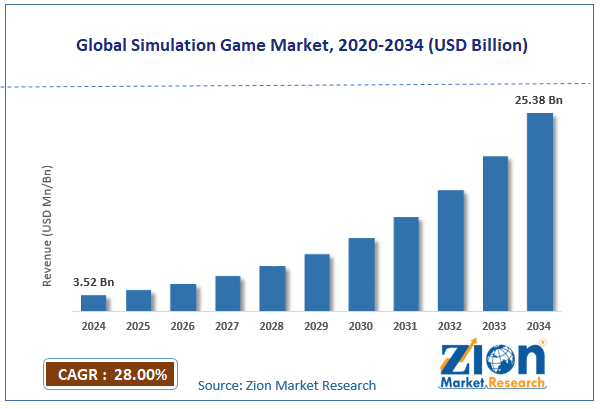
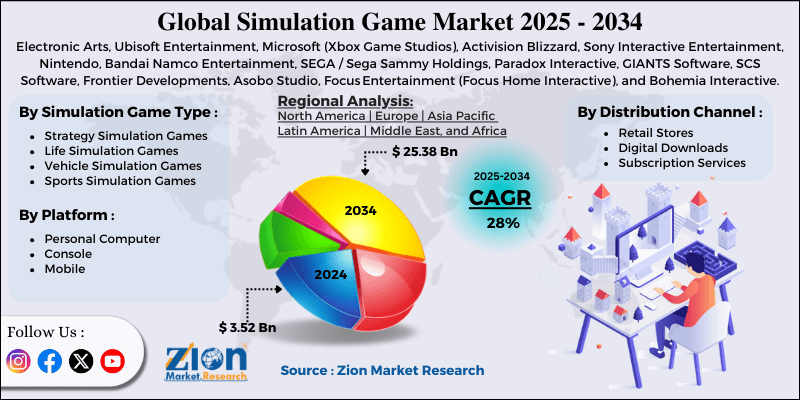
The global simulation game market size was around USD 3.52 billion in 2024 and is projected to reach USD 25.38 billion by 2034, with a compound annual growth rate (CAGR) of roughly 28% between 2025 and 2034.
Key Insights:
- As per the analysis shared by our research analyst, the global simulation game market is estimated to grow annually at a CAGR of around 28% over the forecast period (2025-2034)
- In terms of revenue, the global simulation game market size was valued at around USD 3.52 billion in 2024 and is projected to reach USD 25.38 billion by 2034.
- The simulation game market is projected to grow significantly owing to the proliferation of smartphones and mobile gaming platforms, surging demand for realistic and immersive gaming experiences, and expansion into mobile and cross-platform gaming (PC, mobile, console, VR).
- Based on simulation game type, the strategy simulation games segment is expected to lead the market, while the life simulation games segment is expected to grow considerably.
- Based on platform, the mobile segment is the dominant one, while the personal computer segment is projected to record sizeable revenue over the forecast period.
- Based on distribution channel, the digital downloads segment is expected to lead the market, followed by subscription services.
- Based on region, North America is projected to dominate the global market during the estimated period, followed by the Asia Pacific.
Simulation Game Market: Overview
A simulation game is an interactive experience that imitates real-world systems, activities, or environments, allowing players to make decisions, experiment, and observe outcomes without real-life consequences. These games focus on resource management, strategy, and problem-solving, offering immersive scenarios like managing a business, navigating social situations, running a city, or piloting vehicles. The global simulation game market is likely to expand rapidly, driven by technological advancements, broader platform reach, and rising interest in creative & sandbox gameplay. Better graphics, more intelligent in-game behavior, realistic physics, and the progress of AR/VR make simulations more believable and immersive. This boosts the demand for high-fidelity experiences.
Moreover, as mobile hardware becomes more capable and consoles/PCs remain strong, simulation games can reach both mobile and casual players, including life-simulation games, city-building games, and dedicated simulation enthusiasts, thereby expanding the overall experience. Many players enjoy the open-ended, sandbox-style play that simulation games offer, in which they set their own targets. The desire for personalization, creativity, and self-guided gameplay attracts fans to simulation games.
Despite the growth, the global market is constrained by factors such as high development costs, complexity, and niche appeal for hardcore simulations. Creating a high-quality simulation game demands well-developed graphics, rich content, realistic physics, and AI, which can lead to large development budgets and long production times that may deter some developers, especially smaller studios. Likewise, ultra-realistic or highly detailed simulations may attract only a small, dedicated audience. Casual players may find them too complex or unforgiving, thereby limiting mainstream adoption. Nonetheless, the global simulation game industry stands to gain from a few key opportunities, like the integration of AR/VR and educational and training simulations.
As AR/VR devices become more prevalent and affordable, simulation games are uniquely positioned to deliver deeply immersive experiences that other genres cannot. Improvements in motion tracking, spatial design, and haptic feedback improve player engagement and realism. Developers can use this technology to distinguish their games and capture premium segments. Additionally, simulation games offer controlled, safe environments for skill development, making them valuable for training centers, schools, and corporate programs. By integrating fun with functionality, they can teach concepts such as planning, management, and technical operations more efficiently than traditional methods. This offers new B2B and institutional association opportunities for developers.
Simulation Game Market Dynamics
Growth Drivers
How is the simulation game market driven by the escalating demand for realistic & immersive experiences?
Players increasingly favor games that involve minor real-world activities, such as flying, driving, city-building, and life simulation, because these games offer creativity, control, and a sense of realism. As visual fidelity, in-game mechanics, and physics are enhanced, these immersive experiences become more appealing and convincing. This realism attracts both casual gamers seeking a deeper understanding and enthusiasts wanting a simulation closer to 'real-life'. That demand drives developers to invest in more detailed simulation titles, widening the industry's appeal. Over time, this search for immersion has become a foundational driver of global growth in the adoption of simulation games.
How is expansion into educational and training applications fueling the simulation game market?
Simulation games are increasingly used beyond recreation – in professional training and skill development contexts (for example, business strategy, medical scenarios, and flight training). This widens the user base beyond gamers to include students, institutions, and professionals seeking interactive, low-risk training environments. As practical, experiential learning becomes more valued, simulations offer a compelling alternative to conventional techniques. This professional and educational applicability creates new demand streams, aiding the growth of the simulation game market even among non-traditional gaming demographics. Subsequently, simulation games become more versatile, attracting both those seeking learning/training solutions and those seeking entertainment.
Restraints
Steep learning curve and complexity for casual gamers adversely impact the market progress
The detailed mechanics, realistic simulations, and controls that define many simulation games also make them complex and time-consuming to learn. Casual gamers – who prefer quick and easy-to-pick-up entertainment – may find these games time-consuming or intimidating. This may reduce adoption among a wider audience, confining several simulation games to enthusiast or niche communities. Hence, several potential users may avoid simulation games altogether, limiting the genre's growth in the mass market.
Opportunities
How is monetization via live services, DLCs & custom content presenting favorable prospects for the simulation game industry expansion?
Instead of one-off sales, simulation games can adopt 'live services' models – regular updates, cosmetic or expansion packs, downloadable content (DLC), or user-generated content marketplaces. This creates recurring streams while keeping games engaged over the long term. Custom content, community-driven assets, or mods can further deepen user investment. For developers, this sustainable monetization model can support ongoing development and advancement rather than one-time launches, thereby shaping the growth of the simulation game industry.
Challenges
Regulatory, cultural barriers, and localization in global expansion restrict the market growth
Expanding into multiple regions comprises dealing with different norms, data privacy regulations, age-rating standards, and localization needs (cultural preferences, language, and regional content preferences). Navigating these for every target market demands enormous resources. Failure to properly localize or comply with local laws may lead to poor adoption or legal issues. This complexity acts as a key obstacle to truly worldwide rollout for several simulation titles.
Simulation Game Market : Report Scope
| Report Attributes | Report Details |
|---|---|
| Report Name | Simulation Game Market Research Report |
| Market Size in 2024 | USD 3.52 Billion |
| Market Forecast in 2034 | USD 25.38 Billion |
| Growth Rate | CAGR of 28% |
| Number of Pages | 220 |
| Key Companies Covered | Electronic Arts, Ubisoft Entertainment, Microsoft (Xbox Game Studios), Activision Blizzard, Sony Interactive Entertainment, Nintendo, Bandai Namco Entertainment, SEGA / Sega Sammy Holdings, Paradox Interactive, GIANTS Software, SCS Software, Frontier Developments, Asobo Studio, Focus Entertainment (Focus Home Interactive), and Bohemia Interactive. |
| Segments Covered | By Simulation Game Type, By Platform, By Distribution Channel And By Region |
| Regions Covered | North America, Europe, Asia Pacific (APAC), Latin America, The Middle East and Africa (MEA) |
| Base Year | 2024 |
| Historical Year | 2019 to 2023 |
| Forecast Year | 2025 - 2034 |
| Customization Scope | Avail customized purchase options to meet your exact research needs. Request For Customization |
Simulation Game Market: Segmentation
The global simulation game market is segmented based on simulation game type, platform, distribution channel, and region.
Based on simulation game type, the global simulation game industry is divided into strategy simulation games, life simulation games, vehicle simulation games, and sports simulation games. The strategy simulation games segment holds a remarkable market share due to their engaging gameplay focused on resource management, strategic decision-making, and planning. They attract both hardcore and casual gamers on consoles, PCs, and mobile platforms. Their replay value and versatility improve player retention and long-term engagement. This broader prominence makes them the leading segment in the simulation game sector.
Based on platform, the global simulation game market is segmented into personal computers, consoles, and mobile. The mobile platform segment holds a dominant market share because smartphones are widely available, enabling gamers to enjoy simulation games anywhere, anytime. Mobile simulations usually cater to casual gamers, offering easy-to-pick-up gameplay and frequent in-app content or updates. Their wider reach, particularly in regions with low console or PC penetration, gives mobile the leading share of simulation game users worldwide.
Based on distribution channel, the global market is segmented into retail stores, digital downloads, and subscription services. The digital downloads segment leads the market. Their convenience of instant access, compatibility across PC, mobile, and console, and ease of updates and patches make digital distribution the leading segment. As physical retail declines, digital distribution remains the primary means by which players purchase and play simulation games.
Simulation Game Market: Regional Analysis
Why is North America outperforming other regions in the global Simulation Game Market?
North America is expected to retain its leading role in the global simulation game market due to a strong gaming infrastructure and widespread adoption of advanced technologies, high disposable income and spending power, and a large, established gaming culture. North America benefits from broader access to high-class consoles, PCs, and fast internet, allowing smooth gameplay and high-fidelity simulation experiences. Early adoption of AR, VR, and advanced graphics technology further supports complex development. This infrastructure appeals to hardcore simulation and casual gamers, fueling industry dominance. Moreover, players in the region have higher disposable incomes, allowing them to invest in gaming hardware, expansions, and games.
This financial capacity supports a wide range of simulation titles, from casual to mobile to high-end VR. Therefore, revenue per user and total industry value remain strong. Furthermore, the region holds a long-established gaming community and sophisticated ecosystem of publishers, esports networks, and developers. This culture encourages continuous innovation, high engagement, and diverse content through simulation games. It also nurtures player loyalty and sustained industry growth.
Asia Pacific ranks as the second-largest region in the global simulation game industry, driven by rapid internet and mobile penetration, a young, digital-savvy population, and growing disposable incomes and spending power. In the Asia Pacific, millions of users access the internet through smartphones due to affordable devices and expanding mobile networks. This extensive mobile access makes simulation games, especially mobile-optimized or casual ones, more easily accessible to broader audiences.
Hence, the region holds a remarkable user base beyond traditional console/PC gamers. The region's relatively young population is comfortable with digital games and social gaming culture. Their flexible lifestyles and openness to gaming make them well-suited to consumers who enjoy simulation genres that emphasize creativity, casual play, and social interaction. This demographic trend leads to strong, growing demand. Additionally, economic development in several Asia-Pacific nations is increasing disposable incomes, giving consumers greater capacity to spend on games and entertainment. This propels both free-to-play and purchase-based models with in-game purchases, premium content, or expansions. Therefore, revenue per user and industry value grow steadily.
Simulation Game Market: Competitive Analysis
The leading players in the global simulation game market are
- Electronic Arts
- Ubisoft Entertainment
- Microsoft (Xbox Game Studios)
- Activision Blizzard
- Sony Interactive Entertainment
- Nintendo
- Bandai Namco Entertainment
- SEGA / Sega Sammy Holdings
- Paradox Interactive
- GIANTS Software
- SCS Software
- Frontier Developments
- Asobo Studio
- Focus Entertainment (Focus Home Interactive)
- Bohemia Interactive
Simulation Game Market: Key Market Trends
Emphasis on user-generated content & modding
Developers are offering tools that let players share, create, and customize in-game content, such as mods, scenarios, and maps. This boosts replayability, fosters robust community engagement, and increases game longevity. User-generated content transforms games into evolving creative platforms.
Growth of cross-platform & cloud-based play
Simulation games now support cross-platform play, allowing players on console, PC, and mobile devices to connect seamlessly. Cloud gaming enables high-fidelity titles to run without extensive hardware. These trends increase accessibility and appeal to a broader audience worldwide.
The global simulation game market is segmented as follows:
By Simulation Game Type
- Strategy Simulation Games
- Life Simulation Games
- Vehicle Simulation Games
- Sports Simulation Games
By Platform
- Personal Computer
- Console
- Mobile
By Distribution Channel
- Retail Stores
- Digital Downloads
- Subscription Services
By Region
- North America
- The U.S.
- Canada
- Europe
- France
- The UK
- Spain
- Germany
- Italy
- Rest of Europe
- Asia Pacific
- China
- Japan
- India
- South Korea
- Southeast Asia
- Rest of Asia Pacific
- Latin America
- Brazil
- Mexico
- Rest of Latin America
- Middle East & Africa
- GCC
- South Africa
- Rest of Middle East & Africa
Table Of Content
Methodology
FrequentlyAsked Questions

HappyClients

