
Rotary Lobe Pump Market Size, Share, Growth, Opportunities 2034

Rotary Lobe Pump Market By Type (Single-Stage and Multi-Stage), By Drive Type (Electric, Diesel, and Hydraulic), By End-User Industry (Food & Beverage, Chemical, Pharmaceutical, Wastewater Treatment, Oil & Gas, and Others), and By Region - Global and Regional Industry Overview, Market Intelligence, Comprehensive Analysis, Historical Data, and Forecasts 2025 - 2034
| Market Size in 2024 | Market Forecast in 2034 | CAGR (in %) | Base Year |
|---|---|---|---|
| USD 910.27 Million | USD 1430.39 Million | 5.15% | 2024 |
Rotary Lobe Pump Industry Perspective:
What is the size of the global rotary lobe pump market during the forecast period?
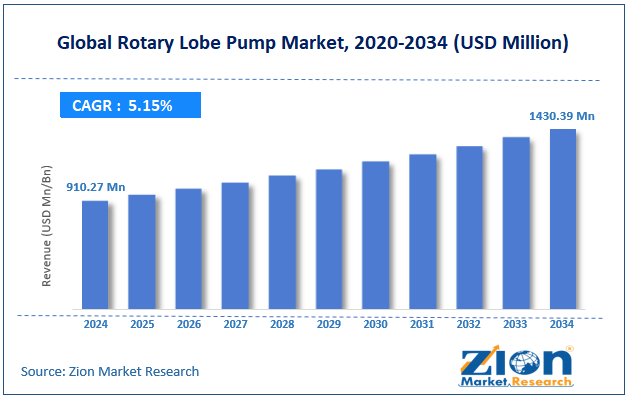
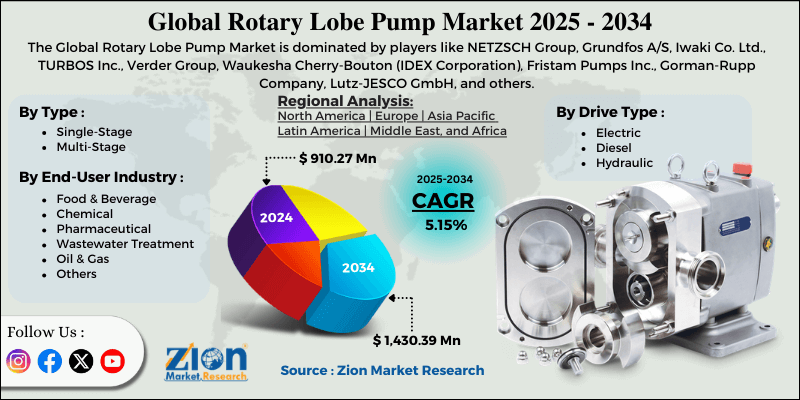
The global rotary lobe pump market size was worth around USD 910.27 million in 2024 and is predicted to grow to around USD 1,430.39 million by 2034, with a compound annual growth rate (CAGR) of roughly 5.15% between 2025 and 2034. The report examines the primary drivers, challenges, and restraints shaping global demand for the rotary lobe pump market throughout the forecast period and identifies high-growth opportunities across the industry.
Key Insights
- As per the analysis shared by our research analyst, the global rotary lobe pump market is estimated to grow annually at a CAGR of around 5.15% over the forecast period (2025-2034)
- In terms of revenue, the global rotary lobe pump market size was valued at around USD 910.27 million in 2024 and is projected to reach USD 1,430.39 million by 2034.
- The rotary lobe pump market is projected to grow at a significant rate due to the growing rate of industrial automation.
- Based on the type, the single-stage segment is growing at a high rate and will continue to dominate the global market, as per industry projections.
- Based on the drive type, the electric segment is anticipated to command the largest market share.
- Based on the end-user industry, the food & beverage segment is projected to lead the market growth trends.
- Based on region, the Asia-Pacific is projected to dominate the global market during the forecast period.
Rotary Lobe Pump Market: Overview
Rotary lobe pumps are a form of positive-displacement pump that uses lobes to create a suction effect to move fluids through the pump. Unlike centrifugal pumps, which create fluid flow through a combination of velocity and pressure, rotary lobe pumps create fluid flow by trapping fluid in cavities and then transporting it from the inlet to the outlet of the pump with no shear or damage to the fluid itself. Therefore, they can also be used in applications sensitive to shear force (e.g., viscous fluids, slurries, and pharmaceutical products). One of the most significant advantages of rotary lobe pumps is their sanitary design and construction, which make them easy to clean and help to eliminate the risk of contamination. This is especially important for industries such as food and beverage and pharmaceutical, where product safety is directly correlated with hygienic practices.
In addition to their use in the food and beverage and pharmaceutical industries, rotary lobe pumps are often used in the wastewater industry for handling sludge and in oil and gas applications, where rotary lobe pumps are used to transfer viscous liquids and heavy hydrocarbons. The ability of rotary lobe pumps to maintain a steady flow rate across varying pressures is another reason they are increasingly adopted worldwide. However, while rotary lobe pumps offer many advantages, they also present challenges, including high initial capital costs and ongoing maintenance requirements. Nevertheless, there is a growing trend toward using industrial digitalization and smart pumping systems, which will provide new opportunities for growth in the rotary lobe pump market.
Rotary Lobe Pump Market: Dynamics
Growth Drivers
How will automation and process efficiency in industries influence demand in the rotary lobe pump market?
Industrial automation continues to be a strong factor behind the expansion of the global rotary lobe pump market. The integration of rotary lobe pumps into automated control systems provides the ability to monitor flow rate, pressure, and performance in real time, thereby reducing or eliminating the human interaction required to monitor these variables, thereby increasing overall efficiency. Precision pumps provide assurance of quality as well as reliability for the manufacturing process of customers in industries such as pharmaceuticals, chemicals, and food.
With the increasing implementation of smart factory solutions and the growing use of predictive maintenance solutions, there is a continued increase in demand for advanced rotary lobe pumps that can digitally connect and integrate sensors into their functionality.
Increasing demand from the food & beverage sector to propel industry revenue in the coming years
Rotary Lobe Pumps (RLP) are currently the most common type of pump used within the food & beverage sector, as this segment represents the largest end-user for RLPs. Pumps in this sector transfer products such as dairy, sauces, juices, syrups, and many more viscous fluids throughout the process of manufacturing, filling, and packaging. Due to RLPs’ ability to move viscous fluids while maintaining product integrity without shearing, which is essential to maintaining both flavor and texture, they are preferred over other types of pumps.
Additionally, strict hygiene regulations set forth by government agencies (FDA, EFSA) require that all equipment be fully cleanable, an area in which RLPs excel. As the world continues to experience an increase in consumer demand for processed and packaged food items, a corresponding increase in demand for stable and efficient fluid-handling solutions is sure to enhance growth possibilities in the global rotary lobe pump market.
Restraints
Why will the high cost of ownership and maintenance limit growth in the rotary lobe pump market?
While rotary lobe pumps offer benefits, their pricing is typically higher than that of other pump types because their design incorporates sanitary configurations, advanced sealing systems, and precision materials. Additionally, the solutions available in the global rotary lobe pumps industry require periodic inspection and maintenance as part of regular service for seal checks and rotor inspections to maintain maximum efficiency and reliability; a lack of this capability can impede the adoption of rotary lobe pumps within industries with a limited degree of technical expertise or where their operating expense must remain tightly controlled.
Consequently, many small businesses may extend the replacement cycles for older pump systems, thereby continuing to limit market growth for rotary lobe pumps, particularly in regions where pricing pressure is greatest.
Opportunities
Emergence of smart pumps and predictive maintenance to create growth opportunities for the industry players
The merging of digital technologies such as IoT sensors, cloud connectivity, and sophisticated control systems has opened new avenues for the global rotary lobe pump market. Smart pumps with the capability of real-time monitoring can alert operators when maintenance is required, anticipate potential failures, and enhance energy efficiency. By implementing predictive maintenance, businesses can reduce operational downtime and extend pump service life, thereby reducing costs.
With the recent shift being made by many industries throughout the world toward Industry 4.0 business models, rotary lobe pumps with digital functions will appeal even more to manufacturers, particularly in advanced manufacturing applications. In addition, many manufacturers have begun designing and producing energy-efficient, low-noise pumps to support sustainable manufacturing objectives, which is likely to create further demand for their products in local markets worldwide.
Challenges
How will challenges associated with technical expertise and workforce constraints affect the rotary lobe pump market?
The global rotary lobe pump industry faces a significant lack of qualified workers who are competent at managing and maintaining advanced systems. This keeps large portions of these developing economies from getting the best technology available. Additionally, in many remote or underdeveloped areas, essential infrastructure may be lacking, including reliable, stable electricity sources and the capacity to integrate them into existing systems. This can negatively impact their ability to deploy them to these areas.
Rotary Lobe Pump Market: Segmentation
The global rotary lobe pump market is segmented based on type, drive type, end-user industry, and region.
Why will the single-stage segment lead the rotary lobe pump market during the projection period?
Based on type, the global market is segmented into single-stage and multi-stage. The single-stage rotary lobe pumps had the largest share of total sales for all types of rotary lobe pump sales in 2024, accounting for nearly 52% of total revenue. The expected segmental CAGR during the projection period is 5.35%, as they are the simplest, cheapest, and most widely applicable type. Multi-stage rotary lobe pumps are ideal for applications that need to deliver greater pressure and require greater durability.
Which drive type will emerge as the highest revenue generator in the rotary lobe pump market?
Based on drive type, the global rotary lobe pump industry is divided into electric, diesel, and hydraulic. In 2024, the electric segment generated the highest revenue and will continue to dominate the market. The segment accounted for around 42% of the final revenue in 2024 and is expected to grow at a CAGR of more than 2.57% in the coming years. Electric drive types have reduced operational costs and offer energy efficiency, driving segmental growth trends.
Which factors will contribute to the food & beverage leading the rotary lobe pump market?
Based on the end-user industry, the global market divisions are food & beverage, chemical, pharmaceutical, wastewater treatment, oil & gas, and others. The food & beverage industry is the leading market segment, accounting for over 25% of the global revenue. It is anticipated to deliver a CAGR of 6.01% over the projection period, driven by increased demand for fluids used safely and heightened concerns about fluid cleanliness. Other important markets are also found in chemical and pharmaceutical manufacturing processes that need to transfer fluids without contamination and need highly accurate transfer systems.
Rotary Lobe Pump Market: Report Scope
| Report Attributes | Report Details |
|---|---|
| Report Name | Rotary Lobe Pump Market |
| Market Size in 2024 | USD 910.27 Million |
| Market Forecast in 2034 | USD 1,430.39 Mllion |
| Growth Rate | CAGR of 5.15% |
| Number of Pages | 221 |
| Key Companies Covered | NETZSCH Group, Grundfos A/S, Iwaki Co. Ltd., TURBOS Inc., Verder Group, Waukesha Cherry-Bouton (IDEX Corporation), Fristam Pumps Inc., Gorman-Rupp Company, Lutz-JESCO GmbH, and others. |
| Segments Covered | By Type, By Drive Type, By End-User Industry, and By Region |
| Regions Covered | North America, Europe, Asia Pacific (APAC), Latin America, Middle East, and Africa (MEA) |
| Base Year | 2024 |
| Historical Year | 2019 to 2023 |
| Forecast Year | 2025 - 2034 |
| Customization Scope | Avail customized purchase options to meet your exact research needs. Request For Customization |
Rotary Lobe Pump Market: Regional Analysis
Why is Asia-Pacific expected to lead the rotary lobe pump market during the forecast period?
The Asia-Pacific region is expected to be the largest segment of the global rotary lobe pump market over the period covered by this report, with a CAGR of approximately 5.67%. Additionally, due to rapid industrialization, increasing demand in both the food processing and pharmaceutical industries, and investment in wastewater treatment facility construction, this area is expected to lead the growth in this product category. China and India continue to experience growth in manufacturing across key end markets, thereby increasing demand for advanced fluid-handling systems.
Why will North America and Europe show steady growth in the coming years?
With high levels of automation adoption and the replacement of ageing industrial facilities, the economy is expected to grow for the foreseeable future. The growth of the North American market is being fueled by increasing attention to regulations and the need to reduce emissions. Europe has also established itself as an important player in the global market because of strict environmental regulations, combined with a high concentration of sanitary equipment used within the food and pharmaceutical industries.
Rotary Lobe Pump Market: Competitive Analysis
The global rotary lobe pump market is moderately concentrated, with several leading players competing based on product innovation, quality, and geographic reach. Key companies include:
- NETZSCH Group
- Grundfos A/S
- Iwaki Co. Ltd.
- TURBOS Inc.
- Verder Group
- Waukesha Cherry-Bouton (IDEX Corporation)
- Fristam Pumps Inc.
- Gorman-Rupp Company
- Lutz-JESCO GmbH
What are the key trends in the rotary lobe pump market?
Development of digital transformation and implementation of Industry 4.0
Pumps equipped with IoT technology, connected via the Cloud, equipped with Artificial Intelligence (AI) analysis, equipped with Smart Sensors, along with Predictive Analytic Data Analysis software, are becoming standard operating procedure within an Advanced Industrial facility.
Growth in wastewater treatment investments
There is increasing emphasis on water reuse and sustainability in municipalities and industries, thereby increasing the need for high-quality, efficient pumping products for municipal and industrial wastewater treatment plants.
Growth of Hygienically Qualified Equipment Needed
The demand for sanitary pumps (those that meet the Food and Drug Administration requirements for pharmaceutical and food and beverage use) continues to increase due to new regulations on safety and quality.
The global rotary lobe pump market is segmented as follows:
By Type
- Single-Stage
- Multi-Stage
By Drive Type
- Electric
- Diesel
- Hydraulic
By End-User Industry
- Food & Beverage
- Chemical
- Pharmaceutical
- Wastewater Treatment
- Oil & Gas
- Others
By Region
- North America
- The U.S.
- Canada
- Europe
- France
- The UK
- Spain
- Germany
- Italy
- Rest of Europe
- Asia Pacific
- China
- Japan
- India
- South Korea
- Southeast Asia
- Rest of Asia Pacific
- Latin America
- Brazil
- Mexico
- Rest of Latin America
- Middle East & Africa
- GCC
- South Africa
- Rest of Middle East & Africa
Table Of Content
Methodology
FrequentlyAsked Questions
A rotary lobe pump is a positive-displacement pump that uses rotating lobes to transfer fluids. It is especially effective for viscous and shear-sensitive liquids and is widely used across hygiene-critical industries.
Growing industrial automation, expanding food & beverage manufacturing, and stringent hygiene and environmental regulations are major growth drivers.
The rotary lobe pump market was worth around USD 910.27 million in 2024 and is projected to reach about USD 1,430.39 million by 2034.
The CAGR value of the rotary lobe pump market is expected to be around 5.15% during 2025-2034.
High initial cost, maintenance requirements, and lack of trained technicians are key challenges limiting the rotary lobe pump market.
Smart pumps with digital connectivity and energy-efficient designs are the emerging trends impacting the rotary lobe pump market.
Stringent emission standards are expected to affect the rotary lobe pump market.
Asia-Pacific is expected to dominate the global rotary lobe pump market during the forecast period.
The global rotary lobe pump market is moderately concentrated, with several leading players competing based on product innovation, quality, and geographic reach. Key companies include NETZSCH Group, Grundfos A/S, Iwaki Co., Ltd., TURBOS Inc., Verder Group, Waukesha Cherry-Bouton (IDEX Corporation), Fristam Pumps, Inc., Gorman-Rupp Company, and Lutz-JESCO GmbH.
The report explores crucial aspects of the rotary lobe pump market, including a detailed discussion of existing growth factors and restraints, while also browsing future growth opportunities and challenges that impact the market.

HappyClients

