
Global Robotic Lawn Mower Market Size, Share, Trends, Growth and Forecast 2032

Robotic Lawn Mower Market By Lawn Size (Medium-Sized, Small-Sized, and Large-Sized), By End-User (Commercial and Residential), By Distribution Channel (Retail Stores and Online Websites), By Connectivity Type (Models Without Connectivity and Models With Connectivity), and By Region - Global and Regional Industry Overview, Market Intelligence, Comprehensive Analysis, Historical Data, and Forecasts 2024 - 2032
| Market Size in 2023 | Market Forecast in 2032 | CAGR (in %) | Base Year |
|---|---|---|---|
| USD 1.86 Billion | USD 5.19 Billion | 12.08% | 2023 |
Robotic Lawn Mower Industry Perspective
What will be the global robotic lawn mower market size during the forecast period?
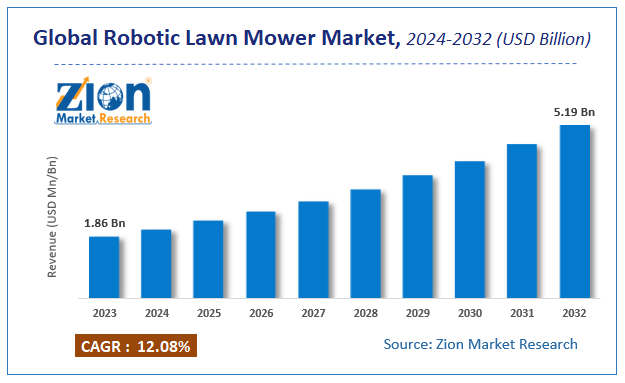
Zion Market Research has published a report on the global robotic lawn mower market, estimating its value at USD 1.86 billion in 2023, with projections indicating that it will reach USD 5.19 billion by 2032. The market is expected to expand at a compound annual growth rate (CAGR) of 12.08% over the forecast period 2024-2032.
This report provides a comprehensive analysis of the growth drivers, restraints, and challenges shaping demand across the global robotic lawn mower market throughout the forecast period, while highlighting high-potential emerging opportunities within the industry.
Key Insights
- As per the analysis shared by our research analyst, the global robotic lawn mower market is estimated to grow at a CAGR of approximately 12.08% during the forecast period from 2024 to 2032.
- In terms of revenue, the global robotic lawn mower market size was valued at around USD 1.86 billion in 2023 and is projected to reach USD 5.19 billion by 2032.
- The market is driven by growing robotics trends, large-scale segment use of AI for precise task execution, the paradigm shift in technology, and rising smartphone use for controlling mower functions.
- Based on the lawn size, the medium-sized segment is predicted to acquire a major chunk of the overall market share due to the increase in lawn spaces in developed countries, leading to massive demand for mid-sized robotic lawn mowers.
- Based on the end-user, the commercial segment is projected to register a high growth rate owing to the introduction of new technologies and the design of robotic lawn mowers suited for larger commercial applications.
- Regionally, Europe holds a leading position in the global market, supported by high residential adoption, established landscaping ecosystems, and strong regulatory frameworks favoring battery-electric autonomous equipment.
Robotic Lawn Mower Market: Overview
A robotic lawn mower is an autonomous device designed to cut grass with minimal human intervention. Equipped with electric motors, navigation technology, and sensors, it automatically mows the lawn within a defined boundary, typically indicated by a perimeter wire or advanced wire-free systems.
These mowers often feature programmable schedules, rain sensors, and app connectivity, and they return to their charging station when necessary. They are favored for their environmental benefits, convenience, and ability to maintain lawns without constant supervision, with the majority being fully electric.
Robotic Lawn Mower Market: Dynamics
Growth Drivers
Why is demand for robotic lawn mowers accelerating across residential and commercial settings?
The growing trend toward robotics and the large-scale application of artificial intelligence for tasks requiring precision and exactness are major drivers of market expansion. These technologies enable robotic lawn mowers to navigate complex terrains, avoid obstacles, and deliver consistent cutting performance with minimal human oversight. The paradigm shift in technology, combined with the rising use of smartphones to control and monitor mower functions via dedicated applications, is further accelerating adoption by enhancing user convenience and accessibility.
The broader movement toward automation in household tasks, particularly the reduction of manual labor associated with lawn maintenance, is creating sustained demand. Consumers and commercial operators increasingly value the time savings, environmental benefits of electric operation, and reliable performance offered by these autonomous systems, supporting continuous market growth.
Restraints
What factors are limiting wider adoption of robotic lawn mowers?
High upfront costs compared with traditional mowers can deter price-sensitive consumers, particularly in markets where disposable income for premium outdoor equipment is limited. Traditional models that rely on buried perimeter wires also require professional or time-consuming installation, which can act as a barrier for some residential users.
Concerns related to performance on complex or steep terrains, battery life limitations, and the need for regular maintenance of sensors and blades may also restrain adoption in certain applications. These factors can slow penetration in regions or segments where simpler, lower-cost alternatives remain preferred.
Opportunities
Where do the most promising growth avenues exist for robotic lawn mower manufacturers?
The introduction of new technologies and the continuous redesign of robotic lawn mowers for commercial applications present significant opportunities. Facilities such as golf courses, sports grounds, educational institutions, and large residential estates are increasingly seeking automated solutions to reduce labor costs and improve turf quality, expanding the addressable market beyond private gardens.
Advances in wire-free navigation, AI-based obstacle detection, and enhanced connectivity are opening new use cases and improving user experience. Manufacturers that deliver scalable, reliable, and feature-rich platforms are well positioned to capture growing demand across both residential and professional segments.
Challenges
What operational and technical hurdles must the industry overcome?
Ensuring consistent performance across diverse lawn sizes, terrain types, and weather conditions remains a technical challenge. Models must balance cutting efficiency, battery endurance, obstacle avoidance, and safety features while remaining accessible in terms of price and ease of use.
Regulatory requirements related to safety, battery standards, and cybersecurity for connected devices, particularly in key markets, add complexity and cost for manufacturers. Meeting these evolving standards while maintaining product competitiveness requires ongoing investment in research, certification, and product refinement.
Robotic Lawn Mower Market: Report Scope
| Report Attributes | Report Details |
|---|---|
| Report Name | Robotic Lawn Mower Market |
| Market Size in 2023 | USD 1.86 Billion |
| Market Forecast in 2032 | USD 5.19 Billion |
| Growth Rate | CAGR of 12.08% |
| Number of Pages | 255 |
| Key Companies Covered | Robert Bosch GmbH, The Toro Company, The Husqvarna Group, Zucchetti Centro Sistemi S.P.A., Deere & Company, STIGA S.p.A., Honda Motor Company, The Yamabiko Corporation, AL-KO, STIHL Holding AG & CO.KG, WORX, and Milagrow, among others |
| Segments Covered | By Lawn, By End-User, By Distribution Channel, By Connectivity Type, and By Region |
| Regions Covered | North America, Europe, Asia Pacific (APAC), Latin America, Middle East, and Africa (MEA) |
| Base Year | 2023 |
| Historical Year | 2018 - 2022 |
| Forecast Year | 2024 - 2032 |
| Customization Scope | Avail customized purchase options to meet your exact research needs. Request For Customization |
Robotic Lawn Mower Market: Segmentation
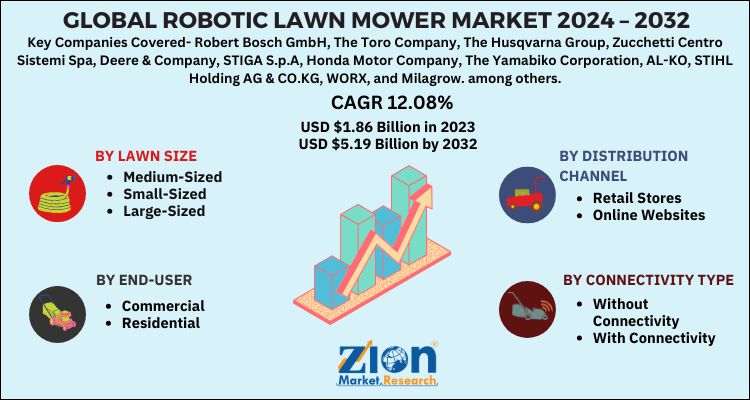
The robotic lawn mower market is segmented by lawn size, end-user, distribution channel, connectivity type, and region. All the segments of the robotic lawn mower market have been analyzed based on present and future trends and the market is estimated from 2024 to 2032.
Based on the lawn size, the market is segmented into medium-sized, small-sized, and large-sized. The medium-sized segment is predicted to acquire a major chunk of the overall market share over the forecast timeline. The growth is attributed to the increase in lawn spaces in developed countries, leading to massive demand for mid-sized robotic lawn mowers.
On the basis of end-user, the robotic lawn mower industry is divided into commercial and residential sectors. The introduction of new technologies, along with the design of robotic lawn mowers, is projected to assist the commercial sector register high growth rate over the forthcoming years. Expanding use in golf courses, sports facilities, and institutional grounds is reinforcing commercial demand and contributing meaningfully to overall market expansion.
Based on Distribution Channel, the robotic lawn mower market is divided into retail stores and online websites. Retail stores continue to play an important role by providing hands-on product demonstrations, professional advice, and after-sales support that many buyers value for higher-value outdoor equipment. Online websites are expanding rapidly as consumers become more comfortable researching and purchasing connected devices digitally, offering wider model selection and competitive pricing. Both channels support market growth by improving accessibility and reaching different customer preferences.
Based on Connectivity Type, the robotic lawn mower market is divided into models without connectivity and models with connectivity. Models with connectivity are gaining increasing preference because they enable smartphone control, remote scheduling, status monitoring, and integration with smart home systems. Non-connected models remain relevant for users seeking simpler, lower-cost solutions. The progressive shift toward connected devices is enhancing user experience and supporting higher average selling prices, thereby contributing to market value growth.
Robotic Lawn Mower Market: Regional Analysis
Why will Europe continue to dominate the global market during the projection period?
Europe continues to hold a leading position in the global robotic lawn mower market. The region benefits from high residential adoption rates, well-established professional landscaping ecosystems, and regulatory frameworks that favor battery-electric and low-emission outdoor equipment. Countries such as Germany, Sweden, and others in Northern and Western Europe demonstrate strong consumer willingness to invest in durable automation solutions for private gardens and commercial green spaces. Mature distribution networks, brand loyalty to established manufacturers, and a cultural emphasis on well-maintained turf further reinforce demand. These factors enable Europe to serve as the anchor market that drives product innovation, sets performance expectations, and influences global development of robotic lawn care technologies.
North America represents a significant and growing market, supported by large residential lawn sizes, rising landscaping labor costs, and increasing integration with smart home systems. Asia Pacific is expanding as awareness of autonomous outdoor equipment rises and manufacturing capabilities strengthen. Latin America and the Middle East & Africa remain emerging regions where gradual adoption is expected as infrastructure and consumer awareness develop.
Robotic Lawn Mower Market: Competitive Analysis
Some of the leading players in the global market include
- Robert Bosch GmbH
- The Toro Company
- The Husqvarna Group
- Zucchetti Centro Sistemi S.P.A.
- Deere & Company
- STIGA S.p.A
- Honda Motor Company
- The Yamabiko Corporation
- AL-KO
- STIHL Holding AG & CO.KG
- WORX
- Milagrow
Segments Covered
The global robotic lawn mower market is segmented as follows:
By Lawn Size
- Medium-Sized
- Small-Sized
- Large-Sized
By End-User
- Commercial
- Residential
By Distribution Channel
- Retail Stores
- Online Websites
By Connectivity Type
- Models Without Connectivity
- Models With Connectivity
By Region
- North America
- The U.S.
- Canada
- Mexico
- Europe
- France
- The UK
- Spain
- Germany
- Italy
- Rest of Europe
- Asia Pacific
- China
- Japan
- India
- Australia
- South Korea
- Rest of Asia Pacific
- The Middle East & Africa
- Saudi Arabia
- UAE
- Egypt
- Kuwait
- South Africa
- Rest of the Middle East & Africa
- Latin America
- Brazil
- Argentina
- Rest of Latin America
Table Of Content
Methodology
FrequentlyAsked Questions
A robotic lawn mower is an autonomous device intended to cut grass with minimal human intervention. It is equipped with electric motors, navigation technology, and sensors, and automatically mows the lawn within a defined boundary. These mowers frequently feature programmable schedules, rain sensors, and app connectivity, and can return to their charging station when necessary.
The global robotic lawn mower market is driven by growing robotics trends, large-scale use of AI for precise task execution, the paradigm shift in technology, rising smartphone use for controlling mower functions, and the broader demand for automation that reduces manual labor in lawn maintenance.
The global robotic lawn mower market size was valued at approximately USD 1.86 billion in 2023 and is expected to reach around USD 5.19 billion by 2032.
The global robotic lawn mower market is expected to expand at a compound annual growth rate (CAGR) of approximately 12.08% during the forecast period from 2024 to 2032.
Europe is expected to contribute notably and hold a leading position in the global robotic lawn mower market, supported by high residential adoption, established landscaping ecosystems, and favorable regulatory environments.
Some of the major players leveraging the robotic lawn mower market growth are Robert Bosch GmbH, The Toro Company, The Husqvarna Group, Zucchetti Centro Sistemi S.P.A., Deere & Company, STIGA S.p.A., Honda Motor Company, The Yamabiko Corporation, AL-KO, STIHL Holding AG & CO.KG, WORX, and Milagrow.

HappyClients

