
PV Inverter Market Size, Trend, Growth, Industry Analysis 2034

PV Inverter Market By Inverter Type (String Inverters, Central Inverters, Micro Inverters, and Hybrid/Battery-Ready Inverters), By Phase (Single-Phase and Three-Phase), By Connection Type (Off-Grid and On-Grid), By Application (Commercial, Residential, Industrial, and Utility-Scale), and By Region - Global and Regional Industry Overview, Market Intelligence, Comprehensive Analysis, Historical Data, and Forecasts 2026 - 2034
| Market Size in 2025 | Market Forecast in 2034 | CAGR (in %) | Base Year |
|---|---|---|---|
| USD 21.46 Billion | USD 123.72 Billion | 21.50% | 2025 |
PV Inverter Industry Perspective:
What is the anticipated size of the PV inverter market during the projection period?
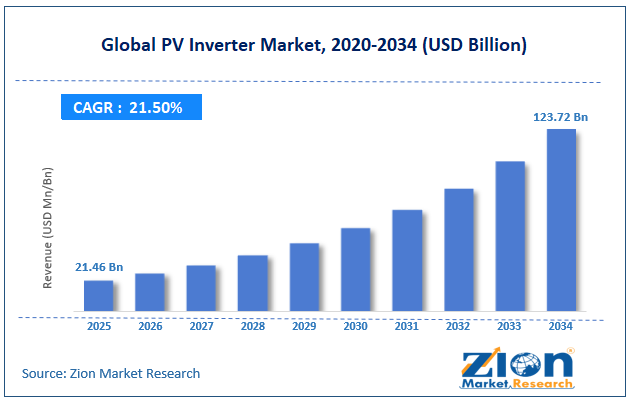
The global PV inverter market size was worth around USD 21.46 billion in 2025 and is predicted to grow to around USD 123.72 billion by 2034 with a compound annual growth rate (CAGR) of roughly 21.50% between 2026 and 2034.
Key Insights:
- As per the analysis shared by our research analyst, the global PV inverter market is estimated to grow annually at a CAGR of around 21.50% over the forecast period (2026-2034)
- In terms of revenue, the global PV inverter market size was valued at around USD 21.46 billion in 2025 and is projected to reach USD 123.72 billion, by 2034.
- The PV inverter market is projected to grow at a significant rate due to the growing solar energy installations, favorable government policies, and advancements in PV inverter technology.
- Based on the inverter type, the string inverters segment is growing at a high rate and will continue to dominate the global market as per industry projections.
- Based on the phase, the three-phase segment is anticipated to command the largest market share.
- Based on the connection type, the off-grid segment will grow at a faster CAGR of 8.35%.
- Based on the application, the utility-scale segment is projected to influence revenue in the market.
- Based on region, Asia-Pacific is projected to dominate the global market during the forecast period.
PV Inverter Market: Overview
Photovoltaic (PV) inverters are essential components of solar energy systems. PV inverters convert direct current (DC) from solar panels into alternating current (AC) energy. This latter is what powers household appliances and facilitates grid connection. PV inverters ensure that solar panels generate energy efficiently and in a usable form. During the forecast period, demand for PV inverters is expected to grow, driven by expanding solar installations, supportive government policies, and advances in PV inverter technology. However, high initial cost of investment, infrastructure limitations, varying availability of sunlight, and cybersecurity concerns around interconnected devices may impact market revenue in the long run.
Impact of the USA-Israel and Iran war on the PV Inverter Market:
The USA-Israel and Iran war is expected to significantly and positively affect the PV inverter market during the forecast period. Global economies are moving toward new technologies that support energy security as concerns over traditional energy-generation feedstocks intensify. In the short term, the war has affected the supply of PV inverters and their components across geographical borders. However, in the long run, this geopolitical conflict will encourage higher domestic reliance and new strategies to evolve among market leaders.
PV Inverter Market: Dynamics
Growth Drivers
How will increasing solar installations drive PV inverter market demand in the coming years?
The global PV inverter market is expected to benefit from rising solar energy installations across residential, commercial, and industrial facilities. Photovoltaic inverters are the backbone of solar systems, as they convert DC into usable current. According to the International Energy Agency (IEA), solar energy accounted for one-third of all renewable energy installations in 2025, reaching 647 GW of new capacity. Residential installations are growing as household energy demand is on the rise. On the other hand, industrial and commercial installations are heavily influenced by regulatory mandates and a surge in energy consumption rate,
Evolving energy security needs will promote market expansion in the coming years
Countries worldwide are expanding their power infrastructure as concerns over energy security have intensified. Escalating geopolitical tensions between world powers, especially in the Middle East, have disrupted energy supply chains and essential raw materials. Energy prices have skyrocketed in the past few months due to the ongoing war between Russia and Ukraine and Israel-USA and Iraq. As governments seek ways to mitigate these changes and ensure reliable energy supply, the global PV inverter market will witness higher revenue.
Restraints
How will cost barriers limit the growth in the PV inverter industry?
The global PV inverter industry is expected to be restricted due to the high cost of initial investment, especially for large-scale installations. Hybrid and next-generation solar systems, along with additional battery-storage technologies, are expensive to deploy and maintain. Moreover, the increasing cost of living, a surge in inflation rate, and economic uncertainty may limit industry expansion in price-sensitive regions worldwide.
Opportunities
Which technological advancements will support expansion of the PV inverter market during the forecast period?
The global PV inverter market is projected to generate growth opportunities due to steady technological advancements such as the use of next-generation materials, adoption of wide-bandgap semiconductors, and novel inverter technologies. In September 2026, WattPower, a leading provider of solar inverter and energy storage solutions, launched a 506KTL utility-scale, grid-forming inverter. The new system is expected to help renewable energy developers develop future-proof, grid-ready solar projects. In August 2026, Freyr Energy launched high-performance solar inverters in the Indian market. The new range includes 3 kW and 5 kW single-phase variants. High-performance PV inverters will register higher demand in the coming years.
Favorable government initiatives to support market expansion in the coming years
Falling solar system costs and additional government support will encourage greater PV inverter deployment. These policies take the form of tax subsidies, feed-in tariffs, financial incentives, and renewable energy auctions. The policies are designed to lower the cost of technology ownership and operation. During the forecast period, these policies will open new growth avenues for the market leaders.
Challenges
Regulatory hurdles and cybersecurity concerns to challenge PV inverter industry expansion
The global PV inverter industry is expected to face regulatory hurdles, such as strict certification standards & approvals for grid connection. In addition, internet-connected systems are vulnerable to cybercrimes, posing a threat to energy security. Lack of supportive infrastructure and dependence on access to continuous sunlight for energy generation are additional industry challenges.
PV Inverter Market: Report Scope
| Report Attributes | Report Details |
|---|---|
| Report Name | PV Inverter Market |
| Market Size in 2025 | USD 21.46 Billion |
| Market Forecast in 2034 | USD 123.72 Billion |
| Growth Rate | CAGR of 21.50% |
| Number of Pages | 227 |
| Key Companies Covered | SMA Solar Technology, Huawei Technologies, Power Electronics, Sungrow Power Supply, FIMER, Fronius International, Delta Electronics, GoodWe, Ginlong Solis, TMEIC, SolarEdge Technologies, Aiswei, Enphase Energy, Growatt, Sineng Electric, and others. |
| Segments Covered | By Inverter Type, By Phase, By Connection Type, By Application, and By Region |
| Regions Covered | North America, Europe, Asia Pacific (APAC), Latin America, Middle East, and Africa (MEA) |
| Base Year | 2025 |
| Historical Year | 2020 - 2024 |
| Forecast Year | 2026 - 2034 |
| Customization Scope | Avail customized purchase options to meet your exact research needs. Request For Customization |
PV Inverter Market: Segmentation
The global PV inverter market is segmented based on inverter type, phase, connection, application, and region.
Why will the string inverters segment lead the PV inverter industry revenue during the forecast period?
Based on the inverter type, the global market segments are string inverters, central inverters, micro inverters, and hybrid/battery-ready inverters. In 2025, the string inverters segment showed the highest growth. It accounted for 49.25% of the global revenue and will continue growing at a CAGR of 7.17% during the forecast period. String inverters are cost-effective and have witnessed higher adoption across residential and commercial landscapes.
Which will be the fastest-growing phase during the forecast period in the PV inverter market?
Based on phase, the global PV inverter industry is divided into single-phase and three-phase. In 2025, the three-phase segment led market growth, accounting for 80% of global revenue. During the forecast period, it is expected to grow the fastest, with a strong CAGR of 7.51%. Three-phase PV inverters are ideal for commercial and utility-scale installations. Rising focus on energy security and government support will aid segmental dominance during the forecast period.
Which factors drive demand in the off-grid segment in the PV inverter industry?
Based on connection type, the global market divisions are off-grid and on-grid. In 2025, the highest market share was held by the on-grid segment. It contributed up to 88% of the total revenue. During the forecast period, the off-grid segment will grow at a faster CAGR of 8.35%. Growing electrification in remote parts of the world and the shift toward expanding renewable energy systems will drive segmental growth.
What will be the influence of the XX segment on the PV inverter market?
Based on application, the global market divisions are commercial, residential, industrial, and utility-scale. In 2025, the leading revenue generator was the utility-scale segment, with control over 63% of the total market share. During the forecast period, it is expected to deliver a CAGR of 6.5%. Increasing government funding, growing privatization, rising energy security concerns, and development of next-generation solar systems will aid segmental prominence in the coming years.
PV Inverter Market: Regional Analysis
Why will Asia-Pacific lead the PV inverter market in the coming years?
The global PV inverter market is currently led by Asia-Pacific. In 2025, it accounted for 59% of the global revenue and will grow at a strong CAGR of 19.02% during the forecast period. China is the world’s leading producer of solar power systems. It is also home to some of the most prominent utility-scale renewable energy grid installations. High PV inverter production across China, India, and other Asian countries will drive regional growth in the coming years.
How is North America expected to perform in the PV inverter market during the forecast period?
North America is expected to emerge as a strong player in the PV inverter market with a CAGR of 22.09% during the forecast period. In 2025, it accounted for 25.01% of the global revenue. Modernization of existing grid infrastructure, energy security concerns, accelerated electrification of remote locations, and rising energy demand are driving regional growth. The proliferation of data centers and industrial growth will drive investments in renewable energy, subsequently increasing the use of PV inverters.
PV Inverter Market: Competitive Analysis
The global PV inverter market is led by players like:
- SMA Solar Technology
- Huawei Technologies
- Power Electronics
- Sungrow Power Supply
- FIMER
- Fronius International
- Delta Electronics
- GoodWe
- Ginlong Solis
- TMEIC
- SolarEdge Technologies
- Aiswei
- Enphase Energy
- Growatt
- Sineng Electric
What are the latest key trends in the PV inverter market?
Grid-forming (GFM) inverters
Grid-forming inverters are next-generation power inverters. These systems generate voltage waveforms independently, thus setting a stable reference for the electrical grid. They are quickly replacing conventional grid-following inverters, thus encouraging market innovation.
Expansion of virtual power plants (VPPs)
Residential solar systems, PVs, and battery management systems are being leveraged as virtual power plants. This has created new growth opportunities for market players to amplify their role in grid management.
The global PV inverter market is segmented as follows:
By Inverter Type
- String Inverters
- Central Inverters
- Micro Inverters
- Hybrid/Battery-Ready Inverters
By Phase
- Single-Phase
- Three-Phase
By Connection Type
- Off-Grid
- On-Grid
By Application
- Commercial
- Residential
- Industrial
- Utility-Scale
By Region
- North America
- The U.S.
- Canada
- Mexico
- Europe
- France
- The UK
- Spain
- Germany
- Italy
- Rest of Europe
- Asia Pacific
- China
- Japan
- India
- Australia
- South Korea
- Rest of Asia Pacific
- The Middle East & Africa
- Saudi Arabia
- UAE
- Egypt
- Kuwait
- South Africa
- Rest of the Middle East & Africa
- Latin America
- Brazil
- Argentina
- Rest of Latin America
Table Of Content
Methodology
FrequentlyAsked Questions
Photovoltaic (PV) inverters are essential components of solar energy systems. PV inverters convert direct current (DC) from solar panels into alternating current (AC) energy.
The global PV inverter market is expected to benefit from rising solar energy installations across residential, commercial, and industrial facilities.
According to study, the global PV inverter market size was worth around USD 21.46 billion in 2025 and is predicted to grow to around USD 123.72 billion by 2034.
The CAGR value of the PV inverter market is expected to be around 21.50% during 2026-2034.
The global PV inverter industry is anticipated to be challenged by regulatory hurdles such as strict certification standards & approvals for grid connection.
Grid-forming (GFM) inverters and expansion of virtual power plants (VPPs) are the emerging trends and innovations impacting the PV inverter market.
The global PV inverter market has performed well so far and will offer similar trends in the coming years.
Asia-Pacific will contribute notably towards the PV inverter market value.
The global PV inverter market is led by players like SMA Solar Technology, Huawei Technologies, Power Electronics, Sungrow Power Supply, FIMER, Fronius International, Delta Electronics, GoodWe, Ginlong Solis, TMEIC, SolarEdge Technologies, Aiswei, Enphase Energy, Growatt, and Sineng Electric.
The report explores crucial aspects of the PV inverter market, including a detailed discussion of existing growth factors and restraints, while also browsing future growth opportunities and challenges that impact the market.

HappyClients

