
Protein Labeling Market Growth, Size, Share, Trends, and Forecast 2032

Protein Labeling Market By vivo labeling (into photoreactive labeling and radioactive), By vitro labeling (site-specific, cotranslational, nanoparticle, dye-based, and enzymatic labeling), By biorthogonal labeling methods And By Region: - Global And Regional Industry Overview, Market Intelligence, Comprehensive Analysis, Historical Data, And Forecasts, 2024-2032
| Market Size in 2023 | Market Forecast in 2032 | Growth Rate (in %) | Base Year |
|---|---|---|---|
| USD 2,505.70Million | USD 6,255.40 Million | CAGR at 10.70% | 2023 |
Description
What is the Protein Labeling Market Size?
According to the report published by Zion Market Research, the global Protein Labeling Market size was valued at USD 2,505.70 Million in 2023 and is predicted to reach USD 6,255.40 Million by the end of 2032. The market is expected to grow with a CAGR of 10.70% during the forecast period. The report analyzes the global Protein Labeling Market’s growth drivers, restraints, and impact on demand during the forecast period. It will also help navigate and explore the arising opportunities in the Protein Labeling Market industry.
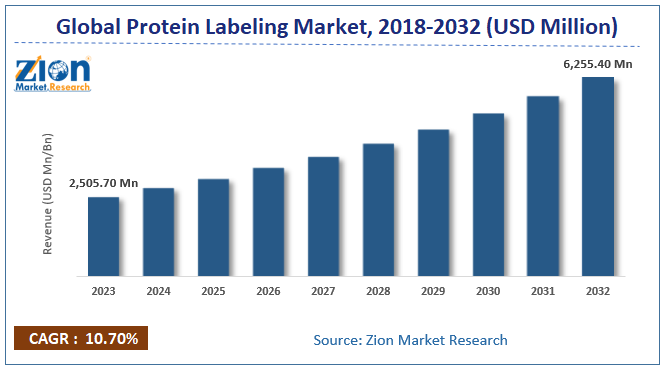
Protein Labeling Market: Overview
Proteins are the major and most significant biomolecules in a living organism, they are considered very essential for the functioning of an organism. Once they are produced within a cell, proteins come in touch with other biomolecules and carry out significant roles to keep the cell active. As a result, more significance is given to delve into the protein strap mechanism during specialized fields of research, such as protein chemistry and proteomics. Protein labeling is an indispensable and essential step in any protein examines study, as the detection or refinements of the protein of interest are feasible through it. Labeling methods result in the covalent connection of various molecules, which includes biotin, radioactive isotopes, fluorophores, and reporter enzymes, to target nucleotide sequence or protein.
Protein Labeling Market: Growth Factors
The protein labeling market is experiencing several new product launches and enhancement in accessible technologies that are projected to speed up growth in the demand. The product portfolio accessible with several most important players includes: services for in-vitro, different reagents, kits, in-vivo or biorthogonal labeling of the definite peptides. Expansion of highly developed dyes that quickly conjugates with the precise peptides in order to distinguish their existence and further the refinement method more accurately are anticipated to have a positive impact on development. Biorthogonal labeling occupies the labeling of the protein inside a living cell without any intrusion in the reactions and biochemical functions inside the cell. Therefore, going to a micro scale of working on the manufacturing demands, highly active environment improve the requirement for highly capable professionals and products to meet customer demand for this method.
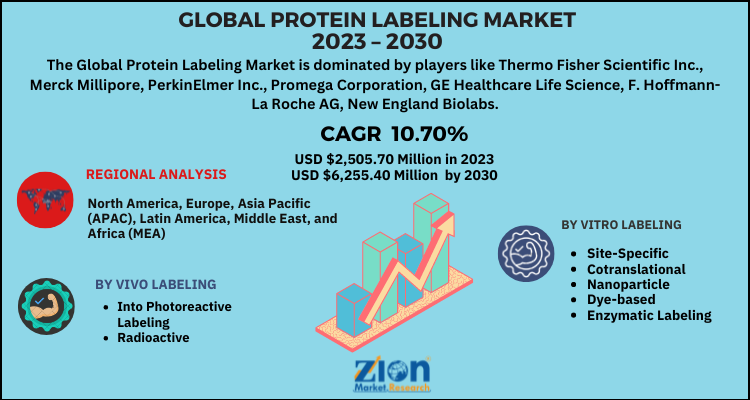
Protein Labeling Market: Segmentation
The protein labeling market is divided into three labeling methods in vivo labeling, in vitro labeling, and biorthogonal labeling methods.
In vitro labeling methods are further divided into site-specific, cotranslational, nanoparticle, dye-based, and enzymatic labeling.
The in vivo labeling process market is divided into photoreactive labeling and radioactive. The protein labeling market is further divided based on products offered for in detail analysis of expertise markets in the years to come.
Protein Labeling Market : Report Scope
| Report Attributes | Report Details |
|---|---|
| Report Name | Protein Labeling Market Research Report |
| Market Size in 2023 | USD 2,505.70 Million |
| Market Forecast in 2032 | USD 6,255.40 Million |
| Growth Rate | CAGR of 10.70% |
| Number of Pages | 196 |
| Key Companies Covered | Thermo Fisher Scientific Inc., Merck Millipore, PerkinElmer Inc., Promega Corporation, GE Healthcare Life Science, F. Hoffmann-La Roche AG, New England Biolabs, Eurogentec S.A, LI-COR Inc., Kirkegaard & Perry Laboratories (KPL) |
| Segments Covered | By vivo labeling, By vitro labeling, By biorthogonal labeling methods and By Region |
| Regions Covered | North America, Europe, Asia Pacific (APAC), Latin America, Middle East, and Africa (MEA) |
| Base Year | 2023 |
| Historical Year | 2018 - 2022 |
| Forecast Year | 2024 - 2032 |
| Customization Scope | Avail customized purchase options to meet your exact research needs. Request For Customization |
Protein Labeling Market: Regional Analysis
North America accounted high growth rate in the past year due to the existence of a very huge installed base of proteomic profiling and genetic platforms across the U.S. High market utilization of peptide identification methods to be utilized in sequencing and term analysis projects in several educational and clinical research institutes is also considered as one of the major aspect responsible for the region’s huge market share.
Asia Pacific is anticipated to experience development at a quicker rate in the coming years owing to growing investment in proteomic and genomic research in a number of major developing countries. In addition, quick rise in acceptance of bioengineering technology solutions has also been seen in the region, which in turn is anticipated to drive their usage in the years to come.
Protein Labeling Market: Competitive players
The key players of the global protein labeling market are:
- Thermo Fisher Scientific Inc.
- Merck Millipore
- PerkinElmer Inc.
- Promega Corporation
- GE Healthcare Life Science
- F. Hoffmann-La Roche AG
- New England Biolabs
- Eurogentec S.A
- LI-COR Inc.
- Kirkegaard & Perry Laboratories (KPL).
The Global Protein Labeling Market is segmented as follows:
By vivo labeling
- into photoreactive labeling
- radioactive
By vitro labeling
- site-specific
- cotranslational
- nanoparticle
- dye-based
- enzymatic labeling
By Region
- North America
- The U.S.
- Canada
- Mexico
- Europe
- France
- The UK
- Spain
- Germany
- Italy
- Rest of Europe
- Asia Pacific
- China
- Japan
- India
- Australia
- South Korea
- Rest of Asia Pacific
- The Middle East & Africa
- Saudi Arabia
- UAE
- Egypt
- Kuwait
- South Africa
- Rest of the Middle East & Africa
- Latin America
- Brazil
- Argentina
- Rest of Latin America
What Report Provides
- Full in-depth analysis of the parent market
- Important changes in market dynamics
- Segmentation details of the market
- Former, on-going, and projected market analysis in terms of volume and value
- Assessment of niche industry developments
- Market share analysis
- Key strategies of major players
- Emerging segments and regional markets
- Testimonials to companies in order to fortify their foothold in the market.
Table Of Content

FrequentlyAsked Questions
Protein labeling is attaching a detectable tag to proteins for tracking, visualization, or measurement in experiments.
The global protein labeling market is expected to be driven by the Growth is fueled by expanding proteomics research, rising use in diagnostics, and advancements in fluorescence and tagging technologies.
According to study, the global protein labeling market size was worth around USD 2,505.70 Million in 2023 and is predicted to grow to around USD 6,255.40 Million By 2032.
The global protein labeling market is expected to grow at a Compound Annual Growth Rate (CAGR) of around CAGR 10.70% during the forecast period from 2024-2032.
The global protein labeling industry is projected to be challenged by Challenges involve reagent stability, high costs, and experimental reproducibility. Adoption depends on research funding availability.
The Opportunities lie in proteomics research, biomarker discovery, and growth in imaging and flow cytometry workflows. Better dyes, multiplexing, and kit-based formats support recurring consumables demand will offer significant growth opportunities in the protein labeling market.
Fluorescent and mass-tag innovations for multiplex assays; site-specific bioorthogonal labeling chemistries; improved stability tags for live-cell imaging are the emerging trends and innovations impacting the protein labeling market.
The global protein labeling market is expected to be led by North America during the forecast period.
Some of the prominent players operating in the global protein labeling market are; Thermo Fisher Scientific Inc., Merck Millipore, PerkinElmer Inc., Promega Corporation, GE Healthcare Life Science, F. Hoffmann-La Roche AG, New England Biolabs, Eurogentec S.A, LI-COR Inc., Kirkegaard & Perry Laboratories (KPL) and others.
The report explores crucial aspects of the protein labeling market, including a detailed discussion of existing growth factors and restraints, while also browsing future growth opportunities and challenges that impact the market.
HappyClients

