
Programmable Oscillator Market Size, Share, Trends, Growth and Forecast 2034

Programmable Oscillator Market By Product Type (Fixed Frequency Oscillators, Voltage Controlled Oscillators, Temperature Compensated Oscillators, Field Programmable Oscillators), By Application (Telecommunications Equipment, Consumer Electronics, Industrial Automation, Aerospace and Defense Systems), By End-User (Electronics Manufacturers, Telecommunication Companies, Automotive Industry, Government and Defense Agencies), By Distribution Channel (Direct Sales, Electronic Component Distributors, Online Procurement Platforms, Government and Institutional Tender Procurement), and By Region - Global and Regional Industry Overview, Market Intelligence, Comprehensive Analysis, Historical Data, and Forecasts 2026 - 2034
| Market Size in 2025 | Market Forecast in 2034 | CAGR (in %) | Base Year |
|---|---|---|---|
| USD 1.86 Billion | USD 2.98 Billion | 5.28% | 2025 |
Programmable Oscillator Industry Perspective:
What will be the size of the programmable oscillator market during the forecast period?
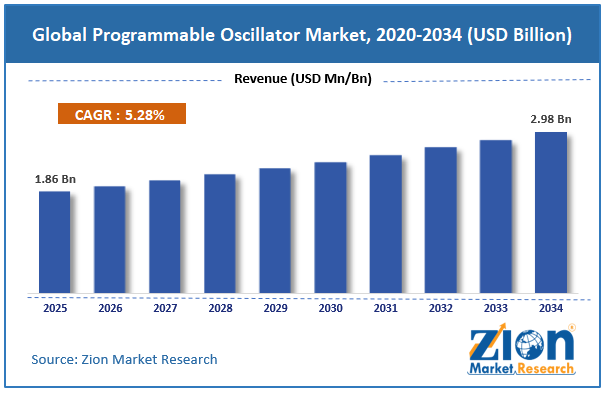
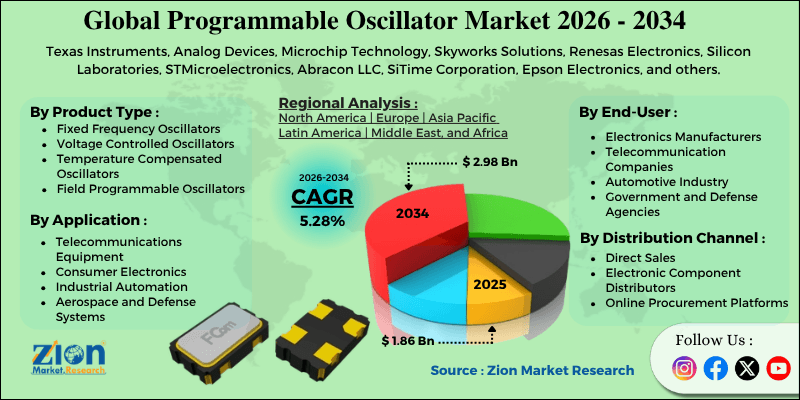
The global programmable oscillator market size was approximately USD 1.86 billion in 2025 and is projected to reach USD 2.98 billion by 2034, growing at a compound annual growth rate of approximately 5.28% between 2026 and 2034.
Key Insights
- According to our research team's analysis, the global programmable oscillator market is expected to grow at a compound annual growth rate of approximately 5.28% over the forecast period from 2026 to 2034.
- In terms of revenue, the global programmable oscillator market was valued at approximately USD 1.86 billion in 2025 and is projected to reach USD 2.98 billion by 2034.
- The programmable oscillator market is expected to grow steadily due to rising demand for flexible timing solutions, increasing adoption of five G and connected devices, and continuous advancements in semiconductor manufacturing.
- Based on product type, field programmable oscillators hold the largest market share, as manufacturers increasingly prefer flexible components that reduce design complexity, while voltage-controlled oscillators are growing the fastest due to rising demand in telecommunications and signal processing applications.
- Based on application, telecommunications equipment leads the market as network providers continue expanding infrastructure, while industrial automation applications are growing steadily as more factories adopt smart and connected machinery.
- Based on end user, electronics manufacturers hold the largest market share due to widespread use of oscillators across countless devices, while the automotive industry is growing rapidly as vehicles become more electronic and connected.
- Based on distribution channel, direct sales lead the market because large manufacturers prefer working directly with component suppliers, while electronic component distributors are expanding steadily to serve smaller businesses and specialized markets.
- Based on region, North America leads the global programmable oscillator market due to strong semiconductor research and development and growing demand for advanced electronics, followed by Asia Pacific, where expanding manufacturing capacity and rising electronics production are driving further growth.
Programmable Oscillator Market: Overview
A programmable oscillator is an electronic component that generates accurate timing signals and can be easily programmed to produce different frequencies for various electronic devices. Unlike fixed-frequency oscillators, it can be adjusted after manufacturing, giving engineers greater flexibility during product design. It acts like the heartbeat of an electronic system, ensuring all components work together smoothly and at the right speed. Programmable oscillators are widely used in smartphones, computers, servers, automotive electronics, industrial equipment, medical devices, and communication systems. They help improve device performance, reduce design complexity, and lower inventory costs by replacing multiple fixed-frequency oscillators with a single programmable solution. These components also offer high accuracy, low power consumption, and compact sizes, making them ideal for modern electronic products.
As technologies such as 5G, the Internet of Things (IoT), artificial intelligence, and industrial automation continue to grow, the demand for flexible timing solutions is increasing. Manufacturers are developing advanced programmable oscillators to support faster data transmission, reliable system operation, and energy-efficient electronics. These advantages are driving steady growth in the programmable oscillator market across multiple industries worldwide.
The programmable oscillator industry is expanding steadily as electronics manufacturers, telecommunications companies, and industrial businesses seek flexible and dependable timing solutions to power their devices and systems.
Impact of the USA-Israel War on Iran on the Programmable Oscillator Market
Rising tensions between the United States, Israel, and Iran may temporarily disrupt the supply of raw materials and specialized components used in semiconductor and oscillator manufacturing. They could also affect shipping routes for electronic goods. However, the demand for precise timing components remains strong because telecommunications networks, industrial systems, and consumer electronics need to keep functioning regardless of global events. As more industries continue to adopt automated and connected technologies, the programmable oscillator market is expected to grow despite short-term disruptions.
Programmable Oscillator Market: Technology Roadmap 2026–2034
What is the projected development roadmap of the programmable oscillator market over the forecast period?
The programmable oscillator market is advancing through smaller chip designs, improved frequency stability, lower power consumption, and growing use of artificial intelligence to optimize timing performance in real time. The market is expected to grow at a compound annual growth rate of approximately 5.28% during the forecast period, driven by rising demand for connected devices, growing automation, and continuous innovation in semiconductor design.
The following roadmap outlines key development phases expected through 2034.
2026–2028: Miniaturization and Efficiency Phase
- Smaller, more energy-efficient oscillator designs are expected to see wider adoption as manufacturers seek compact solutions for portable devices.
- Improved frequency stability features are expected to make it easier for engineers to design reliable systems for demanding applications.
- Expanding distributor networks are expected to make it easier for smaller manufacturers to access advanced timing components conveniently.
2029–2032: Smart Timing and Automation Phase
- Artificial intelligence-powered calibration systems are expected to help devices automatically adjust timing settings for optimal performance.
- Software-configurable oscillators are expected to allow engineers to reprogram timing settings remotely without needing new hardware.
- Hybrid timing solutions that combine multiple oscillator types are expected to offer more flexible and reliable performance across different applications.
2033–2034: Advanced Integration and Sustainability Phase
- Advanced chip integration technology is expected further to reduce the size and power requirements of timing components.
- Next-generation oscillators with longer lifespans and greater accuracy are expected to improve the overall value of electronic timing systems.
- Stronger recycling and sustainable manufacturing practices are expected to reduce the environmental impact of semiconductor component production.
Programmable Oscillator Market: Dynamics
Growth Drivers
How is the rising demand for flexible and accurate timing solutions driving the programmable oscillator market?
The programmable oscillator market is growing as electronics manufacturers, telecom companies, and industrial businesses seek flexible timing solutions that accommodate varying frequency requirements without hardware changes. These components help simplify product design, reduce development time, and lower inventory costs by replacing multiple fixed-frequency oscillators with a single programmable device. The rising demand for 5G networks, Internet of Things (IoT) devices, smart electronics, and industrial automation is increasing the need for accurate and reliable timing solutions. Manufacturers are developing programmable oscillators with higher accuracy, lower power consumption, and smaller sizes to meet the needs of modern electronic devices. These components are widely used in telecommunications, automotive electronics, consumer devices, industrial equipment, and data centers to improve system performance and reliability. These trends are supporting steady growth in the programmable oscillator market across industries worldwide.
The growing demand for 5G and connected-device technology drives the programmable oscillator market.
The programmable oscillator industry is growing as telecommunications companies and electronics manufacturers need highly accurate timing solutions for modern electronic systems. These components help devices stay synchronized, improve signal quality, and ensure reliable data transmission across different applications. The rapid expansion of 5G networks, data centers, cloud computing, and Internet of Things (IoT) devices is increasing the demand for flexible and precise timing components. Programmable oscillators can be easily configured to different frequencies, simplifying product design and reducing manufacturing costs. They are widely used in telecommunications equipment, networking devices, consumer electronics, automotive systems, industrial automation, and medical devices. Manufacturers are investing in advanced chip technologies to improve frequency accuracy, reduce power consumption, and develop smaller, more efficient products. Better production techniques are also making programmable oscillators more affordable for a wider range of industries.
As electronic devices become faster, smarter, and more connected, the need for reliable timing solutions continues to grow. These trends are creating new opportunities for semiconductor companies while driving steady growth in the programmable oscillator market across global telecommunications, automotive, industrial, and consumer electronics industries.
Restraints
How are design complexity and component costs affecting the programmable oscillator market?
The programmable oscillator market faces several challenges that may slow its growth. One of the main challenges is the higher cost of programmable oscillators compared to traditional fixed-frequency oscillators, making them less suitable for budget-sensitive applications. Using these components also requires technical knowledge for proper programming and integration, which can increase development time and costs. Many small manufacturers continue to rely on conventional timing components because they are familiar, readily available, and easier to use.
In addition, disruptions in the semiconductor supply chain and raw material shortages can affect production and product availability. Limited technical support and a shortage of skilled professionals also make it difficult for some companies to adopt programmable oscillator technology. Rapid technological changes require manufacturers to invest continuously in research and product development to remain competitive. Although these challenges may slow market growth, ongoing advances in semiconductor technology and lower manufacturing costs are expected to support wider adoption in the coming years.
Opportunities
How are emerging technologies, automation, and expanding electronics production creating opportunities in the programmable oscillator market?
The programmable oscillator industry offers strong growth opportunities as countries expand electronics manufacturing and upgrade telecommunications infrastructure. Rising investment in semiconductor production across the Asia Pacific, Latin America, the Middle East, and Africa is increasing demand for advanced timing components. The growing adoption of 5G networks, Internet of Things (IoT) devices, smart factories, and industrial automation is creating new opportunities for programmable oscillator manufacturers. These components are also becoming essential in electric vehicles, autonomous driving systems, medical devices, and data centers, where precise timing is critical for reliable performance. Governments are supporting domestic semiconductor production through funding programs and favorable policies, helping strengthen local supply chains.
At the same time, manufacturers are investing in research to develop smaller, more accurate, and energy-efficient programmable oscillators for modern electronic devices. Advances in chip technology are making these components easier to integrate into a wide range of applications. As industries continue to adopt connected and intelligent technologies, demand for flexible timing solutions is expected to rise, supporting the long-term growth of the programmable oscillator market worldwide.
Challenges
What challenges does the programmable oscillator market face in achieving broad adoption and delivering long-term value?
The programmable oscillator industry faces several challenges that could affect its growth. One major challenge is maintaining accurate and stable timing under different operating conditions, such as temperature changes, electrical noise, and harsh environments. Manufacturers also depend on specialized semiconductor materials, and supply chain disruptions can delay production and increase costs. Many small electronics companies lack the technical expertise needed to configure and integrate programmable oscillators into their products.
In addition, manufacturers must comply with changing industry standards and certification requirements, making product development more complex and time-consuming. Strong competition among semiconductor companies is also putting pressure on prices, forcing manufacturers to deliver better performance at lower costs. Rapid technological advancements require continuous investment in research and innovation to stay competitive. Despite these challenges, the increasing demand for reliable timing solutions, advances in semiconductor technology, and the growth of electronics manufacturing are expected to support the long-term growth of the programmable oscillator market across telecommunications, automotive, industrial, consumer electronics, and other high-tech industries worldwide.
Programmable Oscillator Market: Report Scope
| Report Attributes | Report Details |
|---|---|
| Report Name | Programmable Oscillator Market |
| Market Size in 2025 | USD 1.86 Billion |
| Market Forecast in 2034 | USD 2.98 Billion |
| Growth Rate | CAGR of 5.28% |
| Number of Pages | 230 |
| Key Companies Covered | Texas Instruments, Analog Devices, Microchip Technology, Skyworks Solutions, Renesas Electronics, Silicon Laboratories, STMicroelectronics, Abracon LLC, SiTime Corporation, Epson Electronics, and others. |
| Segments Covered | By Product Type, By Application, By End-User, By Distribution Channel, and By Region |
| Regions Covered | North America, Europe, Asia Pacific (APAC), Latin America, Middle East, and Africa (MEA) |
| Base Year | 2025 |
| Historical Year | 2020 - 2024 |
| Forecast Year | 2026 - 2034 |
| Customization Scope | Avail customized purchase options to meet your exact research needs. Request For Customization |
Programmable Oscillator Market: Segmentation
The global programmable oscillator market is segmented by product type, application, end user, distribution channel, and region.
How do field programmable oscillators maintain their leading position in the programmable oscillator market?
Based on product type, the global programmable oscillator market is segregated into fixed-frequency oscillators, voltage-controlled oscillators, temperature-compensated oscillators, and field-programmable oscillators. Field programmable oscillators lead with about a 41% share because they offer manufacturers the flexibility to configure a single component for multiple applications, reducing design complexity and inventory needs. The voltage-controlled oscillators segment holds around 26% of the market share. It is growing rapidly due to increasing demand in telecommunications and signal processing applications.
What is driving the dominance of telecommunications equipment in the programmable oscillator market?
Based on application, the market is classified into telecommunications equipment, consumer electronics, industrial automation, and aerospace and defense systems. Telecommunications equipment accounts for about 36% of market share, as network providers continue to expand infrastructure to support faster, more reliable connectivity. The industrial automation segment holds around 27% share. It is growing steadily as more factories adopt smart, connected machinery that requires precise timing components.
Why do electronics manufacturers account for the largest share of the programmable oscillator market?
Based on end user, the programmable oscillator market is segmented into electronics manufacturers, telecommunications companies, the automotive industry, and government and defense agencies. Electronics manufacturers hold around a 44% share because oscillators are used across countless consumer and industrial devices produced by this group. The automotive industry segment accounts for about 22% of the market share. It is growing rapidly due to the rising use of electronic components and connected systems in modern vehicles.
Which factors are driving the growth of direct sales in the programmable oscillator market?
Based on distribution channel, the programmable oscillator industry is divided into direct sales, electronic component distributors, online procurement platforms, and government and institutional tender procurement. Direct sales account for about 43% of market share because large manufacturers, such as electronics and telecommunication companies, prefer to purchase directly from component suppliers. The electronic component distributors segment holds around 30% of the market share. It continues expanding by serving smaller businesses and specialized markets across various regions.
Programmable Oscillator Market: Regional Analysis
How is technological innovation strengthening the North America programmable oscillator market?
The North American programmable oscillator market is expected to grow at a CAGR of 6.9% during the forecast period, driven by a strong semiconductor industry, advanced electronics manufacturing, and ongoing investment in new technologies. The United States holds the largest market share due to the presence of major semiconductor companies, the expansion of 5G infrastructure, and rising demand for connected devices, cloud computing, and data centers. Electronics manufacturers are increasingly using programmable oscillators to improve product flexibility, reduce design complexity, and enhance system performance. Canada is also contributing to market growth through investments in semiconductor research and innovation, as well as partnerships between technology companies and research institutions.
Mexico is emerging as an important manufacturing hub, supported by the expansion of electronics production and increasing demand for cost-effective timing solutions. The region benefits from a well-developed supply chain, advanced manufacturing facilities, and ongoing technological innovation. The growing adoption of industrial automation, Internet of Things (IoT) devices, artificial intelligence, and high-speed communication networks is further increasing the demand for programmable oscillators. These factors are expected to maintain North America's leadership in the programmable oscillator market while supporting long-term industry growth and technological advancement.
Why is the expansion of electronics manufacturing accelerating growth in the Asia-Pacific programmable oscillator market?
The Asia Pacific programmable oscillator market is expected to grow at a CAGR of 7.8% during the forecast period, supported by rapid expansion in electronics manufacturing, semiconductor production, and telecommunications infrastructure. China leads the market with its large semiconductor industry, high consumer electronics production, and strong government support for technology development. Japan and South Korea are also major contributors, driven by advanced chip manufacturing, innovation, and growing demand for high-performance electronic components. India and Southeast Asian countries are expanding their electronics manufacturing capabilities and investing in semiconductor facilities to strengthen domestic production.
Manufacturers across the region are increasingly adopting programmable oscillators to improve product performance, simplify circuit design, and reduce manufacturing costs. Government initiatives, financial incentives, and investments in research and development are further accelerating market growth. The rising adoption of 5G networks, Internet of Things (IoT) devices, industrial automation, electric vehicles, and smart consumer electronics is driving strong demand for accurate and flexible timing solutions. These factors, along with continuous advances in semiconductor technology, are expected to support the long-term growth of the Asia Pacific programmable oscillator market and strengthen the region's position in the global electronics industry.
Recent Market Developments
- In February 2026, SiTime announced its acquisition of Renesas Electronics' timing business, significantly expanding its programmable oscillator, clock, and timing product portfolio while strengthening its presence in AI data centers, telecommunications, industrial, and automotive applications.
Programmable Oscillator Market: Competitive Analysis
The leading players in the global programmable oscillator market are:
- Texas Instruments
- Analog Devices
- Microchip Technology
- Skyworks Solutions
- Renesas Electronics
- Silicon Laboratories
- STMicroelectronics
- Abracon LLC
- SiTime Corporation
- Epson Electronics
The global programmable oscillator market is segmented as follows:
By Product Type
- Fixed Frequency Oscillators
- Voltage Controlled Oscillators
- Temperature Compensated Oscillators
- Field Programmable Oscillators
By Application
- Telecommunications Equipment
- Consumer Electronics
- Industrial Automation
- Aerospace and Defense Systems
By End-User
- Electronics Manufacturers
- Telecommunication Companies
- Automotive Industry
- Government and Defense Agencies
By Distribution Channel
- Direct Sales
- Electronic Component Distributors
- Online Procurement Platforms
- Government and Institutional Tender Procurement
By Region
- North America
- The U.S.
- Canada
- Mexico
- Europe
- France
- The UK
- Spain
- Germany
- Italy
- Rest of Europe
- Asia Pacific
- China
- Japan
- India
- Australia
- South Korea
- Rest of Asia Pacific
- The Middle East & Africa
- Saudi Arabia
- UAE
- Egypt
- Kuwait
- South Africa
- Rest of the Middle East & Africa
- Latin America
- Brazil
- Argentina
- Rest of Latin America
Table Of Content
Methodology
FrequentlyAsked Questions
A programmable oscillator is an electronic component that generates accurate timing signals and can be easily programmed to produce different frequencies for various electronic devices. Unlike fixed-frequency oscillators, it can be adjusted after manufacturing, giving engineers greater flexibility during product design.
The global programmable oscillator market is expected to grow, driven by rising demand for flexible timing solutions worldwide, increasing adoption of 5G and connected device technologies, growing automation in industrial settings, and continuous improvements in semiconductor manufacturing.
According to research, the global programmable oscillator market was valued at approximately USD 1.86 billion in 2025 and is projected to reach approximately USD 2.98 billion by 2034.
The compound annual growth rate of the programmable oscillator market is expected to be approximately 5.28% from 2026 to 2034.
North America is expected to lead the global programmable oscillator market throughout the forecast period, driven by robust semiconductor research and development, expanding telecommunications infrastructure, and rising demand for connected devices.
The major players in the global programmable oscillator market include Texas Instruments, Analog Devices, Microchip Technology, Skyworks Solutions, Renesas Electronics, Silicon Laboratories, STMicroelectronics, Abracon LLC, SiTime Corporation, and Epson Electronics.
The report examines key aspects of the programmable oscillator market, including growth drivers, adoption barriers, emerging opportunities, competitive dynamics, detailed regional performance, and a forward-looking outlook across all major product types, applications, end-user segments, and geographic regions through 2034.
The programmable oscillator market faces challenges such as higher product costs than fixed-frequency oscillators, semiconductor supply chain disruptions, complex integration requirements, evolving industry standards, and the need for continuous research and development to meet growing demands for performance and power efficiency.
The programmable oscillator market is highly competitive, with global semiconductor companies focusing on product innovation, strategic partnerships, mergers and acquisitions, manufacturing expansion, and advanced timing technologies. Companies compete through performance, reliability, customization, energy efficiency, and strong global distribution networks.
The programmable oscillator market is seeing prices gradually decline due to manufacturing advancements and economies of scale. In contrast, premium programmable oscillators with higher accuracy, lower power consumption, and advanced features continue to command higher prices in specialized applications.

HappyClients

