
Precision Swine Farming Market Size, Share, Trends, Growth and Forecast 2034

Precision Swine Farming Market By Component (Hardware, Software, and Services), By Technology (IoT and Sensors, Robotics and Automation, Big Data Analytics, Artificial Intelligence, Blockchain Traceability, and Cloud Computing), By Farm Size (Large-Scale Farms, Small-Scale Farms, and Medium-Scale Farms), By Application (Nutrition Optimization, Breeding Management, Health Monitoring, Waste Management and Environmental Control), and By Region - Global and Regional Industry Overview, Market Intelligence, Comprehensive Analysis, Historical Data, and Forecasts 2026 - 2034
| Market Size in 2025 | Market Forecast in 2034 | CAGR (in %) | Base Year |
|---|---|---|---|
| USD 1.4 Billion | USD 4.1 Billion | 12.6% | 2025 |
Precision Swine Farming Industry Perspective:
What will be the size of the global precision swine farming market during the forecast period?
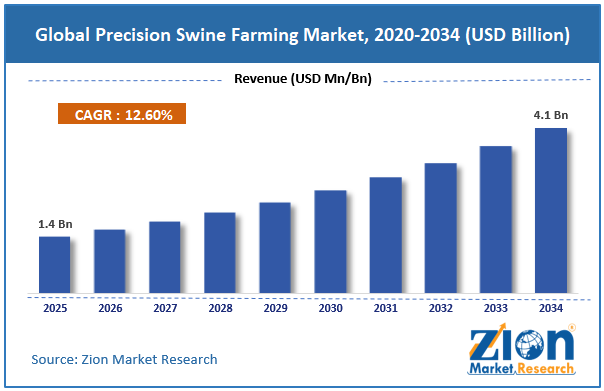
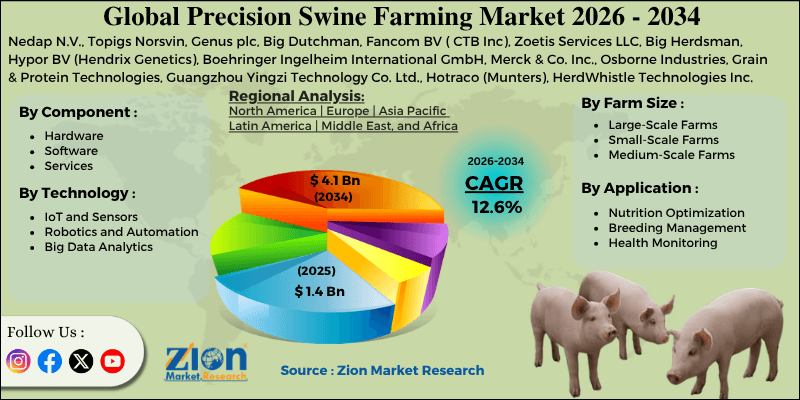
The global precision swine farming market size was worth around USD 1.4 billion in 2025 and is predicted to grow to around USD 4.1 billion by 2034, with a compound annual growth rate (CAGR) of roughly 12.6% between 2026 and 2034.
Precision Swine Farming Market: Overview
Precision swine farming (PSF) is one of the most innovative methods of farming that uses the application of various technologies, including digital technologies, sensors, artificial intelligence (AI), Internet of Things (IoT), machine vision, and an automatic monitoring system to collect and analyze data related to the pigs and the entire environment. This technology is used to improve the health and welfare of animals, increase productivity and feed efficiency, improve profitability, reduce the number of farm employees, and minimize environmental impact.
As compared to the usual way of pig farming, in which observations of the pigs were made manually from time to time, precision swine farming creates possibilities for constant decision-making according to monitoring of various parameters, including feed intake, body weight, growth rate, behavior, activity, environmental factors such as humidity, temperature, air quality, and diseases.
Key Insights
- As per the analysis shared by our research analyst, the global precision swine farming market is estimated to grow annually at a CAGR of around 12.6% over the forecast period (2026-2034).
- In terms of revenue, the global precision swine farming market size was valued at around USD 1.4 billion in 2025 and is projected to reach USD 4.1 billion by 2034.
- Rising demand for improved feed efficiency and cost optimization is expected to propel the precision swine farming market over the projected period.
- Based on the component, the hardware segment held the largest market share of 47% in 2025.
- Based on the technology, the IoT and sensors segment held a prominent market share of 35% in 2025.
- Based on the farm size, the large-scale farms segment held the largest revenue share of 51% in 2025.
- Based on the application, the health monitoring segment held the largest revenue share of 37% in 2025.
- Based on region, Europe led the precision swine farming market in terms of revenue, which is around 31% of the global market.
Impact of the USA-Israel War on Iran on the Precision Swine Farming Market
The USA-Israel dispute regarding Iran will indirectly affect the PSF market, not directly. This is because the PSF market operates using advanced technology. In other words, PSF relies on digital technology, connected devices, automated machinery, and animal husbandry. For this reason, the success of the PSF market is greatly affected by the level of farm investment, energy and feed costs, and the supply chain. The US-Israel dispute has adversely affected energy, transportation, and agricultural supply chains globally.
Precision Swine Farming Market: Dynamics
Growth Drivers
Why does the growing adoption of AI, IoT, and smart farming technologies drive the precision swine farming market?
One of the main factors behind the rising popularity of AI, IoT, and smart farming technologies that drive the precision swine farming market is their ability to provide continuous, real-time monitoring and management of pig farming, replacing conventional manual observations. Various IoT sensors, smart cameras, wearable devices, and environmental monitoring technologies continuously collect data on pigs' feed consumption, body weight, activity level, health condition, temperature, humidity, and air quality. Then, the collected data is analyzed by AI-powered algorithms, which can identify diseases at early stages, optimize feed schedules, increase feed conversion efficiency, control climate, and forecast productivity performance. The implementation of these features can allow producers to reduce feed loss, decrease labor expenses, enhance animal welfare, minimize mortality, and improve productivity and profitability. Concerned with efficiency, biosecurity, and sustainability, commercial swine farms continue to invest in precision farming powered by AI and IoT, thereby contributing to market growth.
For instance, one of the latest product launches that exemplifies this trend is PIGI Pro from Corntec Inc., an AI-powered camera app for pig farms, launched in July 2023. The solution automatically measures pigs and piglets, forecasts carcass characteristics, manages the shipment process, and uses advanced algorithms and measurement accuracy. In this way, PIGI Pro enables informed management decisions by automating livestock monitoring and delivering real-time production insights.
Restraints
Why do the high initial investment costs hamper the growth of the precision swine farming industry?
High initial investment costs pose obstacles to the development of the precision swine farming industry, as adopting a smart farm management system requires substantial funds that pork producers, especially small and medium-sized farms, cannot easily afford. The use of PSF includes elements such as AI-powered cameras, IoT sensors and RFID tags, automated feeding and weighing systems, environmental monitoring equipment, farm management software, communications, and data analytics platforms. Apart from the purchase of equipment, producers have to cover expenses for installation, system integration, personnel training, subscription services, and maintenance and support services.
Although adoption of these technologies will help enhance feed efficiency, animal well-being, labor productivity, and farm profitability in the long run, the return on investment comes only after several years. It discourages producers from investing, especially when pork prices fluctuate, feed prices rise, or economic uncertainty prevails. Lack of access to financing and credit services in developing countries prevents farmers from adopting these technologies, as they must spend their money on more pressing operational needs. High initial costs reduce the adoption rate of precision technologies and limit market penetration.
Opportunities
Why does the growing consumption of pork offer a lucrative opportunity for the precision swine farming market?
The increasing consumption of pork worldwide indicates considerable growth potential for the precision swine farming industry, as greater consumption requires improving production efficiency, increasing herd size, and adopting innovative livestock management technologies. To satisfy consumers' demand for meat products and remain economically profitable, swine producers are investing in AI-driven monitoring systems, IoT sensors, precision feeding, automated weighing, and smart environmental control. With the help of the mentioned technologies, it is possible to optimize feed conversion ratio, improve animal health and welfare, prevent disease outbreaks, reduce production costs, and increase productivity. As commercial farms intensify their operations and grow in size, PSF becomes an essential tool for managing larger herds efficiently, maintaining consistent meat quality, and meeting higher biosecurity and sustainability requirements.
According to the OECD–FAO Agricultural Outlook 2025–2034, global pig meat consumption will grow by about 5% until 2034, reaching about 130 million tonnes (carcass weight equivalent), driven mainly by upper-middle-income and developing countries. Also, almost 45% of global meat consumption growth will be driven by upper-middle-income countries due to increased incomes, urbanization, and changes in eating habits.
Challenges
Lack of technical skills and digital literacy poses a significant challenge to the precision swine farming market
A lack of digital skills and digital literacy is a key barrier to the development of the precision swine farming market, as the proper implementation of modern livestock technologies requires farmers and farm workers to understand and work with sophisticated IT systems. Modern precision swine farming solutions – from AI-driven analytics and IoT devices to RFID, machine vision, automated feeding equipment, cloud-farm management software, and data visualization dashboards – generate vast amounts of real-time data that must be properly analyzed to make sound decisions.
However, many farmers, especially those who run small- and medium-sized farms or come from developing countries, have little experience with digital technologies, data analytics, and automated farm equipment. Such a skills deficit may result in improper use of system functions, inaccurate data analysis, inefficiency, and reluctance to adopt new innovations. Moreover, farm owners require specialized training, technical assistance, and qualified staff for the proper installation, troubleshooting, operation, and maintenance of precision farming technology, making its implementation complex and costly. Hence, low digital literacy and the absence of technical skills slow down the implementation of precision swine farming innovations.
Precision Swine Farming Market: Report Scope
| Report Attributes | Report Details |
|---|---|
| Report Name | Precision Swine Farming Market |
| Market Size in 2025 | USD 1.4 Billion |
| Market Forecast in 2034 | USD 4.1 Billion |
| Growth Rate | CAGR of 12.6% |
| Number of Pages | 226 |
| Key Companies Covered | Nedap N.V., Topigs Norsvin, Genus plc, Big Dutchman, Fancom BV ( CTB Inc), Zoetis Services LLC, Big Herdsman, Hypor BV (Hendrix Genetics), Boehringer Ingelheim International GmbH, Merck & Co. Inc., Osborne Industries, Grain & Protein Technologies, Guangzhou Yingzi Technology Co. Ltd., Hotraco (Munters), HerdWhistle Technologies Inc., and others. |
| Segments Covered | By Component, By Technology, By Farm Size, By Application, and By Region |
| Regions Covered | North America, Europe, Asia Pacific (APAC), Latin America, Middle East, and Africa (MEA) |
| Base Year | 2025 |
| Historical Year | 2020 - 2024 |
| Forecast Year | 2026 - 2034 |
| Customization Scope | Avail customized purchase options to meet your exact research needs. Request For Customization |
Precision Swine Farming Market: Segmentation
Component Insights
Why does the hardware segment hold a prominent position in the precision swine farming market?
The hardware segment held the largest share in the precision swine farming industry of 47% in 2025. Hardware revenues are expected to rise as automated livestock equipment is increasingly used in large-scale commercial swine facilities that aim to increase production efficiency, minimize labor dependence, and enhance biosecurity measures. Concerns about the outbreak of ASF and other diseases, as well as the need for early detection, have accelerated the development of AI cameras, thermal scanners, and environmental sensors that can detect unusual behavior in livestock and their health problems. Moreover, the growth of commercial pig farming in Asia-Pacific, Europe, and North America will result in higher revenue for RFID identification equipment, precision feeders, and climate control devices.
Technology Insights
How does the IoT and sensors segment capture the largest market share in the precision swine farming market?
The IoT and sensors segment held a prominent share in the precision swine farming market of 35% in 2025. The growing revenues in this market are driven by the rising need for continuous monitoring and early detection of animal diseases. The sensors can detect changes in their eating, movement, or environmental factors that could indicate disease or stress among animals. This technology is very important for managing biosecurity risks posed by diseases such as ASF (African Swine Fever) and PRRS (Porcine Reproductive and Respiratory Syndrome).
Farm Size Insights
Does the large-scale farms segment capture the largest market share in the precision swine farming market?
The large-scale farms segment held the largest revenue share in the precision swine farming market of 51% in 2025. In this segment, revenue growth is driven by big commercial farmers' ability to invest in expensive, advanced technology due to their financial capacity. Unlike small farmers, big commercial farmers can achieve economies of scale by achieving better feed conversion rates, incurring fewer losses due to disease, making better use of labor, and improving production efficiency. Consolidation in the global swine industry is prompting farmers to adopt digital management systems across multiple farms.
Application Insights
How does the health monitoring segment capture the largest market share in the precision swine farming market?
The health monitoring segment held the largest revenue share in the precision swine farming industry of 37% in 2025. This convergence has led to accelerated adoption in the market. The farmers will have access to information about their herd's health on their cell phones, tablets, and computers, and will receive notifications whenever there is something amiss. In addition, advances in technology, such as artificial intelligence, machine learning, and computer vision, have increased the accuracy of disease prediction.
Regional Insights
Why does Europe lead the precision swine farming market?
Europe led the precision swine farming market in terms of revenue, which is around 31% of the global market. This growth can be attributed to the high level of development of commercial pig farming, regulatory attention paid to animal well-being and traceability, and increased investment in agriculture digitalization and innovative smart livestock technologies. European pork producers use AI-based health monitoring, IoT sensors, automated feeding systems, machine vision, RFID animal identification, and cloud-based farm management platforms to increase production efficiency, reduce labor dependence, ensure biosecurity, and comply with strict environmental and animal welfare regulations.
Data from government agencies show the impressive scale of the European pork industry, providing strong grounds for the development of precision agriculture technologies. According to Eurostat, in 2024, there were about 132 million pigs in the European Union, making pigs the most numerous livestock type in Europe. In 2024, Spain remained the leader in pig production in the EU, followed by Germany and Denmark, and tens of millions of pigs were produced annually for the EU pork industry. The number of pigs has been decreasing due to the adoption of sustainable farming practices, but pork producers continue to invest in precision technologies to increase each animal's productivity and cut costs.
Precision Swine Farming Market: Competitive Analysis
The global precision swine farming market is dominated by players like:
- Nedap N.V.
- Topigs Norsvin
- Genus plc
- Big Dutchman
- Fancom BV ( CTB Inc)
- Zoetis Services LLC
- Big Herdsman
- Hypor BV (Hendrix Genetics)
- Boehringer Ingelheim International GmbH
- Merck & Co. Inc.
- Osborne Industries
- Grain & Protein Technologies
- Guangzhou Yingzi Technology Co. Ltd.
- Hotraco (Munters)
- HerdWhistle Technologies Inc.
The global precision swine farming market is segmented as follows:
By Component
- Hardware
- Software
- Services
By Technology
- IoT and Sensors
- Robotics and Automation
- Big Data Analytics
- Artificial Intelligence
- Blockchain Traceability
- loud Computing
By Farm Size
- Large-Scale Farms
- Small-Scale Farms
- Medium-Scale Farms
By Application
- Nutrition Optimization
- Breeding Management
- Health Monitoring
- Waste Management
- Environmental Control
By Region
- North America
- The U.S.
- Canada
- Mexico
- Europe
- France
- The UK
- Spain
- Germany
- Italy
- Rest of Europe
- Asia Pacific
- China
- Japan
- India
- Australia
- South Korea
- Rest of Asia Pacific
- The Middle East & Africa
- Saudi Arabia
- UAE
- Egypt
- Kuwait
- South Africa
- Rest of the Middle East & Africa
- Latin America
- Brazil
- Argentina
- Rest of Latin America
Table Of Content
Methodology
FrequentlyAsked Questions
Precision swine farming is one of the most innovative methods of farming that uses the application of various technologies, including digital technologies, sensors, artificial intelligence (AI), Internet of Things (IoT), machine vision, and an automatic monitoring system to collect and analyze data related to the pigs and the entire environment.
Increasing outbreaks of diseases such as African Swine Fever (ASF), Porcine Reproductive and Respiratory Syndrome (PRRS), and swine influenza are driving demand for continuous health monitoring, early disease detection, and predictive analytics solutions.
Increasing use of cloud-connected farm management platforms raises concerns about data ownership, unauthorized access, cyberattacks, and protection of sensitive operational information.
Based on the application, the health monitoring segment is expected to dominate the Precision swine farming market growth during the projected period.
The growing use of IoT sensors, RFID tags, wearable devices, and smart environmental sensors enables continuous monitoring of feed intake, water consumption, body weight, activity levels, temperature, humidity, and air quality, allowing farmers to respond quickly to changes in animal health and barn conditions.
According to the report, the global precision swine farming market size was worth around USD 1.4 billion in 2025 and is predicted to grow to around USD 4.1 billion by 2034.
The global precision swine farming market is expected to grow at a CAGR of 12.6% during the forecast period.
The global precision swine farming industry growth is expected to be led by Europe over the forecast period.
The global precision swine farming market is dominated by players like Nedap N.V., Topigs Norsvin, Genus plc, Big Dutchman, Fancom BV (CTB, Inc), Zoetis Services LLC, Big Herdsman, Hypor BV (Hendrix Genetics), Boehringer Ingelheim International GmbH, Merck & Co., Inc., Osborne Industries, Grain & Protein Technologies, Guangzhou Yingzi Technology Co, Ltd, Hotraco (Munters), and HerdWhistle Technologies Inc., among others.
The precision swine farming market report covers the geographical market along with a comprehensive competitive landscape analysis. It also includes cash flow analysis, profit ratio analysis, market basket analysis, market attractiveness analysis, sentiment analysis, PESTLE analysis, trend analysis, SWOT analysis, trade area analysis, demand & supply analysis, Porter’s five forces analysis, and value chain analysis.

HappyClients

