
Global Powder Coating Market Size, Share, Growth, Opportunities 2034

Powder Coating Market By Product Type (Thermosetting Powder Coating, Thermoplastic Powder Coating, and UV-Curable Powder Coating), By Application (Architectural and Building, Automotive and Transportation, Appliances and White Goods, General Industrial, and Furniture and Fixtures), By End-User (Automotive Manufacturers, Construction Companies, Appliance Makers, Industrial Equipment Producers, and Consumer Goods Companies), By Distribution Channel (Direct Sales, Distributors and Dealers, Online Platforms, and Specialty Coating Suppliers), and By Region - Global and Regional Industry Overview, Market Intelligence, Comprehensive Analysis, Historical Data, and Forecasts 2025 - 2034
| Market Size in 2024 | Market Forecast in 2034 | CAGR (in %) | Base Year |
|---|---|---|---|
| USD 17.32 Billion | USD 28.22 Billion | 5.57% | 2024 |
Powder Coating Industry Perspective
What will be the size of the powder coating market during the forecast period?
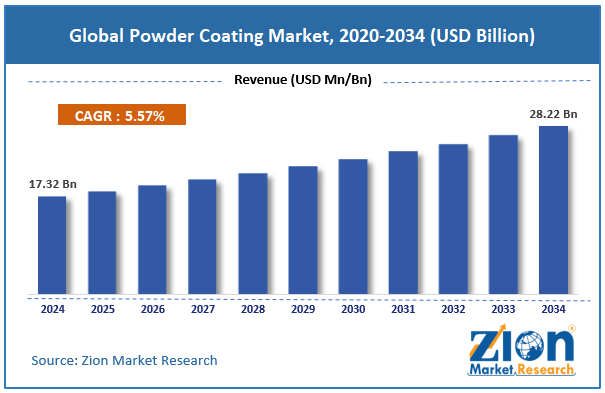
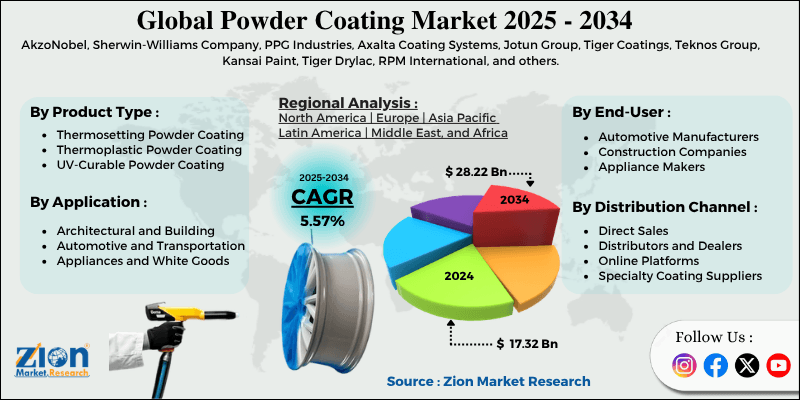
The global powder coating market size was worth approximately USD 17.32 billion in 2024 and is projected to grow to around USD 28.22 billion by 2034, with a compound annual growth rate (CAGR) of roughly 5.57% between 2025 and 2034.
This report provides a comprehensive analysis of the growth drivers, restraints, and challenges shaping demand across the global powder coating market throughout the forecast period, while highlighting high-potential emerging opportunities within the industry.
Key Insights
- As per the analysis shared by our research analyst, the global powder coating market is estimated to grow annually at a CAGR of around 5.57% over the forecast period (2025–2034).
- In terms of revenue, the global powder coating market size was valued at approximately USD 17.32 billion in 2024 and is projected to reach USD 28.22 billion by 2034.
- The powder coating market is expected to grow strongly, driven by rising demand for durable, eco-friendly coatings, stricter limits on solvent-based paints, increasing use in automotive and construction, expanding manufacturing in Asia and Latin America, and ongoing innovation in powder formulations.
- Based on product type, the thermosetting powder coating segment is expected to lead the powder coating market, while the UV-curable powder coating segment is anticipated to grow at a notably fast pace.
- Based on application, the automotive and transportation segment is expected to lead the powder coating market, while the architectural and building segment is anticipated to grow at a significant rate.
- Based on end-user, the automotive manufacturers segment is the largest current end-user group, while the construction companies segment is anticipated to grow most rapidly during the forecast period.
- Based on the distribution channel, the distributors and dealers segment is expected to lead the powder coating market, while the online platforms segment is anticipated to grow steadily.
- Based on region, Asia Pacific is projected to dominate the global powder coating market during the estimated period, followed by North America and Europe.
Powder Coating Market: Overview
Powder coating is a process of applying a dry, free-flowing powder to a surface, usually metal, to create a protective and decorative finish. It differs from regular liquid paint because it does not use a liquid solvent. Instead, a fine, dry powder is sprayed onto the surface with an electrostatic charge, helping it stick evenly. After application, the coated item is heated in an oven. The heat melts the powder, forming a smooth, solid layer that firmly bonds to the surface. This process creates a strong and long-lasting finish that is more durable than traditional paint. Powder-coated surfaces are highly resistant to scratches, chipping, fading, and wear over time. They also provide excellent protection against rust, moisture, sunlight, and many chemicals, making them suitable for both indoor and outdoor use.
Powder coating is commonly used in industries such as automotive, construction, home appliances, furniture, and industrial equipment. Another key benefit of powder coating is its environmental friendliness. Since it does not use solvents, it emits very low levels of harmful air pollutants. It also produces minimal waste, as any unused powder can be collected and reused, making it a cleaner, more efficient coating method. The rising demand for durable coatings, stricter environmental rules, growing manufacturing in emerging markets, and advances in powder technology are driving steady growth in the powder coating market.
Impact of the USA-Israel war on Iran on the powder coating market
The ongoing USA-Israel war on Iran is likely to create both immediate and long-term effects on the powder coating market’s production and supply chain. Rising energy prices driven by tensions in the Strait of Hormuz are expected to increase manufacturing and logistics costs in the near term. Over time, recovery in industrial output and infrastructure projects may support gradual market growth.
Powder Coating Market: Technology Roadmap 2025 to 2034
What is the projected development roadmap of the powder coating market over the forecast period?
The powder coating market is evolving through advances in low-temperature curing technology, UV-curable formulations, expanded color options, the adoption of sustainable raw materials, and digitally controlled application systems. The market is expected to grow at a CAGR of around 5.57% over the forecast period, driven by strong demand from the automotive, construction, appliance, and general manufacturing sectors.
The following roadmap outlines key development phases expected through 2034.
2025–2027: Low-Temperature Curing and Sustainability Phase
- Powder coating manufacturers are expected to advance low-temperature curing technologies, reducing energy consumption during curing and making the technology accessible for heat-sensitive substrates such as wood and plastic.
- Bio-based raw material adoption is likely to grow, reducing dependency on petroleum-derived ingredients in powder formulations.
- Smart electrostatic application systems are projected to become more widely used, improving transfer efficiency and reducing material waste on production lines.
2028–2031: Specialty Coatings and Market Expansion Phase
- Functional powder coatings offering antimicrobial, anti-graffiti, heat-resistant, and self-healing properties are expected to see wider commercial adoption across industrial and architectural segments.
- Manufacturers are likely to expand production facilities in Southeast Asia, Latin America, and the Middle East to serve rapidly growing regional manufacturing industries.
- Digital color-matching tools and custom powder formulation services are projected to become standard offerings, improving the customer experience and reducing inventory waste.
2032–2034: Smart Coating and Circular Economy Phase
- Powder coating systems integrated with industrial automation and robotics are expected to become common in large manufacturing facilities, improving consistency and reducing labor costs.
- Recyclable and reclaimed powder systems are likely to be adopted more widely, contributing to circular economy goals in the manufacturing sector.
- Nanotechnology-enhanced powder coatings offering superior corrosion resistance and self-cleaning properties are projected to reach commercial maturity in specialized markets.
Powder Coating Market: Dynamics
Growth Drivers
What is driving the growth of the powder coating market as global industrial manufacturing and sustainable finishing solutions expand?
The powder coating market is growing steadily as industries move away from traditional liquid paints to cleaner, efficient, and longer-lasting coating solutions. This growth is mainly driven by stricter environmental regulations, rising awareness about pollution, and the need for cost-effective manufacturing processes. Liquid paints release harmful chemicals into the air, which can affect both the environment and worker health, leading governments to enforce strict rules. Powder coating, which contains no solvents and generates very little waste, helps companies easily meet these rules while maintaining high-quality finishes.
In addition, its strong performance is attracting more industries. Powder-coated surfaces are more durable and resist scratches, fading, and wear, reducing maintenance costs and extending product life. This is especially important for industries such as automotive, appliances, and outdoor equipment, where long-lasting materials are required. As companies focus on sustainability, durability, and cost savings, the powder coating market continues to expand across global industries.
The increase in manufacturing and infrastructure growth is boosting powder coating demand.
The powder coating industry is growing strongly due to rapid industrial expansion in emerging economies such as China, India, Vietnam, Brazil, and Mexico. These countries are seeing fast growth in manufacturing, automotive, and construction sectors, which are major users of powder coating. This expansion is driving steady, increasing demand for reliable coating solutions. The construction industry is a key growth driver, as powder coating is widely used for aluminum frames, windows, curtain walls, steel structures, and other building components. These materials need to handle weather, moisture, and sunlight for long periods, and powder coating offers both durability and design flexibility.
Rising urbanization is also increasing the number of residential and commercial construction projects, further boosting demand. At the same time, the appliance industry is growing as people in developing countries have higher incomes and improved living standards. This in turn increases demand for products such as refrigerators, washing machines, and ovens that use powder-coated surfaces for protection and long life, supporting continued market growth.
Restraints
How do raw material price volatility and high initial setup costs create challenges for businesses in the powder coating market?
The powder coating market faces several challenges that can slow its growth and impact profits. One major issue is the fluctuation in raw material prices. Powder coatings use materials like resins, pigments, and additives, many of which come from petroleum, so changes in oil prices directly affect production costs. When these costs increase, manufacturers either reduce their profit margins or raise prices, which can lower demand, especially in price-sensitive markets.
Another key restraint is the high initial cost of setting up powder coating systems. Equipment such as curing ovens, spray systems, and safety setups requires significant investment, making it difficult for small businesses to adopt this technology. In addition, companies need to train workers and adjust their processes when shifting from liquid paints to powder coating. These cost and transition challenges can slow adoption, particularly among small and medium enterprises, limiting the overall growth of the powder coating market.
Opportunities
The growing electric vehicle industry and sustainable building movement are creating new opportunities for the powder coating market.
The powder coating market is creating strong opportunities as it benefits from the growth of electric vehicles and sustainable construction worldwide. The electric vehicle industry is expanding quickly as governments support clean transportation and automakers increase production of battery-powered cars. These vehicles require coatings that are strong, lightweight, and heat-resistant, making powder coating a suitable choice for parts such as battery enclosures, wheels, and structural components. As electric vehicle production rises across Asia, Europe, and North America, demand for advanced powder coating solutions is expected to increase.
At the same time, the shift toward green and energy-efficient buildings is opening new opportunities. Builders and developers are choosing materials that meet environmental standards and reduce long-term costs. Powder coating is widely preferred because it produces low emissions and offers long-lasting protection. It is used on aluminum frames, steel structures, and solar panel systems that require durability and low maintenance. As green building practices and regulations continue to grow, the powder coating market is expected to see strong, sustained demand.
Challenges
What challenges does the powder coating market face in coating heat-sensitive materials and maintaining consistent quality in high-volume production?
The powder coating industry faces several technical and operational challenges that can affect its growth and efficiency. One major challenge is coating materials that cannot handle high heat. Powder coating usually needs high curing temperatures, which work well for metals but can damage materials like wood, plastics, and composites. As demand for coated furniture and plastic components increases, companies need low-temperature solutions, but these remain costly and are not widely used. Another challenge is maintaining consistent quality in large-scale production.
Many factors, such as powder size, equipment settings, surface preparation, humidity, and oven temperature, can affect the final finish. Even small changes can cause defects, leading to rework and material waste. Coating complex shapes evenly is also difficult and requires advanced equipment and skilled workers. In addition, customers are demanding more decorative finishes, such as textures and metallic effects, which increases production complexity and requires continuous investment in research, technology, and quality control systems.
Powder Coating Market: Report Scope
| Report Attributes | Report Details |
|---|---|
| Report Name | Powder Coating Market |
| Market Size in 2024 | USD 17.32 Billion |
| Market Forecast in 2034 | USD 28.22 Billion |
| Growth Rate | CAGR of 5.57% |
| Number of Pages | 255 |
| Key Companies Covered | AkzoNobel, Sherwin-Williams Company, PPG Industries, Axalta Coating Systems, Jotun Group, Tiger Coatings, Teknos Group, Kansai Paint, Tiger Drylac, RPM International, and others. |
| Segments Covered | By Product Type, By Application, By End-User, By Distribution Channel, and By Region |
| Regions Covered | North America, Europe, Asia Pacific (APAC), Latin America, Middle East, and Africa (MEA) |
| Base Year | 2024 |
| Historical Year | 2019 - 2023 |
| Forecast Year | 2025 - 2034 |
| Customization Scope | Avail customized purchase options to meet your exact research needs. Request For Customization |
Powder Coating Market: Segmentation
The global powder coating market is segmented by product type, application, end-user, distribution channel, and region. All the segments of the powder coating market have been analyzed based on present and future trends and the market is estimated from 2024 to 2032.
What makes the thermosetting powder coating segment the expected leader in the powder coating market?
Based on product type, the global powder coating market is categorized into thermosetting, thermoplastic, and UV-curable powder coatings. The thermosetting powder coating segment accounts for about 68% of the global market and remains dominant due to its strong, durable finish, achieved through chemical curing, making it ideal for automotive, industrial, and architectural applications. The thermoplastic powder coating segment holds around a 22% share. It is important in applications requiring flexibility and impact resistance, such as dishwasher racks and outdoor furniture.
How does the automotive and transportation application segment maintain its leading position in the powder coating market?
Based on application, the powder coating industry is divided into architectural and building, automotive and transportation, appliances and white goods, general industrial, and furniture and fixtures. The automotive and transportation segment accounts for approximately 35% of the global market share, due to its widespread use in coating vehicle parts requiring durable, long-lasting protection. The architectural and building segment holds around a 24% share. It is growing steadily, driven by rising construction activity and increasing demand for durable finishing solutions for aluminum and steel components.
What makes the automotive manufacturers segment lead the powder coating end-user market?
Based on end-user, the market is segregated into automotive manufacturers, construction companies, appliance makers, industrial equipment producers, and consumer goods companies. The automotive manufacturers segment leads the market with approximately 33% of global market share, driven by the consistent, large-scale use of powder coating across global vehicle assembly plants and automotive parts suppliers. The construction companies segment holds around 22% share. It is growing rapidly due to rising construction and infrastructure projects across developing regions and increasing demand for durable, low-maintenance surface coatings.
How do distributors and dealers dominate the distribution landscape of the powder coating market?
Based on distribution channels, the powder coating market is classified into direct sales, distributors and dealers, online platforms, and specialty coating suppliers. The distributors and dealers segment accounts for around 48% of the global market and is expected to remain dominant, as the majority of powder coating purchases are made through established regional distribution networks that provide technical support and product variety. The online platforms segment holds around an 11% share. It is growing steadily as smaller manufacturers and coating shops increasingly use online platforms to source specialty powders and accessories.
Powder Coating Market: Regional Analysis
What factors make Asia Pacific the leading region in the powder coating market?
The powder coating market is led by Asia Pacific, which is expected to grow at a CAGR of around 7.2% during the forecast period, driven by its large manufacturing base, rapid industrial growth, and strong construction activity. The region continues to dominate due to increasing demand across key industries. China is the largest contributor, with its strong presence in automotive production, appliance manufacturing, and infrastructure development driving high demand for powder coatings. The country also plays a major role in supplying powder coating materials, strengthening its position in both production and consumption. India is another fast-growing market, supported by government initiatives that promote local manufacturing, infrastructure projects, and foreign investments. The growth of the automotive sector, rising demand for appliances, and expanding construction activities are increasing the use of powder coating in the country.
Southeast Asian countries such as Vietnam, Thailand, Indonesia, and Malaysia are also contributing as they expand manufacturing and attract global investments. In addition, the region benefits from lower production costs, availability of skilled labor, and supportive government policies that encourage industrial growth. Increasing urbanization and rising middle-class populations are further boosting demand for consumer goods and housing, which directly supports powder coating usage. Strong supply chains, environmental regulations, and continuous industrial development ensure Asia Pacific remains the leading region in the powder coating market.
What factors support North America's strong position in the global powder coating market?
The powder coating market sees North America as the second-largest region, expected to grow at a CAGR of around 5.4% during the forecast period, supported by a strong industrial base and steady technological advancements. The United States drives most of the regional demand due to its well-developed manufacturing sector. Industries such as automotive, heavy machinery, appliances, and architectural metalwork widely use powder coating for its durability and clean finish. The country was an early adopter of this technology, and companies continue to invest in advanced systems and improved processes.
Strict environmental regulations are encouraging industries to shift away from liquid paints toward cleaner powder coating solutions. In addition, the automotive refinishing market is expanding, driving greater demand for high-quality coatings. The growth of electric vehicle production is also opening new opportunities for advanced coating applications. The region also benefits from strong research and development capabilities, which support innovation in coating materials and application technologies. High consumer awareness about sustainability and product quality further supports market demand. With strong regulations, innovation, and steady demand, North America remains the second-largest region in the powder coating market.
Recent Developments
- In November 2025, AkzoNobel and Axalta Coating Systems announced a merger agreement to create a global coatings leader, aiming to expand their powder coating portfolios and strengthen market presence across Europe and North America.
Powder Coating Market: Competitive Analysis
The leading players in the global powder coating market are:
- AkzoNobel
- Sherwin-Williams Company
- PPG Industries
- Axalta Coating Systems
- Jotun Group
- Tiger Coatings
- Teknos Group
- Kansai Paint
- Tiger Drylac
- RPM International
Segments Covered
The global powder coating market is segmented as follows:
By Product Type
- Thermosetting Powder Coating
- Thermoplastic Powder Coating
- UV-Curable Powder Coating
By Application
- Architectural and Building
- Automotive and Transportation
- Appliances and White Goods
- General Industrial
- Furniture and Fixtures
By End-User
- Automotive Manufacturers
- Construction Companies
- Appliance Makers
- Industrial Equipment Producers
- Consumer Goods Companies
By Distribution Channel
- Direct Sales
- Distributors and Dealers
- Online Platforms
- Specialty Coating Suppliers
By Region
- North America
- The U.S.
- Canada
- Mexico
- Europe
- France
- The UK
- Spain
- Germany
- Italy
- Rest of Europe
- Asia Pacific
- China
- Japan
- India
- Australia
- South Korea
- Rest of Asia Pacific
- The Middle East & Africa
- Saudi Arabia
- UAE
- Egypt
- Kuwait
- South Africa
- Rest of the Middle East & Africa
- Latin America
- Brazil
- Argentina
- Rest of Latin America
Table Of Content
Methodology
FrequentlyAsked Questions
Powder coating is a process of applying a dry, free-flowing powder to a surface, usually metal, to create a protective and decorative finish. The powder is electrostatically charged and sprayed onto the surface, then cured under heat to form a smooth, durable coating that resists corrosion, scratches, and wear while improving overall appearance.
The global powder coating market is expected to grow, driven by rising demand for eco-friendly, durable coatings, stricter regulations on solvent-based paints, expanding manufacturing and EV production, and advances in low-temperature and UV-curable technologies.
According to a study, the global powder coating market size was worth around USD 17.32 billion in 2024 and is predicted to grow to around USD 28.22 billion by 2034.
The CAGR value of the powder coating market is expected to be around 5.57% during 2025–2034.
Asia Pacific is expected to lead the global powder coating market during the forecast period, driven by the large and expanding manufacturing, automotive, and construction sectors in China and India.
The major players in the global powder coating market include AkzoNobel, Sherwin-Williams Company, PPG Industries, Axalta Coating Systems, Jotun Group, Tiger Coatings, Teknos Group, Kansai Paint, and RPM International.
The report examines key aspects of the powder coating market, including growth drivers, restraints, emerging opportunities, challenges, a competitive landscape analysis, regional breakdowns, and a detailed future outlook across all major product types, applications, end users, and geographies.
The powder coating market value chain includes raw material sourcing, powder formulation and manufacturing, quality testing, distribution through dealers or direct channels, surface preparation and application by coating service providers, curing, and final delivery to end users across the automotive, construction, industrial, and consumer product sectors.

HappyClients

