
Parylene Market Size, Trend, Growth, Industry Analysis 2034

Parylene Market By Type (Parylene C, Parylene N and Parylene D), By Coating Method (Chemical Vapour Deposition and Physical Vapour Deposition), By Application (Electrical Insulation, Consumer Electronics, Medical Devices and Automotive Components), By End-Use Industry (Aerospace, Telecommunications, Healthcare and Semiconductors) and By Region - Global and Regional Industry Overview, Market Intelligence, Comprehensive Analysis, Historical Data, and Forecasts 2025 - 2034
| Market Size in 2024 | Market Forecast in 2034 | CAGR (in %) | Base Year |
|---|---|---|---|
| USD 1.4 Billion | USD 2.3 Billion | 5.67% | 2024 |
Parylene Industry Perspective:
What will be the size of the global parylene market during the forecast period?
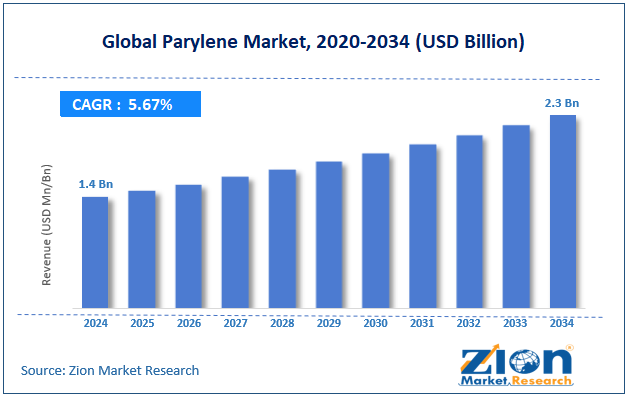
The global parylene market size was worth around USD 1.4 billion in 2024 and is predicted to grow to around USD 2.3 billion by 2034 with a compound annual growth rate (CAGR) of roughly 5.67% between 2025 and 2034.
Key Insights
- As per the analysis shared by our research analyst, the global parylene market is estimated to grow annually at a CAGR of around 5.67% over the forecast period (2025-2034).
- In terms of revenue, the global parylene market size was valued at around USD 1.4 billion in 2024 and is projected to reach USD 2.3 billion by 2034.
- Growth in medical devices & implants is expected to propel the parylene market over the projected period.
- Based on the type, the parylene C segment captures the largest market share in 2024.
- Based on the coating method, the chemical vapour deposition captures the largest revenue share in 2024.
- Based on the application, the electrical insulation segment captures the largest revenue share in 2024.
- Based on the end-use industry, the aerospace segment captures the largest revenue share in 2024.
- Based on region, North America accounted for the highest market share in the parylene market in 2024 of 45%.
Parylene Market: Overview
The term “parylene” refers to a group of polymeric coatings formed by a special coating method called chemical vapor deposition (CVD), which involves applying a vaporized monomer to the substrate to form a thin, smooth, hole-free polymer coating. While liquid-based coatings must be applied to substrates under normal atmospheric conditions, parylene can be applied using vacuum technology, allowing the material to flow smoothly and cover all surfaces and sharp edges of the substrate. In addition to excellent water- and chemical-resistance, parylene possesses very good insulating and biocompatible properties.
Impact of the USA-Israel War on Iran on the Parylene Market
The continuing USA-Israel war against Iran has had an increasingly significant indirect effect on the parylene market through disturbances in energy supply, petrochemicals supplies, and international manufacturing activities. As parylene is derived from petrochemicals, the destruction of energy facilities caused by this war and Iran's subsequent decision to stop exporting petrochemicals have restricted parylene feedstock availability, thereby increasing prices. The conflict in the Middle East has triggered an unprecedented global oil supply shock and several disruptions in the Strait of Hormuz, where a large share of global oil shipments passes, driving up oil and energy prices. Higher energy prices directly raise the cost of manufacturing parylene, as the process of depositing it consumes significant energy. The war has also disrupted international shipping routes, leading to higher shipping costs and slower transit times.
Moreover, as this conflict has disrupted shipping, fewer ships are passing through key shipping straits, meaning fewer vessels will transport the raw materials needed to produce parylene and completed parylene coatings to their final destinations. Finally, in terms of demand for parylene, this war has increased demand in some sectors while reducing it in others due to the increased uncertainty about global economic prospects.
Parylene Market: Dynamics
Growth Drivers
Why does the rising demand for miniaturized electronics drive the parylene market?
One major factor driving the increase in parylene coating use is the ongoing need for electronics, which are shrinking in size while improving functionality. Such products include smartphones, wearables, Internet of Things sensors, and medical electronics, which require highly complex circuitry, whereby conventional coating materials cannot ensure uniformity during application due to their inability to cover sharp edges, corners, and internal components.
Parylene coatings offer an added advantage because they produce thin, uniform films that cover the complex surfaces of miniature electronic devices and, since they undergo chemical vapor deposition, do not add weight or thickness to the device. This makes parylene suitable for protecting electronic devices from dust, chemicals, moisture, and electromagnetic interference, among other factors that may affect their functionality and durability.
Restraints
High production & processing costs hamper the industry growth
Parylene coating processes, characterized by high manufacturing and processing costs owing to the use of sophisticated processes such as chemical vapor deposition (CVD), expensive vacuum chambers, and cleanrooms, usually serve as an inhibitor of adoption rather than a driver of growth in the market. The process is too costly to be adopted by all players and, consequently, is confined to expensive applications such as medical devices, aircraft components, and advanced electronic devices.
On the other hand, the process cost structure can drive market growth by spurring innovation and product differentiation as manufacturers target premium segments and applications where parylene is indispensable.
Opportunities
How does the launch of multilayer coatings offer a lucrative opportunity for the parylene market?
One significant growth driver for the parylene market is the emergence of multilayer coatings, as this approach extends parylene coating capabilities beyond the limits of single-layer applications. Generally, parylene a coating technique based on chemical vapor deposition—is known for its moisture resistance, insulation, and conformal properties. But by combining parylene with other materials, such as metals, oxides, or additional polymers, industry players develop hybrid, multilayered solutions that enhance the performance of the final coating. In this context, multilayer coatings allow the creation of a unique protective film, with each layer responsible for different properties conformity, insulation, barrier properties, etc. This feature makes multilayer coatings essential in the production of sophisticated products, such as flexible electronics, MEMS, implantable medical devices, and other hi-tech components, where single-layered coatings are insufficient to fulfill all necessary functions.
For instance, in October 2025, to further enhance the barrier performance of protective coatings, COAT-X developed a new generation of composite multilayer coatings. This best-in-class protection coating combines parylene and ceramic coating technologies, implemented via atomic layer deposition (ALD) and chemical vapor deposition (CVD). Owing to this achievement, COAT-X provides the CX ULTIMA coating, an ultra-high barrier protection with an unprecedentedly low water vapor transmission rate, as a contract coating service from the company's facilities in Switzerland. The mentioned coating protects highly sensitive components, such as active implantable medical devices (AIMD), from environmental factors, such as moisture. Further development of this technology is embodied in COAT-X's CXC-20 deposition cluster of the latest generation, which integrates ALD/CVD deposition.
Challenges
How does the increasing competition from alternatives pose a significant challenge to the parylene market?
Competition from other coating types is another problem facing the growth of the parylene market, since several other coatings, including acrylates, silicones, epoxides, and urethanes, are less expensive and more convenient to use than parylene. The reason these coatings pose a challenge to parylene is that, unlike parylene, which is applied using sophisticated methods such as chemical vapor deposition that require vacuum conditions, some alternative coatings can be applied conveniently using techniques such as spray application, brushing, and dipping, among others.
In addition, many other types of coating can serve their purpose adequately for protecting equipment against moisture, electrical insulation, and chemical corrosion, among other properties, and thus do not require the use of the expensive parylene coating. They also have other features, including easy repairability after any damage. For this reason, some manufacturers in sectors that cannot afford high costs, such as consumer electronics and general industry, choose alternatives.
Parylene Market: Report Scope
| Report Attributes | Report Details |
|---|---|
| Report Name | Parylene Market |
| Market Size in 2024 | USD 1.4 Billion |
| Market Forecast in 2034 | USD 2.3 Bllion |
| Growth Rate | CAGR of 5.67% |
| Number of Pages | 226 |
| Key Companies Covered | Specialty Coating Systems (SCS), Chireach Group, KISCO Ltd., Curtiss-Wright Corporation, Penta Technology (Suzhou) Co. Ltd., VSi Parylene, Para-Coat Technologies Inc., Advanced Coating, Plasma Ruggedized Solutions, Galentis SRL, Shanghai Parylene Biotechnology Co. Ltd., Diamond-MT, Hunan Nanhua Chemical Co. Ltd., Paratronix Inc., Parylene Coatings Services (PCS), American Durafilm Co. Inc., SCS Coatings, Para Tech Coating, Niche Parylene Coatings, KISCO Conformal Coating LLC, and others. |
| Segments Covered | By Type, By Coating Method, By Application, By End-Use Industry, and By Region |
| Regions Covered | North America, Europe, Asia Pacific (APAC), Latin America, Middle East, and Africa (MEA) |
| Base Year | 2024 |
| Historical Year | 2019 to 2023 |
| Forecast Year | 2025 - 2034 |
| Customization Scope | Avail customized purchase options to meet your exact research needs. Request For Customization |
Parylene Market: Segmentation
Type Insights
Why does the parylene C dominate the parylene market?
The parylene C segment captures the largest market share in 2024. The growth in its revenue is mainly driven by increased demand for the material due to the requirement for moisture, chemical, and environmental resistance in electronics, medical applications, and automotive electronics. The type of Parylene known as Parylene C offers the best balance of low permeability, excellent dielectric strength, and chemical resistance among the various types, and is thus a favored choice for coating printed circuit boards and biomedical components. The fast-growing market for miniature electronics and wearable devices has further fueled its growth.
Coating Method Insights
Do the Chemical Vapour Deposition (CVD) capture the largest market share in the parylene market?
The Chemical Vapour Deposition (CVD) capture the largest revenue share in 2024. This expansion can be attributed to its capability to provide extremely even, conforming, and pinhole-free coatings. Parylene deposition is performed by chemical vapor deposition in a vacuum environment, enabling it to cover difficult geometries, corners, and even internal structures that cannot be coated by traditional methods. This characteristic has led the product to find greater use in growing applications such as microelectronics, medical devices, the aerospace industry, and automotive electronics, where accuracy and reliability are key requirements. Increased demand for advanced protection coatings for small components has been a major factor driving growth in this space.
Application Insights
Why does electrical insulation segment capture the largest market share in the parylene market?
The electrical insulation segment captures the largest revenue share in 2024. Industries need reliable insulation for small and high-performing electronic parts. Parylene coating provides excellent insulation due to its strong dielectric properties and homogeneous coverage achieved through chemical vapor deposition. In addition, its properties have become essential in many applications, including consumer electronic products, automotive electronic products, medical devices, and industrial control systems, among others, to prevent short circuits, signal interference, and electrical leakage. With the increasing performance of electronic products and their shrinking sizes, there is a growing need for innovative insulation technologies, which is encouraging the use of parylene coating.
End-Use Industry Insights
How does aerospace segment capture the largest market share in the parylene market?
The aerospace segment captures the largest revenue share in 2024. It is driven by the rising demand for high-reliability protective coatings in critical operations. This material is often used as a coating for avionics, sensors, circuit boards, and satellite hardware since it offers remarkable resistance to heat, moisture, chemicals, and vacuum. Coating materials using chemical vapor deposition, parylene creates an extremely thin layer that ensures even coating without extra weight, which is crucial for aerospace applications. With rising investments in exploring outer space, launching satellites, and military modernization, demand for durable yet lightweight electronic devices is increasing rapidly.
Regional Insights
Why does North America lead the parylene market?
North America accounted for the largest market share of 45% in 2024. Growth in the region is driven by increasing demand for products in the electronics, automotive, and medical industries, as well as by strict government regulations that favor quality-based coatings. Key players in the region, along with advanced technologies, are playing an important role in expanding the market.
Also, significant investment in R&D is a major factor for the development. Major companies operating in the region include specialty coating systems and parylene market coating services.
Parylene Market: Competitive Analysis
The global parylene market is dominated by players like:
- Specialty Coating Systems (SCS)
- Chireach Group
- KISCO Ltd.
- Curtiss-Wright Corporation
- Penta Technology (Suzhou) Co. Ltd.
- VSi Parylene
- Para-Coat Technologies Inc.
- Advanced Coating
- Plasma Ruggedized Solutions
- Galentis SRL
- Shanghai Parylene Biotechnology Co. Ltd.
- Diamond-MT
- Hunan Nanhua Chemical Co. Ltd.
- Paratronix Inc.
- Parylene Coatings Services (PCS)
- American Durafilm Co. Inc.
- SCS Coatings
- Para Tech Coating
- Niche Parylene Coatings
- KISCO Conformal Coating LLC
The global parylene market is segmented as follows:
By Type
- Parylene C
- Parylene N
- Parylene D
By Coating Method
- Chemical Vapour Deposition
- Physical Vapour Deposition
By Application
- Electrical Insulation
- Consumer Electronics
- Medical Devices
- Automotive Components
By End-Use Industry
- Aerospace
- Telecommunications
- Healthcare
- Semiconductors
By Region
- North America
- The U.S.
- Canada
- Mexico
- Europe
- France
- The UK
- Spain
- Germany
- Italy
- Rest of Europe
- Asia Pacific
- China
- Japan
- India
- Australia
- South Korea
- Rest of Asia Pacific
- The Middle East & Africa
- Saudi Arabia
- UAE
- Egypt
- Kuwait
- South Africa
- Rest of the Middle East & Africa
- Latin America
- Brazil
- Argentina
- Rest of Latin America
Table Of Content
Methodology
FrequentlyAsked Questions
The term “parylene” refers to a group of polymeric coatings formed by a special coating method called chemical vapor deposition (CVD), which involves applying a vaporized monomer to the substrate to form a thin, smooth, hole-free polymer coating.
Key growth drivers for the parylene market include **rising demand for miniaturized electronics, increasing adoption in medical devices, expansion of automotive and aerospace electronics, and the need for high-performance coatings enabled by chemical vapor deposition technology.
Major challenges restraining the growth of the parylene market include **high production and processing costs, complex application processes using chemical vapor deposition, difficult rework and repair, adhesion limitations without surface treatment, and strong competition from lower-cost alternative coatings.
Based on the application, the electrical insulation segment is expected to dominate the parylene market growth during the projected period.
One of the most prominent trends is the development of ultra-thin and nanoscale coatings, enabling protection of highly miniaturized electronic components and advanced semiconductor devices, which is becoming increasingly important as device sizes shrink.
According to the report, the global parylene market size was worth around USD 1.4 billion in 2024 and is predicted to grow to around USD 2.3 billion by 2034.
The global parylene market is expected to grow at a CAGR of 5.67% during the forecast period.
The global parylene industry growth is expected to be led by North America over the forecast period.
The global Parylene market is dominated by players like Specialty Coating Systems (SCS), Chireach Group, KISCO Ltd., Curtiss-Wright Corporation, Penta Technology (Suzhou) Co., Ltd., VSi Parylene, Para-Coat Technologies, Inc., Advanced Coating, Plasma Ruggedized Solutions, Galentis SRL, Shanghai Parylene Biotechnology Co., Ltd., Diamond-MT, Hunan Nanhua Chemical Co., Ltd., Paratronix, Inc., Parylene Coatings Services (PCS), American Durafilm Co., Inc., SCS Coatings, Para Tech Coating, Niche Parylene Coatings and KISCO Conformal Coating, LLC among others.
The market report covers the geographical market along with a comprehensive competitive landscape analysis. It also includes cash flow analysis, profit ratio analysis, market basket analysis, market attractiveness analysis, sentiment analysis, PESTLE analysis, trend analysis, SWOT analysis, trade area analysis, demand & supply analysis, Porter’s five forces analysis, and value chain analysis.

HappyClients

