
Parenteral Packaging Market Size, Share Report, Analysis, Trends, Growth 2032

Parenteral Packaging Market by Material Type (Glass and Plastic), by Product Type (Bags, Ampoules, Vials, Prefilled Syringes and Cartridges, and Ready to Mix Systems), and by Packaging Type (Small-Volume Parenteral and Large-Volume Parenteral): Global Industry Perspective, Comprehensive Analysis and Forecast 2024-2032
| Market Size in 2023 | Market Forecast in 2032 | CAGR (in %) | Base Year |
|---|---|---|---|
| USD 9.84 Billion | USD 23.21 Billion | 10% | 2023 |
How big is the parenteral packaging market?
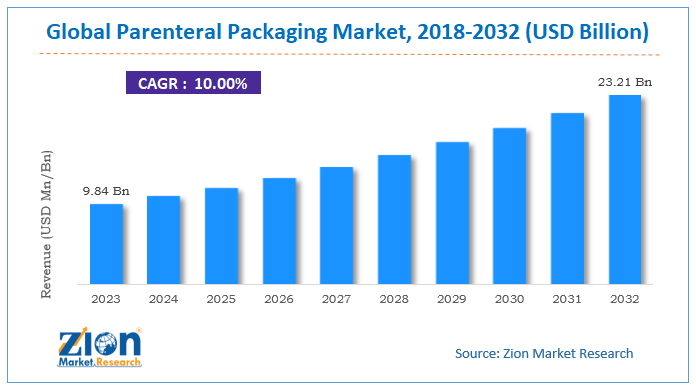
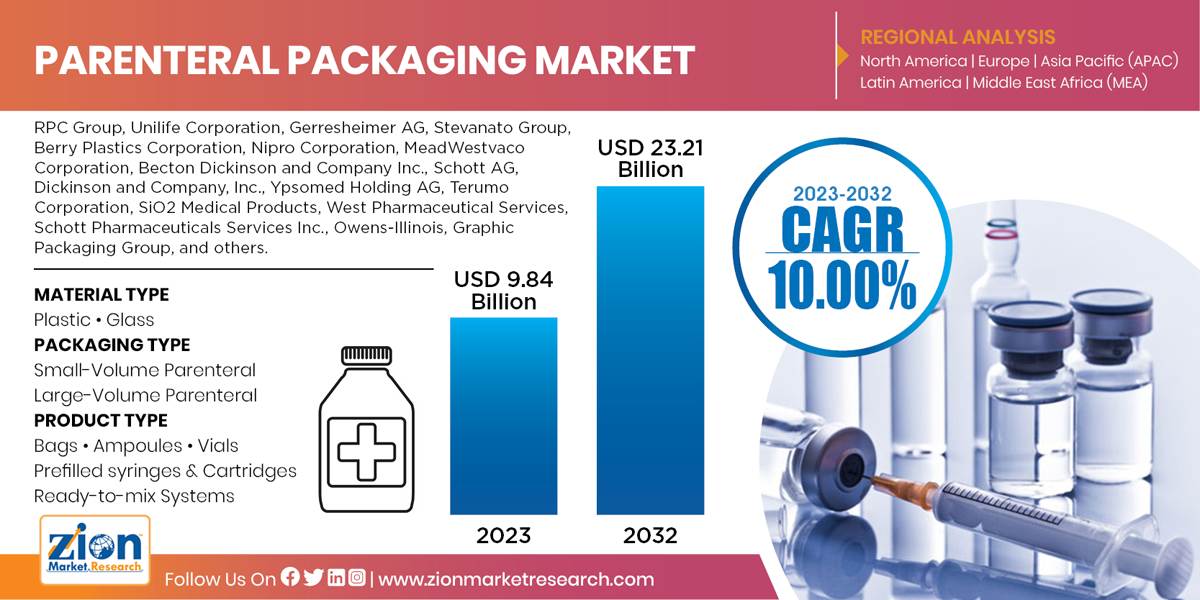
The global Parenteral Packaging market size accrued earnings worth approximately USD 9.84 Billion in 2023 and is predicted to gain revenue of about USD 23.21 Billion by 2032, is set to record a CAGR of nearly 10% over the period from 2024 to 2032.
Key Insights
- As per the analysis shared by our research analyst, the parenteral packaging market is anticipated to grow at a CAGR of 10% during the forecast period.
- The global parenteral packaging market was estimated to be worth approximately USD 9.84 billion in 2023 and is projected to reach a value of USD 23.21 billion by 2032.
- The growth of the parenteral packaging market is being driven by increasing demand for injectable drugs, vaccines, and biologics across the pharmaceutical and biotechnology industries.
- Based on the material type, the plastic segment is growing at a high rate and is projected to dominate the market.
- On the basis of packaging type, the small-volume parenteral segment is projected to swipe the largest market share.
- In terms of product type, the bags segment is expected to dominate the market.
- By region, North America is expected to dominate the global market during the forecast period.
Parenteral Packaging Market Overview
Packaging can be referred as the process of covering, casing, and securing products from any external damage. In the case of pharmaceutical and medical products, parenteral products can be defined as the drugs that are made from sterile suspensions, solutions, and emulsions for infusion purpose during surgical procedures. These products are sterilized as they are anticipated to be administrated directly into the systemic circulation in human beings or animals. Due to their biological composure, the parenteral products or biopharmaceuticals tends to be fragile and are likely to be vulnerable to packaging products. Thus to avoid and eliminate the chances of vulnerability, these biopharmaceuticals are carefully manufactured, stored, and shipped.
Parenteral Packaging Market Growth Analysis
Parenteral packaging market is experiencing the highest growth rate in developed as well as developing countries. The advancements in packaging technology have resulted in upgradation and continuous innovation in the package development in many sectors of the healthcare and pharmaceutical market. The advancement of packaging in the case of parenteral solutions includes green packaging technology where environment-friendly products are encouraged for utilization which further maintains the sustainability by causing no harm to the environment. The raw materials used for parenteral packaging are mainly glass and plastic. The rising popularity for the usage of plastic products for the primary packaging is driving the market growth and development. In addition, with the introduction of biodegradable plastic packaging, the demand for sustainable packaging among the pharmaceutical manufacturers is growing.
Moreover, with the change in lifestyle among people there have also been a rise in the chronic diseases across the globe. The rise in chronic diseases is expected to drive the market. In 2016, according to the American Cancer Society (ACS), it was anticipated that over 1,685,220 cases of cancer were diagnosed and over 589,690 cancer deaths happened in the U.S. because of the factors that directly lead to the path of chronic diseases. Those factors are obesity, smoking tobacco, high consumption of alcoholic beverages, and many more. The rise in prevalence of chronic diseases will increase the number of surgical procedures. Hence, such factors are contributing to the parenteral products which, in turn, will increase the demand for the parenteral packaging market growth over the forecast period.
In order to give the users of this report a comprehensive view of the parenteral packaging market, we have included competitive landscape and analysis of Porter’s Five Forces model for the market. The study encompasses a market attractiveness analysis, wherein material type segment, packaging type segment, and product type segment are benchmarked based on their market size, growth rate, and general attractiveness.
Recent Development
- In September 2024, BD completed the acquisition of Edwards Lifesciences’ Critical Care product group (renamed BD Advanced Patient Monitoring). The acquisition is highly positive as it expands BD’s portfolio of smart, connected care solutions by integrating leading hemodynamic monitoring technologies, including AI-enabled clinical decision tools.
- In May 2024, Gerresheimer announced its agreement to acquire Blitz LuxCo (the holding company of the Bormioli Pharma Group). The transaction was aimed at significantly expanding Gerresheimer's European footprint, boosting its moulded-glass and vial capacity, and establishing a new moulded glass business unit, all of which support its transformation into a full-service provider for the pharma and biotech industries.
- In July 2022, Becton, Dickinson & Company completed its acquisition of Parata Systems. The acquisition significantly bolstered BD's automation and medication-management capabilities by adding Parata's pharmacy automation solutions, which are expected to reduce costs, enhance patient safety, and streamline pharmacy fill/finish and parenteral workflows across various care settings.
Parenteral Packaging Market: Report Scope
| Report Attributes | Report Details |
|---|---|
| Report Name | Parenteral Packaging Market |
| Market Size in 2023 | USD 9.84 Billion |
| Market Forecast in 2032 | USD 23.21 Billion |
| Growth Rate | CAGR of 10% |
| Number of Pages | 198 |
| Key Companies Covered | RPC Group, Unilife Corporation, Gerresheimer AG, Stevanato Group, Berry Plastics Corporation, Nipro Corporation, MeadWestvaco Corporation, Becton Dickinson and Company Inc., Schott AG, Dickinson and Company, Inc., Ypsomed Holding AG, Terumo Corporation, SiO2 Medical Products, West Pharmaceutical Services, Schott Pharmaceuticals Services Inc., Owens-Illinois, Graphic Packaging Group, and others. |
| Segments Covered | By Materials, By Packaging Type, By Product Type, and By Region |
| Regions Covered | North America, Europe, Asia Pacific (APAC), Latin America, Middle East, and Africa (MEA) |
| Base Year | 2023 |
| Historical Year | 2018 - 2022 |
| Forecast Year | 2024 - 2032 |
| Customization Scope | Avail customized purchase options to meet your exact research needs. Request For Customization |
The report provides company market share analysis in order to give a broader overview of the key players in the market. In addition, the report also covers key strategic developments of the market including acquisitions & mergers, new technology launch, agreements, partnerships, collaborations & joint ventures, research & development, technology and regional expansion of major participants involved in the market on global and regional basis. Moreover, the study covers price trend analysis, packaging type portfolio of various companies according to region.
Parenteral Packaging Market Segmentation Analysis
Based on material type, the market is segmented into plastic and glass. Plastic segment is further sub-segmented into polyolefin and PVC. On the basis of product type, the market is categorized into ampoules, vials, prefilled syringes and cartridges bags, and ready to mix systems. Based on packaging type, the parenteral packaging market is bifurcated into small-volume parenteral and large-volume parenteral.
North America is growing at a significant growth rate in the global parenteral packaging market in 2023 and the region is predicted to continue with its regional domination over the forecast period. The growth of this regional market is accredited to the rise in elderly population over the years. Also, the growing health concerns among the people in developed countries are predicted to boost the market growth and development over the forecasted time period. The Asia Pacific is predicted to endow with considerable opportunity for parenteral packaging. The growth is anticipated in the region because of the regulations and implications formed by the government coupled with the FDA in order to counterfeit pharmaceutical products. Manufacturers in the region are adopting methods that could counterfeit products, patient compliance, and drug integrity and credibility among the population. These factors are expected to drive the parenteral packaging market growth over the forecast timeline.
The regional segmentation includes the historic and forecast demand for North America, Europe, Asia Pacific, Latin America, and the Middle East & Africa. This segmentation includes demand for parenteral packaging market based on all segments in all the regions and countries.
The report also includes detailed profiles of end players such as
- RPC Group
- Unilife Corporation
- Gerresheimer AG
- Stevanato Group
- Berry Plastics Corporation
- Nipro Corporation
- MeadWestvaco Corporation
- Becton Dickinson and Company Inc.
- Schott AG
- Dickinson and Company, Inc.
- Ypsomed Holding AG
- Terumo Corporation
- SiO2 Medical Products
- West Pharmaceutical Services
- Schott Pharmaceuticals Services Inc.
- Owens-Illinois
- Graphic Packaging Group, and others.
This report segments the global parenteral packaging market as follows:
By Material Type
- Plastic
- PVC
- polyolefin
- Glass
By Packaging Type
- Small-Volume Parenteral
- Large-Volume Parenteral
By Product type
- Bags
- Ampoules
- Vials
- Prefilled syringes & Cartridges
- Ready-to-mix Systems
By Region
- North America
- The U.S.
- Canada
- Mexico
- Europe
- France
- The UK
- Spain
- Germany
- Italy
- Rest of Europe
- Asia Pacific
- China
- Japan
- India
- Australia
- South Korea
- Rest of Asia Pacific
- The Middle East & Africa
- Saudi Arabia
- UAE
- Egypt
- Kuwait
- South Africa
- Rest of the Middle East & Africa
- Latin America
- Brazil
- Argentina
- Rest of Latin America
Table Of Content
Methodology
FrequentlyAsked Questions
Parenteral packaging is used for injectable drugs and sterile fluids. It ensures safety, contamination prevention, and dosage accuracy.
The global parenteral packaging market is expected to be driven by the injectable drug demand, biologics expansion, and need for sterile and secure pharmaceutical packaging solutions.
According to study, the global parenteral packaging market size was worth around USD 9.84 Billion in 2023 and is predicted to grow to around USD 23.21 Billion By 2032.
The global parenteral packaging market is expected to grow at a Compound Annual Growth Rate (CAGR) of around CAGR 10% during the forecast period from 2024-2032.
The global parenteral packaging industry is projected to be challenged by Major challenges include strict sterility and quality standards, high validation costs, and material compatibility issues. Supply reliability and regulatory inspections increase complexity.
The Opportunities include growth in injectables and biologics, ready-to-use formats, and contamination control. Advanced materials and automation improve safety and efficiency will offer significant growth opportunities in the parenteral packaging market.
Ready-to-use sterile packaging formats; cyclic olefin polymers for drug compatibility; enhanced contamination control systems are the emerging trends and innovations impacting the parenteral packaging market.
The global parenteral packaging market is expected to be led by APAC during the forecast period.
Some of the prominent players operating in the global parenteral packaging market are; RPC Group, Unilife Corporation, Gerresheimer AG, Stevanato Group, Berry Plastics Corporation, Nipro Corporation, MeadWestvaco Corporation, Becton Dickinson and Company Inc., Schott AG, Dickinson and Company, Inc., Ypsomed Holding AG, Terumo Corporation, SiO2 Medical Products, West Pharmaceutical Services, Schott Pharmaceuticals Services Inc., Owens-Illinois, Graphic Packaging Group, and others. and others.
The report explores crucial aspects of the parenteral packaging market, including a detailed discussion of existing growth factors and restraints, while also browsing future growth opportunities and challenges that impact the market.

HappyClients

