
Global Optical Network Equipment Market Size, Share, And Growth Trends, 2032

Optical Network Equipment Market By Application Type (FTTH (Fiber-To-The-Home) And FTTB (Fiber-To-The-Building)), By Technology Type (Asynchronous Transfer Mode PON, Broadband PON, Gigabit PON, And Ethernet PON), And By Region - Global And Regional Industry Overview, Market Intelligence, Comprehensive Analysis, Historical Data, And Forecasts 2024-2032
| Market Size in 2023 | Market Forecast in 2032 | CAGR (in %) | Base Year |
|---|---|---|---|
| USD 25.96 Billion | USD 55.17 Billion | 8.86% | 2023 |
What is Market Size of Optical Network Equipment Industry?
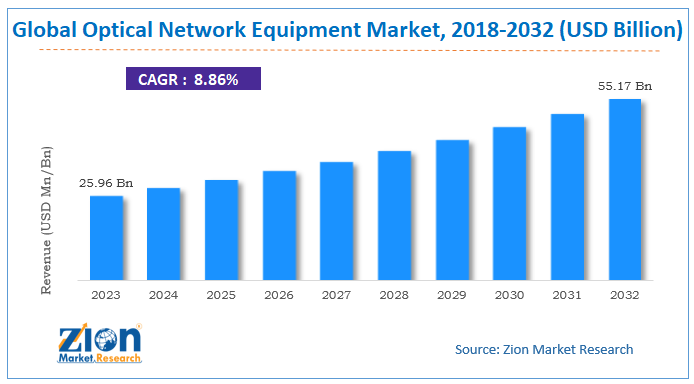
The global optical network equipment market size was worth around USD 25.96 billion in 2023 and is predicted to grow to around USD 55.17 billion by 2032 with a compound annual growth rate (CAGR) of roughly 8.86% between 2024 and 2032. The report covers forecast and analysis for the optical network equipment market on a global and regional level. The study provides historic data of 2018 to 2022 along with a forecast from 2024 to 2032 based on revenue (USD Billion).
Key Insights
- As per the analysis shared by our research analyst, the optical network equipment market is anticipated to grow at a CAGR of 8.86% during the forecast period (2024-2032).
- The global optical network equipment market was estimated to be worth approximately USD 25.96 billion in 2023 and is projected to reach a value of USD 55.17 billion by 2032.
- The growth of the optical network equipment market is being driven by the rising demand for high-speed data transmission, increased internet traffic, and the global rollout of 5G networks.
- Based on the application type, the ftth (fiber-to-the-home) segment is growing at a high rate and is projected to dominate the market.
- On the basis of technology type, the asynchronous transfer mode pon (apon) segment is projected to swipe the largest market share.
- By region, North America is expected to dominate the global market during the forecast period.
Optical Network Equipment Market: Overview
Optical Networking is a method of communication in which the signal is encoded onto light and then is transmitted among various nodes of telecommunication network through an optical fiber. They can be operated from a range of national, international, and transoceanic distances to a limited range of local area network (LAN) and wide area network (WAN). It is a form of optical communication which is carried out by using lasers, optical amplifiers, LED’s, and wave division multiplexing (WDM) to transmit a large number of data with minimum losses and maximum bandwidth. Some of the major components used in optical networking are an optical amplifier, single-mode or multimode fiber, light source - laser or LED, multiplexer or demultiplexer, optical switch, an optical splitter, and circulator, among others.
The study includes drivers and restraints for the optical network equipment market along with the impact they have on the demand over the forecast period. Additionally, the report includes the study of opportunities available in the optical network equipment market on a global level.
This report offers comprehensive coverage of global optical network equipment market along with, market trends, drivers, and restraints of the optical network equipment market. This report includes a detailed competitive scenario and the product portfolio of key vendors. To understand the competitive landscape in the market, an analysis of Porter’s Five Forces model for the market has also been included. The study encompasses a market attractiveness analysis, wherein all segments are benchmarked based on their market size, growth rate, and general attractiveness. This report is prepared using data sourced from in-house databases, secondary and primary research team of industry experts.
Optical Network Equipment Market: Growth Drivers
The optical network equipment is witnessing a huge demand from last few years; further, the demand for this equipment is continuously increasing with each passing day due to increasing demand for bandwidth from both residential and business customers. Websites and companies are asking for more data with faster speed as there is a continuous increase in the number of users of online gaming, chatting, shopping, video surfing, and social networking which is compelling the network provider and equipment manufacturer to meet with the increasing demand of the market and providing necessary infrastructure and equipment that can handle the extensive data traffic with ease.
The optical network equipment came into existence due to its increased transmission capability in the form of optical signals, broader bandwidth with the secure and reliable network over the existing network, which couldn’t provide high-speed data. All these factors are driving the optical network equipment market. Along with this, companies are focusing on advanced emerging technologies due to the increase in the use of mobile smartphones, laptops, and PCs for high-speed data. Thus the optical network equipment market is expected to grow at tremendous speed as it can fulfill the networking requirements for transmitting high-speed data smoothly and in an eco-friendly way.
At the same time, the high initial installation cost of optical networking equipment for operators is a major factor expected to hamper the early adoption of optical network equipment. Due to this, it becomes difficult for small industries to adopt these solutions to overcome higher digital traffic over the network. Other factors such as emerging terabit networking, the rising market of data centers, and an increase in cloud storage by top companies are creating major growth opportunities for the optical network equipment market.
Optical Network Equipment Market: Segmentation
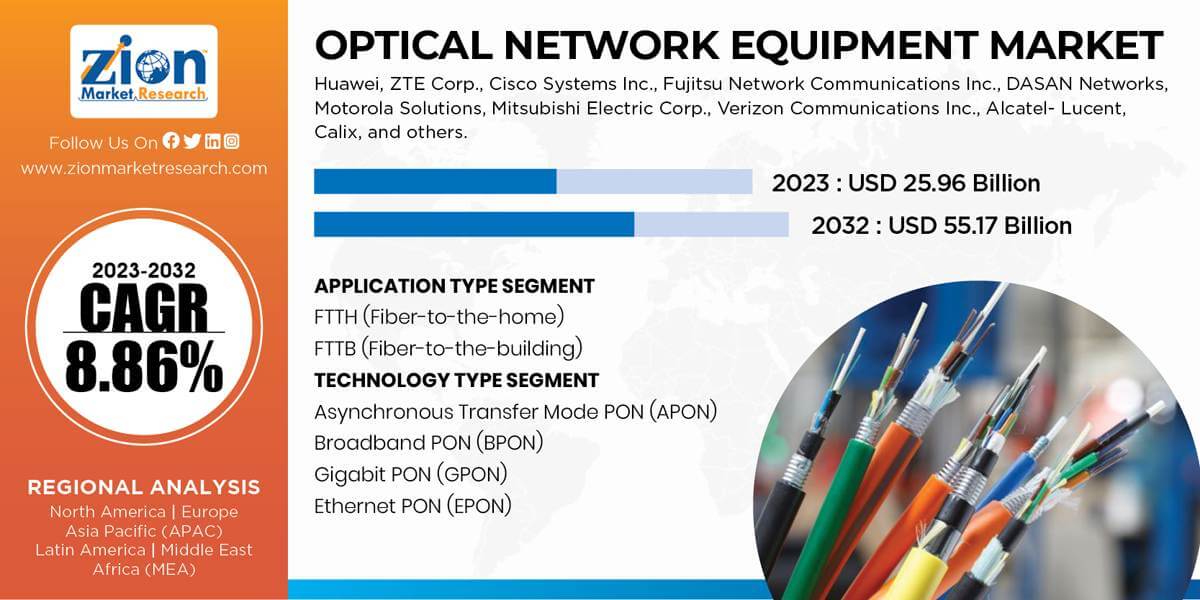
The study provides a decisive view of the optical network equipment market by segmenting the market based on application, technology, and regions. All the segments have been analyzed based on present and the future trends and the market is estimated from 2024 to 2032.
By application type, the market is divided into FTTH (Fiber-to-the-home) and FTTB (Fiber-to-the-building).
On the basis of technology wise the market is segmented into Asynchronous Transfer Mode PON, Broadband PON, Gigabit PON, and Ethernet PON.
On the basis of region, the market is bifurcated into the Middle East and Africa, Europe, Asia Pacific, North America, and Latin America.
Recent Development
- In September 2025, Ciena, the global leader in high-speed connectivity, announced it had entered into a definitive agreement to acquire Nubis Communications, a privately held company based in New Providence, New Jersey. The acquisition of Nubis, which specializes in high-performance, ultra-compact, low-power optical and electrical interconnects for AI workloads, will expand Ciena’s portfolio and add critical talent to address a wider range of opportunities inside the data center.
- In August 2025, Amphenol Corporation announced a definitive agreement to acquire CommScope’s Connectivity and Cable Solutions (CCS) business for $10.5 billion in cash, subject to customary post-closing adjustments. The transaction expands Amphenol’s interconnect product capabilities in the fast-growing IT datacom market, particularly adding fiber optic interconnect products for artificial intelligence and other data center applications, and further diversifies Amphenol’s broad portfolio of fiber optic and other interconnect product solutions in the communications networks and industrial markets.
- In April 2025, MNSi (Managed Network Systems, Inc.), a leading fiber optic internet service provider in Windsor, Ontario, announced its intention to acquire substantially all of the assets of DZS Inc., DZS Services, and DZS California, including but not limited to technology, intellectual property, lab facilities, IT systems, and customer and supplier contracts.
- In December 2024, Adtran and IdeaTek announced their partnership to deploy 50Gbit/s passive optical network (50G PON) technology across Kansas, marking a milestone in advancing connectivity for rural and underserved communities in the region. Building on the deployment of Adtran’s 10G fiber access platform and Wi-Fi 7-enabled mesh gateways, which have already helped IdeaTek expand its subscriber base, the latest collaboration will leverage the 50G PON-capable SDX 6400 Series OLT to deliver services at 10Gbit/s, 20Gbit/s, and beyond.
Optical Network Equipment Market: Report Scope
| Report Attributes | Report Details |
|---|---|
| Report Name | Optical Network Equipment Market Research Report |
| Market Size in 2023 | USD 25.96 Billion |
| Market Forecast in 2032 | USD 55.17 Billion |
| Growth Rate | CAGR of 8.86% |
| Number of Pages | 110 |
| Key Companies Covered | Huawei, ZTE Corp., Cisco Systems Inc., Fujitsu Network Communications Inc., DASAN Networks, Motorola Solutions, Mitsubishi Electric Corp., Verizon Communications Inc., Alcatel- Lucent, Calix, and others |
| Segments Covered | By Application Type, By Technology Type, And By Region |
| Regions Covered | North America, Europe, Asia Pacific (APAC), Latin America, Middle East, and Africa (MEA) |
| Base Year | 2023 |
| Historical Year | 2018 - 2022 |
| Forecast Year | 2024 - 2032 |
| Customization Scope | Avail customized purchase options to meet your exact research needs. Request For Customization |
Optical Network Equipment Market: Competitive Analysis
The report covers a detailed competitive outlook including the market share and company profiles of the key participants operating in the global optical network equipment market include:
- Huawei
- ZTE Corp.
- Cisco Systems Inc.
- Fujitsu Network Communications Inc.
- DASAN Networks
- Motorola Solutions
- Mitsubishi Electric Corp.
- Verizon Communications Inc.
- Alcatel- Lucent
- Calix
The report segments global optical network equipment market as follows:
By Application Type
- FTTH (Fiber-to-the-home)
- FTTB (Fiber-to-the-building)
By Technology Type
- Asynchronous Transfer Mode PON (APON)
- Broadband PON (BPON)
- Gigabit PON (GPON)
- Ethernet PON (EPON)
By Region
- North America
- The U.S.
- Canada
- Mexico
- Europe
- France
- The UK
- Spain
- Germany
- Italy
- Rest of Europe
- Asia Pacific
- China
- Japan
- India
- Australia
- South Korea
- Rest of Asia Pacific
- The Middle East & Africa
- Saudi Arabia
- UAE
- Egypt
- Kuwait
- South Africa
- Rest of the Middle East & Africa
- Latin America
- Brazil
- Argentina
- Rest of Latin America
Table Of Content
Methodology
FrequentlyAsked Questions
Optical network equipment transmits data using light signals. It supports high-speed fiber optic communication
The global Optical Network Equipment market is expected to be driven by the rising data traffic, fiber network expansion, and 5G backhaul needs. Growth of data centers and broadband services boosts demand.
According to study, the global Optical Network Equipment market size was worth around USD 25.96 Billion in 2023 and is predicted to grow to around USD 55.17 Billion By 2032.
The global Optical Network Equipment market is expected to grow at a Compound Annual Growth Rate (CAGR) of around CAGR 8.86% during the forecast period from 2024-2032.
The global Optical Network Equipment industry is projected to be challenged by Challenges include high capex, rapid technology evolution, and intense vendor competition.
The Opportunities include fiber network expansion, data traffic growth, 5G backhaul demand, and hyperscale data center connectivity will offer significant growth opportunities in the Optical Network Equipment market.
400G/800G coherent optics; software-defined and open networking; energy-efficient designs for data centers and 5G are the emerging trends and innovations impacting the Optical Network Equipment market.
The global Optical Network Equipment market is expected to be led by APAC during the forecast period.
Some of the prominent players operating in the global Optical Network Equipment market are; Huawei, ZTE Corp., Cisco Systems Inc., Fujitsu Network Communications Inc., DASAN Networks, Motorola Solutions, Mitsubishi Electric Corp., Verizon Communications Inc., Alcatel- Lucent, Calix, and others and others.
The report explores crucial aspects of the Optical Network Equipment market, including a detailed discussion of existing growth factors and restraints, while also browsing future growth opportunities and challenges that impact the market.

HappyClients

