
Nut Midline Carcinoma Treatment Market Size, Share, Value and Forecast 2034

Nut Midline Carcinoma Treatment Market By Treatment (Chemotherapy, Immunotherapy, Targeted Therapy, Radiation Therapy and Others), By Route of Administration (Oral, Intravenous (IV) and Others), By End Use (Hospitals, Specialty Clinics and Others) and By Region - Global and Regional Industry Overview, Market Intelligence, Comprehensive Analysis, Historical Data, and Forecasts 2026 - 2034
| Market Size in 2025 | Market Forecast in 2034 | CAGR (in %) | Base Year |
|---|---|---|---|
| USD 22.5 Billion | USD 80.4 Billion | 15.2% | 2025 |
Nut Midline Carcinoma Treatment Industry Perspective:
What will be the size of the global nut midline carcinoma treatment market during the forecast period?
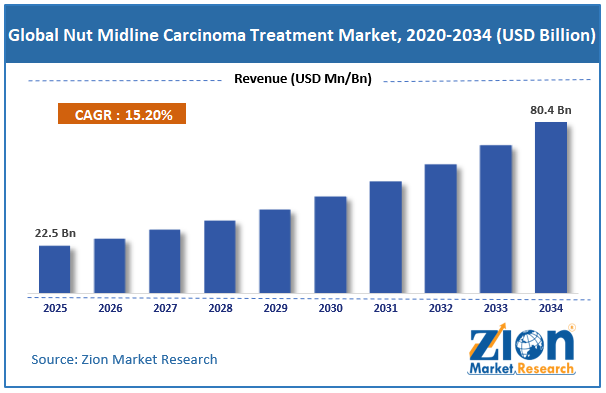
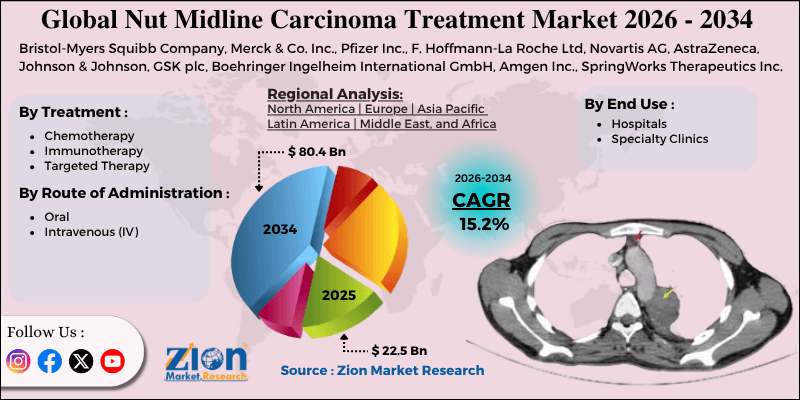
The global nut midline carcinoma treatment market size was worth around USD 22.5 billion in 2025 and is predicted to grow to around USD 80.4 billion by 2034 with a compound annual growth rate (CAGR) of roughly 15.2% between 2026 and 2034.
Nut Midline Carcinoma Treatment Market: Overview
NUT Midline Carcinoma (NMC), formerly known as NUT carcinoma, is an ultra-rare, exceptionally aggressive squamous cell malignancy characterized by a signature genetic mutation in which the NUTM1 gene fuses with another gene, most commonly BRD4. This specific fusion creates an oncoprotein that blocks cellular differentiation and drives rapid, uncontrolled cell proliferation, typically involving midline structures such as the lungs, mediastinum, head, and neck. Because NMC is highly invasive and frequently resistant to standard therapies, there is no single universally curative protocol. Standard treatment strategies prioritize a multimodal approach combining radical surgical resection, high-dose radiation therapy, and aggressive platinum- or ifosfamide-based combination chemotherapy to control local tumor progression.
However, because conventional methods often yield temporary responses that rapidly recur, the definition of NMC management has increasingly shifted toward precision medicine. This includes the implementation of targeted epigenetic therapies—such as bromodomain and extra-terminal (BET) inhibitors and histone deacetylase (HDAC) inhibitors that directly disrupt the BRD4-NUT fusion mechanism—as well as immune checkpoint inhibitors for tumors expressing high levels of PD-L1, often facilitated through early enrollment in specialized clinical trials.
Key Insights
- As per the analysis shared by our research analyst, the global nut midline carcinoma treatment market is estimated to grow annually at a CAGR of around 15.2% over the forecast period (2026-2034).
- In terms of revenue, the global nut midline carcinoma treatment market size was valued at around USD 22.5 billion in 2025 and is projected to reach USD 80.4 billion by 2034.
- Increasing awareness among oncologists and pathologists is expected to propel the nut midline carcinoma treatment market over the projected period.
- Based on the treatment, the chemotherapy segment held the largest revenue share in 2025 of 33%.
- Based on the route of administration, the intravenous category holds a prominent revenue share of 69% in 2025.
- Based on the end use, the hospital segment accounted for the largest revenue share of over 64% in 2025.
- Based on region, North America accounted for the largest market share in 2025 of over 38%.
Impact of the USA-Israel War on Iran on the Nut Midline Carcinoma Treatment Market
The current USA-Israel controversy about Iran is predicted to negatively affect the nut midline carcinoma treatment market, which will be moderate. The condition is very rare and relies heavily on the oncology drug supply chain, clinical trials, diagnostic precision, and advanced therapies. Due to tensions in the Middle East, the region has seen an increase in fuel prices, transportation problems, and uncertainty in pharmaceutical supply chains, which may drive up the costs of producing and distributing cancer medications.
Moreover, global logistics disruptions and possible interruptions to clinical research can further impede the development and availability of new therapies, such as BET inhibitors. Nonetheless, the influence of the situation is expected to be moderate given the market's geographic concentration.
Nut Midline Carcinoma Treatment Market: Dynamics
Growth Drivers
Why does the growing development of BET inhibitors drive the nut midline carcinoma treatment market?
The increasing availability of BET inhibitors is propelling the NUT midline carcinoma treatment market, as such drugs treat the fundamental genetic abnormality associated with the condition, especially the BRD4-NUTM1 fusion, which contributes significantly to tumor proliferation. As such drugs interfere with the function of the fusion protein, they can induce differentiation of cancer cells and prevent tumor growth. The ability of such drugs to offer an improved treatment compared to traditional chemotherapy is spurring research into BET inhibitors and making the rare cancer an area of interest for drug manufacturers.
Restraints
How does the limited availability of approved therapies hamper the growth of the nut midline carcinoma treatment industry?
The lack of FDA-approved drugs limits the development of the NUT Midline Carcinoma Treatment Market, as it constrains treatment options for patients and the adoption of specialized treatments. As NUT carcinoma is considered to be an ultra-rare and extremely aggressive form of cancer, most patients have been found to receive either chemotherapy, radiotherapy, or surgeries that prove less beneficial clinically. This further makes it difficult for stakeholders to gain confidence in this market, owing to the lack of a standardized treatment regime, which ultimately results in low market growth.
Opportunities
Why does the increasing drug approval offer a lucrative opportunity for the nut midline carcinoma treatment market?
The increasing drug approval is expected to offer a lucrative opportunity for the nut midline carcinoma treatment market. For instance, in October 2025, Zenith Epigenetics Ltd. (hereinafter referred to as "Zenith" or the "Company") would like to announce that ZEN-3694 for the treatment of NUT carcinoma has been designated as an orphan drug by the United States Food and Drug Administration ("FDA"). NUT carcinoma is a type of aggressive cancer that currently lacks any approved treatments. The Company previously announced Fast Track designation for ZEN-3694 and intends to seek Breakthrough Therapy designation.
Challenges
Limited availability of approved therapies poses a significant challenge to the nut midline carcinoma treatment market
The scarcity of approved treatments is another factor that will negatively impact market growth, as very few treatments are approved specifically for NUT Midline Carcinoma and, therefore, patients rely on traditional treatments such as chemotherapy, radiation therapy, and surgical intervention, which may not yield effective results. In addition to the restricted scope of approved targeted treatments for NUT Midline Carcinoma, this lack of available drugs leads to lower clinical uptake, delayed guideline development, and reduced confidence among healthcare professionals.
Nut Midline Carcinoma Treatment Market: Report Scope
| Report Attributes | Report Details |
|---|---|
| Report Name | Nut Midline Carcinoma Treatment Market |
| Market Size in 2025 | USD 22.5 Billion |
| Market Forecast in 2034 | USD 80.4 Billion |
| Growth Rate | CAGR of 15.2% |
| Number of Pages | 227 |
| Key Companies Covered | Bristol-Myers Squibb Company, Merck & Co. Inc., Pfizer Inc., F. Hoffmann-La Roche Ltd, Novartis AG, AstraZeneca, Johnson & Johnson, GSK plc, Boehringer Ingelheim International GmbH, Amgen Inc., SpringWorks Therapeutics Inc., Revolution Medicines Inc., Novartis AG, Olema Oncology, Ipsen Pharma, Astex Pharmaceuticals, Nanobiotix, C4 Therapeutics Inc., BeOne Medicines, and others. |
| Segments Covered | By Treatment, By Route of Administration, By End Use, and By Region |
| Regions Covered | North America, Europe, Asia Pacific (APAC), Latin America, Middle East, and Africa (MEA) |
| Base Year | 2024 |
| Historical Year | 2020 - 2024 |
| Forecast Year | 2026 - 2034 |
| Customization Scope | Avail customized purchase options to meet your exact research needs. Request For Customization |
Nut Midline Carcinoma Treatment Market: Segmentation
Treatment Insights
Why does the chemotherapy dominate the nut midline carcinoma treatment market?
The chemotherapy segment held the largest revenue share in 2025 of 33%. Aggressive and rare as NMC is, chemotherapy becomes the most preferable method of treatment that often combines several approaches. Usually, the first thing patients try when they have NMC is chemotherapy because there are no targeted treatments for NMC approved by the authorities yet. In recent developments in NMC treatment, ongoing clinical studies examine combinations of chemotherapy with new therapies, such as BET inhibitors.
As shown above, four ongoing clinical trials on NUT carcinoma are being conducted by researchers at Dana-Farber Cancer Institute, a cancer treatment and research institution for adults and children. For instance, there is a study on a new drug therapy combining two chemotherapy agents, namely etoposide and cisplatin, with a BET bromodomain inhibitor that blocks proteins involved in tumor formation.
Route of Administration Insights
How does the intravenous segment capture the largest market share in the nut midline carcinoma treatment market?
The intravenous category holds a prominent revenue share of 69% in 2025. This has been made necessary by the need for quick, instant action to treat NMC. IV medications offer better availability and faster delivery into the body than oral medications, thereby increasing the likelihood of potent drugs reaching cancer cells. This is because NMC is an aggressive condition that requires immediate treatment in order to achieve positive results. Moreover, many of the chemotherapeutic and other targeted medicines currently exist in intravenous form.
End Use Insights
Does the hospital segment capture the largest market share in the nut midline carcinoma treatment market?
The hospital segment accounted for the largest revenue share of over 64% in 2025. Hospitals have equipment, such as molecular diagnostics and imaging technologies, necessary for proper diagnosis and staging of NMC. Hospitals can offer many treatment options ranging from intravenous chemotherapy to radiation therapy and even targeted treatment, all of which are necessary to ensure effective management of the condition. Hospitals may even have oncology departments and can offer patients the opportunity to participate in clinical trials.
Regional Insights
Why does North America lead the nut midline carcinoma treatment market?
North America accounted for the largest market share in 2025 of over 38%. The market for North America is driven by the high prevalence of advanced medical infrastructure, emphasis on research and development, and favorable regulations. The latest news from North America involves approvals of new oral and IV drugs and research towards precision medicine aimed at improving patient outcomes.
As an example, researchers at Georgetown University have created NMC cell lines (TC-797 and TC1297) from a child patient. Their research identified a set of new chromosomal translocations that contribute to poor prognosis in this disease. The NMC cell lines demonstrated high IGF-IR expression levels in a subset of thymic carcinoma patients with very poor prognoses.
Nut Midline Carcinoma Treatment Market: Competitive Analysis
The global nut midline carcinoma treatment market is dominated by players like:
- Bristol-Myers Squibb Company
- Merck & Co. Inc.
- Pfizer Inc.
- F. Hoffmann-La Roche Ltd
- Novartis AG
- AstraZeneca
- Johnson & Johnson
- GSK plc
- Boehringer Ingelheim International GmbH
- Amgen Inc.
- SpringWorks Therapeutics Inc.
- Revolution Medicines Inc.
- Novartis AG
- Olema Oncology
- Ipsen Pharma
- Astex Pharmaceuticals
- Nanobiotix
- C4 Therapeutics Inc.
- BeOne Medicines
The global nut midline carcinoma treatment market is segmented as follows:
By Treatment
- Chemotherapy
- Immunotherapy
- Targeted Therapy
- Radiation Therapy
- Others
By Route of Administration
- Oral
- Intravenous (IV)
- Others
By End Use
- Hospitals
- Specialty Clinics
- Others
By Region
- North America
- The U.S.
- Canada
- Mexico
- Europe
- France
- The UK
- Spain
- Germany
- Italy
- Rest of Europe
- Asia Pacific
- China
- Japan
- India
- Australia
- South Korea
- Rest of Asia Pacific
- The Middle East & Africa
- Saudi Arabia
- UAE
- Egypt
- Kuwait
- South Africa
- Rest of the Middle East & Africa
- Latin America
- Brazil
- Argentina
- Rest of Latin America
Table Of Content
Methodology
FrequentlyAsked Questions
NUT Midline Carcinoma (NMC), formerly known as NUT carcinoma, is an ultra-rare, exceptionally aggressive squamous cell malignancy characterized by a signature genetic mutation in which the NUTM1 gene fuses with another gene, most commonly BRD4. This specific fusion creates an oncoprotein that blocks cellular differentiation and drives rapid, uncontrolled cell proliferation, typically involving midline structures such as the lungs, mediastinum, head, and neck.
Key growth drivers for the NUT midline carcinoma treatment market include the increasing development of BET inhibitors, advancements in precision oncology and molecular diagnostics, rising investment in rare cancer research, growing clinical trial activity, and increasing awareness leading to earlier and more accurate diagnosis.
Major challenges restraining the growth of the NUT midline carcinoma treatment market include the extremely low disease prevalence, limited availability of approved therapies, difficulties in early and accurate diagnosis, challenges in clinical trial recruitment, high treatment costs, and limited clinical data due to the rarity of the disease.
Based on the treatment, the chemotherapy segment is expected to dominate the nut midline carcinoma treatment market growth during the projected period.
Emerging trends and innovations impacting the NUT midline carcinoma treatment market include the development of BET inhibitors and other epigenetic therapies, advances in genomic profiling and precision medicine, increasing use of biomarker-based diagnostics, growing clinical research on combination therapies, and expanding adoption of targeted treatment approaches for rare cancers.
According to the report, the global nut midline carcinoma treatment market size was worth around USD 22.5 billion in 2025 and is predicted to grow to around USD 80.4 billion by 2034.
The global nut midline carcinoma treatment market is expected to grow at a CAGR of 15.2% during the forecast period.
The global nut midline carcinoma treatment industry growth is expected to be led by North America over the forecast period.
The global nut midline carcinoma treatment market is dominated by players like Bristol-Myers Squibb Company, Merck & Co., Inc., Pfizer Inc., F. Hoffmann-La Roche Ltd, Novartis AG, AstraZeneca, Johnson & Johnson, GSK plc, Boehringer Ingelheim International GmbH, Amgen Inc., SpringWorks Therapeutics, Inc., Revolution Medicines, Inc., Novartis AG, Olema Oncology, Ipsen Pharma, Astex Pharmaceuticals, Nanobiotix, C4 Therapeutics, Inc. and BeOne Medicines among others.
The market report covers the geographical market along with a comprehensive competitive landscape analysis. It also includes cash flow analysis, profit ratio analysis, market basket analysis, market attractiveness analysis, sentiment analysis, PESTLE analysis, trend analysis, SWOT analysis, trade area analysis, demand & supply analysis, Porter’s five forces analysis, and value chain analysis.

HappyClients

