North America Recreational Vehicle Market Size, Share, Value and Forecast 2034

North America Recreational Vehicle Market By Vehicle Type (Travel Trailers, Folding Camp Trailers, Truck Campers, Fifth Wheel Trailers), By Motorhomes Type (Type A, Type B, Type C), By Application (Private, Commercial), and By Region - Regional Market Overview, Market Intelligence, Comprehensive Analysis, Historical Data, and Forecasts 2025 - 2034
| Market Size in 2024 | Market Forecast in 2034 | CAGR (in %) | Base Year |
|---|---|---|---|
| USD 20.16 Billion | USD 38 Billion | 8.25% | 2024 |
North America Recreational Vehicle Industry Perspective:
What will be the size of the North America recreational vehicle market during the forecast period?
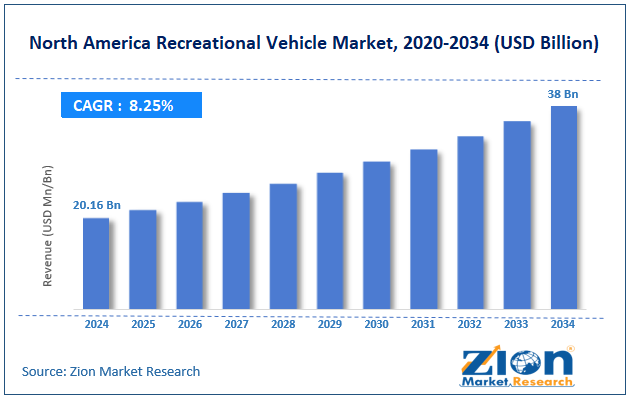
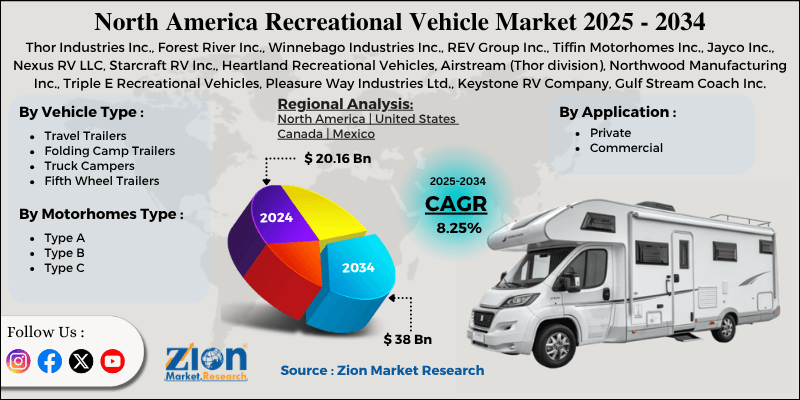
The North America recreational vehicle market size was around USD 20.16 billion in 2024 and is projected to reach USD 38 billion by 2034, with a compound annual growth rate (CAGR) of roughly 8.25% between 2025 and 2034.
Key Insights
- The North America recreational vehicle market is expected to grow at an annual CAGR of about 8.25% from 2025 to 2034.
- In terms of revenue, the North America recreational vehicle market size was valued at around USD 20.16 billion in 2024 and is projected to reach USD 38 billion by 2034.
- The North America recreational vehicle market is projected to grow significantly owing to an aging population seeking travel leisure, fuel-efficient RV models, and the expansion of RV rental services.
- Based on vehicle type, the travel trailers segment is expected to lead the market, while the fifth-wheel segment is expected to grow considerably.
- Based on motorhome type, the type C segment is the dominating segment, while the type B segment is projected to witness sizeable revenue over the forecast period.
- Based on application, the private segment is expected to lead the market, followed by the commercial segment.
- By region, the United States is projected to dominate the market during the forecast period, followed by Canada.
North America Recreational Vehicle Market: Overview
A recreational vehicle is a towable or motorized vehicle designed for temporary living and travel, combining transportation with cooking, sleeping, and bathroom facilities. Common types include campervans, motorhomes, fifth-wheel trailers, and travel trailers, offering diverse levels of amenities and comfort. The North America recreational vehicle market is projected to witness substantial growth driven by the growing adventure and outdoor travel trend, increased remote work flexibility, and strong economic conditions and disposable income. Growing interest in nature-based and outdoor travel is driving demand for RVs as consumers seek self-contained trips. Recreational vehicles eliminate lodging constraints, attracting families and millennials alike. This cultural shift towards experiential travel is fueling strong market growth. Hybrid and remote work models allow longer road trips without disturbing careers. RVs function as mobile offices, smoothly blending with productivity. This flexibility is expanding the user base beyond retirees. Furthermore, economic resilience and rising disposable income in the region support purchases of high-value leisure assets, such as recreational vehicles. Consumers willingly invest in lifestyle products. Financing options also lower upfront costs.
Although drivers exist, the market faces challenges such as fuel price volatility and storage and maintenance costs. Large RVs consume more fuel, leading to unstable gas prices for owners. Growing fuel costs may hamper long-distance travel and lower use frequency. This unpredictability hinders industry growth. Likewise, RVs need secure storage when not in use, which many urban residents lack. These burdens decrease overall ownership appeal.
Even so, the North America recreational vehicle industry is well-positioned due to the development of hybrid and electric RVs and subscription and rental models. Improvements in lightweight and battery materials create potential for hybrid and electric RV models. Lower life-cycle costs and reduced emissions attract eco-conscious consumers. This improvement can unveil fresh customer segments. Additionally, RV subscription and peer-to-peer rental platforms reduce barriers to entry for occasional users. Flexible use without ownership lowers financial commitment. Growing rental infrastructure accelerates industry penetration.
Impact of the USA-Israel war on Iran on the North America Recreational Vehicle Market
The conflict has significantly increased gasoline and oil prices due to market uncertainty and disrupted supply routes, such as the Strait of Hormuz, leading to escalating fuel costs in the United States and higher travel expenses for RV owners. High energy prices and weak consumer confidence are cooling discretionary spending on high-ticket recreational products, such as RVs. Economic volatility and lengthy inflationary pressures may slow the regional market growth as consumers prioritize essentials over new leisure vehicle purchases.
North America Recreational Vehicle Market: Dynamics
Growth Drivers
How is Remote Work Driving Growth in the North America Recreational Vehicle Market?
The shift toward hybrid and remote work arrangements has made RVs viable long-term work and living solutions, expanding the North America recreational vehicle market beyond leisure buyers. Professionals are leveraging mobile lifestyles, turning RVs into mobile offices with connectivity features, which is fueling sustained interest. Reports predict accelerating growth, with RV demand driven by lifestyle flexibility that enables work-while-travel patterns. This widens the buyer base from retirees to young, tech-oriented consumers who prefer freedom and anonymity in their location. As mobility becomes normalized in work culture, RV use extends beyond vacations into daily life.
How are Technological Innovations transforming the North America Recreational Vehicle Market?
Technological improvements are reshaping the recreational vehicle experience, with manufacturers incorporating energy-efficient features, connectivity, and smart controls. Advanced RVs are embedded with IoT-enabled monitoring, lightweight construction, and solar power options, allowing sustainability and convenience. These advancements attract digital nomads and young buyers who value efficient, connected lifestyles on the road. Tech adoption also supports entertainment needs and remote work, making RVs viable living spaces beyond recreational use. As functionality grows, RVs compete directly with traditional homes for lifestyle versatility.
Restraints
How are Storage and Space Limitations restricting Recreational Vehicle ownership in North America?
Several suburban and urban homes lack space to store or park RVs, forcing owners into expensive off-site facilities. Municipal constraints on street parking for large vehicles add a logistical burden that deters ownership. Storage expenses may rival insurance costs over time for casual users. This practical obstacle disproportionately impacts city dwellers and young buyers with limited property space. Hence, a segment of potential buyers opts for rental over ownership.
Opportunities
How are After-Sales Services and Financing Options creating opportunities in the North America Recreational Vehicle Market?
Improving after-sales services, such as maintenance plans, extended warranties, and roadside assistance, enhances long-term ownership value. Creative financing solutions, such as low-interest packages and leasing options, make purchases more accessible. Dealer networks that expand their service infrastructure create recurring revenue and strengthen brand loyalty.
Altogether, these trends help reduce obstacles to entry and enhance customer retention. These services can differentiate brands in a competitive landscape, providing opportunities in the North America recreational vehicle industry.
Challenges
How does Limited Consumer Awareness Challenge Recreational Vehicle adoption in North America?
Despite growing interest, several potential buyers lack awareness of total ownership costs, maintenance requirements, and campground logistics. Misalignment between real-world RV ownership and buyer expectations may lead to dissatisfaction. Educating users on product features, lifestyle trade-offs, and financing remains vital. Dealer and manufacturer outreach strategies should evolve to remove knowledge gaps. Enhancing upfront guidelines may reach buyer hesitation.
North America Recreational Vehicle Market: Report Scope
| Report Attributes | Report Details |
|---|---|
| Report Name | North America Recreational Vehicle Market |
| Market Size in 2024 | 20.16 Billion |
| Market Forecast in 2034 | 38 Billion |
| Growth Rate | CAGR of 8.25% |
| Number of Pages | 228 |
| Key Companies Covered | Thor Industries Inc., Forest River Inc., Winnebago Industries Inc., REV Group Inc., Tiffin Motorhomes Inc., Jayco Inc., Nexus RV LLC, Starcraft RV Inc., Heartland Recreational Vehicles, Airstream (Thor division), Northwood Manufacturing Inc., Triple E Recreational Vehicles, Pleasure Way Industries Ltd., Keystone RV Company, Gulf Stream Coach Inc., and others. |
| Segments Covered | By Vehicle Type, By Motorhomes Type, By Application, and By Region |
| Regions Covered in North America | The U.S., Canada, Mexico, and Rest of North America |
| Base Year | 2024 |
| Historical Year | 2019 to 2023 |
| Forecast Year | 2025 - 2034 |
| Customization Scope | Avail customized purchase options to meet your exact research needs. Request For Customization |
North America Recreational Vehicle Market: Segmentation
The North America recreational vehicle market is segmented based on vehicle type, motorhome type, application, and region.
Why is the Travel Trailers segment projected to dominate the North America recreational vehicle market?
Based on vehicle type, the North America recreational vehicle industry is divided into travel trailers, folding camp trailers, truck campers, and fifth-wheel trailers. The travel trailer segment holds a leading market share of over 60%. They hold the largest share of towable RV sales, typically the bulk of the industry, due to their versatility, affordability, and broader consumer adoption.
Conversely, the fifth wheel trailers segment captures second place with approximately 28% share, the largest share in the towable RV market. This growth is backed by their larger living space and prominence among long-term or frequent users.
What factors help the Type C segment lead the North America recreational vehicle market?
Based on motorhome type, the North America recreational vehicle market is segmented into type A, type B, and type C. The Class C segment holds leadership with 42% market share because they balance functionality, size, and cost, thereby increasing its appeal to a wider range of buyers, such as retirees and families. The over-cab sleeping area and spacious interior offer practical living space without the high cost of large motorhomes. Their ease of driving compared to larger Class A units appeals to both experienced and first-time RV users. Also, strong resale values and different floor plans help maintain this demand.
However, the Class B segment ranks second in market share due to its van-based and compact design, which suits urban access and fuel efficiency. These models attract mobile and younger buyers, as well as digital nomads who value maneuverability and low operating costs. Their versatility for everyday use as both a travel vehicle and a living space widens their customer base. With growing interest in flexible, minimalist lifestyles, Class B units continue to attract attention across diverse age groups.
What are the key reasons for the leadership of the Private segment in the North America Recreational Vehicle Market?
Based on application, the market is segmented into private and commercial. The private segment ranks second, accounting for nearly 70% of the total RV market value, as most purchases are for leisure travel, lifestyle mobility, and vacations.
Nonetheless, the commercial segment ranks second with 31% of the total market. This is fueled by the rising adoption of RVs as mobile offices, hospitality units, clinics, and other business applications. The segment also grows considerably as businesses increasingly recognize the cost benefits and flexibility of RV-based solutions for on-the-go services.
North America Recreational Vehicle Market: Regional Analysis
What enables the United States strong foothold in the North America Recreational Vehicle Market?
The United States is likely to sustain its leadership in the North America recreational vehicle market, with a 7.5-8% CAGR, driven by a large and affluent consumer base, well-developed RV infrastructure, and cultural affinity for road trips. The United States dominates the market due to its large, developed consumer base with high disposable income, enabling broader adoption of RVs for lifestyle and leisure travel. Retirees and families make up the core demographic, driving consistent demand for motorized and towable RVs. Another major factor is the mature RV infrastructure, including extensive campgrounds, highways, RV parks, and service facilities. This convenience makes RV travel highly accessible and boosts longer trips, driving usage frequency and sales.
Furthermore, cultural affinity for outdoor recreation and road trips also plays a vital role. Americans have a long-standing tradition of exploring national parks, rural areas, and coastlines by road, making RVs a preferred option for comfort, flexibility, and self-contained travel.
Why does Canada rank second in the North America Recreational Vehicle Market?
Canada continues to hold the second-highest share, with an 8-8.5% CAGR in the North America recreational vehicle industry, owing to high disposable income and leisure spending, abundant natural attractions, and well-developed RV infrastructure. Canada has a wealthy, lifestyle-focused population with high spending power, supporting purchases of RVs for vacations, seasonal travel, and weekend getaways. Families and retirees make up the majority of the consumer base, fueling steady demand for a wide range of RV types. The country’s vast natural landscapes, scenic routes, and national parks encourage RV travel, making self-contained mobility increasingly appealing. Outdoor recreation is deeply ingrained in Canadian culture, driving RV use in several provinces.
Additionally, Canada benefits from an extensive network of highways, campgrounds, and RV service networks, especially in regions known for tourism. Accessible infrastructure makes long-distance and seasonal RV trips more convenient, supporting elevated adoption rates.
North America Recreational Vehicle Market: Competitive Analysis
The leading players in the North America recreational vehicle market are:
- Thor Industries Inc.
- Forest River Inc.
- Winnebago Industries Inc.
- REV Group Inc.
- Tiffin Motorhomes Inc.
- Jayco Inc.
- Nexus RV LLC
- Starcraft RV Inc.
- Heartland Recreational Vehicles
- Airstream (Thor division)
- Northwood Manufacturing Inc.
- Triple E Recreational Vehicles
- Pleasure Way Industries Ltd.
- Keystone RV Company
- Gulf Stream Coach Inc.
What are the key trends in the North America Recreational Vehicle Market?
Rising outdoor recreation & experience‑based travel:
Consumers in the region increasingly seek outdoor adventure, road trips, and camping, driving demand for RVs as a flexible solution. This shift is significantly influenced by a cultural focus on wellness, nature, and getaway vacations, which RVs uniquely support. As road trips become more popular than conventional travel, RV use continues to expand across most groups.
Expansion of rental and sharing platforms:
Peer-to-peer sharing and digital RV rental platforms are lowering barriers to entry and expanding access to RV travel without ownership. These platforms primarily attract occasional and younger users who value affordability and flexibility. Growth in rentals usually leads to eventual purchases by new RV adopters, broadening the industry base.
The North America recreational vehicle market is segmented as follows:
By Vehicle Type
- Travel Trailers
- Folding Camp Trailers
- Truck Campers
- Fifth Wheel Trailers
By Motorhomes Type
- Type A
- Type B
- Type C
By Application
- Private
- Commercial
By Region
- North America
- United States
- Canada
- Mexico
Table Of Content
Methodology
FrequentlyAsked Questions
A recreational vehicle is a towable or motorized vehicle designed for temporary living and travel, combining transportation with cooking, sleeping, and bathroom facilities. Common types include campervans, motorhomes, fifth-wheel trailers, and travel trailers, offering diverse levels of amenities and comfort.
The North America recreational vehicle market is projected to grow due to rising disposable income, increasing domestic tourism, and technological advancements (such as smart RVs).
According to a study, the North America recreational vehicle market size was around USD 20.16 billion in 2024 and is expected to grow to around USD 38 billion by 2034.
The CAGR value of the North America recreational vehicle market is expected to be around 8.25% during 2025-2034.
Class C motorhomes are projected to lead the market by 2034, because they offer the best balance of drivability, affordability, and spacious living, appealing to families and first-time recreational vehicle buyers.
Emerging trends shaping the North America recreational vehicle market include hybrid RVs and electrification, growth of rental/subscription models, smart connectivity and IoT integration, lightweight and sustainable designs, and digital/virtual buying experiences.
The United States drives the majority of North America’s recreational vehicle market because it has high disposable income, the largest consumer base, a strong culture of road travel, and extensive RV infrastructure.
The key players profiled in the North America recreational vehicle market include Thor Industries, Inc., Forest River Inc., Winnebago Industries Inc., REV Group Inc., Tiffin Motorhomes Inc., Jayco Inc., Nexus RV LLC, Starcraft RV Inc., Heartland Recreational Vehicles, Airstream (Thor division), Northwood Manufacturing Inc., Triple E Recreational Vehicles, Pleasure Way Industries Ltd., Keystone RV Company, and Gulf Stream Coach Inc.
Leading players are expanding their market presence through digital sales platforms, product innovation, expanded dealer networks, strategic collaborations, and rental/subscription service offerings.
The report examines key aspects of the North America recreational vehicle market, including a detailed analysis of existing growth factors and restraints, as well as future growth opportunities and challenges that will impact the market.

HappyClients