
New Oral Anticoagulants Market Size, Share, Value and Forecast 2034

New Oral Anticoagulants Market By Drug Type (Dabigatran (Pradaxa), Apixaban (Eliquis), Rivaroxaban (Xarelto), Betrixaban (Bevyxxa), and Edoxaban (Savaysa/Lixiana)), By Application (Pulmonary Embolism (PE), Deep Vein Thrombosis (DVT), Stroke Prevention, and Atrial Fibrillation (AF), and Others), By Distribution Channel (Retail Pharmacies, Hospital Pharmacies, and Online Pharmacies), and By Region - Global and Regional Industry Overview, Market Intelligence, Comprehensive Analysis, Historical Data, and Forecasts 2026 - 2034
| Market Size in 2025 | Market Forecast in 2034 | CAGR (in %) | Base Year |
|---|---|---|---|
| USD 42.5 Billion | USD 79.6 Billion | 7.22% | 2025 |
New Oral Anticoagulants Industry Perspective:
What is the anticipated size of the new oral anticoagulants market during the projection period?
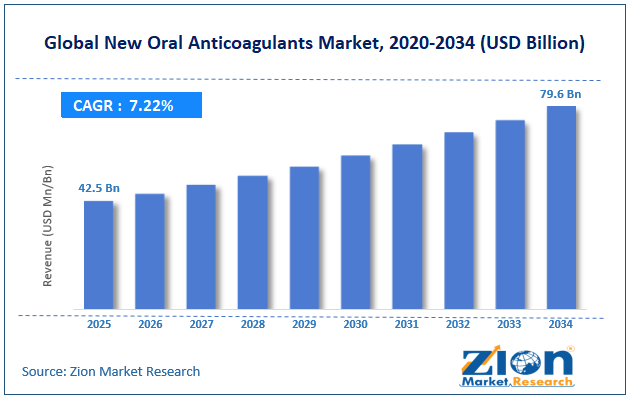
The global new oral anticoagulants market size was worth around USD 42.5 billion in 2025 and is predicted to grow to around USD 79.6 billion by 2034, with a compound annual growth rate (CAGR) of roughly 7.22% between 2026 and 2034.
Key Insights:
- As per the analysis shared by our research analyst, the global new oral anticoagulants market is estimated to grow annually at a CAGR of around 7.22% over the forecast period (2026-2034)
- In terms of revenue, the global new oral anticoagulants market size was valued at around USD 42.5 billion in 2025 and is projected to reach USD 79.6 billion, by 2034.
- The new oral anticoagulants market is projected to grow at a significant rate due to a growing geriatric population, rising AF-related cases, and higher demand for preventive medicines.
- Based on the drug type, the Apixaban (Eliquis) segment is growing at a high rate and will continue to dominate the global market as per industry projections.
- Based on the application, the deep vein thrombosis (DVT) segment is projected to generate the highest CAGR of 6.12%.
- Based on the distribution channel, online pharmacies are anticipated to generate a CAGR of 7.21% during the forecast period.
- Based on region, North America is projected to dominate the global market during the forecast period.
New Oral Anticoagulants Market: Overview
New oral anticoagulants (NOACs) are an emerging class of novel medicines for blood thinning. They are expected to replace existing anticoagulants in the coming years because of their high efficiency and superior performance. The main new oral anticoagulants are Apixaban, Dabigatran, Rivaroxaban, and Edoxaban. They are primarily used in treatments concerning deep-vein thrombosis (DVT), atrial fibrillation (AF), prevention of stroke/systemic embolism, and pulmonary embolism (PE). During the forecast period, demand for new oral anticoagulants is expected to be driven by a growing geriatric population, rising AF-related cases, and higher demand for preventive medicines. However, safety concerns and concerns over patent expiration will affect market revenue in the long run.
Impact of the USA-Israel and Iran war on the New Oral Anticoagulants Market:
The USA-Israel and Iran war is expected to primarily affect the supply chain of pharmaceutical raw materials. Additionally, this conflict is expected to impact logistics costs and partnership strategies between international collaborators. However, the long-term impact will be negligible, as demand for NOACs is expected to continue growing as pressure on the existing healthcare infrastructure intensifies.
New Oral Anticoagulants Market: Dynamics
Growth Drivers
Why will growing cases of atrial fibrillation drive demand in the new oral anticoagulants market?
The global new oral anticoagulants market is expected to benefit as demand for atrial fibrillation medicines and treatments grows. Anticoagulants assist in blood thinning and hence are an effective drug class for reducing stroke risk. Atrial fibrillation (AFib) is an irregular heart rhythm, also known as an arrhythmia. Frequent irregularities in heart rhythm can lead to blood clot formation in the heart. This, in turn, increases the risk of stroke and severe heart failure. AFib can be caused by several factors. For instance, a congenital heart defect, a birth defect, can lead to atrial fibrillation. Other causes include heart attack, lung disease, viral infections, high blood pressure, and blocked arteries. According to the US Centers for Disease Control and Prevention (CDC), more than 12.1 million people in the country are expected to develop AFib by 2050.
Increasing shift toward preventive care to drive market revenue in the coming years
New oral anticoagulants are used for preventive treatment to prevent blood clot formation in patients at higher risk. NOACs inhibit the production of specific clotting factors. According to market research, new oral anticoagulants are used in patients with atrial fibrillation or after knee/hip replacement and Venous Thromboembolism (VTE), Pulmonary Embolism (PE), and Deep Vein Thrombosis (DVT) treatments. The global new oral anticoagulants market will continue to benefit as medical treatments shift toward preventive care instead of reactive treatment.
Restraints
Which health risks will limit expansion of the new oral anticoagulants industry?
The global new oral anticoagulants industry is projected to be restricted due to several health risks associated with the novel drug class. Industry analysis suggests that NOAC use can lead to life-threatening bleeding in some cases, especially in elderly or high-risk patients. In addition, the industry also suffers from low patient compliance and adherence to prescribed medicines. This can raise doubts about long-term drug effectiveness.
Opportunities
Why are increased regulatory approvals expected to create growth opportunities for the new oral anticoagulants market players?
The global new oral anticoagulants market is anticipated to generate growth opportunities due to a surge in regulatory approvals worldwide. In 2025, the US Food & Drug Administration (FDA) announced the approval of the first generic versions of the anticoagulant rivaroxaban. It is being marketed as Xarelto and reduces the risk of major cardiovascular events in adults suffering from peripheral artery disease (PAD) and coronary artery disease (CAD). In addition, the European Medicines Agency (EMA) recently updated its assessment and approval for Xarelto for pediatric applications. Under the new approval, Xarelto can now be used for treating children with venous thromboembolism (VTE) recurrence.
Which factors are pulling new oral anticoagulants companies toward emerging markets?
Emerging economies are witnessing rapid expansion of healthcare infrastructure. Favorable government policies and growing pressure on existing healthcare systems are driving demand for novel, effective medical solutions such as NOACs. In addition, global healthcare agencies such as the World Bank, World Health Organization, and United Nations International Children’s Emergency Fund (UNICEF) have amplified their efforts to make medical care accessible to all, creating growth avenues for NOAC providers.
Challenges
High cost and limited infrastructure challenge industry growth trends
The global new oral anticoagulants industry is projected to face challenges from high treatment costs and ineffective healthcare infrastructure across emerging economies. Generic anticoagulants are easily available at affordable prices. However, NOACs are relatively costlier. In addition, lack of clinical evidence confirming drug effectiveness across all patient groups may further affect industry adoption.
New Oral Anticoagulants Market: Report Scope
| Report Attributes | Report Details |
|---|---|
| Report Name | New Oral Anticoagulants Market |
| Market Size in 2025 | USD 42.5 Billion |
| Market Forecast in 2034 | USD 79.6 Billion |
| Growth Rate | CAGR of 7.22% |
| Number of Pages | 229 |
| Key Companies Covered | Boehringer Ingelheim, Dr. Reddy’s Laboratories, Bristol-Myers Squibb, Sandoz, Sun Pharmaceutical Industries, Zydus Lifesciences, Pfizer Inc., Johnson & Johnson, Teva Pharmaceutical Industries, Viatris, Lupin Limited, Teva Pharmaceutical Industries, GSK plc, Sanofi, Daiichi Sankyo, Bayer AG, and others. |
| Segments Covered | By Drug Type, By Application, By Distribution Channel, and By Region |
| Regions Covered | North America, Europe, Asia Pacific (APAC), Latin America, Middle East, and Africa (MEA) |
| Base Year | 2025 |
| Historical Year | 2020 - 2024 |
| Forecast Year | 2026 - 2034 |
| Customization Scope | Avail customized purchase options to meet your exact research needs. Request For Customization |
New Oral Anticoagulants Market: Segmentation
The global new oral anticoagulants market is segmented based on drug type, application, distribution channel, and region.
Why will the apixaban segment lead the new oral anticoagulants industry revenue during the forecast period?
Based on drug type, the global market segments are Dabigatran (Pradaxa), Apixaban (Eliquis), Rivaroxaban (Xarelto), Betrixaban (Bevyxxa), and Edoxaban (Savaysa/Lixiana). In 2025, the Apixaban (Eliquis) segment had the highest market growth. It accounted for 33% of the total market share and will grow at a CAGR of 8.89% during the projection period. Higher application of Apixaban in AFib and VT treatments will fuel segmental expansion in the coming years.
Which will be the fastest-growing application during the forecast period in the new oral anticoagulants market?
Based on application, the global new oral anticoagulants industry is divided into pulmonary embolism (PE), deep vein thrombosis (DVT), stroke prevention, and atrial fibrillation (AF), among others. In 2025, the atrial fibrillation (AF) segment held the largest market share. It accounted for 53% of the total revenue. The deep vein thrombosis (DVT) segment is projected to generate the highest CAGR of 6.12%, driven by an aging population, higher surgical interventions, and improving diagnosis rates.
Which factors drive demand in the online pharmacies segment in the new oral anticoagulants industry?
Based on distribution channel, the global market segments are retail pharmacies, hospital pharmacies, and online pharmacies. In 2025, retail pharmacies accounted for 47.2% of the global revenue. During the forecast period, online pharmacies are expected to grow at a CAGR of 7.21%. Increasing launch of digital pharmacy applications and their advantages, such as home delivery, wider options, and prescription-refill services, will drive segmental growth.
New Oral Anticoagulants Market: Regional Analysis
Why will North America lead the new oral anticoagulants market in the coming years?
The global new oral anticoagulants market is currently led by North America. In 2025, it accounted for the majority of the global revenue and will grow at a strong CAGR during the forecast period. A robust, well-established healthcare infrastructure is a primary driver of regional market growth. In addition, increasing research & development (R&D), a clear and comprehensive regulatory framework for clinical trials and approvals, and a high patient awareness rate will add to regional revenue in the coming years.
Why will Asia-Pacific generate the fastest CAGR in the new oral anticoagulants market during the forecast period?
Asia-Pacific is expected to emerge as the fastest-growing region in the new oral anticoagulants market with a significant CAGR during the forecast period. Rising cardiovascular disease prevalence, increasing healthcare investment, favorable government policies, and an aging population will drive regional growth. China, India, Japan, and South Korea will lead growth across Asia-Pacific. The region is also expected to witness higher investments in domestic R&D.
New Oral Anticoagulants Market: Competitive Analysis
The global new oral anticoagulants market is led by players like:
- Boehringer Ingelheim
- Dr. Reddy’s Laboratories
- Bristol-Myers Squibb
- Sandoz
- Sun Pharmaceutical Industries
- Zydus Lifesciences
- Pfizer Inc.
- Johnson & Johnson
- Teva Pharmaceutical Industries
- Viatris
- Lupin Limited
- Teva Pharmaceutical Industries
- GSK plc
- Sanofi
- Daiichi Sankyo
- Bayer AG
What are the latest key trends in the new oral anticoagulants market?
NOACs with reduced risk
Market players are working on developing new oral anticoagulants that do not pose significant bleeding risk to patients. Safer NOACs will promote wider adoption across medical infrastructure.
Integrating personalized medicine with NOACs
Demand for personalized care has grown worldwide. Tailored treatments deliver better results. Integrating personalized medical care programs with NOACs will open new growth avenues for the industry leaders.
The global new oral anticoagulants market is segmented as follows:
By Drug Type
- Dabigatran (Pradaxa)
- Apixaban (Eliquis)
- Rivaroxaban (Xarelto)
- Betrixaban (Bevyxxa)
- Edoxaban (Savaysa/Lixiana)
By Application
- Pulmonary Embolism (PE)
- Deep Vein Thrombosis (DVT)
- Stroke Prevention
- Atrial Fibrillation (AF)
- Others
By Distribution Channel
- Retail Pharmacies
- Hospital Pharmacies
- Online Pharmacies
By Region
- North America
- The U.S.
- Canada
- Mexico
- Europe
- France
- The UK
- Spain
- Germany
- Italy
- Rest of Europe
- Asia Pacific
- China
- Japan
- India
- Australia
- South Korea
- Rest of Asia Pacific
- The Middle East & Africa
- Saudi Arabia
- UAE
- Egypt
- Kuwait
- South Africa
- Rest of the Middle East & Africa
- Latin America
- Brazil
- Argentina
- Rest of Latin America
Table Of Content
Methodology
FrequentlyAsked Questions
New oral anticoagulants (NOACs) are an emerging class of novel medicines for blood thinning.
The global new oral anticoagulants market is expected to benefit as demand for atrial fibrillation medicines and treatments grows.
According to study, the global new oral anticoagulants market size was worth around USD 42.5 billion in 2025 and is predicted to grow to around USD 79.6 billion by 2034.
The CAGR value of the new oral anticoagulants market is expected to be around 7.22% during 2026-2034.
The global new oral anticoagulants industry is projected to be challenged by high cost of treatment and ineffective healthcare infrastructure across emerging economies.
NOACs with reduced risk and integrating personalized medicine with NOACs are the emerging trends and innovations impacting the new oral anticoagulants market.
The global new oral anticoagulants market has performed well so far and will offer similar trends in the coming years.
North America will contribute notably towards the new oral anticoagulants market value.
The global new oral anticoagulants market is led by players like Boehringer Ingelheim, Dr. Reddy’s Laboratories, Bristol-Myers Squibb, Sandoz, Sun Pharmaceutical Industries, Zydus Lifesciences, Pfizer Inc., Johnson & Johnson, Teva Pharmaceutical Industries, Viatris, Lupin Limited, Teva Pharmaceutical Industries, GSK plc, Sanofi, Daiichi Sankyo, and Bayer AG.
The report explores crucial aspects of the new oral anticoagulants market, including a detailed discussion of existing growth factors and restraints, while also browsing future growth opportunities and challenges that impact the market.

HappyClients

