
Global Natural Cosmetics Market Size, Share, Growth Trends, and Forecast 2032

Natural Cosmetics Market By Product Type (Skincare, Makeup, Body Care, and Hair Care), By Distribution Channel (Specialty Stores, E-Commerce, Department Stores, Direct Sales, and Pharmacies), and By Region - Global and Regional Industry Overview, Market Intelligence, Comprehensive Analysis, Historical Data, and Forecasts 2024 - 2032
| Market Size in 2023 | Market Forecast in 2032 | CAGR (in %) | Base Year |
|---|---|---|---|
| USD 49 Billion | USD 77 Billion | 5% | 2023 |
Natural Cosmetics Industry Perspective
What will be the global natural cosmetics market size during the forecast period?
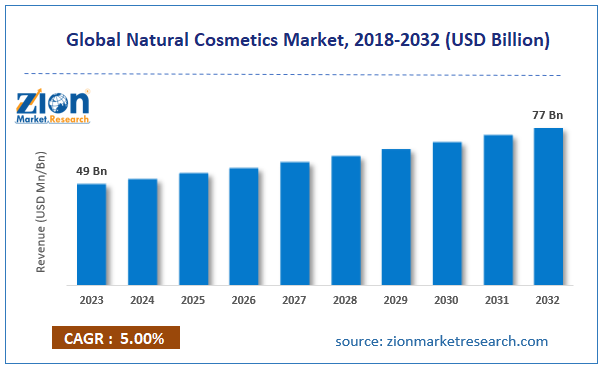
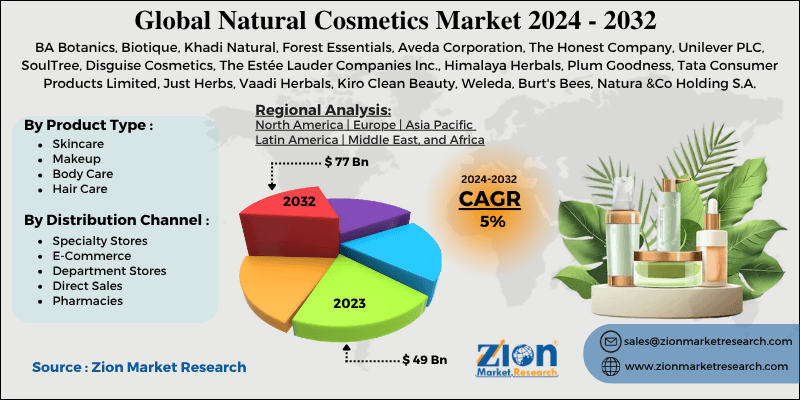
The global natural cosmetics market size was evaluated at USD 49 billion in 2023 and is slated to reach USD 77 billion by the end of 2032, with a CAGR of nearly 5% between 2024 and 2032.
This report provides a comprehensive analysis of the growth drivers, restraints, and challenges shaping demand across the global natural cosmetics market throughout the forecast period, while highlighting high-potential emerging opportunities within the industry.
Key Insights
- As per the analysis shared by our research analyst, the global natural cosmetics market is projected to expand at an annual growth rate of around 5% over the forecast time span (2024-2032)
- In terms of revenue, the global natural cosmetics market size was evaluated at nearly $49 billion in 2023 and is expected to reach $77 billion by 2032.
- The global natural cosmetics market is expected to grow rapidly over the forecast period due to the widespread availability of organic products through specialty stores, digital platforms, and retailers.
- By product type, the skincare segment is expected to dominate the market over the forecast period.
- Based on distribution channel, the e-commerce segment is predicted to dominate the global industry surge in the ensuing years.
- Region-wise, the Asia-Pacific natural cosmetics industry is projected to register the fastest CAGR during the assessment timespan.
Natural Cosmetics Market: Overview
Natural cosmetics are formulated mainly from natural ingredients, such as minerals, plants, and other naturally occurring substances. Moreover, these products are designed to be gentle on the skin, making them suitable for individuals with sensitive skin or allergies owing to the absence of harsh chemicals.
Natural Cosmetics Market: Growth Factors
Escalating consciousness of health problems to prop up the global market surge by 2032
Surging awareness among customers about health issues such as allergies and skin irritation caused by synthetic chemicals is likely to prop up the growth of the global natural cosmetics market. Moreover, the growing trend towards the use of clean-labeled products and ethical issues such as cruelty-free product manufacturing will drive the global market expansion.
The huge availability of organic products through specialty stores, digital platforms, and retailers will embellish the global market progression. Product innovations encompassing advanced extraction methods, along with the launch of new botanical ingredients, will increase the size of the global market. Preference for clean beauty trends and globalization will bolster the global market surge in the years ahead. An increase in the working women population has culminated in a huge demand for cosmetics that are organic in nature, thereby driving the global market trends.
Natural Cosmetics Market: Restraints
Surging manufacturing prices and limited longevity can retard the global industry surge over 2024-2032
A rise in production costs and the short lifespan of the product can retard the growth of the global natural cosmetics industry. Apart from this, a lack of uniformity in laws regulating the use of the product can further inhibit the progress of the global industry. Cutthroat competition from industry players can hamper the global industry surge in the years ahead.
Natural Cosmetics Market: Opportunities
Thriving online retail activities impacting consumer purchasing behavior to impact the global market surge
Flourishing e-commerce sector and the rising focus on sustainability among customers influencing their purchasing decisions will open new growth avenues for the global natural cosmetics market. Supportive government policies and favorable legislation are expected to shape the growth of the market globally. The focus of firms on targeting the millennial and Gen Z population will steer the expansion of the market across the globe.
Natural Cosmetics Market: Challenges
Escalating product prices may put brakes on the industry's upsurge over the period from 2024 to 2032
Huge costs and limited efficiency of the product can challenge the expansion of the global natural cosmetics industry. Moreover, issues associated with apt product labeling are anticipated to hinder the growth of the industry across the globe.
Natural Cosmetics Market: Report Scope
| Report Attributes | Report Details |
|---|---|
| Report Name | Natural Cosmetics Market |
| Market Size in 2023 | USD 49 Billion |
| Market Forecast in 2032 | USD 77 Billion |
| Growth Rate | CAGR of 5% |
| Number of Pages | 224 |
| Key Companies Covered | BA Botanics, Biotique, Khadi Natural, Forest Essentials, Aveda Corporation, The Honest Company, Unilever PLC, SoulTree, Disguise Cosmetics, The Estée Lauder Companies Inc., Himalaya Herbals, Plum Goodness, Tata Consumer Products Limited, Just Herbs, Vaadi Herbals, Kiro Clean Beauty, Weleda, Burt's Bees, Natura &Co Holding S.A., L'Oréal S.A., and others. |
| Segments Covered | By Product Type, By Distribution Channel, and By Region |
| Regions Covered | North America, Europe, Asia Pacific (APAC), Latin America, Middle East, and Africa (MEA) |
| Base Year | 2023 |
| Historical Year | 2018 - 2022 |
| Forecast Year | 2024 - 2032 |
| Customization Scope | Avail customized purchase options to meet your exact research needs. Request For Customization |
Natural Cosmetics Market: Segmentation
The global natural cosmetics market is divided into product type, distribution channel, and region. All the segments of the report have been analyzed based on present and future trends and the market is estimated from 2024 to 2032.
In terms of product type, the natural cosmetics market across the globe is segmented into skincare, makeup, body care, and hair care segments. The skincare segment is likely to be the leading segment among various product types during the forecast timeframe. The rapid growth of this segment can be due to key driving factors, including surging skin health awareness, diverse product offerings, and a focus on holistic wellness.
On the basis of distribution channels, the global natural cosmetics industry is bifurcated into specialty stores, e-commerce, department stores, direct sales, and pharmacies segments. Furthermore, the e-commerce segment is likely to dominate the growth of the global industry in the next eight years. The key factors driving the segmental expansion are its wide reach, accessibility, convenience, and personalized experiences. The launch of direct-to-consumer models is projected to provide impetus to the segmental sphere.
Natural Cosmetics Market: Regional Insights
Europe is projected to maintain a leading position in the global market over the analysis timeframe
Europe, which contributed approximately half of the global natural cosmetics market earnings in 2023, is anticipated to maintain a dominant position in the next decade. Apparently, the rapid progression of the market in Europe over the forecast timespan can be due to surging customer awareness pertaining to personal care & hygiene. In addition, the growing preference for organic products will drive the market surge in Europe.
The Asia-Pacific natural cosmetics industry is set to record the highest CAGR in the forecast period. The industry expansion in the region can be credited to rising per capita income, increasing awareness about the advantages offered by natural ingredients, and supportive government laws. Moreover, China and India are predicted to be the key regional revenue growth drivers.
Natural Cosmetics Market: Competitive Space
The global natural cosmetics market profiles key players such as:
- BA Botanics
- Biotique
- Khadi Natural
- Forest Essentials
- Aveda Corporation
- The Honest Company
- Unilever PLC
- SoulTree
- Disguise Cosmetics
- The Estée Lauder Companies Inc.
- Himalaya Herbals
- Plum Goodness
- Tata Consumer Products Limited
- Just Herbs
- Vaadi Herbals
- Kiro Clean Beauty
- Weleda
- Burt's Bees
- Natura &Co Holding S.A.
- L'Oréal S.A.
Segments Covered
The global natural cosmetics market is segmented as follows:
By Product Type
- Skincare
- Makeup
- Body Care
- Hair Care
By Distribution Channel
- Specialty Stores
- E-Commerce
- Department Stores
- Direct Sales
- Pharmacies
By Region
- North America
- The U.S.
- Canada
- Mexico
- Europe
- France
- The UK
- Spain
- Germany
- Italy
- Rest of Europe
- Asia Pacific
- China
- Japan
- India
- Australia
- South Korea
- Rest of Asia Pacific
- The Middle East & Africa
- Saudi Arabia
- UAE
- Egypt
- Kuwait
- South Africa
- Rest of the Middle East & Africa
- Latin America
- Brazil
- Argentina
- Rest of Latin America
Table Of Content
Methodology
FrequentlyAsked Questions
Natural cosmetics are formulated mainly from ingredients sourced from nature, such as minerals, plants, and other naturally occurring substances.
The global natural cosmetics market's growth over the forecast period can be attributed to product innovations encompassing advanced extraction methods and the launch of new botanical ingredients.
According to a study, the global natural cosmetics industry size was 49 billion in 2023 and is projected to reach $77 billion by the end of 2032.
The global natural cosmetics market is anticipated to record a CAGR of nearly 5% from 2024 to 2032.
The Asia-Pacific natural cosmetics industry is set to register the fastest CAGR over the forecasting timeframe.
The global natural cosmetics market is led by players such as Janitronics Facility Services, ServiceMaster Global Holdings Inc., ABM Industries Inc., Jani-King International Inc., Stanley Steemer International Inc., ISS World Services A/S, CleanNet USA Inc., Coverall North America Inc., Compass Group PLC, Sodexo, Vanguard Cleaning Systems Inc., Sunshine Cleaning Systems, Inc., Stratus Building Solutions, SELECT Commercial Services, Aramark Corporation, Eagle Clean Group, Chem-Dry, Pritchard Industries Inc., Sonlight Cleaning Service, Inc., MasterCorp, Inc., Almighty Cleaning, Inc., and Anago Cleaning Systems.
The global natural cosmetics market report covers the geographical market along with a comprehensive competitive landscape analysis. It also includes cash flow analysis, profit ratio analysis, market basket analysis, cash-benefit analysis, market attractiveness analysis, sentiment analysis, PESTEL analysis, trend analysis, SWOT analysis, trade area analysis, demand & supply analysis, Porter’s five force analysis, factor analysis, and value chain analysis. It provides an apt scenario about demand and factor conditions in the country impacting the profitability of the firms in the domestic and international markets.

HappyClients

