
Microgrid As A Service Market Size, Growth, Global Trends, Forecast 2034

Microgrid As A Service Market By Grid Type (Islanded and Grid Connected), By Service (Operational & Maintenance Services, Software Services, Engineering & Design Services, and Monitoring Services), and By Region - Global and Regional Industry Overview, Market Intelligence, Comprehensive Analysis, Historical Data, and Forecasts 2025 - 2034
| Market Size in 2024 | Market Forecast in 2034 | CAGR (in %) | Base Year |
|---|---|---|---|
| USD 3.82 Billion | USD 6.51 Billion | 9.36% | 2024 |
Microgrid As A Service Industry Perspective:
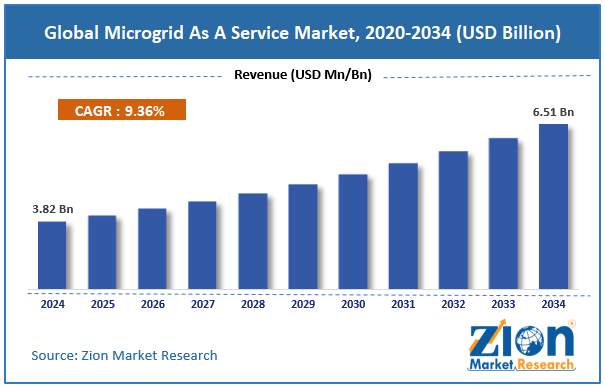
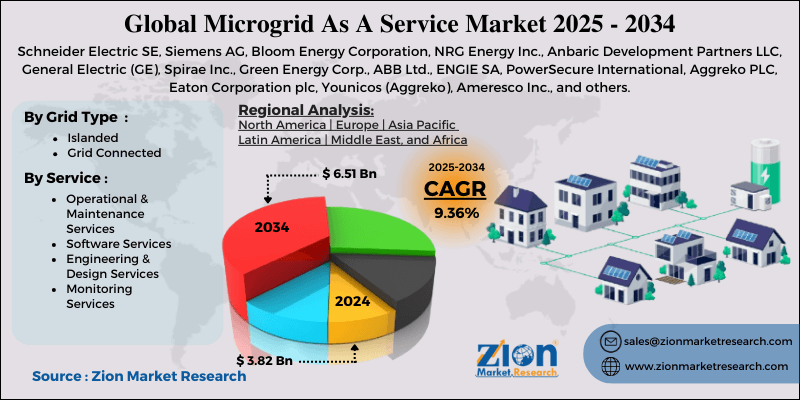
The global microgrid as a service market size was worth around USD 3.82 billion in 2024 and is predicted to grow to around USD 6.51 billion by 2034, with a compound annual growth rate (CAGR) of roughly 9.36% between 2025 and 2034.
Key Insights:
- As per the analysis shared by our research analyst, the global microgrid as a service market is estimated to grow annually at a CAGR of around 9.36% over the forecast period (2025-2034)
- In terms of revenue, the global microgrid as a service market size was valued at around USD 3.82 billion in 2024 and is projected to reach USD 6.51 billion by 2034.
- The microgrid as a service market is projected to grow at a significant rate due to the demand for energy security, which continues to escalate worldwide
- Based on the grid type, the grid-connected segment is growing at a high rate and will continue to dominate the global market, as per industry projections
- Based on the service, the monitoring services segment is anticipated to command the largest market share
- Based on region, the Asia-Pacific is projected to dominate the global market during the forecast period
Microgrid As A Service Market: Overview
Microgrid-as-a-Service refers to an arrangement in which a third party is responsible for managing all aspects of a microgrid. According to the United States Department of Energy, a microgrid is an interconnected system of loads and distributed energy resources that have clearly defined electrical boundaries. This group of loads acts as a single controllable entity with respect to the grid. Microgrids are generally developed to provide reliable electricity to a localized area such as a military base, university campus, hospital campus, or a specific geographical location. Developing a standalone microgrid is a resource-intensive process, leading to the emergence of third parties that deliver microgrid-as-a-service solutions.
In addition, the growing demand for reliable energy worldwide and the development of smart cities are expected to propel the global microgrid-as-a-service market. On the other hand, the industry players can explore more growth opportunities by integrating with renewable energy sources such as wind and solar power. On the other hand, limited adoption of the concept in major parts of the world, along with cost and cybersecurity concerns, may impact the rapid expansion of the industry during the forecast period.
Microgrid As A Service Market Dynamics
Growth Drivers
Why will the growing demand for energy security fuel growth in the microgrid as a service market?
The global microgrid as a service market is expected to witness steady growth as demand for energy security continues to escalate worldwide. All economies worldwide, including developed and developing nations, are seeking novel solutions to ensure uninterrupted supply to citizens and industrial units at affordable prices. The growing political and social instability across the globe, along with severe natural disasters, pose a significant threat to the consistent supply of energy.
Frequent disruptions in energy supply can lead to economic and social losses to an economy. Microgrids offer an excellent alternative to traditional means of energy supply. Since microgrids are self-contained, they tend to operate in island mode and hence deliver power without any external support. Microgrid-as-a-service can help economies meet local energy demands, ensuring a limited impact on the economy. Microgrid-as-a-service solutions are scalable and more cost-effective than independent microgrid facilities.
Favorable government policies and incentives to attract more revenue in the market
In recent times, government support toward promoting the adoption of microgrid solutions has improved worldwide. Regional governments are offering extensive support to initiatives or developing ideas concerning the deployment of microgrid solutions by professional service providers. For instance, states in the US, such as Colorado and California, have started offering incentives and grants for projects related to microgrid systems.
In June 2025, the US government allocated USD 8 million in funds and technical assistance to over 14 microgrid projects in the country. In October 2025, China launched a 5-year plan to strengthen and accelerate new energy industries along with grid resilience. Government support and favorable policies will remain critical to the expansion strategies adopted by the global microgrid as a service market provider in the coming years.
Restraints
How will limited service adoption in emerging economies restrict the microgrid as a service market growth?
The global industry for microgrid as a service is expected to be restricted to limited adoption of the solution in emerging economies. According to industry analysis, the majority of nations continue to rely on conventional methods of power generation and distribution to meet regional energy demands. Microgrids are novel concepts and hence witness limited integration in energy or power infrastructure worldwide. Lack of public awareness and the absence of sufficient numbers of players in the market can impact the overall growth rate of the industry in the coming years.
Opportunities
Integration with other renewable energy sources to offer novel expansion opportunities to industry players
The global microgrid as a service market is projected to come across new growth opportunities in the form of integration with other renewable energy sources, such as solar and wind power. For instance, market players can ensure optimal performance and meet regulatory standards by developing microgrid-as-a-service solutions powered by clean, renewable energy sources. In addition, integrating the entire setup with next-generation technologies such as Artificial Intelligence (AI) and the Internet of Things (IoT) can improve service performance and add value.
How will the development of smart cities and factories create growth opportunities for the microgrid as a service industry?
Smart cities and industrial facilities have higher energy demand. In addition, achieving energy efficiency is a critical point to be considered when developing a next-generation smart residential unit or an intelligent factory. Microgrid-as-a-service solutions can help smart cities and factories achieve energy reliability and flexibility. According to official statistics, the global smart city market is expected to reach over USD 3.5 trillion by 2030. These investments can open new avenues for extended growth for microgrid-as-a-service providers.
Challenges
Cost barriers and regulatory complexities challenge market growth trends
The global microgrid as a service industry is projected to be challenged by the existing cost barriers in the market. Developing a microgrid-as-a-service model is a resource-intensive process for service providers, as it requires extensive funds to build and maintain the systems. Additionally, a lack of standard policies governing the industry and price regulations may discourage the entry of new players in the market. Irregular or unregulated policies can affect business decisions and subsequently lead to diminished profit margins for the players.
Microgrid As A Service Market: Report Scope
| Report Attributes | Report Details |
|---|---|
| Report Name | Microgrid As A Service Market |
| Market Size in 2024 | USD 3.82 Billion |
| Market Forecast in 2034 | USD 6.51 Billion |
| Growth Rate | CAGR of 9.36% |
| Number of Pages | 212 |
| Key Companies Covered | Schneider Electric SE, Siemens AG, Bloom Energy Corporation, NRG Energy Inc., Anbaric Development Partners LLC, General Electric (GE), Spirae Inc., Green Energy Corp., ABB Ltd., ENGIE SA, PowerSecure International, Aggreko PLC, Eaton Corporation plc, Younicos (Aggreko), Ameresco Inc., and others. |
| Segments Covered | By Grid Type, By Service, and By Region |
| Regions Covered | North America, Europe, Asia Pacific (APAC), Latin America, Middle East, and Africa (MEA) |
| Base Year | 2024 |
| Historical Year | 2019 to 2023 |
| Forecast Year | 2025 - 2034 |
| Customization Scope | Avail customized purchase options to meet your exact research needs. Request For Customization |
Microgrid As A Service Market: Segmentation
The global microgrid as a service market is segmented based on grid type, service, and region.
Based on grid type, the global market is segmented into islanded and grid-connected. In 2024, the highest growth was listed in the grid-connected segment due to several advantages associated with the type. Grid-connected solutions offer greater reliability, higher resilience, and improved energy efficiency. Furthermore, they can be easily integrated with renewable energy sources, which will affect market decisions in the long run.
Based on service, the global market segments are operational & maintenance services, software services, engineering & design services, and monitoring services. In 2024, the highest market share was led by monitoring services. The segmental growth rate is a result of increased requirements for tracking solutions during the operational phase of microgrid-as-a-service. Furthermore, the software services segment will be influenced by growing technological advancements in the market.
Microgrid As A Service Market: Regional Analysis
Why is the microgrid as a service market dominated by Asia-Pacific?
The global microgrid as a service market is expected to be led by Asia-Pacific during the forecast period. Australia, India, China, Japan, and South Korea will emerge as leading revenue generators in the region. Growth in Asia-Pacific will be driven by the rising adoption of microgrid-as-a-service solutions across major regions. Regional energy demand in the Asia-Pacific is growing at an unprecedented rate, driving the need to deploy innovative solutions to meet energy requirements. In October 2025, China launched the largest of its kind smart microgrid project in the country’s Jiangsu Province. Such initiatives indicate increased regional focus on achieving energy reliability.
North America is expected to emerge as the fastest-growing market during the forecast period. An increase in government- and private-sector funding for microgrid infrastructure will promote regional expansion. Additionally, integration of microgrid-as-a-service solutions with existing renewable energy architecture may reshape regional industry growth trends in the future. In recent news, the US Department of Energy announced USD 2.2 billion in investments to upgrade the country’s existing grid infrastructure and to promote clean energy.
Microgrid As A Service Market: Competitive Analysis
The global microgrid as a service market is led by players like:
- Schneider Electric SE
- Siemens AG
- Bloom Energy Corporation
- NRG Energy Inc.
- Anbaric Development Partners LLC
- General Electric (GE)
- Spirae Inc.
- Green Energy Corp.
- ABB Ltd.
- ENGIE SA
- PowerSecure International
- Aggreko PLC
- Eaton Corporation plc
- Younicos (Aggreko)
- Ameresco Inc.
Microgrid As A Service Market: Key Market Trends
Applications in healthcare settings
The growing automation in healthcare settings, including hospital campuses and universities, will open new growth avenues for microgrid-as-a-service providers. The rapid increase in patient numbers, the need for improved data management systems, and the growing demand for energy security in healthcare facilities are key growth drivers in the industry.
Expansion into new markets
Market players are increasingly seeking opportunities to expand services in new markets. They are specifically targeting developing economies that are witnessing a sudden surge in energy demand. Furthermore, an increase in infrastructure development projects will improve revenue for market players.
The global microgrid as a service market is segmented as follows:
By Grid Type
- Islanded
- Grid Connected
By Service
- Operational & Maintenance Services
- Software Services
- Engineering & Design Services
- Monitoring Services
By Region
- North America
- The U.S.
- Canada
- Europe
- France
- The UK
- Spain
- Germany
- Italy
- Rest of Europe
- Asia Pacific
- China
- Japan
- India
- South Korea
- Southeast Asia
- Rest of Asia Pacific
- Latin America
- Brazil
- Mexico
- Rest of Latin America
- Middle East & Africa
- GCC
- South Africa
- Rest of Middle East & Africa
Table Of Content
Methodology
FrequentlyAsked Questions

HappyClients

