
Medical Radiation Shielding Market Size, Share, Trends, Growth 2034

Medical Radiation Shielding Market By Product Type (X-ray Shields, MRI Shields, Gamma Shields, and Neutron Shields), By Material (Lead-based Shielding, Hybrid Shielding, and Non-lead Shielding), By Application (Diagnostics, Nuclear Medicine, and Therapeutics), By End-Use (Hospitals & Clinics, Diagnostic Imaging Centers, and Others), and By Region - Global and Regional Industry Overview, Market Intelligence, Comprehensive Analysis, Historical Data, and Forecasts 2025 - 2034
| Market Size in 2024 | Market Forecast in 2034 | CAGR (in %) | Base Year |
|---|---|---|---|
| USD 1.6 Billion | USD 3.2 Billion | 7.20% | 2024 |
Medical Radiation Shielding Industry Perspective:
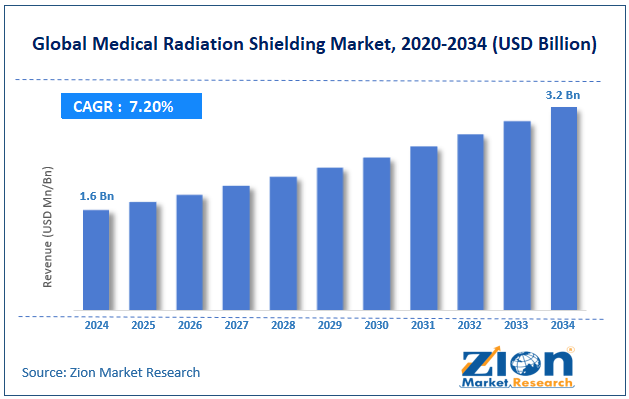
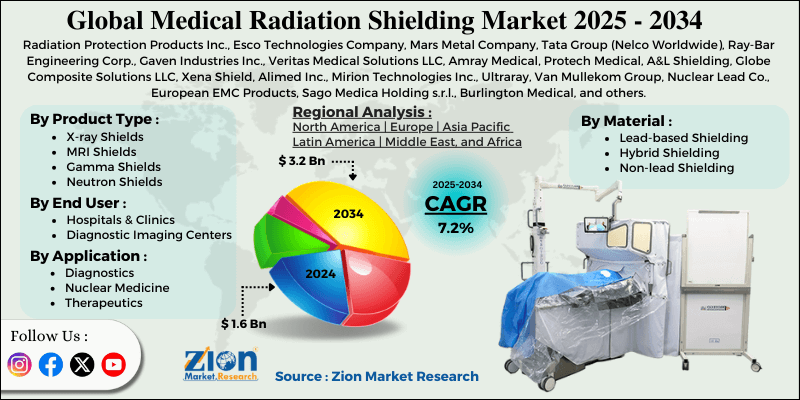
The global medical radiation shielding market size was worth around USD 1.6 billion in 2024 and is predicted to grow to around USD 3.2 billion by 2034, with a compound annual growth rate (CAGR) of roughly 7.2% between 2025 and 2034.
Key Insights
- As per the analysis shared by our research analyst, the global medical radiation shielding market is estimated to grow annually at a CAGR of around 7.2% over the forecast period (2025-2034).
- In terms of revenue, the global medical radiation shielding market size was valued at around USD 1.6 billion in 2024 and is projected to reach USD 3.2 billion by 2034.
- Growing prevalence of cancer and cardiovascular disease is expected to drive the medical radiation shielding market over the forecast period.
- Based on the product type, the X-ray shields segment is expected to capture the largest market share over the projected period.
- Based on the material, the lead-based shielding segment is expected to capture the largest market share over the projected period.
- Based on the application, the diagnostics segment is expected to capture the largest market share over the projected period.
- Based on the end-use, the hospitals & clinics segment is expected to capture the largest market share over the projected period.
- Based on region, North America is expected to dominate the market during the forecast period.
Medical Radiation Shielding Market: Overview
Medical radiation shielding uses various materials and barriers to protect patients, medical staff, and the environment from the harmful effects of ionizing radiation during medical procedures. The primary purpose of this shielding is to keep radiation sources (such as X-rays or radioactive isotopes) away from people or places that need protection. It does this by controlling and limiting radiation exposure to acceptable levels. Attenuation is the gradual decrease in radiation intensity as it passes through shielding materials like lead, lead composites, concrete, water, or specific polymers. This is what determines how well radiation shielding works.
In medical contexts, lead and lead-free composites are often used as shielding materials because they are very dense and can absorb or block X-ray and gamma radiation. Shielding is significant for the safety of both patients and healthcare workers who may be exposed to dispersed radiation during diagnostic and therapeutic procedures. Lead aprons, thyroid shields, and lead glasses are examples of personal protective equipment that can lower occupational exposure and scatter radiation.
Medical Radiation Shielding Market Dynamics
Growth Drivers
How does the rising incidence of chronic diseases expand the medical radiation shielding market?
The medical radiation shielding sector has grown a lot since more people are getting chronic ailments, especially cancer and heart disease. This is mainly because people with chronic conditions need more diagnostic imaging procedures like X-rays, CT scans, and nuclear medicine, all of which employ ionizing radiation. As these treatments become more common for early diagnosis, monitoring, and treatment, the demand for the right radiation shielding solutions to keep patients, healthcare workers, and their surroundings safe also grows.
For instance, according to the World Health Organization, over 35 million new cancer cases are predicted in 2050, a 77% increase from the estimated 20 million cases in 2022. Thus, the above-mentioned facts drive the industry expansion.
Restraints
High cost of shielding materials & installation is restraining the market growth
The medical radiation shielding market cannot expand substantially because the materials and installation are so expensive. Lead-free composites that contain tungsten and bismuth are examples of advanced shielding materials. They are better for the environment and your health, but they cost a lot more than regular lead shielding. Due to the high cost of materials, radiation shielding solutions are more expensive overall. This makes them less accessible, especially for smaller healthcare facilities and clinics with tight budgets. Shielding installation is quite costly since it needs substantial barriers, like walls that are 1/4 inch thick or several inches of concrete, and special adjustments to the building to work well.
For instance, it can cost $6,000 or more to defend a single room with a safe wall and door, because the initial costs are so high. This cost could prevent the best radiation shielding from being installed, especially in small medical facilities or in underdeveloped countries.
Opportunities
How does the growing partnership offer an opportunity for the medical radiation shielding industry?
The rising partnership is expected to offer a potential opportunity for the medical radiation shielding industry's growth. For instance, in July 2025, Arnold Magnetic Technologies Corporation, a Compass Diversified firm and one of the world's biggest makers of high-performance magnets and precision parts, teamed up with Artemis Shielding, a leader in producing new, lead-free radiation shielding solutions. This partnership is a big step forward in making radiation shielding safer, more effective, and better for the environment across many industries. Arnold gives Artemis Shielding new Flexible Composites and Extrusions, which are subsequently used to make cutting-edge radiation shielding solutions that are lead-free and safe for people. Arnold's knowledge in materials science and Artemis' cutting-edge technology are coming together to create better ways to protect against radiation. Arnold's Enhanced Functional Alloy (EFA) Shielding improves the performance of items while protecting people and the environment. Arnold's high-quality flexible magnetic materials and Artemis' creative approach work together to develop cutting-edge radiation protection solutions that are safe for people and the environment.
Challenges
How does the shortage of skilled radiation safety professionals pose a major challenge to the medical radiation shielding market expansion?
The lack of qualified radiation safety professionals is a significant barrier to the growth of the medical radiation shielding industry. These experts are needed to ensure radiation is used safely and effectively in medical settings. Radiation safety experts, such as medical physicists, radiologic technologists, and health physicists, are responsible for developing plans, implementing them, and overseeing radiation protection measures, such as shielding. To satisfy strict regulatory standards, make the most of shielding designs, do risk assessments, and follow safety rules that safeguard patients, healthcare staff, and the environment, they need to know a lot. Thus, these factors pose a major challenge to industry growth.
Medical Radiation Shielding Market: Report Scope
| Report Attributes | Report Details |
|---|---|
| Report Name | Medical Radiation Shielding Market |
| Market Size in 2024 | USD 1.6 Billion |
| Market Forecast in 2034 | USD 3.2 Billion |
| Growth Rate | CAGR of 7.2% |
| Number of Pages | 214 |
| Key Companies Covered | Radiation Protection Products Inc., Esco Technologies Company, Mars Metal Company, Tata Group (Nelco Worldwide), Ray-Bar Engineering Corp., Gaven Industries Inc., Veritas Medical Solutions LLC, Amray Medical, Protech Medical, A&L Shielding, Globe Composite Solutions LLC, Xena Shield, Alimed Inc., Mirion Technologies Inc., Ultraray, Van Mullekom Group, Nuclear Lead Co., European EMC Products, Sago Medica Holding s.r.l., Burlington Medical, and others. |
| Segments Covered | By Product Type, By Material, By Application, By End-Use, and By Region |
| Regions Covered | North America, Europe, Asia Pacific (APAC), Latin America, Middle East, and Africa (MEA) |
| Base Year | 2024 |
| Historical Year | 2019 to 2023 |
| Forecast Year | 2025 - 2034 |
| Customization Scope | Avail customized purchase options to meet your exact research needs. Request For Customization |
Medical Radiation Shielding Market: Segmentation
The global medical radiation shielding industry is segmented based on product type, material, application, end-use, and region.
Based on the product type, the global market is bifurcated into X-ray shields, MRI shields, gamma shields, and neutron shields. The X-ray shields segment is expected to dominate the market. With the increased use of diagnostic imaging methods such as X-rays in healthcare settings, there is a greater demand for appropriate radiation protection measures.
Based on the material, the global medical radiation shielding industry is bifurcated into lead-based shielding, hybrid shielding, and non-lead shielding. The lead-based shielding segment holds the major market share. The growth is largely driven by continued reliance on lead-based shielding materials, which are widely used for their high density and excellent radiation attenuation.
Based on the application, the global medical radiation shielding market is divided into diagnostics, nuclear medicine, and therapeutics. The diagnostics segment is expected to dominate the market over the forecast period. The growth can be attributed to the increasing prevalence of chronic diseases such as cancer and the growing geriatric population.
Based on the end-use, the global industry is divided into hospitals & clinics, diagnostic imaging centers, and others. The hospitals & clinics segment accounts for the majority of revenue. Hospitals and clinics are crucial to the industry because they need a lot of radiation protective equipment. These places must comply with strict radiation safety laws, and to do so, they must implement effective radiation shielding measures to protect patients, staff, and visitors.
Medical Radiation Shielding Market: Regional Analysis
Will North America dominate the medical radiation shielding market over the projected period?
The North America region is expected to dominate the medical radiation shielding market over the analysis period. The region's main growth drivers are a well-established, advanced healthcare system, a high rate of cancer and chronic diseases that require radiation-based diagnostics and treatments, and strict regulatory oversight from bodies such as the Nuclear Regulatory Commission. The area benefits from continued investments in new diagnostic imaging and radiation therapy technologies, such as proton therapy and nuclear medicine, which require robust shielding solutions.
In addition, a large number of tertiary cancer centers and ongoing research and development in medical technologies and biotechnology support the industry's growth. Local advanced manufacturers also help healthcare providers meet their needs for responsive engineering and customization, which allows the industry to thrive in this area.
Medical Radiation Shielding Market: Competitive Analysis
The global medical radiation shielding market is dominated by players like:
- Radiation Protection Products Inc.
- Esco Technologies Company
- Mars Metal Company
- Tata Group (Nelco Worldwide)
- Ray-Bar Engineering Corp.
- Gaven Industries Inc.
- Veritas Medical Solutions LLC
- Amray Medical
- Protech Medical
- A&L Shielding
- Globe Composite Solutions LLC
- Xena Shield
- Alimed Inc.
- Mirion Technologies Inc.
- Ultraray
- Van Mullekom Group
- Nuclear Lead Co.
- European EMC Products
- Sago Medica Holding s.r.l.
- Burlington Medical
The global medical radiation shielding market is segmented as follows:
By Product Type
- X-ray Shields
- MRI Shields
- Gamma Shields
- Neutron Shields
By Material
- Lead-based Shielding
- Hybrid Shielding
- Non-lead Shielding
By Application
- Diagnostics
- Nuclear Medicine
- Therapeutics
By End-Use
- Hospitals & Clinics
- Diagnostic Imaging Centers
- Others
By Region
- North America
- The U.S.
- Canada
- Europe
- France
- The UK
- Spain
- Germany
- Italy
- Rest of Europe
- Asia Pacific
- China
- Japan
- India
- South Korea
- Southeast Asia
- Rest of Asia Pacific
- Latin America
- Brazil
- Mexico
- Rest of Latin America
- Middle East & Africa
- GCC
- South Africa
- Rest of Middle East & Africa
Table Of Content
Methodology
FrequentlyAsked Questions

HappyClients

