
Global Mass Notification Systems Market Size, Industry Share, Analysis, Growth, 2032

Mass Notification Systems Market By Components (Solutions and Services), By Deployment (Cloud-Based and On-Premise), By Organization Size (Large Enterprises and Small & Medium-Sized Enterprises), By Application (Emergency Response, Business Continuity And Management, and Public Warnings And Alerting), By Verticals (Education, Government, Healthcare and Life Sciences, IT and Telecom, Transportation and Logistics, and Others), and By Region: Global and Regional Industry Overview, Market Intelligence, Comprehensive Analysis, Historical Data, and Forecasts 2024 - 2032
| Market Size in 2023 | Market Forecast in 2032 | CAGR (in %) | Base Year |
|---|---|---|---|
| USD 19.00 Billion | USD 117.16 Billion | 22.40% | 2023 |
Mass Notification Systems Industry Perspective
What will be the global Mass Notification Systems market size during the forecast period?
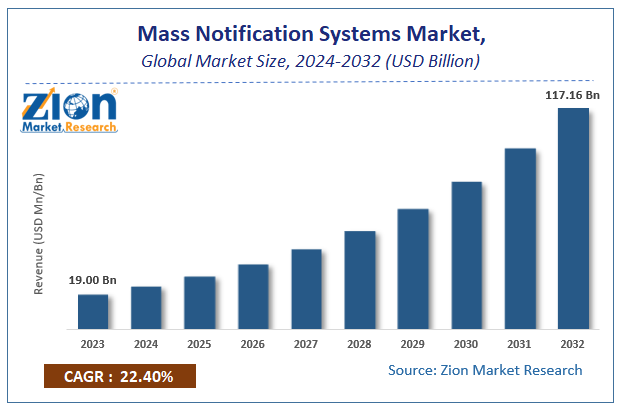
According to a report from Zion Market Research, the global Mass Notification Systems Market was valued at USD 19.00 billion in 2023 and is projected to hit USD 117.16 billion by 2032, with a compound annual growth rate (CAGR) of 22.40% during the forecast period 2024-2032.
This report provides a comprehensive analysis of the growth drivers, restraints, and challenges shaping demand across the global Mass Notification Systems market throughout the forecast period, while highlighting high-potential emerging opportunities within the industry.
Key Insights
- As per the analysis shared by our research analyst, the global Mass Notification Systems market is estimated to grow annually at a CAGR of around 22.40% over the forecast period (2024-2032).
- In terms of revenue, the global Mass Notification Systems market size was valued at around USD 19.00 billion in 2023 and is projected to reach USD 117.16 billion by 2032.
- The market is driven by digitization across industries, the security and safety benefits of IP-enabled devices, rising safety and security concerns, and the ability to manage multi-channel notifications through centralized web-based consoles.
- Based on the Components, Solutions hold market leadership, encompassing distributed recipient solutions, wide-area solutions, and in-building solutions that form the core of system capabilities.
- Based on the Deployment, the On-Premise segment held a share of over 65% in earlier assessments and remains preferred for its trustworthiness
- Based on the Organization Size, Large Enterprises represent a significant portion of demand due to complex communication needs and higher investment capacity
- Based on the Application, Emergency Response is a key area supporting rapid and coordinated crisis communication
- Based on the Verticals, Education drives substantial usage for safety and operational continuity.
- Based on region, North America is expected to hold the largest market share, supported by high usage of mobile devices, laptops, and tablets
Mass Notification Systems Market: Dynamics
Growth Drivers
What factors are accelerating the expansion of the Mass Notification Systems market?
Digitization across industries is a primary growth driver, as it introduces the advantages of security and safety through IP-enabled devices. This has led to extensive implementation of IP-based notification systems, particularly in the education and healthcare sectors. The ability to manage notifications via a single web-based console that tracks and controls processes across multiple communication networks and channels further supports market expansion.
Increasing safety and security concerns for people and organizations continue to elevate demand. These systems enable rapid, accurate communication during crises, helping organizations respond effectively and maintain optimized operations and performance.
Restraints
What factors are limiting the growth of the Mass Notification Systems market?
Concerns related to the sensitive nature of data handled by these systems can restrain adoption, especially in organizations prioritizing strict data control. The need for reliable underlying infrastructure and integration with existing communication channels may also present barriers in certain environments.
In some cases, the complexity of deploying and maintaining multi-channel systems across diverse organizational sizes can moderate the pace of implementation, particularly for smaller entities with limited technical resources.
Mass Notification Systems Market: Report Scope
| Report Attributes | Report Details |
|---|---|
| Report Name | Mass Notification Systems Market |
| Market Size in 2023 | USD 19.00 Billion |
| Market Forecast in 2032 | USD 117.16 Billion |
| Growth Rate | CAGR of 22.4% |
| Number of Pages | 220 |
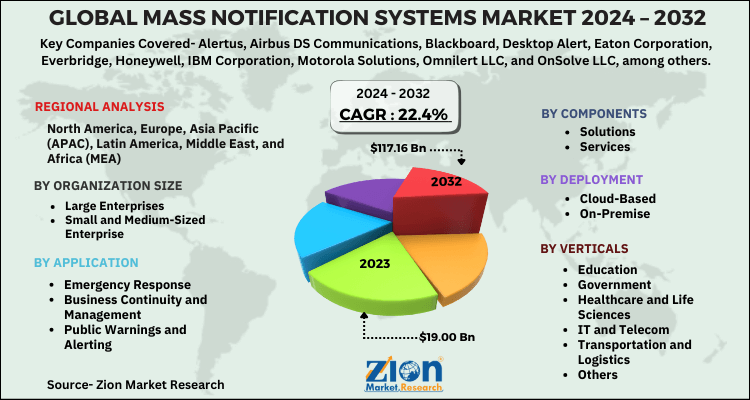
| Key Companies Covered | Alertus, Airbus DS Communications, Blackboard, Desktop Alert, Eaton Corporation, Everbridge, Honeywell, IBM Corporation, Motorola Solutions, Omnilert LLC, and OnSolve LLC, among others |
| Segments Covered | By Components, By Deployment, By Organization Size, By Application, By Verticals, And By Region |
| Regions Covered | North America, Europe, Asia Pacific (APAC), Latin America, Middle East, and Africa (MEA) |
| Base Year | 2023 |
| Historical Year | 2018 - 2022 |
| Forecast Year | 2024 - 2032 |
| Customization Scope | Avail customized purchase options to meet your exact research needs. Request For Customization |
Mass Notification Systems Market: Segmentation
The mass notification systems market is segmented by components, deployment, organization size, application, verticals, and region.
Based on Components, the mass notification systems market is bifurcated into solutions and services. Solutions hold market leadership in the mass notification systems market. The solution segment is further divided into distributed recipient solutions, wide-area solutions, and In-building solutions. Moreover, the service segment can further be bifurcated into Managed Services and Professional Services.
By Deployment, the mass notification systems market is divided into cloud-based and on-premises. The on-premises segment held a share of over 65 % in 2023. The mass notification systems market can be deployed using either cloud-based or on-premises mode. On-premises deployment mode accounts for a larger market share. As the name suggests, on-premises requires the installation of the system on the premises of the organization. It is considered to be the most trustworthy mode of deployment considering the sensitive nature of the data. The turnaround time for operations is significantly reduced in emergencies in this deployment mode.
Based on Organization Size Segment, the mass notification systems market is divided into large enterprises and small and medium-sized enterprises. Large Enterprises account for a substantial portion of demand because of their complex communication needs, multi-location operations, and greater capacity to invest in comprehensive notification platforms. This segment helps drive market scale through high-value deployments.
Based on Application Segment, the mass notification systems market is divided into emergency response, business continuity and management, and public warnings and alerting. Emergency Response is a core application that enables rapid dissemination of critical information during crises. Business Continuity and Management supports organizational resilience by maintaining communication and operational coordination, while Public Warnings and Alerting addresses broader community and public safety needs.
Mass Notification Systems Market: Regional Analysis
Why will North America continue to dominate the global market during the projection period?
North America is expected to hold the largest market share of the mass notification systems market. The high usage of devices such as mobile phones, laptops, tablets, and many more is contributing to the growth of the mass notification systems market in the North American region. The awareness of the optimized usability of resources is considerably high in the region, which translates into the understanding of the need for adopting mass notification systems.
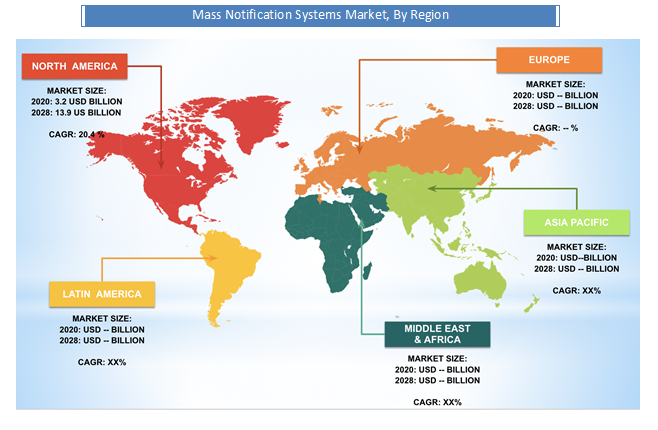
The Asia Pacific is expected to be growing significantly in the mass notification systems market. The developing region has invested in the technology sector due to the increasing demand, which makes it easier to adopt mass notification systems. People also are being conscious of the safety facilities being provided to them. As the economy is rising, there are a lot of government-supported policies that focus on public safety. These may act as a catalyst for the growth of mass notification systems in the region.
Mass Notification Systems Market: Competitive Landscape
Some of the key players in the mass notification systems market are;
- Alertus
- Airbus DS Communications
- Blackboard
- Desktop Alert
- Eaton Corporation
- Everbridge
- Honeywell
- IBM Corporation
- Motorola Solutions
- Omnilert LLC
- OnSolve LLC
Segment Coverage
The global mass notification systems market is segmented as follows:
By Components
- Solutions
- Services
By Deployment
- Cloud-Based
- On-Premise
By Organization Size
- Large Enterprises
- Small and Medium-Sized Enterprises
By Application
- Emergency Response
- Business Continuity and Management
- Public Warnings and Alerting
By Verticals
- Education
- Government
- Healthcare and Life Sciences
- IT and Telecom
- Transportation and Logistics
- Others
By Region
- North America
- The U.S.
- Canada
- Mexico
- Europe
- France
- The UK
- Spain
- Germany
- Italy
- Rest of Europe
- Asia Pacific
- China
- Japan
- India
- Australia
- South Korea
- Rest of Asia Pacific
- The Middle East & Africa
- Saudi Arabia
- UAE
- Egypt
- Kuwait
- South Africa
- Rest of the Middle East & Africa
- Latin America
- Brazil
- Argentina
- Rest of Latin America
Table Of Content
Methodology
FrequentlyAsked Questions
Mass notification systems are platforms used to communicate critical information rapidly and accurately to large groups of people during crises such as natural disasters, extreme weather, public safety incidents, and other emergencies, enabling effective response and coordinated operations.
Key growth drivers include digitization across industries, the security and safety benefits of IP-enabled devices, rising safety and security concerns, extensive adoption in education and healthcare, and the ability to manage multi-channel notifications through centralized web-based consoles.
The global Mass Notification Systems market size was valued at USD 19.00 billion in 2023 and is projected to hit USD 117.16 billion by 2032.
The global Mass Notification Systems market is expected to grow at a compound annual growth rate (CAGR) of 22.40% during the forecast period 2024-2032.
Some of the major companies operating in the mass notification systems market are Some of the key players in the mass notification systems market are Alertus, Airbus DS Communications, Blackboard, Desktop Alert, Eaton Corporation, Everbridge, Honeywell, IBM Corporation, Motorola Solutions, Omnilert LLC, and OnSolve LLC, among others.
Major challenges include concerns around the sensitive nature of data, the need for reliable infrastructure and seamless multi-channel integration, ensuring rapid and accurate response under emergency conditions, and supporting both large and smaller organizations with appropriate solutions.
Emerging trends include continued preference for on-premises deployment for data control and speed, growth in cloud-based options for scalability, expanding adoption driven by digitization and IP-enabled devices, and increasing focus on public safety policies and multi-channel communication capabilities.
North America is expected to hold the largest market share due to high device usage and strong awareness of mass notification needs, while Asia Pacific is projected to grow significantly, supported by technology investment and public safety initiatives.

HappyClients

