
Global Marketing Attribution Software Market Size, Share, Trends, Growth and Forecast 2032

Marketing Attribution Software Market By Attribution Type (Single-Source Attribution, Multi-Source Attribution, and Probabilistic or Algorithmic Attribution), By Component (Solution and Services), By Organization Size (SMEs and Large Enterprises), By Deployment (Cloud and On-Premise), By Vertical (Retail, FMCG, Telecom and IT, BFSI, Media and Entertainment, and Others), and By Region - Global and Regional Industry Overview, Market Intelligence, Comprehensive Analysis, Historical Data, and Forecasts 2024 - 2032
| Market Size in 2023 | Market Forecast in 2032 | CAGR (in %) | Base Year |
|---|---|---|---|
| USD 4.19 Billion | USD 16.23 Billion | 16.24% | 2023 |
Marketing Attribution Software Industry Perspective
What will be the global marketing attribution software market size during the forecast period?
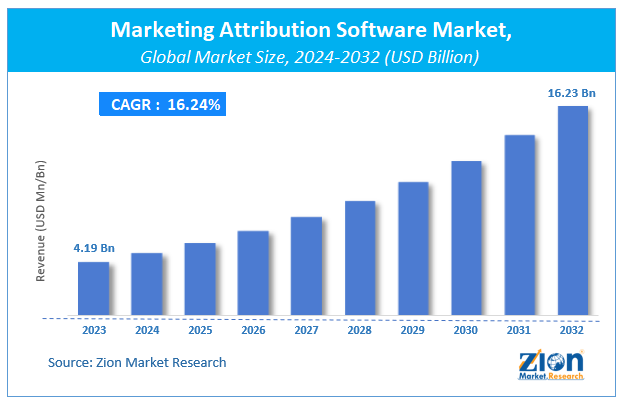
The global marketing attribution software market size was valued at around USD 4.19 billion in 2023 and is projected to reach about USD 16.23 billion by 2032, with a compound annual growth rate (CAGR) of roughly 16.24% between 2024 and 2032.
This report provides a comprehensive analysis of the growth drivers, restraints, and challenges shaping demand across the global marketing attribution software market throughout the forecast period, while highlighting high-potential emerging opportunities within the industry.
Key Insights
- As per the analysis shared by our research analyst, the global marketing attribution software market is estimated to grow at a CAGR of approximately 16.24% during the forecast period from 2024 to 2032.
- In terms of revenue, the global marketing attribution software market size was valued at around USD 4.19 billion in 2023 and is projected to reach USD 16.23 billion by 2032.
- The market is driven by increasing digital marketing spend, demand for data-driven campaign analysis, multi-channel customer engagement, and the need for accurate ROI measurement.
- Based on the attribution type, multi-source attribution is widely preferred as it provides a more complete view of customer journeys across channels and supports more accurate credit allocation than single-touch models.
- Based on the component, the solution segment leads because core attribution platforms deliver the analytics, modeling, and reporting capabilities that organizations require to measure campaign performance.
- Based on the organization size, large enterprises dominate adoption due to higher marketing budgets, complex multi-channel campaigns, and greater demand for sophisticated measurement and optimization tools.
- Based on the deployment, cloud deployment is favored for scalability, faster implementation, and easier integration with existing marketing technology stacks.
- Based on the vertical, retail holds a leading position as brands invest heavily in digital channels and require precise attribution to optimize spend across online and offline touchpoints.
- North America is expected to lead the marketing attribution software market during the forecast period, supported by mature digital advertising ecosystems, high adoption of marketing analytics, and strong presence of major technology providers.
Marketing Attribution Software Market: Overview
Marketing attribution software tracks customer interactions across channels and helps identify which marketing efforts drive conversions. It assigns credit to touchpoints along the customer journey so that organizations can understand the relative contribution of campaigns, channels, and tactics to desired outcomes such as leads, sales, or other conversions. By providing a structured view of performance, these solutions enable more informed budget allocation and campaign optimization.
Marketing Attribution Software Market: Dynamics
Growth Drivers
What factors are accelerating the expansion of the marketing attribution software market?
Increasing digital marketing spend is a primary growth driver. As organizations allocate larger budgets across search, social, display, email, and other channels, they require reliable tools to measure which activities contribute most to conversions. Demand for data-driven campaign analysis and multi-channel customer engagement further accelerates adoption of attribution software that can connect touchpoints and quantify impact.
The need for accurate ROI measurement strengthens the case for dedicated attribution solutions. Marketers and finance stakeholders alike seek transparent, evidence-based views of performance so that spend can be optimized and justified. These requirements support sustained investment in platforms that improve visibility across the full customer journey.
Restraints
What factors are limiting the growth of the marketing attribution software market?
Fragmented data sources remain a significant challenge. Customer interactions often span multiple platforms, systems, and offline channels, making it difficult to assemble a complete and consistent view of the journey. Cookie deprecation and broader privacy changes further complicate traditional tracking methods and reduce the reliability of some historical measurement approaches.
The complexity of multi-touch attribution models can also slow adoption. Organizations may struggle to select, implement, and interpret appropriate models, especially when internal analytics expertise is limited or when stakeholders disagree on how credit should be assigned across channels.
Opportunities
What emerging opportunities exist in the marketing attribution software market?
Demand for ROI-driven marketing and AI-powered analytics creates substantial opportunities. Advanced models that incorporate machine learning can improve the accuracy and adaptability of attribution in complex, multi-channel environments. Growth in omnichannel campaigns and digital advertising spend expands the addressable market for solutions that unify measurement across touchpoints.
Privacy-first measurement approaches that adapt to cookieless environments represent another important opportunity. Vendors that deliver reliable insights while respecting evolving privacy requirements are well positioned to capture demand from organizations navigating regulatory and platform changes.
Challenges
What challenges does the marketing attribution software market face?
Integrating data from diverse sources and maintaining measurement quality in a privacy-conscious landscape remain ongoing challenges. Organizations must balance the desire for granular attribution with compliance and user trust. Selecting and governing attribution models that remain credible as channels and customer behavior evolve requires continuous attention and expertise.
Competition among platform providers and the need to demonstrate clear value against alternative analytics approaches also pressure vendors to innovate and deliver actionable, trustworthy results that influence real marketing decisions.
Marketing Attribution Software Market: Report Scope
| Report Attributes | Report Details |
|---|---|
| Report Name | Marketing Attribution Software Market |
| Market Size in 2023 | USD 4.19 Billion |
| Market Forecast in 2032 | USD 16.23 Billion |
| Growth Rate | CAGR of 16.24% |
| Number of Pages | 285 |
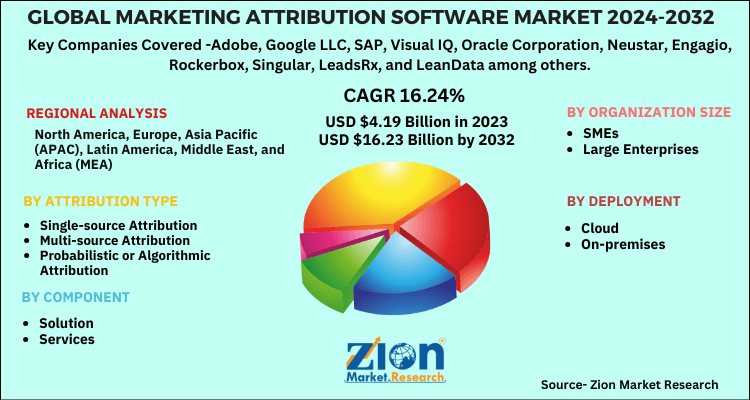
| Key Companies Covered | Adobe, Google LLC, SAP, Visual IQ, Oracle Corporation, Neustar, Engagio, Rockerbox, Singular, LeadsRx, and LeanData, among others |
| Segments Covered | By Attribution Type, By Component, By Organization Size, By Deployment, By Vertical, and By Region |
| Regions Covered | North America, Europe, Asia Pacific (APAC), Latin America, Middle East, and Africa (MEA) |
| Base Year | 2023 |
| Historical Year | 2018 - 2022 |
| Forecast Year | 2024 - 2032 |
| Customization Scope | Avail customized purchase options to meet your exact research needs. Request For Customization |
Marketing Attribution Software Market: Segmentation
The marketing attribution software market is segmented by attribution type, component, organization size, deployment, vertical, and region. All the segments of the marketing attribution software market have been analyzed based on present and future trends and the market is estimated from 2024 to 2032.
Based on Attribution Type, the marketing attribution software market is divided into single-source attribution, multi-source attribution, and probabilistic or algorithmic attribution. Multi-source attribution is widely preferred because it accounts for multiple touchpoints along the customer journey and provides a more balanced and realistic view of channel contribution than single-touch models. This approach supports better budget decisions and campaign optimization in complex digital environments. Probabilistic or algorithmic attribution is gaining importance as organizations seek more sophisticated, data-driven methods that can adapt to incomplete or privacy-constrained data, while single-source models remain relevant for simpler use cases or as baseline comparisons.
Based on Component, the market is divided into solutions and services. The solution segment leads because core software platforms deliver the modeling, analytics, and reporting capabilities that organizations need to measure and optimize marketing performance. These platforms form the foundation of attribution programs. Services, including implementation, integration, training, and ongoing optimization support, complement solutions and help organizations extract full value from their investments, particularly as models and data environments become more complex.
Based on Organization Size, the marketing attribution software market is divided into SMEs and large enterprises. Large enterprises dominate adoption due to higher marketing budgets, more complex multi-channel campaigns, and stronger demand for sophisticated measurement and cross-functional reporting. Their scale and analytical maturity support investment in advanced attribution platforms. SMEs represent a growing opportunity as cloud-based and more accessible solutions lower barriers to entry and enable smaller organizations to improve campaign accountability and efficiency.
Based on Deployment, the marketing attribution software market is divided into cloud and on-premises. Cloud deployment is favored for its scalability, faster time to value, and easier integration with other marketing and analytics tools. It supports remote access and continuous updates that keep pace with changing measurement needs. On-premises deployment remains relevant for organizations with strict data residency, security, or customization requirements, particularly in regulated industries.
Based on Vertical, the market is divided into retail, FMCG, telecom and IT, BFSI, media and entertainment, and others. Retail holds a leading position as brands invest heavily in digital and omnichannel marketing and require precise attribution to optimize spend and understand the path to purchase. Telecom and IT, BFSI, media and entertainment, and FMCG also drive demand as they manage complex customer journeys and seek clearer links between marketing activity and business outcomes.
Marketing Attribution Software Market: Regional Analysis
Why will North America continue to dominate the global market during the projection period?
North America is expected to lead the marketing attribution software market during the forecast period. The region benefits from a mature digital advertising ecosystem, widespread adoption of marketing technologies, and a strong focus on measuring campaign performance and customer acquisition outcomes. High digital marketing expenditure, early adoption of analytics and AI-driven tools, and the presence of major technology and platform providers reinforce demand for advanced attribution solutions. These factors enable North America to shape product development, measurement standards, and best practices that influence global market trends and innovation.
Europe maintains significant demand driven by sophisticated marketing organizations, regulatory attention to data privacy, and ongoing investment in digital transformation. Asia Pacific is positioned for rapid growth as digital advertising expands, e-commerce and mobile engagement rise, and organizations in markets such as China, India, and Japan increase investment in data-driven marketing capabilities. Latin America and the Middle East and Africa represent emerging opportunities where digital marketing maturity is advancing and interest in measurable, ROI-focused campaigns continues to grow.
Marketing Attribution Software Market: Competitive Players
Some of the major players in the global marketing attribution software market include;
- Adobe
- Google LLC
- SAP
- Visual IQ
- Oracle Corporation
- Neustar
- Engagio
- Rockerbox
- Singular
- LeadsRx
- LeanData
Segments Covered
The global marketing attribution software market is segmented as follows:
By Attribution Type
- Single-source Attribution
- Multi-source Attribution
- Probabilistic or Algorithmic Attribution
By Component
- Solution
- Services
By Organization Size
- SMEs
- Large Enterprises
By Deployment
- Cloud
- On-premises
By Vertical
- Retail
- FMCG
- Telecom and IT
- BFSI
- Media and Entertainment
- Others
By Region
- North America
- The U.S.
- Canada
- Mexico
- Europe
- France
- The UK
- Spain
- Germany
- Italy
- Rest of Europe
- Asia Pacific
- China
- Japan
- India
- Australia
- South Korea
- Rest of Asia Pacific
- The Middle East & Africa
- Saudi Arabia
- UAE
- Egypt
- Kuwait
- South Africa
- Rest of the Middle East & Africa
- Latin America
- Brazil
- Argentina
- Rest of Latin America
Table Of Content
Methodology
FrequentlyAsked Questions
Marketing attribution software tracks customer interactions across channels and helps identify which marketing efforts drive conversions. It assigns credit to touchpoints along the customer journey so organizations can understand the contribution of campaigns and channels to desired outcomes and optimize marketing spend.
The global marketing attribution software market is driven by increasing digital marketing spend, demand for data-driven campaign analysis, multi-channel customer engagement, and the need for accurate ROI measurement that supports better budget allocation and campaign optimization.
The global marketing attribution software market size was valued at approximately USD 4.19 billion in 2023 and is expected to reach around USD 16.23 billion by 2032.
The global marketing attribution software market is expected to grow at a compound annual growth rate (CAGR) of approximately 16.24% during the forecast period from 2024 to 2032.
North America is expected to lead and contribute notably to the global marketing attribution software market, supported by a mature digital advertising ecosystem, high adoption of marketing analytics, and strong presence of major technology providers.
Some of the major players leveraging the marketing attribution software market growth are Adobe, Google LLC, SAP, Visual IQ, Oracle Corporation, Neustar, Engagio, Rockerbox, Singular, LeadsRx, and LeanData.
The report provides a detailed examination of growth drivers, restraints, opportunities, and challenges, along with comprehensive segmentation analysis, regional insights, competitive landscape, and forward-looking forecasts that enable stakeholders to make informed strategic decisions.

HappyClients

