Marine Battery Market Size, Share, Trends, Growth and Forecast 2034

Marine Battery Market By Type (Lead Acid Marine Batteries, Lithium Ion Marine Batteries, AGM Marine Batteries, Gel Marine Batteries), By Application (Starting and Ignition, House and Auxiliary Power, Trolling Motor Power, Backup and Emergency Power), By Vessel Type (Recreational Boats, Commercial Vessels, Fishing Vessels, Yachts and Sailboats), By Sales Channel (Original Equipment Manufacturers, Marine Retail Stores, Online Marine Stores, Boat Service Centers), and By Region - Global and Regional Industry Overview, Market Intelligence, Comprehensive Analysis, Historical Data, and Forecasts 2026 - 2034
| Market Size in 2025 | Market Forecast in 2034 | CAGR (in %) | Base Year |
|---|---|---|---|
| USD 1.67 Billion | USD 6.11 Billion | 14.28% | 2025 |
Marine Battery Industry Perspective:
What will be the size of the marine battery market during the forecast period?
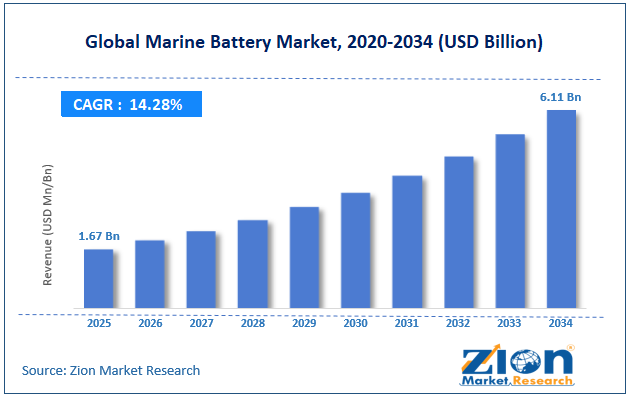
The global marine battery market size was valued at approximately USD 1.67 billion in 2025 and is projected to reach around USD 6.11 billion by 2034, growing at a compound annual growth rate of approximately 14.28% between 2026 and 2034.
Key Insights
- As per the analysis shared by our research team, the global marine battery market is estimated to grow at a compound annual growth rate of approximately 14.28% during the forecast period from 2026 to 2034.
- In terms of revenue, the global marine battery market was valued at approximately USD 1.67 billion in 2025 and is projected to reach USD 6.11 billion by 2034.
- The marine battery market is expected to grow strongly due to rising recreational boating activity, increasing demand for reliable onboard power, growing preference for lightweight lithium options, and expanding commercial fishing operations.
- Based on type, lead-acid marine batteries lead the market because of their affordability and widespread availability, while lithium-ion marine batteries are gaining strong momentum as one of the fastest-growing types among boat owners seeking lighter and longer-lasting power.
- Based on application, starting and ignition leads the market because every vessel requires reliable engine-starting power. In contrast, house and auxiliary power is the fastest-growing segment as boats carry more onboard electronics and comfort features.
- Based on vessel type, recreational boats lead the market due to the large number of privately owned watercraft. In contrast, fishing vessels are the fastest-growing segment as commercial and sport fishing activities expand globally.
- Based on sales channel, marine retail stores lead the market because of specialized product knowledge and installation support, while online marine stores are growing steadily as more boat owners prefer researching and ordering batteries online.
- Based on region, North America leads the global marine battery market, while Asia Pacific is the fastest-growing region due to rising recreational boating interest and expanding commercial fishing fleets.
Marine Battery Market: Overview
Marine batteries are specialized batteries designed to provide reliable power in boats while withstanding water, vibration, movement, and harsh marine conditions. They use stronger cases and corrosion-resistant parts than ordinary vehicle batteries, helping them operate safely in wet, salty environments. The marine battery market serves several power needs, including engine starting, onboard electronics, trolling motors, lighting, and emergency backup systems. Rising recreational boating, commercial fishing, yacht use, and other water-based activities are supporting demand for dependable marine power. Different battery designs support short bursts of starting power or repeated charging and discharging, allowing boat owners to choose products based on vessel size and energy needs. Lithium-ion batteries are also gaining attention because they are lighter, charge faster, and can provide longer operating times for onboard equipment. Manufacturers are improving marine batteries with maintenance-free construction, stronger vibration protection, better heat control, and battery monitoring features. These improvements can increase reliability during longer trips while reducing maintenance needs. Online marine supply stores are further simplifying purchases by helping customers compare battery specifications, capacities, specific applications, and power requirements for different boat sizes before choosing a suitable product.
Growing boating activity and advances in battery technology are creating new opportunities for the marine battery market across recreational and commercial vessels.
Marine Battery Market: Strategic Perspective
Where is the marine battery market heading?
The marine battery market is expected to shift toward lighter, longer-lasting, and smarter battery solutions as boat owners become more selective about weight, runtime, and onboard monitoring capabilities. Lithium-ion options, integrated battery management systems, faster-charging designs, and batteries suited to specific vessel types are likely to gain more attention alongside traditional lead-acid options.
Where should businesses invest in the marine battery market?
The marine battery market presents opportunities in lithium-ion technology, smart battery monitoring systems, corrosion-resistant casings, and direct partnerships with boat manufacturers and marina service centers. Investment in efficient production and reliable supply chains can also help companies maintain quality while managing costs, particularly as demand grows in emerging boating markets and expanding commercial marine sectors.
What will reshape competition in the marine battery market?
Success in the marine battery market will increasingly depend on how effectively companies respond to changing boater expectations around weight, runtime, and reliability. Companies that combine advanced battery chemistry with reliable product availability, competitive pricing, strong warranty support, and dependable performance in harsh marine conditions are likely to stand out in an increasingly competitive power solutions market.
Marine Battery Market: Technology Roadmap 2026–2034
What is the projected development roadmap of the marine battery market over the forecast period?
The marine battery market is advancing through improved lithium-ion cell technology, more precise battery management systems, expanded use of corrosion-resistant materials, and growing incorporation of smart monitoring features, making onboard power more reliable and easier to manage for boat owners of all experience levels. The market is expected to grow at a compound annual growth rate of approximately 14.28% over the forecast period, driven by rising boating activity, evolving marine safety standards, and ongoing refinement of battery manufacturing technology.
The following roadmap outlines key development phases expected through 2034.
2026–2028: Reliability and Durability Building Phase
- Corrosion-resistant construction: Battery manufacturers are expected to strengthen casing materials and terminal designs to withstand saltwater exposure and constant vibration better.
- Deep-cycle performance focus: Companies are likely to focus more on batteries that can be discharged and recharged repeatedly without losing capacity, supporting trolling motors and auxiliary systems.
- Vessel-specific product positioning: Manufacturers are expected to create battery ranges targeting specific boating needs, including weekend recreational use, commercial fishing operations, and long-distance sailing.
2029–2031: Product Diversification and Distribution Expansion Phase
- Lithium-ion adoption growth: Lightweight lithium batteries offering longer runtime and faster charging are expected to gain greater shelf space across marine retail outlets.
- New configuration experimentation: Companies are likely to introduce combinations using modular battery banks, dual-purpose starting and deep-cycle designs, and compact form factors to differentiate products and attract different boater segments.
- Digital retail expansion: Online marine platforms, direct-to-consumer sales, and marina-based service partnerships are expected to give battery brands additional ways to reach boat owners.
2032–2034: Smart and Sustainable Power Phase
- Next-generation battery management: Manufacturers are expected to move toward integrated smart monitoring, mobile app connectivity, and predictive maintenance alerts as boaters seek greater convenience.
- Recyclable battery components: Sustainable manufacturing practices and recyclable battery materials may increasingly become standard as environmental awareness grows among boat owners and marine businesses.
- Customized power solutions: Marine batteries could increasingly be developed around individual vessel requirements, with products tailored to specific power needs, onboard electronics, and boating patterns.
Marine Battery Market: Dynamics
Growth Drivers
What factors are driving changing consumer preferences in the marine battery market?
Consumer preferences in the marine battery market are changing as boat owners increasingly value lighter weight, longer runtime, and dependable performance. Buyers are moving toward batteries that can handle frequent use, harsh marine conditions, and extended trips without requiring regular maintenance. This trend is encouraging manufacturers to develop lightweight, maintenance-free, and deep-cycle batteries for different types of vessels. Smart battery monitoring is also gaining interest, allowing users to track charge levels, battery condition, and remaining operating time more easily. Smaller batteries are becoming popular among personal watercraft and compact boats, while high-capacity models continue to meet the needs of larger vessels and commercial operators. Customers are also paying closer attention to battery life, charging speed, installation requirements, and compatibility before buying. Online marine stores are supporting this shift by making specifications and product choices easier to compare. Manufacturers are responding with modular designs, compact formats, and flexible battery systems that suit different boating needs. These improvements are making marine batteries easier to use while supporting reliable onboard power throughout the boating season.
Premium and technology-driven products are creating opportunities in the marine battery market.
The marine battery market is opening new growth opportunities through premium products that provide better performance, longer service life, and easier maintenance. Manufacturers are using advanced lithium technology, smart monitoring, corrosion-resistant materials, and lightweight designs to attract boat owners seeking dependable power. Lightweight batteries are particularly useful because they can reduce vessel weight and support better fuel efficiency and handling. Sustainability is another emerging opportunity, with companies developing recyclable components, durable battery cells, and cleaner manufacturing processes. Marinas, boat rental businesses, and commercial fishing fleets are adopting premium marine batteries to improve reliability and reduce maintenance requirements during frequent operations. Online marine stores are also helping smaller battery brands reach customers beyond traditional retail channels. Local production can further improve delivery times and reduce dependence on imported parts. Compact lithium batteries are driving demand among personal watercraft owners, small fishing boats, and users who need auxiliary power in space-limited areas. Longer warranties and service agreements can strengthen customer relationships while providing additional revenue opportunities. Together, technological improvements, sustainable designs, specialized products, and broader distribution are expanding opportunities across the market.
Restraints
High production costs are a key challenge limiting growth in the marine battery market.
The marine battery industry faces challenges from changing customer expectations, rising production costs, and competition from alternative power sources. Fluctuating prices of lithium, lead, electronic components, and transportation can make manufacturing expenses difficult to manage. Buyers are also paying closer attention to battery life, charging speed, capacity, and performance, putting pressure on manufacturers that rely on older technologies. Solar charging systems, portable generators, and shore power provide additional choices for boat owners, increasing competition in the onboard power market. Maintaining reliable battery performance can also be difficult because marine environments expose batteries to moisture, salt, vibration, and temperature changes. Used battery disposal and recycling are becoming greater concerns as environmental awareness and regulatory requirements increase. Limited access to specialized marine retailers in developing regions may further restrict product availability and customer awareness. Manufacturers can address these barriers by improving supply chain planning, developing durable battery technologies, reducing production costs, adopting recyclable materials, and strengthening distribution networks. Better product education and after-sales support can also help companies build customer trust and maintain their competitive position.
Opportunities
Reliability-focused product innovation is opening new opportunities in the marine battery market.
Reliability-focused product innovation is creating new opportunities in the marine battery market as boat owners look beyond traditional lead-acid batteries for efficient, durable, and convenient power solutions. Faster charging, longer cycle life, and smart monitoring features are helping manufacturers attract boaters who value dependable technology. Advanced lithium batteries with lightweight construction, stronger casings, and integrated management systems are also supporting premium product offerings for customers willing to invest in better performance. Dual-purpose batteries and modular battery banks let users adjust power capacity to vessel size and energy needs. Compact models suit personal watercraft and smaller boats, while high-capacity batteries serve yachts, fishing vessels, and commercial operations. Marinas, rental companies, and fishing fleets are generating additional demand as they upgrade onboard power systems. Online marine stores are helping specialized brands reach customers beyond traditional retail channels. Sustainable production and recyclable components can further improve product appeal. Manufacturers can also develop vessel-specific batteries, portable backup units, and emergency power packs to address different boating requirements. These innovations are broadening product choices and creating fresh revenue opportunities across the market.
Challenges
How are rising costs and supply challenges affecting the marine battery market?
The marine battery industry faces challenges from fluctuating raw material prices, supply issues, and rising expectations for battery performance. Changes in lithium, lead, component, transportation, and manufacturing costs can increase product prices and make production planning harder for manufacturers. Boat owners are also becoming more careful when comparing battery lifespan, cycle performance, charging speed, and reliability under harsh marine conditions. This pressure is encouraging companies to improve battery designs and deliver longer-lasting products. Competition from solar charging systems, generators, and shore power solutions is adding another challenge by giving boat owners alternative ways to meet onboard energy needs. Battery disposal and recycling are also becoming important as regulators and environmentally conscious customers demand responsible handling of used products. Limited marine retail infrastructure in some regions can make specialized batteries difficult to access. Dependence on imported components may further expose manufacturers to supply disruptions, currency fluctuations, and higher logistics costs. Companies can reduce these pressures by strengthening local sourcing, improving battery durability, adopting sustainable production methods, and building flexible supply networks to support reliable product availability.
Marine Battery Market: Report Scope
| Report Attributes | Report Details |
|---|---|
| Report Name | Marine Battery Market |
| Market Size in 2025 | USD 1.67 Billion |
| Market Forecast in 2034 | USD 6.11 Billion |
| Growth Rate | CAGR of 14.28% |
| Number of Pages | 230 |
| Key Companies Covered | Exide Technologies, Mastervolt, Optima Batteries, Trojan Battery Company, Victron Energy, Interstate Batteries, Odyssey Battery, Lifeline Batteries, Battle Born Batteries, Deka Marine Batteries, and others. |
| Segments Covered | By Type, By Application, By Vessel Type, By Sales Channel, and By Region |
| Regions Covered | North America, Europe, Asia Pacific (APAC), Latin America, Middle East, and Africa (MEA) |
| Base Year | 2025 |
| Historical Year | 2020 - 2024 |
| Forecast Year | 2026 - 2034 |
| Customization Scope | Avail customized purchase options to meet your exact research needs. Request For Customization |
Marine Battery Market: Segmentation
The global marine battery market is segmented by type, application, vessel type, sales channel, and region.
Why do lead-acid marine batteries lead the marine battery market by type?
Based on type, the global marine battery market is divided into lead-acid, lithium-ion, AGM, and gel marine batteries. Lead-acid marine batteries hold about 42% of the market share, leading due to their affordability, wide availability, and long-standing use across recreational and commercial vessels. Lithium-ion marine batteries hold around 23% market share. This is the fastest-growing segment because boat owners increasingly seek lightweight options with longer runtime and faster charging.
How is the starting and ignition application maintaining its lead in the marine battery market?
Based on application, the marine battery industry is classified into starting and ignition, house and auxiliary power, trolling motor power, and backup and emergency power. Starting and ignition accounts for approximately 38% of the global market share, driven by the essential need for reliable engine-starting power across all vessel types. House and auxiliary power holds around 24% market share. It is the fastest-growing due to expanding onboard electronics, lighting systems, and comfort features on modern boats.
Where do recreational boats stand in the marine battery market by vessel type?
By vessel type, the market is segmented into recreational boats, commercial vessels, fishing vessels, and yachts and sailboats. Recreational boats lead with about a 46% share because of the large number of privately owned watercraft and steady demand for replacement batteries. Fishing vessels hold around 22% market share. They are growing steadily as commercial and sport fishing activities expand and require more reliable onboard power for equipment and navigation systems.
Which sales channel accounts for the largest share in the marine battery market?
Based on sales channel, the market is categorized into original equipment manufacturers, marine retail stores, online marine stores, and boat service centers. Marine retail stores account for about 41% of the market, leading because of specialized product knowledge, installation support, and their established position as a trusted source for battery replacement. Online marine stores hold around 20% market share. This segment is expanding quickly as more boat owners research specifications and compare prices before buying.
Marine Battery Market: Regional Analysis
What factors are strengthening North America's position in the marine battery market?
North America leads the global marine battery market and is expected to grow at a CAGR of around 5.5% during the forecast period. This strong position is supported by a widespread recreational boating culture and a large base of boat owners, which create strong, consistent demand for replacement and upgrade batteries. The United States and Canada offer major opportunities because of their extensive coastlines, numerous inland lakes, and well-established boating communities. Boat owners in these countries are increasingly choosing lithium-ion batteries over traditional lead-acid options for better performance and reduced weight. Rising disposable incomes are allowing more households to invest in larger boats and more sophisticated onboard electronics that require reliable power sources. Modern marine retail chains and service centers are reaching smaller coastal towns and inland boating communities alike. Increasing interest in fishing, sailing, and recreational boating as leisure activities is also encouraging first-time boat buyers to invest in quality marine batteries. The region also has strong battery manufacturing capabilities, allowing companies to develop and distribute products efficiently while managing costs. Marine retail stores, service centers, and online platforms are increasing product availability across both coastal and inland regions. Boat owners are showing greater interest in smart, app-connected, and long-lasting battery options, encouraging manufacturers to diversify their offerings. Local battery companies are introducing products tailored to regional boating conditions and vessel types rather than relying only on generic automotive-style batteries.
How are changing lifestyles driving growth in the Asia Pacific marine battery market?
The Asia Pacific marine battery market is expected to grow at a volume CAGR of around 6.1% during the forecast period, supported by rising recreational boating, expanding commercial fishing, and growing demand for dependable marine power. China, Japan, Australia, and Southeast Asian countries are important markets as boat production, marina development, and marine tourism continue to expand. Rising disposable incomes are encouraging consumers to spend more on leisure boating, while fishing fleets need durable batteries that can support long operating hours. Marine batteries power fishing boats, ferries, tourist vessels, private yachts, and other watercraft, driving demand from both commercial and recreational users. Boat owners are also seeking reliable backup power for navigation, communication, lighting, and safety equipment. Manufacturers are adapting battery designs to suit different vessel sizes, operating conditions, and regional preferences. Expanding coastal infrastructure and marine tourism are creating additional demand for dependable power systems. Retailers are increasing the availability of premium and technologically advanced batteries, while regional manufacturers are developing products suited to local applications. Rising investment in boat building, marinas, and coastal facilities is further strengthening demand. Together, these developments are creating sustained opportunities for the Asia Pacific market during the forecast period.
Recent Market Developments
- In June 2026, EST-Floattech received DNV Type Approval for its Octopus LFP Battery System, strengthening its position in certified lithium-ion battery solutions for marine electrification.
- In June 2026, XING Mobility launched its IMMERSIO Matrix marine battery system, using immersion-cooling technology to deliver high continuous power, higher energy density, and improved fire safety for electric vessels.
Marine Battery Market: Competitive Analysis
The leading players in the global marine battery market are:
- Exide Technologies
- Mastervolt
- Optima Batteries
- Trojan Battery Company
- Victron Energy
- Interstate Batteries
- Odyssey Battery
- Lifeline Batteries
- Battle Born Batteries
- Deka Marine Batteries
The global marine battery market is segmented as follows:
By Type
- Lead Acid Marine Batteries
- Lithium Ion Marine Batteries
- AGM Marine Batteries
- Gel Marine Batteries
By Application
- Starting and Ignition
- House and Auxiliary Power
- Trolling Motor Power
- Backup and Emergency Power
By Vessel Type
- Recreational Boats
- Commercial Vessels
- Fishing Vessels
- Yachts and Sailboats
By Sales Channel
- Original Equipment Manufacturers
- Marine Retail Stores
- Online Marine Stores
- Boat Service Centers
By Region
- North America
- The U.S.
- Canada
- Mexico
- Europe
- France
- The UK
- Spain
- Germany
- Italy
- Rest of Europe
- Asia Pacific
- China
- Japan
- India
- Australia
- South Korea
- Rest of Asia Pacific
- The Middle East & Africa
- Saudi Arabia
- UAE
- Egypt
- Kuwait
- South Africa
- Rest of the Middle East & Africa
- Latin America
- Brazil
- Argentina
- Rest of Latin America
Table Of Content
Methodology
FrequentlyAsked Questions
A marine battery is a specialized battery designed to provide reliable power in boats while withstanding water, vibration, movement, and harsh marine conditions.
The global marine battery market is expected to grow due to rising recreational boating activity, increasing demand for reliable onboard power, growing preference for lightweight lithium options, and expanding commercial fishing operations worldwide.
According to research, the global marine battery market was valued at approximately USD 1.67 billion in 2025 and is projected to reach approximately USD 6.11 billion by 2034.
The marine battery market is expected to grow at a compound annual growth rate of approximately 14.28% from 2026 to 2034.
North America is expected to lead the global marine battery market throughout the forecast period, driven by its widespread boating culture, large base of boat owners, and well-established marine retail infrastructure.
The major players in the global marine battery market include Exide Technologies, Mastervolt, Optima Batteries, Trojan Battery Company, Victron Energy, Interstate Batteries, Odyssey Battery, Lifeline Batteries, Battle Born Batteries, and Deka Marine Batteries.
The report examines key aspects of the marine battery market, including research and development drivers, adoption barriers, application opportunities, competitive landscape dynamics, detailed regional market performance analysis, and a comprehensive forward-looking outlook across all major types, applications, vessel types, sales channels, and geographic regions through 2034.
Rising incomes and higher consumer spending on recreational activities are supporting demand in the marine battery market, especially for premium and technologically advanced products. However, inflation and rising raw material, manufacturing, and transportation costs may increase prices and encourage consumers to choose more affordable options.
The marine battery market offers opportunities in lithium-ion technology development, smart monitoring systems, recyclable battery components, marina service partnerships, and online retail expansion. Partnerships between battery manufacturers, boat builders, marina operators, and retailers can support expansion.
Prices in the marine battery market are rising as raw material, manufacturing, labor, and transportation costs increase. Premium products, including lithium-ion, smart-monitored, and technologically advanced batteries, also cost more because of better materials and specialized construction. In contrast, standard lead-acid batteries remain more affordable for cost-sensitive boat owners.

HappyClients