
Manufactured Housing Market Size, Share, Trends, Growth and Forecast 2034

Manufactured Housing Market By House Type (Park Model, Single-Wide, and Multi-Wide), By Construction Material (Modular, Steel, Wood, and Others), By Purpose (Residential, Commercial, and Recreational), By Size (Small, Medium, and Large), By Price Range (Low-Cost, Medium-Cost, and High-Cost), and By Region - Global and Regional Industry Overview, Market Intelligence, Comprehensive Analysis, Historical Data, and Forecasts 2025 - 2034
| Market Size in 2024 | Market Forecast in 2034 | CAGR (in %) | Base Year |
|---|---|---|---|
| USD 31.84 Billion | USD 52.44 Billion | 5.71% | 2024 |
Manufactured Housing Industry Perspective:
What is the anticipated size of the global manufactured housing market during the projection period?
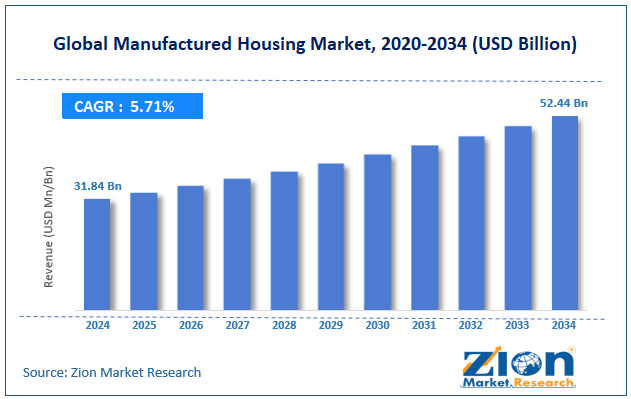
The global manufactured housing market size was worth around USD 31.84 billion in 2024 and is predicted to grow to around USD 52.44 billion by 2034, with a compound annual growth rate (CAGR) of roughly 5.71% between 2025 and 2034.
Key Insights:
- As per the analysis shared by our research analyst, the global manufactured housing market is estimated to grow annually at a CAGR of around 5.71% over the forecast period (2025-2034)
- In terms of revenue, the global manufactured housing market size was valued at around USD 31.84 billion in 2024 and is projected to reach USD 52.44 billion by 2034.
- The manufactured housing market is projected to grow at a significant rate due to the rising demand for affordable housing.
- Based on the house type, the multi-wide segment is growing at a high rate and will continue to dominate the global market, as per industry projections
- Based on the construction material, the steel segment is anticipated to command the largest market share
- Based on the purpose, the residential segment is expected to lead the market growth trends
- Based on the size, the medium segment is projected to influence revenue in the market
- Based on the price, the high-cost segment will emerge as the fastest-growing segment.
- Based on region, Asia-Pacific is projected to dominate the global market during the forecast period
Manufactured Housing Market: Overview
Manufactured housing refers to factory-assembled homes that are later installed on a plot of land. Unlike traditional housing, which involves constructing a unit from scratch on-site, manufactured homes are prefabricated solutions that appeal to budget-conscious buyers. The parts of manufactured housing solutions are constructed and assembled in a factory setting. The parts are then transported to the site where they get assembled on metal piers, concrete blocks, or other substantial tie-downs. Manufactured homes differ significantly from mobile and modular homes, particularly in the legal frameworks that regulate the market.
During the forecast period, demand for manufactured homes is expected to grow due to the growing demand for low-cost or affordable housing. In addition, evolving consumer needs and expectations, along with favorable government policies, may encourage market expansion in the long run. However, less equity in manufactured homes compared to traditional housing solutions and fewer financing options will impact business revenue in the long run.
Manufactured Housing Market: Dynamics
Growth Drivers
How will demand for affordable homes influence the manufactured housing market during the forecast period?
The global manufactured housing market is expected to be driven by the rising demand for affordable housing. According to the U.S. Census Bureau, the average cost of constructing a new house in the US from the ground up can cost over USD 400,000. Similar trends can be reported across other regions, including Europe and the Asia-Pacific.
For instance, European nations such as Spain and Portugal have been facing a housing crisis in the last few years due to the surge in prices associated with home ownership. In addition, growing economic uncertainty worldwide, in the backdrop of changing geopolitics and the ongoing war between major economies, has further amplified demand for low-cost homes among urban and rural populations. As per market research, India is expected to register demand for more than 29 million low-cost homes by 2030 as the urban population continues to rise, thus propelling the use of manufactured home services.
Faster construction time of manufactured homes to influence market revenue in the long run
Manufactured homes can be constructed in less time than traditional homes. The average time taken to develop and install manufactured homes is 8 to 12 months, whereas a traditional house may take over a year to be fully constructed. Faster construction time is due to production taking place indoors, without any external disturbance. Housing demand has reached an all-time high due to the growing population and rapid urbanization, driving production rates in the global manufactured housing market.
Restraints
Why will less equity in prefabricated homes limit the growth of the manufactured housing market?
The global manufactured housing industry is expected to be restricted due to less equity in prefabricated homes compared to traditional housing. Market research suggests that manufactured homes generally depreciate in overall value over time. In addition, manufactured homes have limited financial options because they are not permanently attached to land. The homes may face land ownership issues and generally carry higher default risks, limiting market expansion trends.
Opportunities
Favorable government policies to generate growth opportunities for the market players in the coming years
Over the years, the expansion of policies and regulatory frameworks governing the global manufactured housing market has helped the industry thrive in several parts of the world. In February 2026, the U.S. Department of Housing and Urban Development (HUD) announced the selection of 6 new members for the Manufactured Housing Consensus Committee (MHCC). The federal advisory body is responsible for regulating the manufactured housing industry in the region. The European Union uses harmonized standards, such as the Eurocodes, to cover manufactured housing construction areas, including energy efficiency, safety, and overall structural design.
Challenges
How will limited availability and cookie-cutter design challenge manufactured housing market growth trends?
The global manufactured housing market is expected to be challenged by the limited availability of housing facilities. The industry is currently led by a limited number of players and enjoys popularity in certain areas of the world. The majority of the construction country continues to be led by traditional building structures. In addition, manufactured homes offer limited scope for customization and typically have cooking-cutter designs, which further impact market adoption rates.
Manufactured Housing Market: Report Scope
| Report Attributes | Report Details |
|---|---|
| Report Name | Manufactured Housing Market |
| Market Size in 2024 | USD 31.84 Billion |
| Market Forecast in 2034 | USD 52.44 Bllion |
| Growth Rate | CAGR of 5.71% |
| Number of Pages | 226 |
| Key Companies Covered | Adventure Homes, Cavco Industries, Palm Harbor Homes, Champion Homes, Fairmont Homes, Deer Valley Homebuilders, Redman Homes, Silvercrest Homes, Clayton Homes, Skyline Champion Corporation, Commodore Corporation, Fleetwood Homes, TRU Homes, Karsten Homes, Jessup Housing, and others. |
| Segments Covered | By House Type, By Construction Material, By Purpose, By Size, By Price Range, and By Region |
| Regions Covered | North America, Europe, Asia Pacific (APAC), Latin America, Middle East, and Africa (MEA) |
| Base Year | 2024 |
| Historical Year | 2019 to 2023 |
| Forecast Year | 2025 - 2034 |
| Customization Scope | Avail customized purchase options to meet your exact research needs. Request For Customization |
Manufactured Housing Market: Segmentation
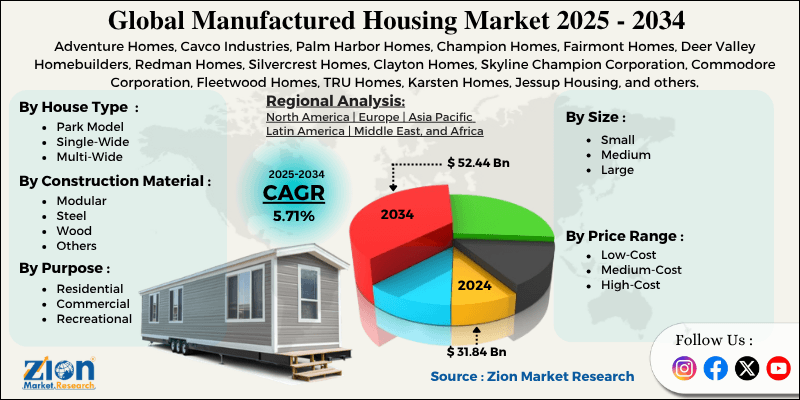
The global manufactured housing market is segmented based on house type, construction, purpose, size, price range, and region.
Why will the multi-wide segment lead the manufactured housing industry revenue during the forecast period?
Based on house type, the global market segments are park model, single-wide, and multi-wide. In 2024, the highest growth was listed in the multi-wide segment, accounting for 64% of the global revenue. It is projected to grow at a 4.1% CAGR during the projection period, driven by greater preference for double- and triple-wide homes, which are ideal for larger families and offer better financing eligibility.
Which factors will influence growth in the steel segment in the manufactured housing industry during the projection period?
Based on construction material, the global manufactured housing industry is fragmented into modular, steel, wood, and other types. The highest growth rate in 2024 was listed in the wood segment, accounting for 55.05% of the global revenue. However, during the forecast period, the steel segment is expected to emerge as the fastest-growing, with a CAGR of 7.12%, driven by growing demand for durable and harsh weather-resistant structures
Why will the residential segment continue to lead the manufactured housing industry in the coming years?
Based on purpose, the global market divisions are residential, commercial, and recreational. The residential segment was the highest revenue generator in 2024, accounting for 81% of global revenue. It is projected to offer a CAGR of 6.12% during the forecast period as demand for affordable housing continues to reach new heights. Growing population density in urban areas will further help the segment thrive.
What is the projected CAGR for the medium segment in the manufactured housing industry during the projection period?
Based on size, the global manufacturing industry is fragmented into small, medium, and large. In 2024, the medium segment accounted for 54.09% of the global revenue. It is projected to deliver a CAGR of 4.51% during the projection period, as medium homes are considered ideal for a nuclear family and are more cost-effective than other options.
What are the reasons for increased growth in the low-cost housing segment in the manufactured housing market?
Based on price, the global market is divided into low-cost, medium-cost, and high-cost. In 2024, the low-cost segment was the highest revenue generator. It contributed around 66% of global revenue in 2024. The high-cost segment is anticipated to deliver a higher CAGR during the forecast period, reaching up to 8.1%, driven by growing demand for luxury or premium prefabricated homes with superior features.
Manufactured Housing Market: Regional Analysis
What is the projected CAGR for North America in the manufactured housing market during the forecast period?
The global manufactured housing market is currently led by North America. The region accounted for nearly 47% of global revenue and is expected to deliver a CAGR of 5.1% in the coming years. The US has a strong presence of several key players producing new manufactured housing designs. Furthermore, the regional market is heavily regulated, allowing accelerated adoption of prefabricated homes.
In March 2026, brightSTAR Communities announced the acquisition of 5 manufactured housing communities, thus expanding the company’s footprint in the regional market.
Why will Asia-Pacific emerge as the fastest-growing region in the manufactured housing market over the forecast duration?
Asia-Pacific is set to emerge as the fastest-growing region in the global manufactured housing market over the forecast duration. In 2024, it accounted for 27.08% of the global revenue. However, it is projected to grow at a CAGR of 8.1% during the projection period, driven by increasing population density in urban areas and rising costs of home ownership. The regional population is seeking affordable houses, especially as the middle-income group continues to rise steadily.
Manufactured Housing Market: Competitive Analysis
The global manufactured housing market is led by players like:
- Adventure Homes
- Cavco Industries
- Palm Harbor Homes
- Champion Homes
- Fairmont Homes
- Deer Valley Homebuilders
- Redman Homes
- Silvercrest Homes
- Clayton Homes
- Skyline Champion Corporation
- Commodore Corporation
- Fleetwood Homes
- TRU Homes
- Karsten Homes
- Jessup Housing
What are the latest key trends in the manufactured housing market?
Decline in consumer spending
The steady decline in consumer spending, especially on material goods and long-term assets, is fueling demand for an affordable and simple lifestyle. Manufactured homes provide basic housing facilities at a reasonable cost and hence enjoy growing demand among end consumers.
Technological advancements
The growing use of advanced technologies, such as factory automation and smart home solutions, is a promising trend in the manufactured housing industry. These technologies are designed to encourage process optimization and enhance consumer lifestyle.
The global manufactured housing market is segmented as follows:
By House Type
- Park Model
- Single-Wide
- Multi-Wide
By Construction Material
- Modular
- Steel
- Wood
- Others
By Purpose
- Residential
- Commercial
- Recreational
By Size
- Small
- Medium
- Large
By Price Range
- Low-Cost
- Medium-Cost
- High-Cost
By Region
- North America
- The U.S.
- Canada
- Mexico
- Europe
- France
- The UK
- Spain
- Germany
- Italy
- Rest of Europe
- Asia Pacific
- China
- Japan
- India
- Australia
- South Korea
- Rest of Asia Pacific
- The Middle East & Africa
- Saudi Arabia
- UAE
- Egypt
- Kuwait
- South Africa
- Rest of the Middle East & Africa
- Latin America
- Brazil
- Argentina
- Rest of Latin America
Table Of Content
Methodology
FrequentlyAsked Questions
Manufactured housing refers to the production of factory-assembled homes that are later installed on a plot of land.
The global manufactured housing market is expected to be driven by the rising demand for affordable housing.
According to study, the global manufactured housing market size was worth around USD 31.84 billion in 2024 and is predicted to grow to around USD 52.44 billion by 2034.
The CAGR value of the manufactured housing market is expected to be around 5.71% during 2025-2034.
The global manufactured housing market is expected to be challenged by the limited availability of housing facilities.
Decline in consumer spending and technological advancements are the emerging trends and innovations impacting the manufactured housing market.
The global manufactured housing market has performed well so far and will offer similar trends in the coming years.
Asia-Pacific is set to emerge as the fastest-growing region in the global manufactured housing market over the forecast duration.
The global manufactured housing market is led by players like Adventure Homes, Cavco Industries, Palm Harbor Homes, Champion Homes, Fairmont Homes, Deer Valley Homebuilders, Redman Homes, Silvercrest Homes, Clayton Homes, Skyline Champion Corporation, Commodore Corporation, Fleetwood Homes, TRU Homes, Karsten Homes, and Jessup Housing.
The report explores crucial aspects of the manufactured housing market, including a detailed discussion of existing growth factors and restraints, while also browsing future growth opportunities and challenges that impact the market.

HappyClients

