
Lenacapavir Injection Market Size, Share, Trends, Growth 2034

Lenacapavir Injection Market By Type (Single-Dose Pre-Filled Syringes, Multi-Dose Vials, Long Acting Injectable Formulations, Combination Injectable Formulations), By Application (HIV Pre-Exposure Prophylaxis, HIV Treatment Therapy, Post-Exposure Preventive Care, Clinical Research Applications), By Distribution Channel (Hospital Pharmacies, Retail Pharmacies, Specialty Clinics, Online Pharmacies), By End User (Hospitals and Clinics, Government Health Programs, Non-Profit Health Organizations, Individual Patients), and By Region - Global and Regional Industry Overview, Market Intelligence, Comprehensive Analysis, Historical Data, and Forecasts 2026 - 2034
| Market Size in 2025 | Market Forecast in 2034 | CAGR (in %) | Base Year |
|---|---|---|---|
| USD 3.66 Billion | USD 5.68 Billion | 4.99% | 2025 |
Lenacapavir Injection Industry Perspective:
What will be the size of the lenacapavir injection market during the forecast period?
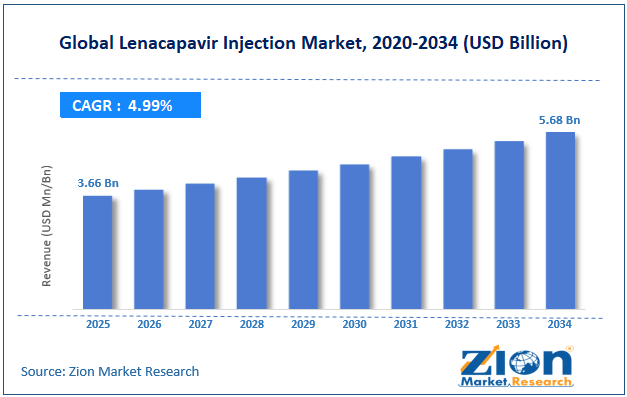
The global lenacapavir injection market size was valued at approximately USD 3.66 billion in 2025 and is projected to reach around USD 5.68 billion by 2034, growing at a compound annual growth rate of approximately 4.99% between 2026 and 2034.
Key Insights
- As per the analysis shared by our research team, the global lenacapavir injection market is estimated to grow at a compound annual growth rate of approximately 4.99% during the forecast period from 2026 to 2034.
- In terms of revenue, the global lenacapavir injection market was valued at approximately USD 3.66 billion in 2025 and is projected to reach USD 5.68 billion by 2034.
- The lenacapavir injection market is expected to grow strongly due to rising HIV prevention initiatives, increasing preference for long-acting therapies, growing government health funding, and expanding access programs in high-burden regions.
- Based on type, single-dose pre-filled syringes lead the market because of their ease of administration in clinical settings, while long-acting injectable formulations are gaining strong momentum as one of the fastest-growing types due to extended dosing intervals.
- Based on application, HIV pre-exposure prophylaxis leads the market due to rising global prevention campaigns. At the same time, post-exposure preventive care is the fastest-growing segment as awareness of emergency HIV prevention options increases.
- Based on distribution channel, hospital pharmacies lead the market because they oversee the administration of injectable therapies, while online pharmacies are growing steadily as telehealth and remote prescription services expand.
- Based on end user, hospitals and clinics lead the market due to their central role in administering injectable treatments, while government health programs are growing rapidly as public funding for HIV prevention increases worldwide.
- Based on region, North America leads the global lenacapavir injection market, while Africa is the fastest-growing region due to high HIV prevalence and expanding international health funding.
Lenacapavir Injection Market: Overview
Lenacapavir injection is a long-acting HIV medicine given by injection to help prevent HIV infection and support treatment. Its extended dosing schedule reduces the need for frequent medication, helping people maintain their HIV prevention or treatment routine with greater convenience. This less frequent dosing can be useful for people who find daily medicines difficult because of busy schedules, travel, forgetfulness, or concerns about stigma. The lenacapavir injection market is growing as healthcare providers and public health programs seek convenient options for HIV prevention and treatment. Rising HIV awareness, government health initiatives, and increased research into long-acting medicines are supporting market growth. Health organizations are also working to improve access to lenacapavir in regions with high HIV rates. Its longer dosing schedule may be especially helpful for people in remote areas who face challenges with regular healthcare visits. Improved patient education can also help healthcare providers explain the benefits and proper use of long-acting HIV prevention options. Growing demand for easier HIV prevention options is creating new opportunities for manufacturers and healthcare providers. Expanding healthcare coverage, affordability programs, and wider availability could further support worldwide market growth.
The lenacapavir injection industry continues to expand as pharmaceutical companies, healthcare providers, and public health agencies work together to widen access to long-acting HIV prevention and treatment options around the world.
Lenacapavir Injection Market: Strategic Perspective
Where is the lenacapavir injection market heading?
The lenacapavir injection market is moving toward wider global access, easier use, and greater adoption through public health HIV prevention programs. Increased investment in production, supply chains, healthcare worker training, and affordable access can help bring lenacapavir to more patients across developed and developing countries.
Where should businesses invest in the lenacapavir injection market?
The lenacapavir injection market offers opportunities in large-scale manufacturing, cold chain distribution, patient support, and partnerships with governments and health organizations. Companies that focus on lowering costs, improving distribution, and making treatment easier to access could benefit as demand for long-acting HIV prevention solutions grows.
What will reshape competition in the lenacapavir injection market?
Competition in the lenacapavir injection market will depend on pricing, production capacity, regulatory approvals, product access, and partnerships with governments and health organizations. Companies that improve affordability, expand availability, and build strong distribution networks, especially in low- and middle-income countries, could gain a stronger market position.
Lenacapavir Injection Market: Technology Roadmap 2026–2034
What is the projected development roadmap of the lenacapavir injection market over the forecast period?
The lenacapavir injection market is advancing through expanded manufacturing capacity, improved distribution networks, growing generic licensing agreements, and continued clinical research into broader applications, making long-acting HIV prevention more accessible worldwide. The market is expected to grow at a compound annual growth rate of approximately 4.99% over the forecast period, driven by rising public health investment, expanding treatment guidelines, and continuous improvement in supply chain infrastructure.
The following roadmap outlines key development phases expected through 2034.
2026–2028: Access Expansion and Regulatory Approval Phase
- Broader regulatory approvals: More countries are expected to approve lenacapavir for HIV prevention and treatment, allowing healthcare providers to offer the injection to more patients.
- Voluntary licensing growth: Drug makers may expand licensing deals with generic manufacturers, helping lower prices and increase lenacapavir supplies in regions with high HIV rates.
- Healthcare worker training: Governments and health groups are likely to train more healthcare workers to give the long-acting injection safely and correctly in clinics.
2029–2031: Supply Chain Strengthening and Program Integration Phase
- Manufacturing capacity growth: Manufacturers are expected to increase production as global demand rises, helping maintain steady supplies and reduce the risk of shortages.
- Integration with public health programs: National health programs may include lenacapavir in HIV prevention plans, community services, and other outreach activities to reach more people.
- Improved cold chain logistics: Better storage and transport systems could help healthcare providers deliver lenacapavir safely to rural and remote areas with limited medical access.
2032–2034: Widespread Access and Preventive Care Phase
- Simplified dosing research: Researchers may develop longer-lasting formulations that reduce how often patients need injections and visits to healthcare facilities.
- Community-based delivery models: Mobile clinics and trained community health workers could provide lenacapavir injections closer to where patients live, improving access outside hospitals.
- Global price harmonization: Manufacturers, governments, and health organizations may work together to create fairer pricing, making lenacapavir more affordable across different countries.
Lenacapavir Injection Market: Dynamics
Growth Drivers
What factors are driving the lenacapavir injection market across HIV prevention and treatment programs?
The lenacapavir injection industry is growing as patients and healthcare providers seek convenient, long-acting HIV prevention and treatment options. Its less frequent dosing can help people who struggle with daily pills because of busy routines, forgetfulness, or treatment fatigue. Growing evidence from clinical studies is also increasing confidence among healthcare providers and supporting wider use across different patient groups. Rising awareness of long-acting HIV care is encouraging more people to consider injectable options. Advances in drug development are improving dosing convenience and supporting the wider use of lenacapavir in routine HIV care. Better healthcare access, specialist clinics, and patient support services are also helping providers introduce long-acting treatment into existing HIV programs. Growing demand for personalized HIV care is encouraging providers to consider treatment options that better match individual needs and lifestyles. Improved patient counseling and follow-up services are also helping healthcare teams support continued use of long-acting therapies. These factors are strengthening demand for lenacapavir and supporting market growth across hospitals, specialty clinics, and other healthcare settings.
Expanding government funding is creating new opportunities in the lenacapavir injection market.
The lenacapavir injection market is gaining opportunities from stronger government spending and international funding for HIV prevention. Public health programs can use lenacapavir to expand prevention services among populations with a higher risk of HIV. Large procurement programs can also create demand for manufacturers as governments plan wider national rollouts. Voluntary licensing agreements may help generic producers supply affordable versions in countries where treatment costs remain a barrier. Partnerships between manufacturers, governments, and global health organizations can further support procurement, distribution, and local supply development. Investment in healthcare infrastructure can improve access to suitable storage, transportation, and injection services. Expanded training programs can prepare more healthcare workers to administer long-acting HIV injections safely. These initiatives can increase market reach while helping countries strengthen their HIV prevention systems. As funding and procurement programs expand, the lenacapavir injection market could gain new opportunities across high-burden and underserved regions.
Restraints
How are affordability and access barriers affecting the lenacapavir injection market?
The lenacapavir injection industry faces affordability and access barriers that can limit adoption, especially in low- and middle-income countries. High treatment costs can strain healthcare budgets and make the injection less affordable for some patients. Limited insurance coverage and differences in healthcare funding can further affect access across regions. Awareness also remains uneven, as some patients and healthcare providers may have limited knowledge of long-acting HIV prevention and treatment options. In rural communities, fewer healthcare facilities can make it harder for patients to receive regular injections. Limited availability of specialized HIV services may further reduce access in underserved areas. Expanding patient education, improving healthcare coverage, and supporting affordable pricing programs can help reduce these barriers. Greater investment in community healthcare can also bring lenacapavir services closer to patients and support wider market adoption.
Opportunities
Will global health partnerships create new opportunities in the lenacapavir injection market?
The lenacapavir injection industry is creating new opportunities through stronger investment in HIV prevention, wider healthcare access, and improvements in drug supply. Public health agencies can expand long-acting HIV prevention programs for people at higher risk, creating new demand across national and community health services. Pharmaceutical companies can benefit by increasing production, improving manufacturing efficiency, and developing simpler administration methods that support wider use. Mobile clinics and community health workers can open new delivery channels in rural and underserved areas. Companies offering cold chain logistics, patient support, and healthcare worker training can also benefit as distribution expands. Growing international funding is creating opportunities to supply lenacapavir across low- and middle-income countries.
Healthcare infrastructure investment can further increase the number of facilities able to provide long-acting injections. Local manufacturing, voluntary licensing, and government procurement programs can further improve supply and affordability in high-burden countries, creating stronger opportunities for market expansion. Digital health platforms can also support patient follow-up, appointment scheduling, and treatment reminders, helping healthcare providers manage long-acting HIV prevention programs more efficiently. Rising demand for reliable distribution partners can create additional opportunities for logistics companies and regional healthcare providers.
Challenges
Manufacturing and distribution limitations are creating challenges for the lenacapavir injection market.
The lenacapavir injection market faces supply-side challenges as manufacturers work to increase production while maintaining reliable product quality. Specialized manufacturing processes can make production expansion more complex and time-consuming. Storage and transportation requirements can also create logistical difficulties, particularly in regions with limited healthcare infrastructure. Healthcare providers must maintain suitable handling conditions to protect product quality during distribution. Different regulatory requirements across countries can further complicate product launches and supply planning. A shortage of trained healthcare workers may also limit the number of facilities that can safely provide injections. Manufacturers and healthcare organizations can address these challenges by expanding production capacity, strengthening distribution networks, improving storage systems, and increasing provider training. Better supply planning and stronger industry partnerships can help improve product availability and support sustainable growth in the global market.
Lenacapavir Injection Market: Report Scope
| Report Attributes | Report Details |
|---|---|
| Report Name | Lenacapavir Injection Market |
| Market Size in 2025 | USD 3.66 Billion |
| Market Forecast in 2034 | USD 5.68 Billion |
| Growth Rate | CAGR of 4.99% |
| Number of Pages | 227 |
| Key Companies Covered | Gilead Sciences, ViiV Healthcare, Merck and Co, Johnson and Johnson, Mylan Pharmaceuticals, Cipla Limited, Aurobindo Pharma, Hetero Drugs, Mankind Pharma, Sun Pharmaceutical Industries, and others. |
| Segments Covered | By Type, By Application, By Distribution Channel, By End User, and By Region |
| Regions Covered | North America, Europe, Asia Pacific (APAC), Latin America, Middle East, and Africa (MEA) |
| Base Year | 2025 |
| Historical Year | 2020 - 2024 |
| Forecast Year | 2026 - 2034 |
| Customization Scope | Avail customized purchase options to meet your exact research needs. Request For Customization |
Lenacapavir Injection Market: Segmentation
The global lenacapavir injection market is segmented by type, application, distribution channel, end user, and region.
What makes single-dose pre-filled syringes the dominant type in the lenacapavir injection market?
Based on type, the global lenacapavir injection market is segregated into single-dose pre-filled syringes, multi-dose vials, long-acting injectable formulations, and combination injectable formulations. Single-dose pre-filled syringes hold about 39% of the market share, leading due to their convenience and reduced risk of dosing errors in clinical settings. Long-acting injectable formulations hold around 25% market share. This segment is the fastest-growing because patients increasingly prefer longer dosing intervals.
How does the HIV pre-exposure prophylaxis application maintain its leading position in the lenacapavir injection market?
Based on application, the lenacapavir injection market is divided into HIV pre-exposure prophylaxis, HIV treatment therapy, post-exposure preventive care, and clinical research applications. HIV pre-exposure prophylaxis accounts for approximately 37% of the global market share, driven by expanding global prevention campaigns and rising awareness of long-acting options. Post-exposure preventive care holds around 18% market share. It is the fastest-growing segment due to increasing awareness of emergency preventive treatment following potential exposure.
What makes hospital pharmacies the dominant distribution channel in the lenacapavir injection market?
Based on distribution channel, the lenacapavir injection industry is classified into hospital pharmacies, retail pharmacies, specialty clinics, and online pharmacies. Hospital pharmacies lead with about a 41% share because they support supervised administration and have established relationships with healthcare providers. Online pharmacies hold around 16% market share. They are growing steadily as telehealth consultations and remote prescription fulfillment become more widely accepted.
How do hospitals and clinics shape the demand landscape of the lenacapavir injection market?
Based on end user, the market is categorized into hospitals and clinics, government health programs, non-profit health organizations, and individual patients. Hospitals and clinics account for about 38% of the market, leading because they administer injectable treatments under medical supervision. Government health programs hold around 26% market share. This segment is expanding quickly as public funding for HIV prevention initiatives continues to increase worldwide.
Lenacapavir Injection Market: Regional Analysis
Why is North America leading the global lenacapavir injection market?
North America holds a 38.45% share of the global lenacapavir injection market and is expected to remain the leading region during the forecast period. The region benefits from strong healthcare infrastructure, early regulatory progress, and established HIV prevention programs. The United States drives much of this growth as hospitals, specialty clinics, and public health agencies adopt long-acting injectable therapies for HIV prevention. High healthcare spending also supports research, patient care, and access to advanced HIV medicines. Insurance coverage can further improve affordability for eligible patients and encourage wider treatment use. Community health organizations work with government agencies to reach people at higher risk of HIV through targeted education and outreach programs. Growing public awareness is also helping more people understand the benefits of long-acting prevention options.
North America has skilled healthcare workers, reliable distribution networks, and advanced storage facilities, which support smooth delivery of lenacapavir injections. Rising demand for convenient HIV prevention is encouraging more healthcare providers to adopt these therapies. Strong public health funding, continued research, and investment in HIV prevention programs are further supporting regional market growth. These factors are expected to strengthen North America's position in the global market throughout the forecast period. At the same time, continued healthcare innovation and wider access programs may create additional opportunities for manufacturers and service providers.
What makes Africa the fastest-growing region in the lenacapavir injection market?
The Africa lenacapavir injection industry accounts for about 5.8% of the global market and is expected to grow strongly during the forecast period. High HIV rates, rising international health funding, and stronger government efforts to improve HIV prevention are supporting regional market growth. South Africa and Kenya are key contributors, as national health programs and community campaigns increase demand for convenient HIV prevention options. Mobile clinics and community health workers are helping reach people in rural and underserved areas where regular healthcare access remains limited. International health organizations are also working with governments to expand distribution and lower treatment costs.
Voluntary licensing agreements with generic manufacturers can further increase access by supporting lower-cost supplies. Healthcare worker training is another important factor, as more trained staff can safely provide long-acting injections across local healthcare facilities. Governments are also integrating HIV prevention into broader national health plans, creating stronger support for long-term adoption. Continued partnerships between global health groups, manufacturers, and regional governments can improve supply and access. Rising investment in healthcare infrastructure and prevention programs is expected to create significant opportunities for the lenacapavir injection market across Africa during the forecast period.
Recent Market Developments
- In August 2026, Gilead presented new lenacapavir research at AIDS 2026, highlighting its continued development as a long-acting HIV prevention and treatment option with different dosing approaches. The company is also evaluating lenacapavir in several ongoing and planned clinical studies.
- In April 2026, Gilead Sciences announced that the U.S. PEPFAR program and the Global Fund would expand access to long-acting lenacapavir for HIV prevention by an additional 1 million people over three years. This brings the joint goal to 3 million people reached across low- and middle-income countries by 2028.
Lenacapavir Injection Market: Competitive Analysis
The leading players in the global lenacapavir injection market are:
- Gilead Sciences
- ViiV Healthcare
- Merck and Co
- Johnson and Johnson
- Mylan Pharmaceuticals
- Cipla Limited
- Aurobindo Pharma
- Hetero Drugs
- Mankind Pharma
- Sun Pharmaceutical Industries
The global lenacapavir injection market is segmented as follows:
By Type
- Single Dose Pre-Filled Syringes
- Multi-Dose Vials
- Long-Acting Injectable Formulations
- Combination Injectable Formulations
By Application
- HIV Pre-Exposure Prophylaxis
- HIV Treatment Therapy
- Post-Exposure Preventive Care
- Clinical Research Applications
By Distribution Channel
- Hospital Pharmacies
- Retail Pharmacies
- Specialty Clinics
- Online Pharmacies
By End User
- Hospitals and Clinics
- Government Health Programs
- Non-profit Health Organizations
- Individual Patients
By Region
- North America
- The U.S.
- Canada
- Mexico
- Europe
- France
- The UK
- Spain
- Germany
- Italy
- Rest of Europe
- Asia Pacific
- China
- Japan
- India
- Australia
- South Korea
- Rest of Asia Pacific
- The Middle East & Africa
- Saudi Arabia
- UAE
- Egypt
- Kuwait
- South Africa
- Rest of the Middle East & Africa
- Latin America
- Brazil
- Argentina
- Rest of Latin America
Table Of Content
Methodology
FrequentlyAsked Questions
Lenacapavir injection is a long-acting HIV medicine given by injection to help prevent HIV infection and support treatment. Its extended dosing schedule reduces the need for frequent medication, helping people maintain their HIV prevention or treatment routine with greater convenience.
The global lenacapavir injection market is expected to grow due to rising HIV prevention initiatives, increasing preference for long-acting therapies, growing government health funding, and expanding access programs worldwide.
According to research, the global lenacapavir injection market was valued at approximately USD 3.66 billion in 2025 and is projected to reach approximately USD 5.68 billion by 2034.
The compound annual growth rate of the lenacapavir injection market is expected to be approximately 4.99% from 2026 to 2034.
North America is expected to lead the global lenacapavir injection market throughout the forecast period, driven by strong healthcare infrastructure, early regulatory approval, and well-established HIV prevention programs.
The major players in the global lenacapavir injection market include Gilead Sciences, ViiV Healthcare, Merck and Co, Johnson and Johnson, Mylan Pharmaceuticals, Cipla Limited, Aurobindo Pharma, Hetero Drugs, Mankind Pharma, and Sun Pharmaceutical Industries.
The report examines key aspects of the lenacapavir injection market, including growth drivers, adoption barriers, application opportunities, competitive landscape dynamics, detailed regional market performance analysis, and a comprehensive forward-looking outlook across all major types, applications, distribution channels, end-user segments, and geographic regions through 2034.
The lenacapavir injection market is seeing faster global rollout, wider use of twice-yearly HIV prevention, generic licensing, and stronger public health programs. New delivery models, expanded manufacturing partnerships, and broader use of long-acting prevention are improving product availability and helping healthcare systems reach more people at risk of HIV.
Technology is helping the lenacapavir injection market develop longer-lasting HIV medicines and simpler delivery options. Research into new formulations, including once-weekly oral lenacapavir, could give patients more choices for convenient HIV prevention.
HIV pre-exposure prophylaxis (PrEP) will offer major opportunities in the lenacapavir injection market, especially through national programs, community clinics, mobile healthcare, and services for people at higher risk of HIV. Growing demand for convenient, long-acting HIV prevention can further support adoption across underserved communities and high-burden regions.

HappyClients

