
Lemonade Market Size, Share, Growth, Opportunities 2034

Lemonade Market By Product Type (Flavored and Unflavored), By Product Format (Ready-To-Drink (RTD) Lemonade, Concentrate Lemonade, and Powdered Lemonade), By Packaging Type (Bottles, Cartons, Cans, Pouches, and Others), By Distribution Channel (B2B and B2C), and By Region - Global and Regional Industry Overview, Market Intelligence, Comprehensive Analysis, Historical Data, and Forecasts 2025 - 2034
| Market Size in 2024 | Market Forecast in 2034 | CAGR (in %) | Base Year |
|---|---|---|---|
| USD 11.9 Billion | USD 22.3 Billion | 6.5% | 2024 |
Lemonade Industry Perspective:
What will be the size of the global lemonade market during the forecast period?
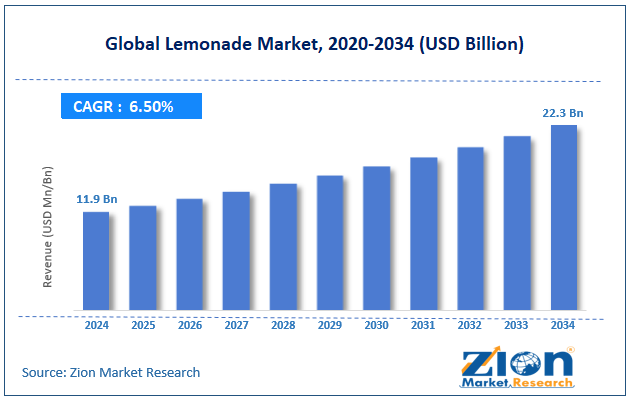
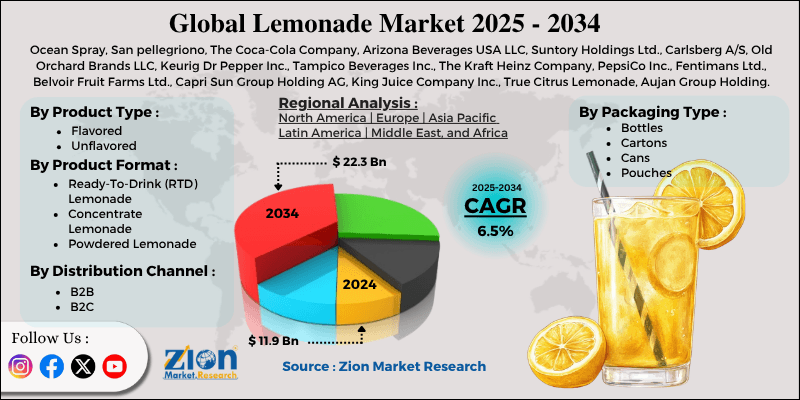
The global lemonade market size was worth around USD 11.9 billion in 2024 and is predicted to grow to around USD 22.3 billion by 2034, with a compound annual growth rate (CAGR) of roughly 6.5% between 2025 and 2034.
Key Insights
- As per the analysis shared by our research analyst, the global lemonade market is estimated to grow annually at a CAGR of around 6.5% over the forecast period (2025-2034).
- In terms of revenue, the global lemonade market size was valued at around USD 11.9 billion in 2024 and is projected to reach USD 22.3 billion by 2034.
- Rising health consciousness is expected to propel the lemonade market over the projected period.
- Based on the product type, the unflavored segment captures the largest market share in 2024 of 55%.
- Based on the product format, the Ready-To-Drink (RTD) Lemonade segment captures the largest revenue share in 2024 of over 50%.
- Based on the packaging type, the bottles segment held the dominant position in 2024, accounting for over 40% of revenue share.
- Based on the distribution channel, the B2B segment accounted for the largest share, at 42%, in the lemonade industry.
- Based on region, North America accounted for the highest market share in the lemonade market of over 33% in 2024.
Lemonade Market: Overview
Lemonade is a popular, affordable, refreshing beverage available in both homemade and commercial varieties, made primarily from lemon juice, water, and a sweetener. It is a universal drink with many types, such as still, sparkling, and flavored, and is available in RTD packages. It is considered healthier than other soft drinks because it contains the right amount of water and natural vitamin C. Lemonade is part of the non-alcoholic RTD soft drink category and, like many other categories, is witnessing shifts in buying trends towards natural, clean-label drinks and convenience. The global lemonade market is a major contributor to the soft drink market, mainly due to increasing consumer preference for natural, healthy drinks, as people are now replacing carbonated soft drinks with drinks perceived as more refreshing, free of artificial ingredients, and rich in vitamin C. The growing health consciousness and need for labels free of artificial ingredients have led to the development of organic, low-sugar, preservative-free lemons. However, the fluctuating raw material prices might be hampering the industry’s growth.
Lemonade Market: Dynamics
Growth Drivers
How does the product innovation & flavor diversification drive the lemonade market?
Product and flavor innovation will continue to be key growth drivers in the lemonade market as consumers increasingly demand a wider variety of options, and brands innovate accordingly to remain competitive. Consumers today will not settle for the relatively less exciting traditional lemonade but will instead expect a differentiated category offering with complex flavor profiles, functional benefits, higher quality, and more exotic ingredients, including those with a health halo. This, in turn, has spurred developments such as a portfolio of exotic-flavored lemonades (berry, mango, lavender, ginger), more sophisticated and premium formats (sparkling, single-flavor glass bottles, organic lemonade, vitamin-enriched lemonade), and premium ingredients (higher lemon content per bottle) to appeal to consumers.
For instance, The Coca-Cola Company has expanded beyond its classic Lemonade in the Minute Maid portfolio to its flavored lemonade portfolio, including Minute Maid Pink Lemonade and Minute Maid Lemonade with real fruit blends, and has also added value to its lemonade with variants with higher fruit content and bold flavors. PepsiCo also expanded its Tropicana lemonade range by offering blends of lemonade with other juice varieties to tap into the market of consumers seeking healthy, natural beverage options. Others, such as Starbucks, introduced innovative options such as iced tea lemonades and flavored lemonade refreshers.
Restraints
Does the strong competition from substitute beverages impede the lemonade market?
Strong competition from alternative beverages poses the biggest threat to the growth of the lemonade market. This is because they have become increasingly functional, convenient to consume, and offer real or perceived health benefits. The strongest substitutes come from carbonated soft drinks produced by companies such as the Coca-Cola Company and PepsiCo. These brands are present on shelves in every part of the world, with high distribution levels, huge advertising budgets, and colorful packaging with myriad flavors. Despite health concerns, consumers choose cheaper carbonated soft drinks over lemonade. Similarly, beverages that are more functional and health-oriented are gaining market share.
For instance, Gatorade and Red Bull offer hydration, energy, and performance benefits. Flavored waters with added vitamins, such as Vitamin Water, also seem popular among health-conscious consumers seeking low-calorie functional drinks. Other significant substitutes are fresh fruit juices and smoothies, which are seen as being more natural and healthier. Tropicana juices and Real (Dabur India Ltd.) are the biggest players in the fruit category, with a wide range of brands competing with lemonade.
Opportunities
Why does a product launch offer a lucrative opportunity for the lemonade market?
Product introductions offer the highest potential for growth in the lemonade category, as they enable brands to sustain consumer excitement and capitalize on emerging trends while landing in the most crowded beverage aisle. As lemonade is a mature product, expansion relies heavily on innovation rather than undifferentiated demand, and innovation is both quick and clear.
For instance, in March 2026, Panera Bread recently launched a new line of energy beverages, two years after the bakery-cafe fast-casual chain was hit with the first of numerous lawsuits over its heavily caffeinated Charged Lemonade beverages. The Energy Refreshers include 28 milligrams of caffeine, while a 30-fluid-ounce contains 42-44 milligrams. This provides a relatively mild caffeine “buzz,” compared to the old Charged Lemonades, which featured up to 390 milligrams in a 30-fluid-ounce.
Challenges
The high cost of sustainable packaging poses a significant challenge to the lemonade market
The cost of sustainable packaging is one of the most pressing issues for the lemonade market, as it dramatically increases companies’ costs in an industry under great pressure to conform to eco-friendly standards. As consumers and governments push for environmentally responsible packaging (reduced plastic, recyclable bottles, biodegradable pitch, USDA certifications), marketers have been forced to move away from traditional, inexpensive plastic packaging. But sustainable options such as glass bottles, aluminum packaging, and bioplastics are often more costly to produce and transport. This issue is especially difficult in the often price-sensitive, competitive lemonade industry (where many other products can be substituted), as it is not easy for companies to recover these additional costs by passing them on to consumers.
For instance, the Coca-Cola company and PepsiCo have announced specific goals to increase their use of recyclable, reusable, and bioplastic packaging, all of which will cost the company more in the short term - a strain that will be magnified for smaller, regional companies.
Lemonade Market: Report Scope
| Report Attributes | Report Details |
|---|---|
| Report Name | Lemonade Market |
| Market Size in 2024 | USD 11.9 Billion |
| Market Forecast in 2034 | USD 22.3 Bllion |
| Growth Rate | CAGR of 6.5% |
| Number of Pages | 225 |
| Key Companies Covered | Ocean Spray, San pellegriono, The Coca-Cola Company, Arizona Beverages USA LLC, Suntory Holdings Ltd., Carlsberg A/S, Old Orchard Brands LLC, Keurig Dr Pepper Inc., Tampico Beverages Inc., The Kraft Heinz Company, PepsiCo Inc., Fentimans Ltd., Belvoir Fruit Farms Ltd., Capri Sun Group Holding AG, King Juice Company Inc., True Citrus Lemonade, Aujan Group Holding (Rani Food), Polar Beverages, Dabur India Ltd, Clover Farms Dairy, and others. |
| Segments Covered | By Product Type, By Product Format, By Packaging Type, By Distribution Channel, and By Region |
| Regions Covered | North America, Europe, Asia Pacific (APAC), Latin America, Middle East, and Africa (MEA) |
| Base Year | 2024 |
| Historical Year | 2019 to 2023 |
| Forecast Year | 2025 - 2034 |
| Customization Scope | Avail customized purchase options to meet your exact research needs. Request For Customization |
Lemonade Market: Segmentation
Product Type Insights
Why does the unflavored dominate the lemonade market?
The unflavored segment captures the largest market share in 2024 of 55%. Its popularity is driven by its close relationship with a drink seen as wide-ranging, popular, and easy to drink, with an authentic image currently sought by customers. The health focus of many consumers is growing, and as such, demand is increasing for the original, best forms of a product rather than the flavored drinks that began to appear later. Unflavored lemonade is also seen as closer to ‘the real thing’, with no added flavorings or preservatives, and this is a growing trend. It is also widely seen as suitable for a range of channels, including households, foodservice, and RTD, and is available in a variety of markets in the developed and emerging/developing worlds.
Product Format Insights
Is the Ready-To-Drink (RTD) Lemonade growing at the highest rate in the lemonade market?
The Ready-To-Drink (RTD) Lemonade segment captures the largest revenue share in 2024 of over 50%. The market segment is being led by demand for convenient, portable formats from urban consumers who are increasingly time-starved. Consumers’ time pressures and busy lifestyles would drive demand for portable lemonade packs that require no prior preparation. Time-starved consumers will prefer packs that are ready to consume and neutralize any variations in their taste. It has become easier for consumers to access such portable formats, primarily through modern retail outlets such as supermarkets, convenience stores, and e-commerce sites, which, in turn, have propelled the growth of RTD Lemonades. RTD Lemonades offer secondary benefits, such as various health benefits, in the form of low-sugar RTD lemonades, organic lemonades, functional Lemonades, and more. Manufacturers are developing innovative packaging formats, such as bottles and portable cans, to enhance consumer convenience.
Packaging Type Insights
Why does the bottle’s packaging type hold a majority of market share in the lemonade market?
The bottles segment held the dominant position in 2024, accounted over 40% of revenue share. The main factors driving its growth are its convenience, portability, and mass availability across retail and foodservice channels. Bottles (Pet & Glass in particular) as a packaging format have proven to be the most preferred because they facilitate consumers in carrying and consuming lemonade on the move.
Distribution Channel Insights
Why B2B is growing at a substantial rate over the analysis period?
The B2B segment accounted for the largest share, at 42%, in the lemonade industry. Lemonade demand is increasing from foodservice, hospitality, and institutional buyers, including restaurants, cafeterias, hotels, catering companies, and QSR chains. More and more companies are demanding bulk or concentrate lemonade, as well as ready-to-serve options, to ensure their operations run smoothly and reduce costs and quality fluctuations.
Regional Insights
Why does North America lead the Lemonade market?
North America accounted for the largest share of the lemonade market, at over 33% in 2024. Regional growth is underpinned by a robust consumer demand for ready-to-drink (RTD) beverages and healthier drink options. Consumers in the regions are progressively moving away from high-sugar carbonated drinks towards perceived more natural drinks such as lemonade, especially by using clean-label, organic, and low-sugar ingredients. The dominance of major beverage corporations such as The Coca-Cola Company and PepsiCo, along with well-developed distribution channels, ensures excellent product availability in supermarkets, convenience stores, and foodservice outlets alike.
Furthermore, ongoing product innovation, including flavored, sparkling, and functional lemonade, helps cater to a wider customer base. Additionally, a strong foodservice and cafe culture in the region, including embedded lemonades in the F&B offer, also contributes to sales. Rising demand for premium and artisanal drinks, alongside increasing interest in sustainable packaging, is also expected to boost value sales.
Lemonade Market: Competitive Analysis
The global lemonade market is dominated by players like:
- Ocean Spray
- San pellegriono
- The Coca-Cola Company
- Arizona Beverages USA LLC
- Suntory Holdings Ltd.
- Carlsberg A/S
- Old Orchard Brands LLC
- Keurig Dr Pepper Inc.
- Tampico Beverages Inc.
- The Kraft Heinz Company
- PepsiCo Inc.
- Fentimans Ltd.
- Belvoir Fruit Farms Ltd.
- Capri Sun Group Holding AG
- King Juice Company Inc.
- True Citrus Lemonade
- Aujan Group Holding (Rani Food)
- Polar Beverages
- Dabur India Ltd
- Clover Farms Dairy
The global lemonade market is segmented as follows:
By Product Type
- Flavored
- Unflavored
By Product Format
- Ready-To-Drink (RTD) Lemonade
- Concentrate Lemonade
- Powdered Lemonade
By Packaging Type
- Bottles
- Cartons
- Cans
- Pouches
- Others
By Distribution Channel
- B2B
- B2C
By Region
- North America
- The U.S.
- Canada
- Mexico
- Europe
- France
- The UK
- Spain
- Germany
- Italy
- Rest of Europe
- Asia Pacific
- China
- Japan
- India
- Australia
- South Korea
- Rest of Asia Pacific
- The Middle East & Africa
- Saudi Arabia
- UAE
- Egypt
- Kuwait
- South Africa
- Rest of the Middle East & Africa
- Latin America
- Brazil
- Argentina
- Rest of Latin America
Table Of Content
Methodology
FrequentlyAsked Questions
Lemonade is a popular, affordable, refreshing beverage that comes in both homemade and commercial varieties and is made primarily from lemon juice, water, and a sweetener. It is a universal drink available in many varieties, including still, sparkling, and flavored, and in RTD packages.
The global lemonade market is a major contributor to the soft drink market, mainly due to increasing consumer preference for natural, healthy drinks, as people are now replacing carbonated soft drinks with drinks perceived as more refreshing, free of artificial ingredients, and providing vitamin C. The growing health consciousness and need for labels free of artificial ingredients have led to the development of organic, low-sugar, preservative-free lemons.
The fluctuating raw material prices and increasing competition in the market might be hampering the industry’s growth.
Based on the product type, the unflavored segment is expected to dominate the lemonade market growth during the projected period.
The lemonade market is being shaped by emerging trends such as the growing demand for low-sugar and functional beverages enriched with vitamins and probiotics, along with increasing preference for clean-label and organic products free from artificial additives. Manufacturers are focusing on flavor innovation, introducing exotic and botanical-infused variants, as well as sparkling and premium lemonade options to attract diverse consumer segments. Additionally, the rise of ready-to-drink (RTD) formats, expansion of e-commerce channels, and adoption of sustainable packaging solutions are further driving innovation, with an overall emphasis on health, convenience, and environmental responsibility.
According to the report, the global lemonade market size was worth around USD 11.9 billion in 2024 and is predicted to grow to around USD 22.3 billion by 2034.
The global lemonade market is expected to grow at a CAGR of 6.5% during the forecast period.
The global lemonade industry growth is expected to be led by North America over the forecast period.
The global lemonade market is dominated by players like Ocean Spray, San pellegriono, The Coca-Cola Company, Arizona Beverages USA LLC, Suntory Holdings Ltd., Carlsberg A/S, Old Orchard Brands LLC, Keurig Dr Pepper Inc., Tampico Beverages Inc., The Kraft Heinz Company, PepsiCo Inc., Fentimans Ltd., Belvoir Fruit Farms Ltd., Capri Sun Group Holding AG, King Juice Company, Inc., True Citrus Lemonade, Aujan Group Holding (Rani Food), Polar Beverages, Dabur India Ltd, and Clover Farms Dairy among others.
The lemonade market report covers the geographical market along with a comprehensive competitive landscape analysis. It also includes cash flow analysis, profit ratio analysis, market basket analysis, market attractiveness analysis, sentiment analysis, PESTLE analysis, trend analysis, SWOT analysis, trade area analysis, demand & supply analysis, Porter’s five forces analysis, and value chain analysis.

HappyClients

