
Global Industrial Salt Market Size, Share, Trends, Growth 2032

Industrial Salt Market By Process Type (Solar Evaporation, Conventional Mining and Vacuum Pan Evaporation), By Source Type (Natural Brine and Rock Salt), By Application (Agriculture, Oil & Gas, De-icing, Water Treatment, Chemical Processing, and Others), and By Region - Global and Regional Industry Overview, Market Intelligence, Comprehensive Analysis, Historical Data, and Forecasts 2024 - 2032
| Market Size in 2023 | Market Forecast in 2032 | CAGR (in %) | Base Year |
|---|---|---|---|
| USD 17.43 Billion | USD 31.32 Billion | 6.73% | 2023 |
Industrial Salt Industry Perspective
What will be the global industrial salt market size during the forecast period?
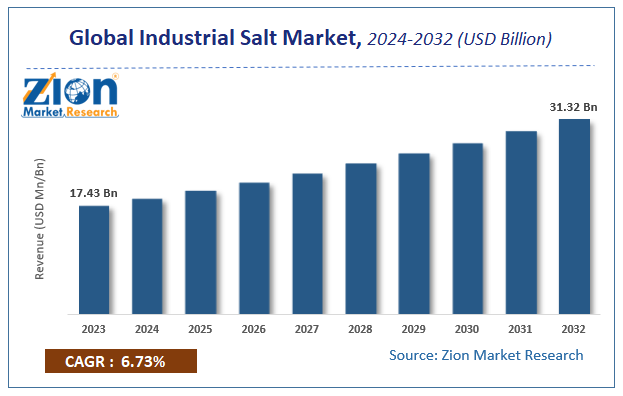
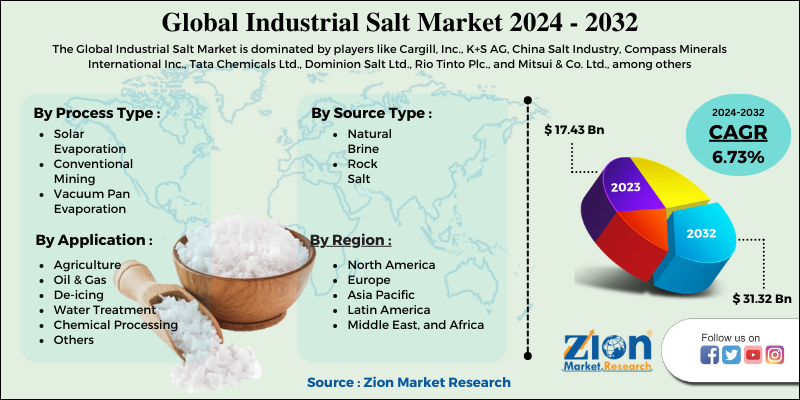
The global industrial salt market size was worth around USD 17.43 billion in 2023 and is predicted to reach around USD 31.32 billion by 2032, with a compound annual growth rate (CAGR) of roughly 6.73% between 2024 and 2032.
This report provides a comprehensive analysis of the growth drivers, restraints, and challenges shaping demand across the global industrial salt market throughout the forecast period, while highlighting high-potential emerging opportunities within the industry.
Key Insights
- As per the analysis shared by our research analyst, the global industrial salt market is estimated to grow annually at a CAGR of roughly 6.73% over the forecast period (2024–2032).
- In terms of revenue, the global industrial salt market size was valued at around USD 17.43 Billion in 2023 and is projected to reach USD 31.32 Billion by 2032.
- The industrial salt market is driven by escalating demand for chlor-alkali derivatives, extensive chemical synthesis, growing road safety measures requiring highway de-icing, and expanding exploration within the oil and gas sector.
- By Process Type, the solar evaporation segment held the largest market share because of its cost-effective operations, reliance on environmentally sustainable solar energy, and large-scale industrial output capacity across coastal territories.
- By Source Type, the rock salt segment dominated market share because of abundant underground geologic deposits, high baseline mineral purity, and suitability for bulk logistics in road safety and industrial chemical extraction.
- By Application, the chemical processing segment accounted for the largest market share because raw industrial salt serves as an irreplaceable, economically viable feedstock in the commercial production of chlorine, caustic soda, and soda ash.
- Asia Pacific dominated market share due to rapid industrialization, massive chemical manufacturing capacity, expansive infrastructure projects, and robust domestic chemical processing hubs led by China and India.
Industrial Salt Market: Overview
Industrial salt refers to various grades of salt used primarily for non-food industrial purposes, including manufacturing, chemical processes, de-icing, water treatment, agriculture, and oil and gas operations. Unlike table salt intended for human consumption, industrial salt serves as a critical raw material for producing caustic soda, chlorine, soda ash, and other chemicals, while also supporting direct applications such as highway de-icing and agriculture.
Industrial Salt Market: Growth Factors
What factors are primarily accelerating demand in the industrial salt market?
Increasing demand and requirements for industrial salt in the major application sectors, including the oil & gas industry, highway de-icing, chemical processing, agriculture, and water treatment, mainly for the generation of caustic soda, chlorine, and soda ash are projected to compel the development of the market growth in the coming years. The industry is projected to grow significantly due to a wide range of direct uses, such as agriculture and de-icing, and indirect uses, including the chemical processing sector for producing caustic soda and chlorine. Rising consumption in chemical processing for manufacturing caustic soda, chlorine, and soda ash is a key growth driver. The chlor-alkali sector relies heavily on industrial salt because viable low-cost alternatives are limited, ensuring consistent baseline demand.
The chlor-alkali division in the chemical sector maximizes product utilization because no cost-effective alternative exists. The global industrial salt market is expected to grow strongly due to increasing technological developments in producing high-purity salt, such as vacuum pan technology. On the other hand, adoption remains relatively low because low-cost production methods, such as solution mining, conventional mining, and solar evaporation, are widely used.
Industrial Salt Market: Restraints
What factors are limiting the expansion of the industrial salt market?
Although high-purity production technologies such as vacuum pan evaporation offer quality advantages, their higher cost relative to solar evaporation and conventional mining limits broader adoption in price-sensitive applications.
Seasonal fluctuations in de-icing demand and regional variations in natural resource availability can also create temporary imbalances between supply and consumption.
Industrial Salt Market: Opportunities
Where do significant growth opportunities lie for the industrial salt market?
Rapid industrialization in Asia Pacific and rising chemical sector demand create substantial opportunities for increased production and consumption. Expanding agricultural applications and infrastructure projects further support volume growth. Advances in production efficiency and the development of higher-purity grades tailored to specific industrial needs offer avenues for value addition and market differentiation.
Industrial Salt Market: Challenges
What key challenges confront participants in the industrial salt market?
Balancing cost competitiveness with purity requirements remains an ongoing challenge, particularly when competing low-cost production methods dominate many applications. Logistics and transportation costs for bulk material also influence profitability across regions. Environmental and regulatory considerations surrounding mining and evaporation operations require continuous attention to ensure sustainable practices and long-term supply security.
 Request Free Sample
Industrial Salt Market: Report Scope
| Report Attributes | Report Details |
|---|---|
| Report Name | Industrial Salt Market |
| Market Size in 2023 | USD 17.43 Billion |
| Market Forecast in 2032 | USD 31.32 Billion |
| Growth Rate | CAGR of 6.73% |
| Number of Pages | 240 |
| Key Companies Covered | Cargill, Inc., K+S AG, China Salt Industry, Compass Minerals International Inc., Tata Chemicals Ltd., Dominion Salt Ltd., Rio Tinto Plc., and Mitsui & Co. Ltd., among others |
| Segments Covered | By Process Type, By Source Type, By Application, And By Region |
| Regions Covered | North America, Europe, Asia Pacific (APAC), Latin America, Middle East, and Africa (MEA) |
| Base Year | 2023 |
| Historical Year | 2018 - 2022 |
| Forecast Year | 2024 - 2032 |
| Customization Scope | Avail customized purchase options to meet your exact research needs. Request For Customization |
Industrial Salt Market: Segmentation
The industrial salt market is segmented by process type, source type, application, and region. All the segments of the industrial salt market have been analyzed based on present and future trends and the market is estimated from 2024 to 2032.
By process type, the industrial salt market is divided into solar evaporation, conventional mining, and vacuum pan evaporation. The solar evaporation segment is the most dominant category in the industry, commanding the highest volume share because of its low mechanical processing overhead, natural use of solar radiation and coastal winds, and long-standing production infrastructure across hot, arid geographies. Meanwhile, the conventional mining segment ranks as the second most dominant category, sustained by massive subterranean salt deposits that enable continuous, weather-independent mechanical extraction to meet heavy industrial winter maintenance and chemical demands worldwide.
Based on source type, the industrial salt market is divided into natural brine and rock salt. The rock salt segment is the most dominant category in the sector, capturing the leading revenue position because of extensive subterranean formations, rapid mechanical harvest rates, and strong commercial suitability for large-scale bulk applications such as road maintenance and foundational chemical processing. The natural brine segment is the second-largest category, maintaining strong market standing because efficient solution-mining techniques route concentrated liquid salt streams directly into chlor-alkali electrolysis facilities without requiring dry bulk transport.
By application segment, the industrial salt market is divided into agriculture, oil & gas, de-icing, water treatment, chemical processing, and others. The chemical processing segment maintains the most dominant market position, driven by the absolute requirement for sodium chloride in manufacturing soda ash, chlorine, and caustic soda, which collectively support essential modern manufacturing ecosystems. The de-icing segment is the second-largest category, capturing large seasonal volumes across the Northern Hemisphere, where public highway safety agencies and commercial transit authorities require massive supplies of road salt to combat snow and ice buildup during severe winter conditions.
Industrial Salt Market: Regional Analysis
Why will Asia Pacific continue to dominate the global market during the projection period?
Asia Pacific, led by China, is positioned for strong performance in the global industrial salt market. Rapid industrialization and growing chemical sector demand are increasing consumption and driving higher domestic production. China is expected to significantly expand production capacity to meet rising domestic demand while remaining a major global participant. Industrial expansion, infrastructure development, and growing chemical processing activity drive substantial volume and support continued investment in production and logistics. This regional momentum influences overall market growth by driving large-scale demand, improving production efficiency, and encouraging broader supply chain development across Asia Pacific.
North America benefits from substantial de-icing requirements under extreme climatic conditions and steady chemical processing demand, with the United States accounting for a notable share. Europe maintains consistent consumption linked to industrial and de-icing needs. Latin America, particularly Chile and Brazil, is rich in natural deposits and possesses significant production capacity, enabling substantial exports to Europe and North America while agricultural applications further support regional demand. The Middle East and Africa are expected to see notable growth as industrial and infrastructure activity expands.
Industrial Salt Market: Competitive Landscape
The global industrial salt market profiles key players such as
- Cargill, Inc
- K+S AG
- China Salt Industry
- Compass Minerals International Inc
- Tata Chemicals Ltd
- Dominion Salt Ltd
- Rio Tinto Plc
- Mitsui & Co. Ltd
Industrial Salt Market: Key Trends
What are the key trends in the industrial salt market?
Continued preference for cost-effective production methods
Solar evaporation and conventional mining remain widely preferred because of their lower cost structure relative to vacuum pan technology. This cost advantage supports high-volume supply for chemical processing and other bulk applications while keeping prices competitive across the industry.
Rising demand from chemical processing and infrastructure-related uses
Growth in chlor-alkali production and expanding requirements for de-icing, water treatment, and agriculture continue to shape consumption patterns. Producers are responding with capacity adjustments and efficiency improvements to meet these evolving needs.
Segments Covered
The industrial salt market is segmented as follows:
By Process Type
- Solar Evaporation
- Conventional Mining
- Vacuum Pan Evaporation
By Source Type
- Natural Brine
- Rock Salt
By Application
- Agriculture
- Oil & Gas
- De-icing
- Water Treatment
- Chemical Processing
- Others
By Region
- North America
- The U.S.
- Canada
- Mexico
- Europe
- France
- The UK
- Spain
- Germany
- Italy
- Rest of Europe
- Asia Pacific
- China
- Japan
- India
- Australia
- South Korea
- Rest of Asia Pacific
- The Middle East & Africa
- Saudi Arabia
- UAE
- Egypt
- Kuwait
- South Africa
- Rest of the Middle East & Africa
- Latin America
- Brazil
- Argentina
- Rest of Latin America
Table Of Content
Methodology
FrequentlyAsked Questions
Industrial salt is a term that denotes a variety of salt grades that are employed in industrial operations and applications. Industrial salt is predominantly used for non-food purposes, such as manufacturing, chemical processes, and a variety of industrial applications, in contrast to table salt, which is intended for human consumption.
Industrial salt is a critical component in the production of caustic soda, chlorine, and other compounds. The demand for industrial salt increases in tandem with the expansion of the chemical industry.
According to Zion Market Research, the global Industrial Salt Market was worth USD 17.43 Billion in 2023. The market is forecast to reach USD 31.32 Billion by 2032.
According to Zion Market Research, the global Industrial Salt Market a compound annual growth rate (CAGR) of 6.73% during the forecast period 2024-2032.
Asia Pacific, particularly China, along with the United States, is expected to contribute substantially, supported by industrial demand, production expansion, and chemical sector growth.
Some of the most important market players in the global industrial salt market are Cargill, Inc., K+S AG, China Salt Industry, Compass Minerals International Inc., Tata Chemicals Ltd., Dominion Salt Ltd., Rio Tinto Plc., and Mitsui & Co. Ltd., among others.

HappyClients

