
Global Industrial Insulation Market Size, Share, Trends, Growth and Forecast 2032

Industrial Insulation Market By Material (Mineral Wool, Calcium Silicate, Plastic Foams, and Others), By Type (Pipe, Blanket, Board, and Others), By End-use (Power, Chemical & Petrochemical, Oil & Gas, Cement, Food & Beverage, Others, and Others), and By Region - Global and Regional Industry Overview, Market Intelligence, Comprehensive Analysis, Historical Data, and Forecasts 2024 - 2032
| Market Size in 2023 | Market Forecast in 2032 | CAGR (in %) | Base Year |
|---|---|---|---|
| USD 7.05 Billion | USD 11.23 Billion | 5.32% | 2023 |
What is the market size of the industrial insulation industry?
What will be the global Industrial Insulation market size during the forecast period?
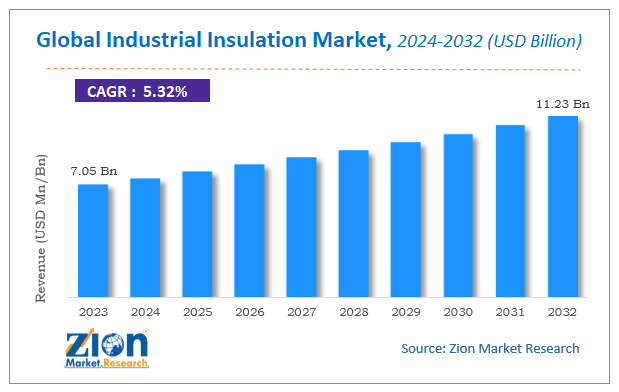
According to a report from Zion Market Research, the global Industrial Insulation Market was valued at USD 7.05 billion in 2023 and is projected to hit USD 11.23 billion by 2032, with a compound annual growth rate (CAGR) of 5.32% during the forecast period 2024-2032.
This report provides a comprehensive analysis of the growth drivers, restraints, and challenges shaping demand across the global Industrial Insulation market throughout the forecast period, while highlighting high-potential emerging opportunities within the industry.
Industrial Insulation Market: Overview
Industrial insulation is the process of protecting buildings from impacts caused by regular or heavy-duty industrial applications. These can incur in the form of vibrations or disturbances in various forms. Generally, buildings require various protection measures to protect from fire, loud noise, among other factors. However, industrial insulation is a specialized process geared at isolating a wide range of impacts often caused by the specific industrial activity.
It's all about industrial thermal insulation. Thermal insulation prevents heat loss and absorption. It prevents industrial facilities like boiler room pipes and connections from wasting energy while working. Due to its insulating characteristics, cork can be used in many applications. Its long lifespan and heat resistance make it ideal for industrial use. Industrial insulation made of cork is fire-resistant and doesn't generate harmful byproducts. Insulation goods are used by builders, industrialists, transporters, and end users.
Key Insights
- As per the analysis shared by our research analyst, the global Industrial Insulation market is estimated to grow annually at a CAGR of around 5.32% over the forecast period (2024-2032).
- In terms of revenue, the global Industrial Insulation market size was valued at around USD 7.05 billion in 2023 and is projected to reach USD 11.23 billion by 2032.
- The market is driven by rising awareness regarding energy conservation, increasing energy costs, the need to protect equipment and personnel, and demand for improved process efficiency, fire safety, and acoustic control in industrial settings.
- Based on the Material, the Mineral Wool segment is growing at a high rate and is projected to dominate the global market.
- Based on the Type, the pipe insulation segment holds a prominent position because of its critical role in minimizing heat loss
- Based on the End-use, the Power segment is a major contributor, supported by continuous demand for energy-efficient insulation
- Based on region, Asia Pacific is expected to achieve the fastest CAGR, driven by growing oil & gas exploration and rising energy demand in India and China
Industrial Insulation Market: Dynamics
Rising Awareness Regarding Energy Conservation and Increasing Energy Costs
The industry receives immediate and long-term benefits from using insulation systems, some of which include protecting equipment, staff, systems, and budgets. Additionally, insulation is responsible for improving the performance of the system's machinery and processes, which reduces the expenses of production and energy consumption. In large-scale industries, acoustic insulation performance reduces high-frequency noises produced by machinery on the factory floor. The use of insulation helps to cut down on the capacity and size of new mechanical equipment that is required.
Additionally, it guards against the spread of fire to any industrial appliances, stops moisture from condensing on the apparatus, and shields the apparatus from damage at temperatures that are either extremely low or extremely high, hence reducing the likelihood of accidental harm.
Energy Costs and Sustainability
Insulation is one of the most reliable and inexpensive ways to conserve energy. Applying external insulation to industrial equipment, such as continuously operated brick wall furnaces, increases their heat storage capacity and modulates their average temperature. Other advantages of industrial insulation include frost protection for pipelines at low ambient temperatures, acoustic insulation in large factories to reduce high-frequency machine noises, and the prevention of mechanical damage to pipework and other components. Insulation can protect equipment and assist in achieving exceedingly high or low temperatures while reducing the risk of accidents. Moisture permeability is a crucial parameter in cryogenic engineering, as it can impair insulation's thermal conductivity.
The oil and gas industry and chemical manufacturers transport their products via vehicles or extensive, high-quality conduits. To preserve the original properties of flammable liquids and high-performance chemicals, perlite insulates the vessels and containers that transport them. Insulation and thermal mass provide industrial equipment and construction with an energy-efficient and cost-effective design, eliminating the need for a heating system and reducing operating expenses. Manufacturers are attempting to develop insulation materials that enhance a product's life cycle and, thus, its efficiency.
Industrial Insulation Market: Key Trends
The rising uncertainty due to climate change, and increase in need for protection for industrial establishments, and rising sophistication in manufacturing facilities will remain key drivers of growth during the forecast period. The growing sophistication in manufacturing facilities, and the advent of automation, will lead to new opportunities for innovative players in the global industrial insulation market. Robotic automation and human interaction are at their nascent stage. This has resulted in grave accidents in recent times, leading to severe damage, and subsequent liabilities. Moreover, the growing requirement for heating, and cooling facilities, cleanboard technology, and rising efficacy of mechanical protection promises major avenues for growth.
Additionally, countries like India, US, and China will likely undertake major infrastructure improvements. It is estimated that the construction sector will grow by 85.2% by 2032. Moreover, these three countries will contribute over 58% of the total growth in the construction sector. The Indian government has announced an infusion of $1.4 trillion in the Indian economy over the forecast period. The investment will result in massive projects including construction of ports, airports, highways, and other public infrastructure. The growth of the construction sector and growing standardization of industrial insulation practices will drive new opportunities for growth.
Industrial Insulation Market: Report Scope
| Report Attributes | Report Details |
|---|---|
| Report Name | Industrial Insulation Market |
| Market Size in 2023 | USD 7.05 Billion |
| Market Forecast in 2032 | USD 11.23 Billion |
| Growth Rate | CAGR of 5.32% |
| Number of Pages | 210 |
| Key Companies Covered | Kingspan Group PLC, Owens Corning, Knauf Insulation, Saint Gobain, and Rockwool Group |
| Segments Covered | By Material, By End-Use, By Type And By Region |
| Regions Covered | North America, Europe, Asia Pacific (APAC), Latin America, Middle East, and Africa (MEA) |
| Base Year | 2023 |
| Historical Year | 2018 - 2022 |
| Forecast Year | 2024 - 2032 |
| Customization Scope | Avail customized purchase options to meet your exact research needs. Request For Customization |
Industrial Insulation Market: Segmentation
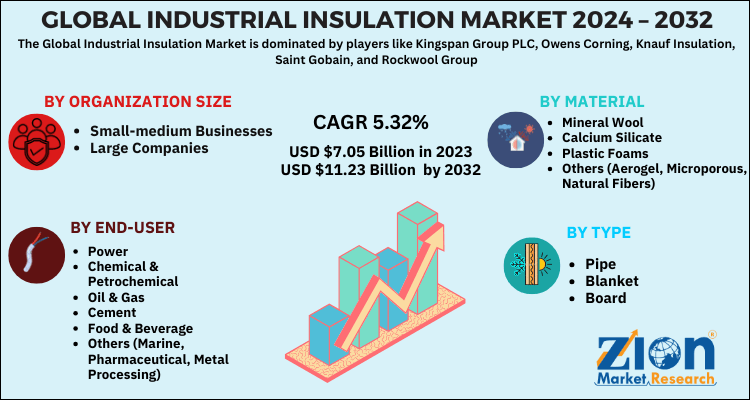
The Industrial Insulation market is segmented by material, type, end-use, and region.
Based on Material Segment, the Industrial Insulation market is divided into Mineral Wool, Calcium Silicate, Plastic Foams, and others. Mineral Wool is a dominant material due to its stable thermal resistance, excellent fire protection, and effective acoustic damping across a wide range of industrial temperatures and operating conditions. This leadership supports market growth by providing a versatile and reliable solution for power, chemical, oil & gas, and general industrial applications. Calcium Silicate and Plastic Foams serve important secondary roles, offering specialized performance for high-temperature or lightweight insulation needs, while other materials such as aerogels and natural fibers address niche high-performance or sustainability-focused requirements.
Based on Type Segment, the Industrial Insulation market is divided into Pipe, Blanket, Board, and others. Pipe insulation holds a leading position because of its essential function in minimizing heat loss, maintaining process temperatures, and protecting pipelines in power generation, oil & gas, chemical, and petrochemical facilities. This dominance drives substantial market volume by addressing critical energy-efficiency and safety requirements in continuous process industries. Blanket and Board forms provide flexible and rigid solutions for equipment surfaces, vessels, and structural applications, contributing complementary demand across a broad range of industrial settings.
Based on End-use Segment, the Industrial Insulation market is divided into Power, Chemical & Petrochemical, Oil & Gas, Cement, Food & Beverage, and others. Power is a major end-use segment, supported by continuous needs for thermal efficiency, process reliability, and personnel safety in energy-intensive operations. These industries drive core market demand through both new installations and maintenance or retrofit activities. Food & Beverage is expected to benefit from rising food processing activity and increasing focus on food safety and hygiene, creating additional growth opportunities. Cement and other sectors, including marine, pharmaceutical, and metal processing, contribute steady demand for specialized insulation solutions.
Industrial Insulation Market: Regional Analysis
Why will Asia Pacific continue to achieve strong growth during the projection period?
The global industrial insulation market report will cover all regions including North America, Asia Pacific, Latin America, Middle East & Africa, and Europe. The growing demand for oil & gas exploration activity, and large-scale use of temporary structures for these activities will drive tremendous growth in this sector in the Asia Pacific region. The growing demand for energy in India and China, and their increased dependence on the same for development, will be a major driver for growth for players in the industrial insulation market. North America and Europe will likely register the highest revenues, respectively, thanks to increased advancement in manufacturing chemicals and rising demand in the food & beverage sector due to changing lifestyles.
North America is projected to register high revenues, supported by advanced manufacturing activity in chemicals and rising demand in the food & beverage sector linked to changing lifestyles and processing requirements. The United States remains a key market due to its mature industrial base and ongoing emphasis on energy efficiency and safety.
Industrial Insulation Market: Competitive Analysis
The global industrial insulation market landscape remains competitive and fragmented landscape with large numbers of small and large players alike. The growing demand for innovation and increased diversification promises tremendous potential for innovative players during the forecast period. Some key players in the industrial insulation market are :
- Kingspan Group PLC
- Owens Corning
- Knauf Insulation
- Saint Gobain
- Rockwool Group.
The global industrial insulation market is segmented as follows:
By Material
- Mineral Wool
- Calcium Silicate
- Plastic Foams
- Others (Aerogel, Microporous, Natural Fibers)
By Type
- Pipe
- Blanket
- Board
- Others
By End-use
- Power
- Chemical & Petrochemical
- Oil & Gas
- Cement
- Food & Beverage
- Others (Marine, Pharmaceutical, Metal Processing)
By Region
- North America
- The U.S.
- Canada
- Mexico
- Europe
- France
- The UK
- Spain
- Germany
- Italy
- Rest of Europe
- Asia Pacific
- China
- Japan
- India
- Australia
- South Korea
- Rest of Asia Pacific
- The Middle East & Africa
- Saudi Arabia
- UAE
- Egypt
- Kuwait
- South Africa
- Rest of the Middle East & Africa
- Latin America
- Brazil
- Argentina
- Rest of Latin America
Table Of Content
Methodology
FrequentlyAsked Questions
Industrial insulation is a specialized thermal, acoustic, and protective system applied to industrial equipment, pipes, vessels, and facilities to prevent heat loss or gain, control noise, provide fire resistance, manage moisture, and protect against extreme temperatures and mechanical impacts associated with industrial operations.
Key growth drivers include rising awareness of energy conservation, increasing energy costs, the need to protect equipment and personnel, demand for improved process efficiency, fire safety, acoustic control, and expanding industrial and infrastructure activity.
The global Industrial Insulation market size was valued at USD 7.05 billion in 2023 and is projected to hit USD 11.23 billion by 2032.
The global Industrial Insulation market is expected to grow at a compound annual growth rate (CAGR) of 5.32% during the forecast period 2024-2032.
Major challenges include installation complexity, material and system cost considerations, the need for specialized designs for extreme conditions, moisture effects on thermal performance, and the requirement to meet evolving efficiency and safety standards.
Emerging trends include greater focus on energy-efficient and multi-functional insulation, development of materials with enhanced life-cycle performance, rising demand linked to infrastructure and manufacturing sophistication, and increasing attention to fire, acoustic, and moisture protection capabilities.
The value chain typically includes raw material production (mineral wool, foams, calcium silicate, and others), manufacturing of pipe, blanket, and board products, system design and engineering, distribution, professional installation, and ongoing maintenance or retrofit services for industrial facilities.
Asia Pacific is expected to achieve the fastest CAGR, driven by oil & gas activity and energy demand in India and China, while North America and Europe are projected to register high revenues from advanced manufacturing and food & beverage sectors.
Kingspan Group PLC, Owens Corning, Knauf Insulation, Saint Gobain, Rockwool Group, and others.
The report explores crucial aspects of the Industrial Insulation market, including a detailed discussion of existing growth factors and restraints, while also examining future growth opportunities and challenges that impact the market. It provides comprehensive segmentation analysis, regional insights, competitive landscape, and forecasts based on historical data.

HappyClients

