
Global Industrial Display Market Size, Share, Trends, Growth and Forecast 2032

Industrial Display Market By Type (Rugged Displays, Open Frame Monitors, Panel-Mount Monitors, Marine Displays, and Video Walls), By Technology (LCD, LED, OLED, and E-Paper Display), By Size (Up to 14", 14-21", 21 -40", 40" and above), By End-User ( Manufacturing, Mining, Energy and Power, Oil and Gas, and Chemical), and By Region: Global Industry Perspective, Comprehensive Analysis, and Forecast, 2024 - 2032
| Market Size in 2023 | Market Forecast in 2032 | CAGR (in %) | Base Year |
|---|---|---|---|
| USD 5.93 Billion | USD 10.86 Billion | 6.2% | 2023 |
Industrial Display Industry Perspective
What will be the global industrial display market size during the forecast period?
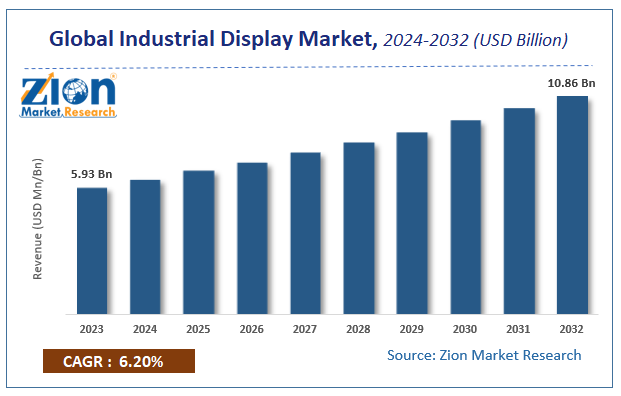
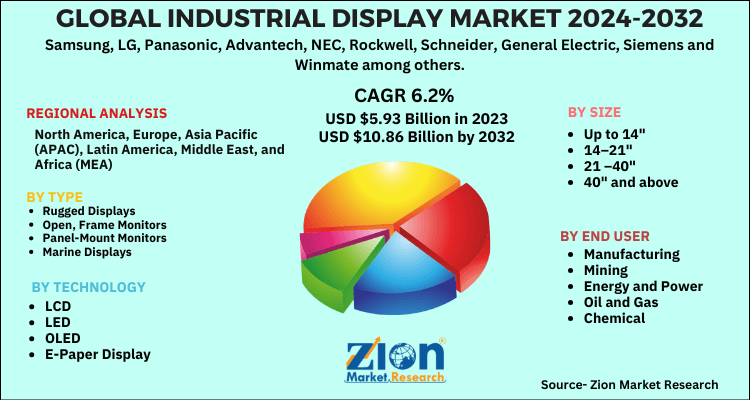
According to a report from Zion Market Research, the global industrial display market was valued at USD 5.93 billion in 2023 and is projected to hit USD 10.86 billion by 2032, with a compound annual growth rate (CAGR) of 6.2% during the forecast period 2024-2032.
This report provides a comprehensive analysis of the growth drivers, restraints, and challenges shaping demand across the global industrial display market throughout the forecast period, while highlighting high-potential emerging opportunities within the industry.
Key Insights
- As per the analysis shared by our research analyst, the global industrial display market is estimated to grow at a CAGR of approximately 6.2% during the forecast period from 2024 to 2032.
- In terms of revenue, the global industrial display market size was valued at around USD 5.93 billion in 2023 and is projected to reach USD 10.86 billion by 2032.
- The market is driven by the increasing adoption of automation, smart manufacturing, and Industry 4.0 initiatives, along with rising demand for real-time data visualization and durable display solutions in harsh industrial environments.
- Based on the type, panel-mount monitors are the most dominant product type due to their durability, ease of integration into equipment enclosures or control panels, and suitability for manufacturing and process control applications.
- Based on the technology, liquid crystal display (LCD) technology dominates the market because of its cost-effectiveness, energy efficiency, wide viewing angles, and compatibility with diverse industrial applications such as control panels and human-machine interfaces.
- Based on the end user, the manufacturing sector is the leading end user, as industrial displays are integral for monitoring equipment status, displaying real-time data, and facilitating communication on the factory floor to enhance operational efficiency and safety.
- Regionally, Asia Pacific holds the largest market share, accounting for approximately 40% of the global industrial display market, driven by rapid industrialization, major manufacturing hubs, and adoption of advanced technologies in countries such as China, Japan, and India.
Industrial Display Market: Overview
Industrial displays are specialized visualization devices engineered for reliable operation in demanding industrial environments. They serve as critical components of human-machine interfaces, remote monitoring systems, control panels, and digital signage across factories, energy facilities, mining sites, and process industries. These displays are designed to withstand harsh conditions including extreme temperatures, dust, moisture, vibration, and chemical exposure while delivering clear, real-time data visualization that supports operator decision-making and process control.
Industrial Display Market: Dynamics
Growth Drivers
What factors are accelerating the expansion of the Industrial Display market?
The primary growth driver is the rapid global shift toward industrial automation and digital transformation. Manufacturers across discrete and process industries are deploying advanced HMIs and visualization systems to improve operational efficiency, reduce downtime, and enhance safety. Industrial displays form the visual core of these systems, enabling operators to monitor complex processes in real time.
A secondary but equally important driver is the rising demand from the energy, oil & gas, and mining sectors for rugged displays capable of withstanding extreme conditions. Investments in smart grids, renewable energy plants, and remote monitoring infrastructure further amplify the need for reliable, high-performance industrial displays that support continuous operation and data-driven decision-making.
Restraints
What factors are limiting the growth of the Industrial Display market?
High initial investment costs associated with ruggedized and certified industrial displays remain a significant barrier, particularly for small and medium-sized enterprises in emerging economies. Specialized features such as high ingress-protection ratings, wide operating temperature ranges, and explosion-proof certifications substantially increase unit prices compared with commercial alternatives.
Supply-chain constraints for high-quality panels, controllers, and protective materials can also delay project timelines and elevate costs. In addition, the long replacement cycles typical of industrial equipment slow the rate of new installations in mature facilities.
Opportunities
What emerging opportunities exist in the Industrial Display market?
The integration of IoT, edge computing, and AI analytics presents substantial opportunities. Displays that can process data locally, support predictive maintenance visualizations, and interface seamlessly with industrial networks are increasingly preferred. Energy-efficient technologies such as OLED and e-paper open new application areas in low-power and sunlight-readable environments.
Expansion into emerging markets in Asia Pacific, Latin America, and the Middle East, where industrialization and infrastructure modernization are accelerating, offers additional growth avenues. Customization capabilities and modular designs further allow vendors to address niche requirements in marine, mining, and chemical processing applications.
Challenges
What challenges does the Industrial Display market face?
Ensuring long-term reliability and compliance with evolving international safety and cybersecurity standards poses ongoing challenges. Connected industrial displays must protect against cyber threats while maintaining operational integrity in harsh environments.
Rapid technological evolution requires continuous research and development investment to stay competitive, particularly as customers demand higher resolutions, wider viewing angles, multi-touch capabilities, and seamless integration with existing control systems. Balancing these advanced features with cost competitiveness remains a persistent industry challenge.
Global Industrial Display Market: Report Scope
| Report Attributes | Report Details |
|---|---|
| Report Name | Industrial Display Market |
| Market Size in 2023 | USD 5.93 Billion |
| Market Forecast in 2032 | USD 10.86 Billion |
| Growth Rate | CAGR of 6.2% |
| Number of Pages | 255 |
| Key Companies Covered | Samsung, LG, Panasonic, Advantech, NEC, Rockwell, Schneider, General Electric, Siemens, and Winmate, among others |
| Segments Covered | By Type, By Technology, By End Users, and By Region. |
| Regions Covered | North America, Europe, Asia Pacific (APAC), Latin America, Middle East, and Africa (MEA) |
| Base Year | 2023 |
| Historical Year | 2018 - 2022 |
| Forecast Year | 2024 - 2032 |
| Customization Scope | Avail customized purchase options to meet your exact research needs. Request For Customization |
Industrial Display Market: Segmentation
The industrial display market is segmented by type, technology, size, end user, and region. All the segments of the industrial display market have been analyzed based on present and future trends and the market is estimated from 2024 to 2032.
Based on Type, the industrial display market is divided into rugged displays, open frame monitors, panel-mount monitors, marine displays, and video walls. Panel-mount monitors represent the most dominant category due to their straightforward installation into control panels and cabinets, excellent protection against environmental factors, and widespread adoption in human-machine interface systems across manufacturing and process industries. Their standardized form factors and compatibility with existing infrastructure make them the preferred choice for both new installations and retrofit projects. Rugged displays rank as the second most dominant category, driven by demand in mining, oil and gas, and outdoor applications where extreme durability, shock resistance, and wide temperature tolerance are essential. These displays enable reliable operation in environments where conventional screens would fail, thereby supporting continuous production and safety monitoring.
Based on Technology, The industrial display market is divided into LCD, LED, OLED, and e-paper displays. LCD technology holds the leading position because of its mature manufacturing ecosystem, competitive pricing, proven longevity, and availability of industrial-grade variants with high brightness and wide temperature ranges. The extensive supplier base and ease of customization further reinforce LCD dominance across diverse end-use applications. LED technology follows as the second major contributor, valued for superior brightness, energy efficiency, and longer lifespan in high-ambient-light industrial settings. OLED is gaining traction for premium applications requiring superior contrast and thin form factors, while e-paper finds niche use in low-power and sunlight-readable scenarios.
Based on Size, the industrial display market is divided into up to 14", 14-21", 21-40", and 40" and above. The 14-21" segment dominates the market as it offers an ideal compromise between screen real estate for clear data visualization and compact dimensions suitable for most operator stations, control rooms, and machine-mounted applications. This size range supports multi-window interfaces without requiring excessive panel space. Displays up to 14" rank second in importance, particularly in space-constrained embedded systems, portable equipment, and compact human-machine interfaces where footprint and power consumption are critical considerations.
Based on End User, the industrial display market is divided into manufacturing, mining, energy and power, oil and gas, and chemical. Manufacturing leads the end-user landscape because of the intensive deployment of automation systems, production monitoring displays, and quality-control interfaces on factory floors. Real-time visualization of machine status, throughput, and alerts directly contributes to productivity gains and reduced downtime. Energy and power constitute the second major segment, supported by the need for reliable displays in power generation, transmission, and distribution facilities, including renewable energy plants and smart grid control centers.
Industrial Display Market: Regional Analysis
Why will Asia Pacific continue to dominate the global market during the projection period?
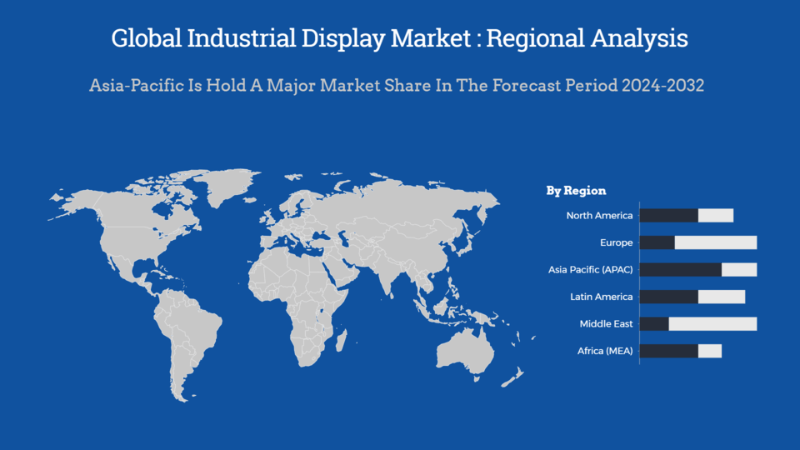
Asia Pacific holds the largest share of the global industrial display market. The region’s dominance is driven by rapid industrialization, the presence of major manufacturing hubs, and the widespread adoption of advanced automation and digitalization technologies in countries such as China, Japan, and India. Strong demand from electronics, automotive, and process industries, combined with ongoing infrastructure modernization and government support for smart manufacturing initiatives, sustains high volume requirements for industrial displays. These factors enable Asia Pacific to shape global supply chains, influence product development priorities, and drive overall market growth through continuous expansion of factory automation and real-time visualization needs.
North America maintains significant demand supported by early and widespread adoption of advanced automation technologies, a mature manufacturing base, and substantial investments in Industry 4.0 initiatives across the United States and Canada. Continuous modernization of industrial infrastructure and expansion in energy and aerospace sectors reinforce regional activity. Europe follows with steady requirements driven by industrial modernization and stringent operational standards. Latin America and the Middle East and Africa represent emerging opportunities where industrialization and infrastructure projects are expected to support gradual increases in demand for rugged and reliable display solutions.
Recent Developments
- In October 2026, Advantech expanded its SPC-600 Series hazardous-area panel PC portfolio with the SPC-612E and SPC-615E models, featuring IECEx, ATEX Zone 2/22, and Class I Division 2 certifications along with high-brightness LCDs for oil and gas, chemical, and other hazardous industrial environments.
- In June 2025, several major players announced strategic collaborations focused on integrating AI-enabled analytics and predictive maintenance visualization capabilities into next-generation industrial HMI displays.
- In March 2025, advancements in OLED and e-paper technologies for industrial use were highlighted through new product launches emphasizing ultra-low power consumption and enhanced outdoor readability.
- In January 2025, key manufacturers introduced expanded lines of marine-grade and explosion-proof certified displays targeting oil & gas and offshore applications.
Industrial Display Market: Competitive Analysis
Some of the major players in the global industrial display market include;
- Samsung
- LG
- Panasonic
- Advantech
- NEC
- Rockwell
- Schneider
- General Electric
- Siemens
- Winmate
Industrial Display Market: Key Trends
What are the key trends in the industrial display market?
Rising integration of IoT and edge intelligence with industrial displays
Industrial displays are increasingly combined with local data processing, predictive maintenance visualizations, and seamless connectivity to industrial networks. This trend supports real-time decision-making on the factory floor and in remote facilities, elevating displays from simple visualization tools to intelligent interface platforms.
Growing demand for rugged and certified displays in harsh environments
End users in mining, oil and gas, energy, and chemical processing continue to prioritize displays with high ingress protection, wide temperature tolerance, and explosion-proof certifications. Manufacturers are responding with specialized product lines that maintain readability and reliability under extreme operating conditions.
Segments Covered
The global industrial display market is segmented as follows:
By Type
- Rugged Displays
- Open, Frame Monitors
- Panel-Mount Monitors
- Marine Displays
- Video Walls
By Technology
- LCD
- LED
- OLED
- E-Paper Display
By Size
- Up to 14"
- 14-21"
- 21-40"
- 40" and above
By End User
- Manufacturing
- Mining
- Energy and Power
- Oil and Gas
- Chemical
By Region
- North America
- The U.S.
- Canada
- Mexico
- Europe
- France
- The UK
- Spain
- Germany
- Italy
- Rest of Europe
- Asia Pacific
- China
- Japan
- India
- Australia
- South Korea
- Rest of Asia Pacific
- The Middle East & Africa
- Saudi Arabia
- UAE
- Egypt
- Kuwait
- South Africa
- Rest of the Middle East & Africa
- Latin America
- Brazil
- Argentina
- Rest of Latin America
Table Of Content
Methodology
FrequentlyAsked Questions
Industrial displays are specialized visualization devices designed for reliable operation in demanding industrial environments. They serve as critical components of human-machine interfaces, remote monitoring systems, control panels, and digital signage across manufacturing, energy, mining, oil and gas, and chemical facilities.
The global industrial display market is driven by the increasing adoption of automation, smart manufacturing, and Industry 4.0 initiatives, rising demand for real-time data visualization, and the need for durable display solutions capable of operating in harsh industrial environments.
The global industrial display market size was valued at approximately USD 5.93 billion in 2023 and is expected to reach around USD 10.86 billion by 2032.
The global industrial display market is expected to grow at a compound annual growth rate (CAGR) of approximately 6.2% during the forecast period from 2024 to 2032.
Asia Pacific holds the largest share of the global industrial display market, driven by rapid industrialization, major manufacturing hubs, and strong adoption of automation technologies in countries such as China, Japan, and India.
Some of the major players leveraging the industrial display market growth are Samsung, LG, Panasonic, Advantech, NEC, Rockwell, Schneider, General Electric, Siemens, and Winmate.
The report provides a detailed examination of growth drivers, restraints, opportunities, and challenges, along with comprehensive segmentation analysis, regional insights, competitive landscape, and forward-looking forecasts that enable stakeholders to make informed strategic decisions.

HappyClients

