
Global Implantable Drug Delivery Devices Market Size, Share and Forecast 2032

Implantable Drug Delivery Devices Market By Product (Drug Infusion Pumps, Drug Delivery Devices, Bio-Absorbable Stents, Coronary Drug Eluting Stents, Brachytherapy Seeds, Contraceptive Drug Delivery Implants, and Others), By End-user (Oncology, Contraception, Cardiovascular, Ophthalmology, Inflammatory Conditions, Diabetes, and Others), and By Region: Global Industry Perspective, Comprehensive Analysis and Forecast, 2024-2032
| Market Size in 2023 | Market Forecast in 2032 | CAGR (in %) | Base Year |
|---|---|---|---|
| USD 13.45 Billion | USD 26.23 Billion | 7.7% | 2023 |
What is the Implantable Drug Delivery Devices Market Size?
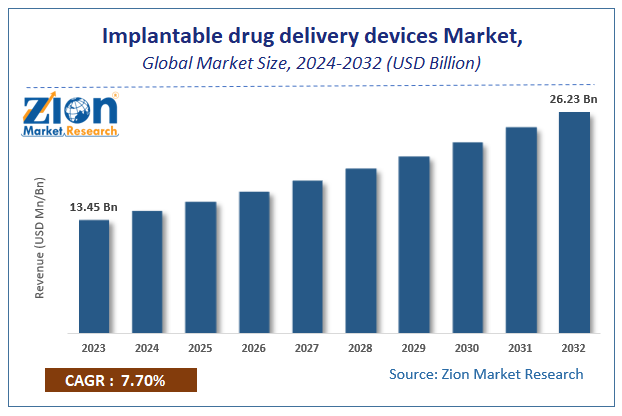
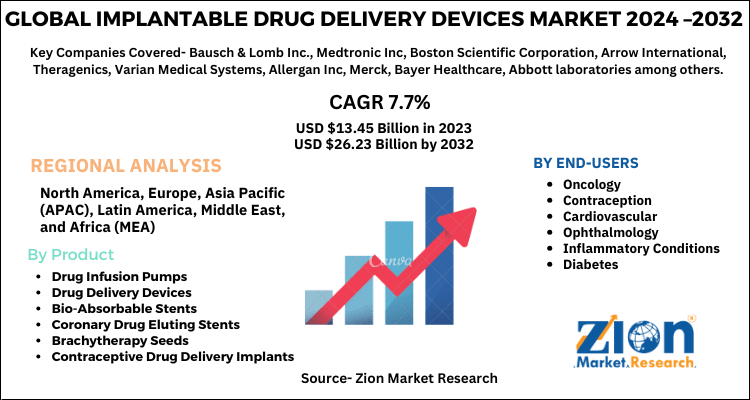
According to Zion Market Research, the global implantable drug delivery devices market was worth USD 13.45 billion in 2023. The market is forecast to reach USD 26.23 billion by 2032, growing at a compound annual growth rate (CAGR) of 7.7% during the forecast period 2024-2032. The report offers a comprehensive analysis of the market, highlighting the factors that will determine growth, potential challenges, and opportunities that could emerge in the implantable drug delivery devices market over the next decade.
Key Insights
- As per the analysis shared by our research analyst, the global Implantable Drug Delivery Devices market is estimated to grow annually at a CAGR of around 7.7% over the forecast period (2024-2032).
- In terms of revenue, the global Implantable Drug Delivery Devices market size was valued at around USD 13.45 billion in 2023 and is projected to reach USD 26.23 billion by 2032.
- The market is driven by the growing aging population, rising prevalence of chronic diseases, and increasing demand for site-specific, controlled drug delivery solutions.
- Based on the Products segment, the Drug Infusion Pumps segment dominated the market with the largest share owing to their widespread use in continuous therapy for chronic pain, oncology, and diabetes management, offering precise dosing and improved patient compliance.
- Based on the End-users segment, the Cardiovascular segment dominated the market due to the extensive adoption of bio-absorbable stents and drug-eluting stents for treating coronary artery disease and preventing restenosis.
- Based on the region, North America dominated the global Implantable Drug Delivery Devices market, supported by advanced healthcare infrastructure, high healthcare expenditure, strong presence of key manufacturers, and early adoption of innovative implantable technologies.
Implantable Drug Delivery Devices Market: Overview
With the help of implantable drug delivery devices, it has become possible to have site-specific drug delivery. This is of great importance in cardiology and oncology. Implantable drug delivery devices help in the constant release of a therapeutic agent. Implantable drug delivery devices require smaller dosages as compared to their counterparts, which in turn reduces the probability of side effects from drugs. Implantable drug delivery devices are used in some applications including HIV/AIDS prevention, diabetes management, chronic pain management, central nervous system (CNS) health, oncology, contraception, and cardiology.
However, the global markets are slowly opening to their full potential and there's a surge in demand. The market would remain bullish in the upcoming year. The significant decrease in the global Implantable drug delivery devices market size in 2020 is estimated on the basis of the COVID-19 outbreak and its negative impact on the economies and industries across the globe. Various scenarios have been analyzed on the basis of inputs from various secondary sources and the current data available about the situation.
Implantable Drug Delivery Devices Market: Growth Factors
What factors are primarily accelerating the expansion of the Implantable Drug Delivery Devices market?
The global implantable drug delivery devices market is primarily driven by a growing aging population and the prevalence of target diseases such as diabetic retinopathy and chronic diseases. Other major driving factors for growth of the implantable drug delivery devices market are rising cases of unwanted pregnancies.
Implantable Drug Delivery Devices Market: Restraints
What are the major factors limiting the growth of the Implantable Drug Delivery Devices market?
Strict regulatory frameworks imposed by health authorities worldwide require extensive clinical validation, lengthy approval timelines, and rigorous post-market surveillance, which delay product launches and increase development costs. The high manufacturing and acquisition costs of advanced implantable devices also restrict accessibility, particularly in cost-sensitive markets and among patients with limited insurance coverage.
These combined factors create barriers for both manufacturers seeking rapid commercialization and healthcare providers aiming to expand treatment options, thereby moderating overall market growth despite strong underlying clinical demand.
Implantable Drug Delivery Devices Market: Opportunities
What emerging opportunities are expected to shape the future of the Implantable Drug Delivery Devices market?
The introduction of next-generation implantable devices featuring improved biocompatibility, programmable dosing, and bio-absorbable materials presents significant opportunities for market participants. Expanding applications in emerging therapeutic areas and increasing healthcare investments in developing regions create new avenues for geographic expansion and product penetration.
Growing focus on personalized medicine and combination products that integrate drugs with advanced delivery platforms further enhances long-term growth potential, enabling companies to address unmet clinical needs and capture higher-value segments of the market.
Implantable Drug Delivery Devices Market: Report Scope
| Report Attributes | Report Details |
|---|---|
| Report Name | Implantable drug delivery devices Market |
| Market Size in 2023 | USD 13.45 Billion |
| Market Forecast in 2032 | USD 26.23 Billion |
| Growth Rate | CAGR of 7.7% |
| Number of Pages | 245 |
| Key Companies Covered | Bausch & Lomb Inc., Medtronic Inc., Boston Scientific Corporation, Arrow International, Theragenics, Varian Medical Systems, Allergan Inc., Merck, Bayer Healthcare, Abbott Laboratories, among others. |
| Segments Covered | By Products, By End-users and By Region |
| Regions Covered | North America, Europe, Asia Pacific (APAC), Latin America, Middle East, and Africa (MEA) |
| Base Year | 2023 |
| Historical Year | 2018 - 2022 |
| Forecast Year | 2024 - 2032 |
| Customization Scope | Avail customized purchase options to meet your exact research needs. Request For Customization |
Implantable Drug Delivery Devices Market: Segment Analysis
The Implantable Drug Delivery Devices market is segmented by Products, End-users, and region. All the segments of the Implantable Drug Delivery Devices market have been analyzed based on present and future trends and the market is estimated from 2024 to 2032.
Based on Products Segment, the implantable drug delivery devices market is segmented on the basis of different products including drug infusion pumps, drug delivery devices, bio-absorbable stents, coronary drug eluting stents, brachytherapy seeds, contraceptive drug delivery implants and others. In 2023, implantable drug infusion pumps were the largest segment of the implantable drug delivery devices market and accounted for the largest share of the total market. Additionally, it is expected to continue its dominance and be the fastest-growing segment in the global market over the forecast period. Contraceptive drug delivery devices are another major product segment of implantable drug delivery devices.
Based on End-users Segment, the market is divided into oncology, birth control/contraception, cardiovascular, ophthalmology, inflammatory conditions, diabetes and others. The cardiovascular end-user segment dominated the market in terms of revenue. The cardiovascular segment is likely to have significant growth within the forecast period and is projected as the fastest-growing segment as a result of increasing usage of bio-absorbable stents.
Implantable Drug Delivery Devices Market: Regional Analysis
Why will North America continue to dominate the global market during the projection period?
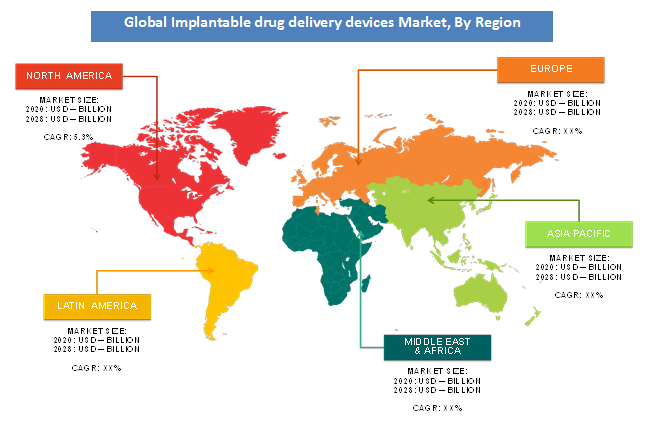
North America is expected to maintain its leading position throughout the forecast period, supported by sophisticated healthcare infrastructure, high healthcare spending, and rapid adoption of advanced medical technologies. The United States remains the primary contributor within the region, benefiting from a strong presence of leading manufacturers, favorable reimbursement frameworks, and a high burden of chronic diseases that necessitate implantable solutions. Continuous innovation, robust research and development activities, and early regulatory approvals further reinforce the region’s dominance and influence global technology trends and market expansion.
Europe holds the position of the second-largest regional market, driven by well-established healthcare systems, aging demographics, and increasing focus on minimally invasive therapies. Countries such as Germany, the United Kingdom, France, and Italy lead regional demand through advanced clinical practices and supportive regulatory environments that encourage the adoption of innovative implantable devices.
Asia Pacific is projected to emerge as the fastest-growing region, fueled by expanding healthcare infrastructure, rising disposable incomes, growing awareness of advanced treatment options, and increasing prevalence of chronic diseases. China, Japan, India, and South Korea are key contributors, with government initiatives to modernize medical facilities and improve access to specialized care accelerating market penetration and technological uptake.
Latin America is anticipated to demonstrate noticeable growth, supported by gradual improvements in healthcare access and rising demand for effective chronic disease management solutions in countries such as Brazil and Argentina. The Middle East and Africa region is also expected to expand steadily as healthcare investments increase and specialized treatment capabilities develop in selected markets.
Recent Developments
- In December 2025, Medtronic launched its MiniMed 780G insulin pump system integrated with the Instinct sensor developed exclusively by Abbott, marking a significant advancement in interoperable implantable and wearable diabetes management solutions.
- In January 2026, Boston Scientific completed the acquisition of Nalu Medical, strengthening its portfolio in neuromodulation and implantable therapies for chronic pain management.
- In 2024, Abbott received FDA clearance for its Esprit bioresorbable scaffold, expanding options in coronary interventions and driving hospital formulary updates across major markets.
Implantable Drug Delivery Devices Market: Key Trends
What are the key trends in the Implantable Drug Delivery Devices Market?
Rising adoption of bio-absorbable and programmable implantable systems
Manufacturers are increasingly focusing on bio-absorbable materials and programmable infusion technologies that eliminate the need for device removal and enable precise, patient-specific dosing. These advancements improve long-term safety profiles and expand clinical applications across cardiovascular, oncology, and diabetes care.
Growing integration of smart sensors and connectivity features
The incorporation of sensors and wireless monitoring capabilities into implantable devices is emerging as a major trend. Such features allow real-time therapy adjustment, remote patient monitoring, and enhanced data collection, supporting personalized medicine and improved treatment outcomes.
Implantable Drug Delivery Devices Market: Competitive Landscape
Some of the major players of the global implantable drug delivery devices market include
- Bausch & Lomb Inc
- Medtronic Inc
- Boston Scientific Corporation
- Arrow International
- Theragenics
- Varian Medical Systems
- Allergan Inc
- Merck
- Bayer Healthcare
- Abbott laboratories
The global Implantable drug delivery devices Market is segmented as follows:
By Products
- Drug Infusion Pumps
- Drug Delivery Devices
- Bio-Absorbable Stents
- Coronary Drug Eluting Stents
- Brachytherapy Seeds
- Contraceptive Drug Delivery Implants
- Others
By End-users
- Oncology
- Contraception
- Cardiovascular
- Ophthalmology
- Inflammatory Conditions
- Diabetes
- Others
By Region
- North America
- The U.S.
- Canada
- Mexico
- Europe
- France
- The UK
- Spain
- Germany
- Italy
- Rest of Europe
- Asia Pacific
- China
- Japan
- India
- Australia
- South Korea
- Rest of Asia Pacific
- The Middle East & Africa
- Saudi Arabia
- UAE
- Egypt
- Kuwait
- South Africa
- Rest of the Middle East & Africa
- Latin America
- Brazil
- Argentina
- Rest of Latin America
Table Of Content
Methodology
FrequentlyAsked Questions
Implantable Drug Delivery Devices are medical systems surgically placed inside the body to provide controlled, continuous, and site-specific release of therapeutic agents, reducing dosage requirements and minimizing systemic side effects across applications such as cardiology, oncology, contraception, and diabetes management.
Key growth drivers include the expanding aging population, rising prevalence of chronic and target diseases such as diabetic retinopathy and cardiovascular disorders, increasing cases of unwanted pregnancies, and continuous technological advancements that improve device efficacy and patient outcomes.
The global Implantable Drug Delivery Devices market was valued at approximately USD 13.45 billion in 2023 and is projected to reach around USD 26.23 billion by 2032
The market is expected to expand at a compound annual growth rate (CAGR) of approximately 7.7% between 2024 and 2032.
Major challenges include strict government regulations, lengthy approval processes, high device costs, potential procedural risks, and complex reimbursement pathways that limit broader accessibility and adoption.
North America is expected to continue contributing the largest share of market value throughout the forecast period, driven by advanced infrastructure, high disease burden, and strong innovation ecosystems.
Major players include Bausch & Lomb Inc., Medtronic Inc., Boston Scientific Corporation, Arrow International, Theragenics, Varian Medical Systems, Allergan Inc., Merck, Bayer Healthcare, and Abbott Laboratories.

HappyClients

