
Hydraulic Hose And Fittings Market Size, Share, Trends, Growth and Forecast 2034

Hydraulic Hose And Fittings Market By Type (Low Pressure, Medium Pressure, and High Pressure), By Distribution Channel (Offline and Online), By End-User (Construction Machinery, Material Handling Machinery, Agricultural Machinery, and Others), and By Region - Global and Regional Industry Overview, Market Intelligence, Comprehensive Analysis, Historical Data, and Forecasts 2025 - 2034
| Market Size in 2024 | Market Forecast in 2034 | CAGR (in %) | Base Year |
|---|---|---|---|
| USD 645 Million | USD 1,030 Million | 4.8% | 2024 |
Hydraulic Hose And Fittings Industry Perspective:
What will be the size of the global hydraulic hose and fittings market during the forecast period?
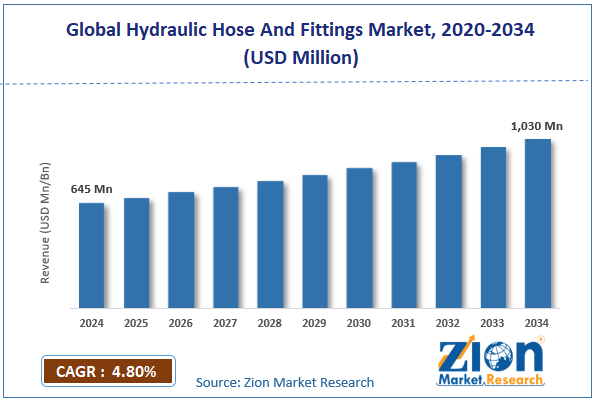
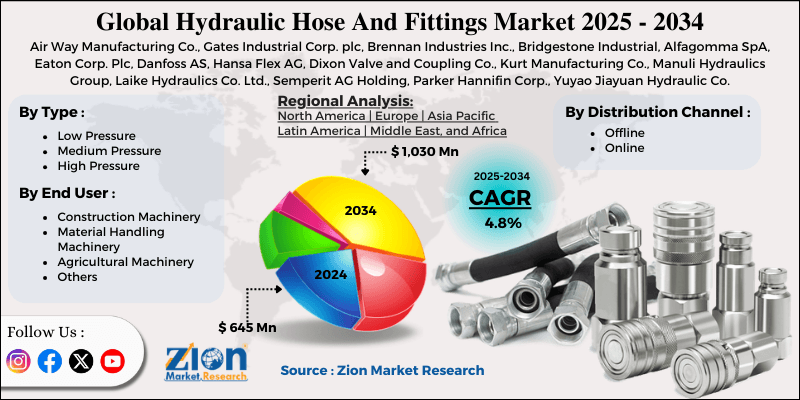
The global hydraulic hose and fittings market size was worth around USD 645 million in 2024 and is predicted to grow to around USD 1030 million by 2034, with a compound annual growth rate (CAGR) of roughly 4.8% between 2025 and 2034.
Key Insights
- As per the analysis shared by our research analyst, the global hydraulic hose and fittings market is estimated to grow annually at a CAGR of around 4.8% over the forecast period (2025-2034).
- In terms of revenue, the global hydraulic hose and fittings market size was valued at around USD 645 million in 2024 and is projected to reach USD 1030 million by 2034.
- Increasing mechanization of agriculture is expected to dominate the hydraulic hose and fittings market over the projected period.
- Based on the type, the high-pressure segment dominated the market in 2024.
- Based on the distribution channel, the offline distribution channel is projected to grow substantially over the projected period.
- Based on the end user, the construction machinery dominated the market with a market share of 45% in 2024.
- Based on region, the Asia Pacific dominated the market with a 43% market share in 2024.
Hydraulic Hose And Fittings Market: Overview
Hydraulic hoses and fittings are used in hydraulic systems to transmit pressurized hydraulic fluid (pressurized oil) between components of machines and equipment. Hydraulic hoses are flexible tubes constructed from synthetic rubber, thermoplastics, or reinforced thermoplastics (with steel wire or textile layers) to withstand high pressures, variations in operating temperature, and extreme operating environments. Hydraulic fittings are connectors between hoses and other components, such as pumps, valves, cylinders, and tubes, providing a secure, leak-free connection in the hydraulic system. The combination of hydraulic hoses and fittings delivers hydraulic power via fluid flow, enabling heavy-duty operations across a wide range of industries, including construction, mining, farming, manufacturing, and oil and gas. Their ability to operate under high pressure is another key strength.
Hydraulic Hose And Fittings Market: Dynamics
Growth Drivers
Why does the expansion of mining activities drive the expansion of the hydraulic hose and fittings market?
The growth in the mining industry is a leading driver of the hydraulic hose and fittings market, as mining activity relies predominantly on extensive hydraulic machinery to perform tough operations such as mineral extraction, transportation, excavation, drifts and tunneling, loading, and debris handling, among others. Hydraulic devices like excavators, wheel loaders, drill rigs, draglines, shovels, bulldozers, haul trucks, and crushers, widely used in the mining industry, operate on hydraulic systems that require numerous rubber hoses and couplings to transfer high-pressure hydraulic fluid between shafts, pumps, valves, motors, and cylinders. As the world's population continues to grow, demand for minerals such as iron ore, copper, lithium, coal, and rare earth metals is increasing, and this demand can only be met by expanding mining activity worldwide. This has led to new uranium, gold, silver, and other mineral exploration projects being undertaken across the globe, which will further require mostly hydraulic equipment for surface and underground mining, leading to increased demand for hydraulic hoses and connectors.
Additionally, the hydraulic circuits must operate with high efficiency and withstand harsh environmental conditions, such as high pressure and temperature, impact, vibration, abrasive dust particles, and mechanical stresses, in mines for long periods of time, which increases the requirement for high-power hydraulic equipment with reliable hoses and connectors. These existing mines are still upgrading, with a large number of hydraulic machines for increased production, repair, and maintenance, which require more hydraulic fittings and hoses, thereby further strengthening the market. The future rise of computer-operated, automated hydraulic mining equipment with complex hydraulic systems will also require more connections, thereby growing the market.
For instance, according to the India Brand Equity Foundation, in FY26 (April-September 2025), crude steel production in India stood at 82.31 MT, while finished steel production stood at 78.56 MT.
Restraints
Fluctuating raw material prices are hampering the hydraulic hose and fittings industry
Variable raw material costs emerge as a further constraint in the hydraulic hose and fittings market, as these components are made from materials – i.e., synthetic rubber, thermoplastics, steel wire reinforcement, and brass or stainless-steel fittings – that are subject to significant price fluctuations on the world’s major commodity markets and in the supply of petrochemical products. As the cost of raw materials like rubber, steel and petroleum derivatives rises as a result of supply chain disruption, political or military destabilization, rates of exchange, fuel prices and perhaps overall demand in the global economy, the immediate effect on product manufacturers selling into this segment can be to push up manufacturing costs on components as diverse as hoses, fittings and other high-volume components.
Sustained expansion in the world’s economy, as seen in recent years, could have serious implications for the profitability of long-established product suppliers, either by reversing the trend of rising prices or by precipitating a supply glut on the back of a sluggish market. This, in turn, could hamper product innovation and expansion plans in the market, as capital investment in new equipment or product lines would be put on hold due to such price oscillation.
Opportunities
How does the increasing investment by key market players in building production facilities offer a potential opportunity for the hydraulic hose and fittings market?
The growth potential for the hydraulic hose and fittings market across a broad range of industry sectors is enhanced by increased investments by major market players in the development of new manufacturing facilities, infrastructure, and production plants to cater to the global surge in demand for hydraulic components. With the expansion of the construction, mining, agriculture, oil and gas, and manufacturing industries, the hydraulic component market has been experiencing a strong upward trend; leading manufacturers are consequently increasing their investments in new production plants, such as new facilities, regional assembly plants, and advanced high-tech manufacturing methods. By strengthening their supply chains and increasing production capacity, this will boost output, shorten delivery lead times, and improve the availability of hydraulic hoses and fittings in major industrial markets.
Furthermore, the production of equipment in developing regions, such as the Asia-Pacific and Latin America, is attracting increased investment from hydraulic hose and fittings manufacturers, as well as from emerging industrial regions in the Middle East, enabling closer proximity of manufacturing to the growing regional market. By establishing manufacturing plants and regional supply hubs, it becomes easier for industry players to enter demanding local markets, support the customization of hydraulic components, and reduce costs, transportation, and supply chain challenges. With the new facilities often featuring innovative materials, automation, and advanced application systems, the products will also benefit from technological advancements and superior performance.
For instance, Continental invested over $40 Million to expand its hydraulic business in North America. A new, state-of-the-art industrial hydraulic hose production facility will be built in San Luis Potosí, Mexico, to increase and complement manufacturing capabilities in the region and beyond. The new facility will provide additional capacity for a diverse range of hose solutions to support growing needs across North America.
Challenges
Does the presence of counterfeit and low-quality products pose a significant challenge to the hydraulic hose and fittings market?
Counterfeiting of low-quality products is a potential concern for the hydraulic hose and fittings market, as these products threaten safety standards, erode the revenue of more established manufacturers, and damage the industry's overall reputation. Hydraulic hoses and fittings are used extensively in high-pressure hydraulic systems across many industries, including construction, mining, and agriculture. Counterfeit or low-quality hydraulic hoses and fittings are often manufactured from inferior materials and do not meet the same standards as authentic products, as they are not subjected to the same quality controls. This means that these counterfeit hoses are unable to operate in the demanding environments required by hydraulic applications, such as high pressure, varying and high temperatures, and both dry and wet environments.
Accordingly, these products are more likely to burst or leak, placing operators and equipment at risk. Also, these inferior products are significantly cheaper than authentic ones and, as such, are attractive to budget-conscious buyers; however, they can undermine established manufacturers who heavily invest in research and development and testing to meet international safety standards. This can jeopardize the industry's overall image.
Hydraulic Hose And Fittings Market: Report Scope
| Report Attributes | Report Details |
|---|---|
| Report Name | Hydraulic Hose And Fittings Market |
| Market Size in 2024 | USD 645 Million |
| Market Forecast in 2034 | USD 1,030 Mllion |
| Growth Rate | CAGR of 4.8% |
| Number of Pages | 224 |
| Key Companies Covered | Air Way Manufacturing Co., Gates Industrial Corp. plc, Brennan Industries Inc., Bridgestone Industrial, Alfagomma SpA, Eaton Corp. Plc, Danfoss AS, Hansa Flex AG, Dixon Valve and Coupling Co., Kurt Manufacturing Co., Manuli Hydraulics Group, Laike Hydraulics Co. Ltd., Semperit AG Holding, Parker Hannifin Corp., Yuyao Jiayuan Hydraulic Co., Shijiazhuang Strongflex Co., Topa Trading Co. Ltd., VOSS Group, Sinopulse Hose Factory Co., and others. |
| Segments Covered | By Type, By Distribution Channel, By End User, and By Region |
| Regions Covered | North America, Europe, Asia Pacific (APAC), Latin America, Middle East, and Africa (MEA) |
| Base Year | 2024 |
| Historical Year | 2019 to 2023 |
| Forecast Year | 2025 - 2034 |
| Customization Scope | Avail customized purchase options to meet your exact research needs. Request For Customization |
Hydraulic Hose And Fittings Market: Segmentation
Type Insights
Why is high pressure expected to hold a dominant position in the hydraulic hose and fittings market?
The high pressure segment dominated the market in 2024. Market segment growth is driven by increasing demand for heavy machinery across construction, mining, agriculture, oil and gas, and other industrial applications. High-pressure hydraulic hoses and fittings are built to withstand very high fluid pressure and the extremely high operating pressures in their respective applications. Equipment such as excavators, drilling rigs, loaders, hydraulic presses, and industrial lifts operate using high-power hydraulic systems that develop very high forces. With construction activities increasing around the world, demand for industrial automation applications is rising.
Distribution Channel Insights
Why is the offline segment growing at a significant rate in the hydraulic hose and fittings market?
The offline distribution channel is projected to grow substantially over the projected period. Segment growth arises from customer preferences and the high dependence of industrial buyers on physical branch networks, authorized dealers, and channels supplying specialized hydraulic components. Many customers (construction, mining, agriculture, manufacturing, and others) frequently need to replace or repair hydraulic hoses and fittings for their equipment, often urgently. Offline channels support these customers by offering wide availability at the point of sale and technical support, while also enabling better pre-purchase assessment of product quality, especially for high-pressure hydraulic components that are safety-critical.
End-User Insights
Why does construction machinery contribute a significant share to the hydraulic hose and fittings market?
The construction machinery dominated the market with a market share of 45% in 2024. The market is set to grow amid the global infrastructure boom and urban construction projects. Construction equipment such as excavators, bulldozers, cranes, loaders, backhoes, and concrete pumps employs various hydraulic systems for their lifting, material handling, earthmoving, and digging operations. Hydraulic hoses and fittings, which transfer high-pressure hydraulic fluid from the pump to the cylinder and the valve, are components of the hydraulic system used extensively on construction machinery (both stationary and mobile). The invention of high-power engines and advances in construction technology are driving the construction machinery market.
Governments and the private sector are investing in a wide range of large infrastructure projects, including highways, bridges, railways, airports, residential complexes, and smart city projects, thereby increasing demand for new construction machinery. This, in turn, results in increased installation of hydraulic components in machinery and increased replacement demand.
Regional Insights
Why does the Asia Pacific lead the Hydraulic Hose and Fittings market?
Asia Pacific dominated the hydraulic hose and fittings market, accounting for 43% of the market in 2024. This region's growth is driven by rapid industrialization, expanding infrastructure, and rising demand for heavy machinery across major industries. Countries like China, India, Japan, and South Korea receive substantial funding for construction, mining, agriculture, and manufacturing.
All of these rely heavily on hydraulic machinery and equipment. Hydraulic hoses and fittings are used in almost all industrial equipment, such as excavators, loaders, and tractors, to deliver high-pressure hydraulic fluids. Growing mining activity and the need for more minerals and metals to meet the demands of energy and infrastructure development are also driving growth in the hydraulic market. Large manufacturing and processing bases, increased government allocation to infrastructure projects, and the growing number of hydraulic equipment manufacturers are other boosting factors.
Hydraulic Hose And Fittings Market: Competitive Analysis
The global hydraulic hose and fittings market is dominated by players like:
- Air Way Manufacturing Co.
- Gates Industrial Corp. plc
- Brennan Industries Inc.
- Bridgestone Industrial
- Alfagomma SpA
- Eaton Corp. Plc
- Danfoss AS
- Hansa Flex AG
- Dixon Valve and Coupling Co.
- Kurt Manufacturing Co.
- Manuli Hydraulics Group
- Laike Hydraulics Co. Ltd.
- Semperit AG Holding
- Parker Hannifin Corp.
- Yuyao Jiayuan Hydraulic Co.
- Shijiazhuang Strongflex Co.
- Topa Trading Co. Ltd.
- VOSS Group
- Sinopulse Hose Factory Co.
The global hydraulic hose and fittings market is segmented as follows:
By Type
- Low Pressure
- Medium Pressure
- High Pressure
By Distribution Channel
- Offline
- Online
By End User
- Construction Machinery
- Material Handling Machinery
- Agricultural Machinery
- Others
By Region
- North America
- The U.S.
- Canada
- Mexico
- Europe
- France
- The UK
- Spain
- Germany
- Italy
- Rest of Europe
- Asia Pacific
- China
- Japan
- India
- Australia
- South Korea
- Rest of Asia Pacific
- The Middle East & Africa
- Saudi Arabia
- UAE
- Egypt
- Kuwait
- South Africa
- Rest of the Middle East & Africa
- Latin America
- Brazil
- Argentina
- Rest of Latin America
Table Of Content
Methodology
FrequentlyAsked Questions

HappyClients

