
Global Hybrid Fabric Market Size, Industry Share, Analysis, Growth, 2032

Hybrid Fabric Market By Fiber Type (Glass/Carbon, Carbon/UHMWPE, Glass/Aramid, Carbon/Aramid, and Others), By Application Form (Composite Form and Non-Composite Form), By End-Use Industry (Automotive & Transportation, Aerospace & Defense, Wind Energy, Sports & Recreational, Consumer Goods, and Others), and By Region - Global and Regional Industry Overview, Market Intelligence, Comprehensive Analysis, Historical Data, and Forecasts 2024 - 2032
| Market Size in 2023 | Market Forecast in 2032 | CAGR (in %) | Base Year |
|---|---|---|---|
| USD 377.63 Million | USD 1447.28 Million | 16.1% | 2023 |
Hybrid Fabric Industry Perspective
What will be the global hybrid fabric market size during the forecast period?
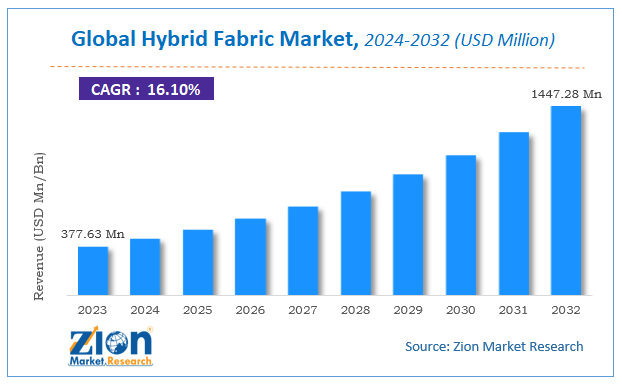
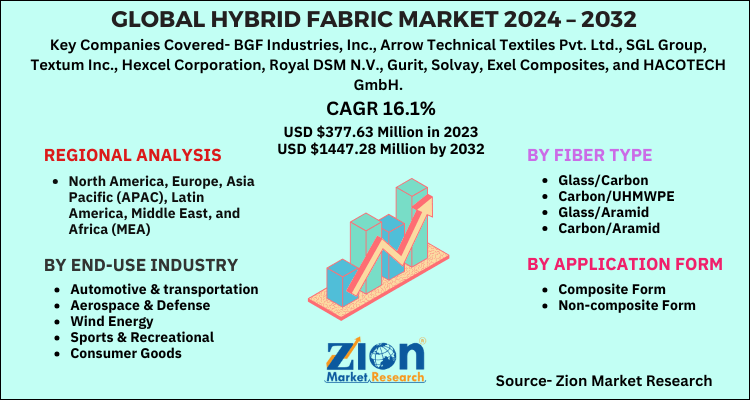
The global hybrid fabric market was valued at USD 377.63 million in 2023 and is expected to reach USD 1447.28 million by the end of 2032. The market is expected to expand at a compound annual growth rate (CAGR) of approximately 16.1% over the forecast period 2024-2032.
The report examines the primary drivers, challenges, and restraints shaping global demand for the hybrid fabric market throughout the forecast period and identifies high-growth opportunities across the industry.
Key Insights
- As per the analysis shared by our research analyst, the global hybrid fabric market is estimated to grow annually at a CAGR of around 16.1% over the forecast period (2024-2032).
- In terms of revenue, the global hybrid fabric market size was valued at around USD 377.63 million in 2023 and is projected to reach USD 1447.28 million by 2032.
- The market is driven by escalating product demand in wind energy, automotive & transportation, and sports & recreational sectors, supported by lightweight characteristics, high strength relative to metals, and beneficial mechanical and damping properties.
- Based on the fiber type, the glass/carbon hybrid fabric segment is the major type employed in the wind energy and transportation & automotive sectors due to its lightweight nature that reduces the weight of wind blades and vehicles.
- Based on the application form, composite forms lead, as hybrid fabrics are widely embedded in matrices to produce high-performance composites for structural applications.
- Based on the end-use industry, the automotive & transportation segment drives significant demand through the need for lightweight, high-strength materials that improve efficiency and performance.
- By Region, Europe is projected to acquire the number one position by 2032 owing to the presence of reputed players in the automotive and aerospace industries and a focus on product innovations by textile manufacturers in the region.
Hybrid Fabric Market: Overview
Hybrid fabrics comprise more than one structural fiber in their configuration and are also referred to as textile composites. These products are intertwined from various fibers, such as a blend of carbon fibers & aramid yarns in different ratios. Apparently, they possess beneficial properties like low mass and high impact resistance. Moreover, the hybrid fabrics are available at reasonable costs. The products can be differentiated from other fabrics on the basis of key features like durability, strength, and outstanding resistance to flames, chemical agents, and heat.
Hybrid Fabric Market: Dynamics
Growth Drivers
What factors are accelerating demand for hybrid fabric?
Escalating product demand in wind energy, automotive & transportation, and sports & recreational sectors is the primary growth driver. Hybrid fabrics offer low weight combined with higher strength than metals, making them attractive for weight-sensitive applications that improve energy efficiency and performance. Beneficial mechanical characteristics and damping features, together with low density and ease of handling, continue to drive market trends. Lower energy requirements for production and the potential for recycling further enhance the appeal of hybrid fabrics across industrial and structural uses.
Restraints
What barriers are limiting market expansion?
Higher costs associated with advanced fiber combinations compared with conventional materials can restrain adoption in price-sensitive applications. Complex manufacturing processes required to achieve consistent hybrid structures may also limit rapid scaling in some regions. Technical challenges related to fiber compatibility, interfacial bonding, and long-term durability under extreme conditions can slow broader commercial deployment in certain end-use sectors.
Hybrid Fabric Market: Report Scope
| Report Attributes | Report Details |
|---|---|
| Report Name | Hybrid Fabric Market |
| Market Size in 2023 | USD 377.63 Million |
| Market Forecast in 2032 | USD 1447.28 Million |
| Growth Rate | CAGR of 16.1% |
| Number of Pages | 255 |
| Key Companies Covered | BGF Industries, Inc., Arrow Technical Textiles Pvt. Ltd., SGL Group, Textum Inc., Hexcel Corporation, Royal DSM N.V., Gurit, Solvay, Exel Composites, and HACOTECH GmbH |
| Segments Covered | By Fiber Type, By Application Form, By End-Use Industry, and By Region |
| Regions Covered | North America, Europe, Asia Pacific (APAC), Latin America, Middle East, and Africa (MEA) |
| Base Year | 2023 |
| Historical Year | 2018 - 2022 |
| Forecast Year | 2024 - 2032 |
| Customization Scope | Avail customized purchase options to meet your exact research needs. Request For Customization |
Hybrid Fabric Market: Segmentation
The hybrid fabric market is segmented by fiber type, application form, end-use industry, and region. All the segments of the report have been analyzed based on present and future trends and the market is estimated from 2024 to 2032.
Based on Fiber Type, the hybrid fabric market is divided into glass/carbon, carbon/UHMWPE, glass/aramid, carbon/aramid, and others. Glass/carbon hybrid fabric is the major type employed in the wind energy and transportation & automotive sectors because these lightweight materials reduce the weight of wind blades and vehicles while delivering balanced stiffness and cost performance. This dominance drives market growth by addressing efficiency and performance requirements in high-volume applications. Carbon/aramid combinations form a strong secondary category valued for high impact resistance and strength in aerospace and protective applications, supporting diversification and premium product development.
Based on Application Form, the hybrid fabric market is divided into composite form and non-composite form. Composite form leads, as hybrid fabrics are extensively used as reinforcements in polymer matrices to create high-performance structural composites for automotive, aerospace, and wind energy components. This dominance propels overall market expansion by enabling weight reduction and improved mechanical performance in critical applications. Non-composite form serves specialized textile and protective uses, contributing additional demand through flexibility in product design and processing.
Based on End-Use Industry, the hybrid fabric market is divided into automotive & transportation, aerospace & defense, wind energy, sports & recreational, consumer goods, and others. Automotive & transportation drive significant demand through the need for lightweight, high-strength materials that improve vehicle efficiency and wind blade performance. These sectors anchor market volume and stimulate continuous material innovation. Aerospace & defense represents a key secondary industry requiring high-performance hybrid fabrics for structural and protective applications, further supporting technology advancement and market growth.
Hybrid Fabric Market: Regional Analysis
Why will Europe continue to dominate the global market during the projection period?
Europe is projected to acquire the number one position by 2032. The region benefits from the presence of reputed players in the automotive and aerospace industries that drive consistent demand for advanced hybrid fabrics. Textile manufacturers in the region are focusing on product innovations that create lucrative growth prospects over the next several years. Strong engineering capabilities, established composite supply chains, and emphasis on lightweighting for energy efficiency and performance further reinforce adoption. These factors enable Europe to lead market development, set material standards, and accelerate innovation across key end-use sectors.
North America contributes significantly through advanced aerospace, automotive, and wind energy applications that require high-performance hybrid materials. Continuous research investment and demand for lightweight structural solutions support steady regional growth.
Hybrid Fabric Market: Competitive Analysis
The global hybrid fabric market is dominated by players:
- BGF Industries, Inc.
- Arrow Technical Textiles Pvt. Ltd.
- SGL Group
- Textum Inc.
- Hexcel Corporation
- Royal DSM N.V.
- Gurit
- Solvay
- Exel Composites
- HACOTECH GmbH
Segments Covered
The global hybrid fabric market is segmented as follows:
By Fiber Type
- Glass/Carbon
- Carbon/UHMWPE
- Glass/Aramid
- Carbon/Aramid
- Others (aramid/diolen, carbon/polyethylene, carbon/zylon, carbon/flax, steel/glass, carbon/vectran, and glass/aramid/carbon)
By Application Form
- Composite Form
- Non-composite Form
By End-Use Industry
- Automotive & Transportation
- Aerospace & Defense
- Wind Energy
- Sports & Recreational
- Consumer Goods
- Others (marine, building & construction, and electronics & electrical)
By Region
- North America
- The U.S.
- Canada
- Mexico
- Europe
- France
- The UK
- Spain
- Germany
- Italy
- Rest of Europe
- Asia Pacific
- China
- Japan
- India
- Australia
- South Korea
- Rest of Asia Pacific
- The Middle East & Africa
- Saudi Arabia
- UAE
- Egypt
- Kuwait
- South Africa
- Rest of the Middle East & Africa
- Latin America
- Brazil
- Argentina
- Rest of Latin America
Table Of Content
Methodology
FrequentlyAsked Questions
Hybrid fabrics comprise more than one structural fiber in their configuration and are also referred to as textile composites. They are intertwined from various fibers such as carbon and aramid blends and offer low mass, high impact resistance, durability, strength, and resistance to flames, chemicals, and heat.
Key growth drivers include escalating demand in wind energy, automotive & transportation, and sports & recreational sectors, along with lightweight characteristics, higher strength than metals, beneficial mechanical and damping properties, and recyclability.
The global hybrid fabric market size was valued at approximately USD 377.63 million in 2023 and is projected to reach around USD 1447.28 million by 2032.
The global hybrid fabric market is expected to grow at a compound annual growth rate (CAGR) of approximately 16.1% during the forecast period from 2024 to 2032.
Europe is expected to contribute notably and acquire the number one position by 2032, supported by the presence of reputed automotive and aerospace players and ongoing product innovation.
Major players include BGF Industries, Inc., Arrow Technical Textiles Pvt. Ltd., SGL Group, Textum Inc., Hexcel Corporation, Royal DSM N.V., Gurit, Solvay, Exel Composites, and HACOTECH GmbH.
The report provides a detailed examination of growth drivers, restraints, opportunities, and challenges, along with comprehensive segmentation analysis, regional insights, competitive landscape, and forward-looking forecasts for the hybrid fabric market.

HappyClients

