
Global Heat-treated Steel Plates Market Size, Share, Trends, Growth and Forecast 2032

Heat-treated Steel Plates Market - By Treatment (Stress Relieving, Normalizing, Quenching & Tempering, and Others), By Steel Type (Alloy, Carbon, and Stainless), and By Application (Industrial Machinery, Energy & Power, Construction, and Others) - Global Industry Perspective, Comprehensive Analysis, and Forecast, 2024 - 2032
| Market Size in 2023 | Market Forecast in 2032 | CAGR (in %) | Base Year |
|---|---|---|---|
| USD 6.82 Billion | USD 9.78 Billion | 4.08% | 2023 |
What is the market size of the heat-treated steel plates industry?
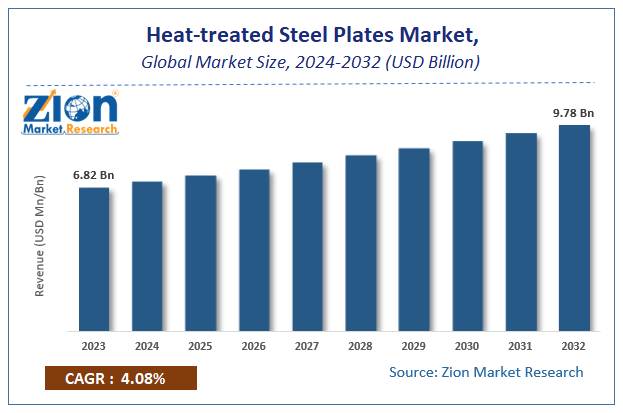
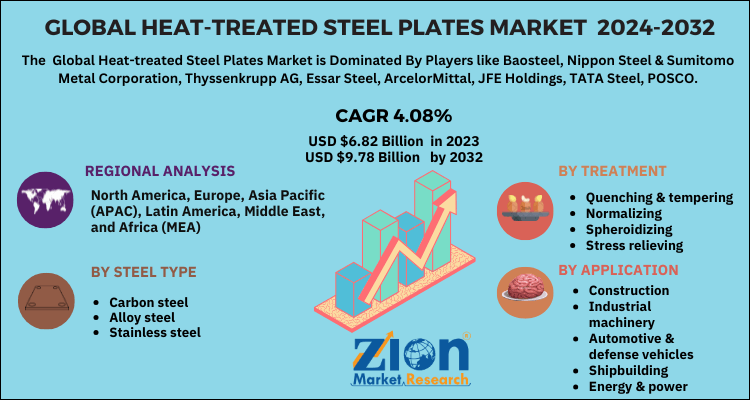
Zion Market Research has published a report on the global Heat-treated Steel Plates Market, estimating its value at USD 6.82 Billion in 2023, with projections indicating that it will reach USD 9.78 Billion by 2032. The market is expected to expand at a compound annual growth rate (CAGR) of 4.08% over the forecast period 2024-2032.
The report explores the factors fueling market growth, the hitches that could hamper this expansion, and the opportunities that may arise in the Heat-treated Steel Plates industry. Additionally, it offers a detailed analysis of how these elements will affect market demand dynamics and market performance throughout the forecast period.
Introduction
Heat-treated steel plates are applied for changing the physical as well as mechanical features of steel without altering the shape of the steel. Apart from this, the heat-treated procedure assists in enhancing stiffness, elasticity, strength, and ductility of the steel.
Key Driving Factors
The massive demand for new edifices across the globe as a result of swift urbanization & industrialization will steer the growth of the heat treated steel plates industry over the forthcoming years. Additionally, the surge in the demand for steel in a plethora of end-use sectors will embellish the industry trends. Apparently, large-scale fund allocation for infrastructural & industrial growth will proliferate the expansion of the heat-treated steel plates industry over the upcoming years.
Global Heat Treated Steel Plates Market Drivers
The market drivers for the Heat Treated Steel Plates Market can be influenced by various factors. These may include:
- Industrial Growth: The demand for heat-treated steel plates is frequently driven by the expansion of industries including construction, automotive, aerospace, and equipment, all of which need robust, long-lasting materials for a variety of applications.
- Infrastructure Development: Because heat-treated steel plates are necessary for long-term structural integrity and durability, the construction of roads, bridges, trains, and buildings all contribute to the need for this type of material.
- Technological Advancements: Better product quality, cost-effectiveness, and efficiency can result from improvements in manufacturing technologies and methods for heat-treated steel plates, which can propel market expansion.
- Growing Need for Lightweight Materials: The automobile and aerospace industries, in particular, are experiencing a surge in demand for lightweight materials such as heat-treated steel plates as they work to cut emissions and increase fuel efficiency.
- Growing Construction Activities: As a result of urbanisation and population growth, there is a greater need for heat-treated steel plates for use in infrastructure projects, buildings, and other construction-related projects.
- Global Economic Trends: Since heat-treated steel plates are essential to many economic sectors, economic variables like GDP growth, industrial production, and consumer spending can affect the demand for them.
- Government Policies and Regulations: Building rules, environmental regulations, and safety regulations may have an influence on the materials used in different industries, which may increase demand for heat-treated steel plates.
- Emerging Markets: As these areas see rapid industrialization and infrastructure development, the market for heat-treated steel plates is poised to see new potential due to growth in emerging markets, notably in regions like Asia-Pacific and Latin America.
- Replacement Demand: In developed economies, the need to replace ageing machinery and infrastructure, particularly in high-wear industries, can fuel the demand for heat-treated steel plates.
Global Heat Treated Steel Plates Market Restraints
Several factors can act as restraints or challenges for the Heat Treated Steel Plates Market. These may include:
- High Initial Investment: Establishing facilities for heat treating steel plates involves a substantial financial outlay, which may discourage smaller and new businesses from entering the market.
- Price volatility for raw materials: Changes in the cost of energy and steel, for example, can have an effect on the bottom line of companies that produce heat-treated steel plates.
- Strict rules: Businesses in this industry may face operating cost increases and regulatory obstacles as a result of adhering to environmental rules and safety standards throughout the heat treatment process.
- Substitute Materials: The market for heat-treated steel plates may be threatened by substitute materials including aluminium, composites, and sophisticated polymers, especially in sectors where corrosion resistance and weight reduction are crucial.
- Competitive Pressure: Price wars and margin erosion can result from fierce manufacturer competition, particularly in areas with excess manufacturing capacity.
- End-Use Industries’ Cyclical Nature: The demand for heat-treated steel plates is strongly correlated with sectors of the economy that are prone to market swings and economic cycles, including manufacturing, construction, and automotive.
- Technological developments: New materials or production techniques could eventually replace the widely used heat-treated steel plates. This could be facilitated by developments in material science and manufacturing technology.
- Global Economic Conditions: Particularly in important end-use industries like construction and infrastructure development, economic downturns or geopolitical concerns can discourage investment and lower demand for heat-treated steel plates.
Additionally, the prominent rise in the construction activities across the globe will spearhead the expansion of the heat-treated steel plates industry over the forthcoming years.
Heat-treated Steel Plates Market: Report Scope
| Report Attributes | Report Details |
|---|---|
| Report Name | Heat-treated Steel Plates Market |
| Market Size in 2023 | USD 6.82 Billion |
| Market Forecast in 2032 | USD 9.78 Billion |
| Growth Rate | CAGR of 4.08% |
| Number of Pages | 110 |
| Key Companies Covered | Baosteel, Nippon Steel & Sumitomo Metal Corporation, Thyssenkrupp AG, Essar Steel, ArcelorMittal, JFE Holdings, TATA Steel, POSCO, Outokumpu, and Novolipetsk Steel |
| Segments Covered | By Steel Type, By Treatment, By Application And By Region |
| Regions Covered | North America, Europe, Asia Pacific (APAC), Latin America, Middle East, and Africa (MEA) |
| Base Year | 2023 |
| Historical Year | 2018 - 2022 |
| Forecast Year | 2024 - 2032 |
| Customization Scope | Avail customized purchase options to meet your exact research needs. Request For Customization |
Asia Pacific To Dominate Overall Market Growth By 2025
The growth of the regional market over the forecast period is owing to an increase in the use of steel across the surging building & construction activities. Furthermore, the flourishing construction sector will amplify the growth of the market in the Asia Pacific region over the forecast period. Furthermore, India and China are projected to be the key demand pockets of the regional market over the forecast timeline.
Key players influencing the growth of the heat-treated steel plates market and profiled in the report include-
- Baosteel
- Nippon Steel & Sumitomo Metal Corporation
- Thyssenkrupp AG
- Essar Steel
- ArcelorMittal
- JFE Holdings
- TATA Steel
- POSCO
- Outokumpu
- Novolipetsk Steel.
The global heat-treated steel plates market is segmented as follows:
By Steel Type
- Carbon steel
- Alloy steel
- Stainless steel
By Treatment
- Quenching & tempering
- Normalizing
- Spheroidizing
- Stress relieving
By Application
- Construction
- Industrial machinery
- Automotive & defense vehicles
- Shipbuilding
- Energy & power
By Region
- North America
- The U.S.
- Canada
- Mexico
- Europe
- France
- The UK
- Spain
- Germany
- Italy
- Rest of Europe
- Asia Pacific
- China
- Japan
- India
- Australia
- South Korea
- Rest of Asia Pacific
- The Middle East & Africa
- Saudi Arabia
- UAE
- Egypt
- Kuwait
- South Africa
- Rest of the Middle East & Africa
- Latin America
- Brazil
- Argentina
- Rest of Latin America
Table Of Content
Methodology
FrequentlyAsked Questions
Heat-treated steel plates are steel sheets processed to enhance strength and durability. They are used in construction and heavy machinery.
The global heat-treated steel plates market is expected to be driven by the infrastructure development, heavy machinery demand, and use in construction, shipbuilding, and mining industries.
According to study, the global heat-treated steel plates market size was worth around USD 6.82 Billion in 2023 and is predicted to grow to around USD 9.78 Billion By 2032.
The global heat-treated steel plates market is expected to grow at a Compound Annual Growth Rate (CAGR) of around CAGR 4.08% during the forecast period from 2024-2032.
The global heat-treated steel plates industry is projected to be challenged by Major challenges include energy-intensive processing, raw material price volatility, and strict quality standards. Demand cyclicality from construction and heavy industry affects volumes.
The Opportunities include infrastructure projects, heavy machinery, and shipbuilding demand. High-strength, lightweight grades support performance and cost efficiency will offer significant growth opportunities in the heat-treated steel plates market.
High-strength and wear-resistant grades; demand from heavy equipment and construction; improved heat-treatment efficiency are the emerging trends and innovations impacting the heat-treated steel plates market.
The global heat-treated steel plates market is expected to be led by APAC during the forecast period.
Some of the prominent players operating in the global heat-treated steel plates market are; Baosteel, Nippon Steel & Sumitomo Metal Corporation, Thyssenkrupp AG, Essar Steel, ArcelorMittal, JFE Holdings, TATA Steel, POSCO, Outokumpu, and Novolipetsk Steel and others.
The report explores crucial aspects of the heat-treated steel plates market, including a detailed discussion of existing growth factors and restraints, while also browsing future growth opportunities and challenges that impact the market.

List of Contents
What is the market size of the heat-treated steel plates industry?IntroductionKey Driving FactorsGlobal Heat Treated Steel Plates Market DriversGlobal Heat Treated Steel Plates Market RestraintsReport ScopeAsia Pacific To Dominate Overall Market Growth By 2025The global heat-treated steel plates market is segmented as follows:HappyClients

