Global Healthcare Distribution Market Size, Share, Growth And Forecasts 2032

Healthcare Distribution Market By Service (Pharmaceutical, Medical Device, and Biopharmaceutical), By End-User (Hospital Pharmacies, Retail Pharmacies, and Others), and By Region - Global And Regional Industry Overview, market Intelligence, Comprehensive Analysis, Historical Data, And Forecasts 2024-2032
| Market Size in 2023 | Market Forecast in 2032 | CAGR (in %) | Base Year |
|---|---|---|---|
| USD 1015.11 Million | USD 1804.38 Million | 6.60% | 2023 |
Healthcare Distribution Industry Perspective
What will be the global healthcare distribution market size during the forecast period?
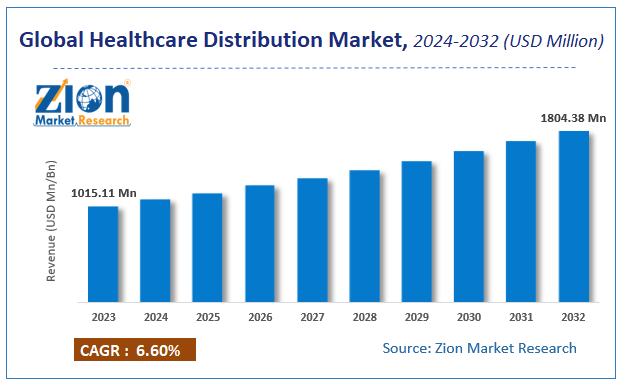
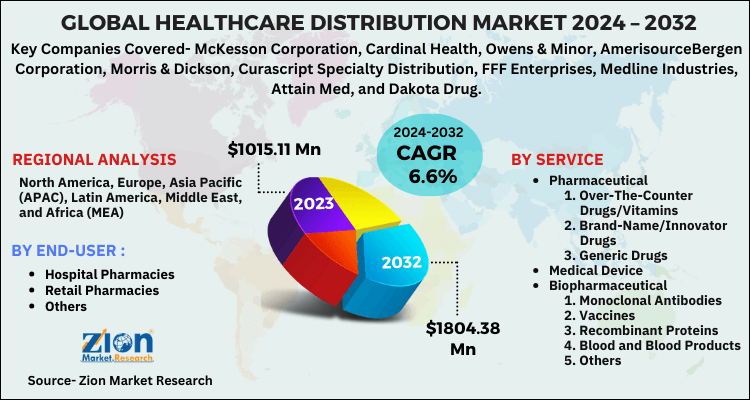
The global healthcare distribution market size was valued at around USD 1015.11 million in 2023 and is projected to reach about USD 1804.38 million by 2032, with a compound annual growth rate (CAGR) of roughly 6.60% between 2024 and 2032.
This report provides a comprehensive analysis of the growth drivers, restraints, and challenges shaping demand across the global healthcare distribution market throughout the forecast period, while highlighting high-potential emerging opportunities within the industry.
Key Insights
- As per the analysis shared by our research analyst, the global healthcare distribution market is estimated to grow at a CAGR of approximately 6.60% during the forecast period from 2024 to 2032.
- In terms of revenue, the global healthcare distribution market size was valued at around USD 1015.11 million in 2023 and is projected to reach USD 1804.38 million by 2032.
- The market is driven by enhanced chronic disease incidences, major investments in research and development, improved importance of generics, escalated application of track and trace solutions, and substantial developments in the medical equipment industry.
- Based on the service, the pharmaceutical segment accounted for the largest market share due to rising pharmaceutical formulations production, increasing pharmaceutical research and development expenditure, and growing outsourcing of pharmaceutical manufacturing.
- Based on the end-user, retail pharmacies accounted for the largest share of the market as these pharmacies deal with large prescription volumes on a daily basis.
- Regionally, North America dominated the healthcare distribution market globally in 2023, supported by a mature pharmaceutical supply chain and high healthcare product volumes, while Asia Pacific is expected to register notable growth driven by rising pharmaceutical and biotechnology activity and strengthening regulatory compliance.
Healthcare Distribution Market: Overview
The healthcare distribution alliance (HDA) is the domestic organization representing main pharmaceutical distributors the essential connection between nationwide pharmaceutical and pharmaceutical producers, hospitals, long-term care centers, clinics, and others. The global healthcare distribution market involves storing and transferring pharmaceutical products to wholesalers, hospitals, and patients directly from manufacturing plants. Pharmaceutical product manufacturers maintain strong partnerships with 3PL providers to promote cost-effective and efficient metrics. Healthcare companies are complying with several rigid public regulations, as pharmaceutical products should be available to patients in usable forms to ensure that these products adhere to their respective safety records. Businesses may also choose to boost their distribution procedures via outsourcing under certain conditions.
The healthcare distribution market is likely to grow swiftly in the future, as healthcare distribution systems are crucial for maintaining an integral part of supply chain management. Healthcare distributors ensure patient safety and the integrity of medicinal products through safe and efficient distribution of healthcare goods and services. This market growth is also driven by the enhanced chronic disease incidences, major investments in research and development, improved importance of generics, escalated application of track and trace solutions, and substantial developments in the medical equipment industry.
Healthcare Distribution Market: Dynamics
Growth Drivers
What factors are accelerating the expansion of the healthcare distribution market?
Rising incidences of chronic diseases are increasing the volume of pharmaceutical and related products that must move through distribution networks. Major investments in research and development continue to expand the pipeline of new therapies that require reliable storage and delivery systems. The growing importance of generic drugs further elevates distribution activity as these products reach large patient populations through retail and hospital channels.
Escalated application of track and trace solutions improves supply chain visibility and regulatory compliance, supporting more efficient and secure product movement. Substantial developments in the medical equipment industry also contribute to demand for specialized distribution capabilities that maintain product integrity from manufacturer to end user.
Restraints
What factors are limiting the growth of the healthcare distribution market?
Healthcare distribution must comply with rigid public regulations that require products to remain in usable and safe condition throughout the supply chain. Meeting these standards can increase operational complexity and cost, particularly for temperature-sensitive or high-value products. Maintaining consistent performance across diverse geographies and regulatory environments adds further pressure on distributors.
In some markets, infrastructure limitations or fragmented logistics networks can constrain the efficiency of distribution operations and slow the expansion of advanced service offerings.
Opportunities
What emerging opportunities exist in the healthcare distribution market?
Growing pharmaceutical and biotechnology activity in emerging markets, combined with increasing compliance with mandatory manufacturing and distribution practices, creates opportunities for expanded service coverage. China and India, in particular, are experiencing rising pharmaceutical industry activity and stricter legislation aimed at improving drug quality and reliability, supporting higher distribution volumes.
Outsourcing of distribution procedures and the adoption of more sophisticated logistics and track-and-trace technologies offer additional avenues for providers to differentiate and capture value across the supply chain.
Challenges
What challenges does the healthcare distribution market face?
Ensuring product integrity and regulatory compliance across complex multi-stakeholder networks remains an ongoing challenge. Distributors must manage diverse product types, including pharmaceuticals, biopharmaceuticals, and medical devices, each with specific handling requirements. Balancing cost efficiency with the need for secure, timely, and compliant delivery continues to require continuous operational refinement and investment in systems and partnerships.
Healthcare Distribution Market: Report Scope
| Report Attributes | Report Details |
|---|---|
| Report Name | Healthcare Distribution Market |
| Market Size in 2023 | USD 1015.11 Million |
| Market Forecast in 2032 | USD 1804.38 Million |
| Growth Rate | CAGR of 6.60% |
| Number of Pages | 280 |
| Key Companies Covered | McKesson Corporation, Cardinal Health, Owens & Minor, AmerisourceBergen Corporation, Morris & Dickson, Curascript Specialty Distribution, FFF Enterprises, Medline Industries, Attain Med, and Dakota Drug, among others. |
| Segments Covered | By Service, By End-User, and By Region |
| Regions Covered | North America, Europe, Asia Pacific (APAC), Latin America, Middle East, and Africa (MEA) |
| Base Year | 2023 |
| Historical Year | 2018 - 2022 |
| Forecast Year | 2024 - 2032 |
| Customization Scope | Avail customized purchase options to meet your exact research needs. Request For Customization |
Healthcare Distribution Market: Segmentation
The healthcare distribution market is segmented by service, end-user, and region. All the segments of the healthcare distribution market have been analyzed based on present and future trends and the market is estimated from 2024 to 2032.
Based on Service, the healthcare distribution market includes pharmaceutical, medical device, and biopharmaceutical. The pharmaceutical segment is further divided into vitamins/over-the-counter drugs, generic drugs, and innovator drugs/brand-name drugs. The biopharmaceutical segment includes blood and blood products, recombinant proteins, vaccines, monoclonal antibodies, and others. The pharmaceutical segment accounted for the largest market in 2023, mainly due to the rising pharmaceutical formulations production, increasing pharmaceutical R&D expenditure, and growing outsourcing of pharmaceutical manufacturing to Asian countries.
Based on End-User, the healthcare distribution market is divided into hospital pharmacies, retail pharmacies, and others. Retail pharmacies accounted for the largest share of the market as these pharmacies deal with large prescription volumes on a daily basis and serve as a primary access point for patients. Hospital pharmacies represent a critical secondary channel focused on inpatient and specialty care requirements. Other end users, including long-term care facilities and specialty outlets, further diversify distribution demand and support overall market activity across the continuum of care.
Healthcare Distribution Market: Regional Analysis
Why will North America continue to dominate the global market during the projection period?
North America dominated the healthcare distribution market globally in 2023. The region benefits from a mature pharmaceutical and medical product supply chain, high volumes of prescription and over-the-counter products, and well-established distributor networks that connect manufacturers with hospitals, retail pharmacies, and other care settings. Strong regulatory frameworks and continuous investment in logistics and track and trace capabilities reinforce efficient and compliant product movement. These factors enable North America to maintain a leading position that influences distribution practices, technology adoption, and service standards across the global market.
Asia Pacific is expected to register a notable growth rate over the forecast period. Rising compliance with mandatory manufacturing and distribution practices, an increasing number of pharmaceutical and biotechnology businesses, and expanding healthcare infrastructure support regional expansion. China and India are among the fastest-growing markets in the region, driven by growing pharmaceutical industries and the application of stricter legislation to improve drug quality and reliability. Europe maintains steady demand supported by established healthcare systems and regulatory requirements. Latin America and the Middle East and Africa represent emerging opportunities where improving healthcare access and distribution infrastructure are expected to support gradual growth.
Recent Developments
- In October 2026, Cardinal Health extended its distribution arrangement with CVS Health through June 30, 2032, maintaining the existing scope of pharmaceutical distribution services and reaffirming related financial guidance.
- In October 2026, McKesson reached an agreement in principle to extend its pharmaceutical distribution relationship with CVS Health through June 2032, covering retail, mail order, and specialty pharmacy channels.
Healthcare Distribution Market: Competitive Players
Some key players in the healthcare distribution market include:
- McKesson Corporation
- Cardinal Health
- Owens & Minor
- AmerisourceBergen Corporation
- Morris & Dickson
- Curascript Specialty Distribution
- FFF Enterprises
- Medline Industries
- Attain Med
- Dakota Drug
Segments Covered
The global healthcare distribution market is segmented as follows:
By Service
- Pharmaceutical
- Over-The-Counter Drugs/Vitamins
- Brand-Name/Innovator Drugs
- Generic Drugs
- Medical Device
- Biopharmaceutical
- Monoclonal Antibodies
- Vaccines
- Recombinant Proteins
- Blood and Blood Products
- Others
By End-User
- Hospital Pharmacies
- Retail Pharmacies
- Others
By Region
- North America
- The U.S.
- Canada
- Mexico
- Europe
- France
- The UK
- Spain
- Germany
- Italy
- Rest of Europe
- Asia Pacific
- China
- Japan
- India
- Australia
- South Korea
- Rest of Asia Pacific
- The Middle East & Africa
- Saudi Arabia
- UAE
- Egypt
- Kuwait
- South Africa
- Rest of the Middle East & Africa
- Latin America
- Brazil
- Argentina
- Rest of Latin America
Table Of Content
Methodology
FrequentlyAsked Questions
Healthcare distribution involves storing and transferring pharmaceutical products, medical devices, and biopharmaceuticals from manufacturing plants to wholesalers, hospitals, pharmacies, and patients. Distributors serve as the essential link between manufacturers and healthcare providers, ensuring products remain safe and usable throughout the supply chain.
The global healthcare distribution market is driven by enhanced chronic disease incidences, major investments in research and development, improved importance of generics, escalated application of track and trace solutions, and substantial developments in the medical equipment industry.
The global healthcare distribution market size was valued at approximately USD 1015.11 million in 2023 and is expected to reach around USD 1804.38 million by 2032.
The global healthcare distribution market is expected to grow at a compound annual growth rate (CAGR) of approximately 6.60% during the forecast period from 2024 to 2032.
North America dominated the global healthcare distribution market in 2023, while Asia Pacific is expected to register notable growth supported by expanding pharmaceutical and biotechnology activity and strengthening regulatory frameworks.
Some of the major players leveraging the healthcare distribution market growth are McKesson Corporation, Cardinal Health, Owens & Minor, AmerisourceBergen Corporation, Morris & Dickson, Curascript Specialty Distribution, FFF Enterprises, Medline Industries, Attain Med, and Dakota Drug.
The report provides a detailed examination of growth drivers, restraints, opportunities, and challenges, along with comprehensive segmentation analysis, regional insights, competitive landscape, and forward-looking forecasts that enable stakeholders to make informed strategic decisions.

HappyClients