
Granular Urea Market Size, Share, Trends, Growth and Forecast 2034

Granular Urea Market By Product Type (Prilled Urea, Granular Urea, Coated and Controlled-Release Urea), By Application (Agricultural Fertilizers, Industrial Uses, Animal Feed Supplements, and Resin and Adhesive Production), By End-User (Crop Farmers, Fertilizer Blenders and Distributors, Chemical Manufacturers, and Livestock Feed Producers), By Distribution Channel (Direct Farm Sales, Agricultural Cooperatives, Fertilizer Retailers and Dealers, and Online Agricultural Platforms), and By Region - Global and Regional Industry Overview, Market Intelligence, Comprehensive Analysis, Historical Data, and Forecasts 2025 - 2034
| Market Size in 2024 | Market Forecast in 2034 | CAGR (in %) | Base Year |
|---|---|---|---|
| USD 44.99 Billion | USD 67.11 Billion | 4.56% | 2024 |
Granular Urea Industry Perspective:
What will be the size of the granular urea market during the forecast period?
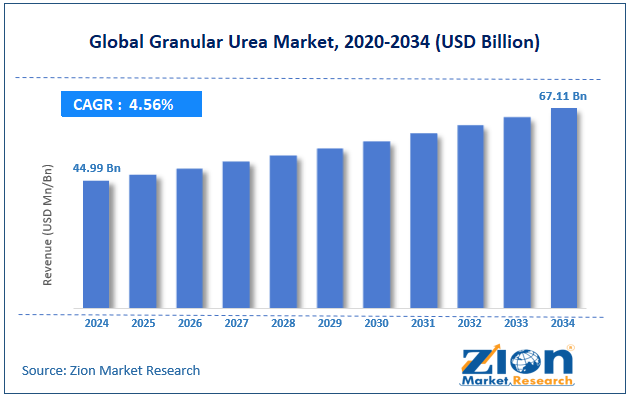
The global granular urea market size was worth approximately USD 44.99 billion in 2024 and is projected to grow to around USD 67.11 billion by 2034, with a compound annual growth rate of roughly 4.56% between 2025 and 2034.
Granular Urea Market: Overview
Granular urea is a high-nitrogen fertilizer widely used to improve crop growth and farm productivity. It is made by combining ammonia and carbon dioxide under controlled conditions to form urea, which is then shaped into small, round granules. These granules are easy to handle, store, and apply. With about 46% nitrogen content, granular urea provides more nutrients per kilogram than most other fertilizers, making it a cost-effective option for farmers. Compared to older prilled urea, granular urea is stronger, larger, and less likely to absorb moisture. This prevents clumping and helps even spread across fields, especially with modern farming machinery. Its uniform size ensures better coverage and efficient use.
Nitrogen is essential for plant growth, supporting leaf development and overall crop health. Once applied, granular urea converts into forms that plants can easily absorb, helping improve yields in crops like rice, wheat, and corn. Apart from farming, it is also used in resins, vehicle emission fluids, and chemical production. It plays a critical role in supporting global food production by helping farmers achieve higher yields and better crop quality. The granular urea market is evolving due to rising fertilizer demand, advances in production technologies, increased mechanization, environmental regulations, and growing global food demand.
Key Insights
- As per the analysis shared by our research analyst, the global granular urea market is estimated to grow annually at a compound annual growth rate of around 4.56% over the forecast period from 2025 to 2034.
- In terms of revenue, the global granular urea market size was valued at approximately USD 44.99 billion in 2024 and is projected to reach USD 67.11 billion by 2034.
- The granular urea market is expected to grow steadily, driven by rising global food demand, expanding cultivated land, increased adoption of mechanized farming, growing awareness of nitrogen management in crop production, and industrial demand for urea in chemical and manufacturing applications.
- Based on product type, the granular urea segment is expected to lead the overall urea market, while the coated and controlled-release urea segment is anticipated to grow at a notably fast pace as precision agriculture practices spread globally.
- Based on application, the agricultural fertilizers segment is expected to lead the granular urea market, while the resin and adhesive production segment is anticipated to grow rapidly, driven by construction and furniture manufacturing activity.
- Based on end-user, the crop farmers segment is the largest current end-user group, while the fertilizer blenders and distributors segment is anticipated to grow most rapidly during the forecast period as blended fertilizer products gain market share.
- Based on distribution channel, the fertilizer retailers and dealers segment is expected to lead the granular urea market, while online agricultural platforms are anticipated to grow steadily as digital procurement gains acceptance among farmers.
- Based on region, Asia Pacific is projected to dominate the global granular urea market during the estimated period, followed by North America and Europe.
Impact of the USA-Israel War on Iran on the Granular Urea Market
Ongoing tensions between the United States, Israel, and Iran could impact the granular urea market. Iran is a major urea producer, and any disruption due to sanctions or logistics issues may reduce supply and increase global prices. Natural gas, the main raw material for urea, is also at risk because the Strait of Hormuz is a key transport route. If shipments are affected, production costs for manufacturers worldwide could rise. In response, farmers and buyers may stock up on fertilizers before planting seasons. This could create short-term demand spikes, higher trade activity, and further price increases in the global granular urea market.
Granular Urea Market: Technology Roadmap 2025–2034
What is the projected development roadmap of the granular urea market over the forecast period?
The granular urea market is evolving through advances in coating technologies for controlled nitrogen release, digital soil monitoring tools that optimize fertilizer application rates, improvements in granule physical quality for better handling and spreading, and the development of more energy-efficient production processes. The market is expected to grow at a compound annual growth rate of around 4.56% over the forecast period, driven by consistent agricultural demand and expanding industrial applications.
The following roadmap outlines key development phases expected through 2034.
2025–2027: Efficiency with Precision Application Phase
- Manufacturers of granular urea are expected to invest more in slow-release coatings, helping crops absorb nutrients more effectively while reducing losses to the air and water.
- Digital soil sensors and satellite crop-monitoring systems are likely to connect with fertilizer machines, helping farmers apply granular urea in varying amounts across different parts of the same field.
- Producers are projected to improve granule strength and size consistency through better production methods, reducing dust, improving storage, and helping farmers spread fertilizer more evenly.
2028–2031: Sustainable Production and Supply Chain Development Phase
- Urea producers are expected to start using green ammonia made from renewable energy, helping lower carbon emissions and meet stricter environmental rules set by governments and global buyers.
- Production capacity in regions like Africa, Southeast Asia, and Latin America is likely to grow as countries aim to reduce imports and build stronger local fertilizer supply systems.
- New tracking and certification systems for low-carbon urea are projected to be developed, helping buyers verify and report the environmental impact of the fertilizers they purchase and use.
2032–2034: Circular Agriculture and Next-Generation Nitrogen Phase
- Advanced urea products with additives like urease and nitrification inhibitors are expected to become widely used, improving nitrogen efficiency and reducing harmful emissions from agricultural soils.
- Systems that recover and reuse nitrogen from farm waste and food processing are likely to grow, creating more sustainable ways to manage nutrients alongside traditional urea fertilizers.
- AI-based crop advisory tools are projected to guide farmers with real-time fertilizer advice, helping them apply granular urea more accurately using smartphones and precision farming services.
Granular Urea Market: Dynamics
Growth Drivers
What is driving the growth of the granular urea market as global food production requirements and agricultural modernization accelerate?
The granular urea market is growing steadily as the need to produce more food worldwide continues to rise. One of the main drivers is rising global food demand driven by a rapidly growing population, which is expected to reach 10 billion in the coming decades. Farmers must produce more crops from limited land, and nitrogen fertilizers like granular urea play a key role in improving crop yields. Without proper nitrogen supply, soil fertility declines and crop productivity drops. Granular urea, with its high nitrogen content, helps farmers achieve higher yields more efficiently. Another important driver is the shift toward mechanized farming in developing regions.
As farmers adopt modern equipment, they prefer fertilizers that can be applied easily using machines. Granular urea, with its larger, stronger particles, spreads more evenly and reduces waste. This makes it more suitable than older fertilizer forms. As agricultural modernization continues, the demand for granular urea is expected to grow consistently across major farming economies.
Industrial demand and environmental regulations are further strengthening the growth of the granular urea market.
The granular urea industry is also expanding due to rising demand from industrial applications beyond farming. One key driver is the growing use of urea in diesel exhaust fluids, which helps reduce harmful emissions from vehicles. Many countries have strict emission regulations, increasing the need for such solutions. Urea is also widely used to make resins for wood products such as plywood and furniture, supporting demand from the construction and housing sectors. As urbanization increases, the need for these materials continues to rise.
Additionally, stricter environmental standards are encouraging industries to adopt cleaner technologies, where urea plays an important role. This growing industrial use creates a stable, diversified demand base. Together, these factors are helping the granular urea market expand beyond agriculture and making it more resilient to changes in farming demand alone.
Restraints
Natural gas price volatility and nitrogen regulations are key challenges in the granular urea market.
The granular urea market faces several restraints that can slow growth and create uncertainty for producers and farmers alike. One major issue is the rising cost of natural gas, which is the main raw material used to produce urea. When gas prices increase, production becomes more expensive, forcing companies to raise fertilizer prices or reduce profits. Higher prices make it difficult for farmers, especially in cost-sensitive regions, to use enough fertilizer, which can affect crop yields and reduce demand.
Another important challenge is growing environmental concern about nitrogen pollution. When granular urea is applied, some nitrogen escapes into the air and water, causing pollution. Governments are now introducing strict rules to limit nitrogen use, especially in regions like Europe. These rules may force farmers to reduce usage or invest in better equipment, increasing costs and limiting market growth.
Opportunities
How are precision agriculture, green fertilizer development, and food security investments creating new opportunities in the granular urea market?
The granular urea industry is set to benefit from several strong opportunities that are expected to support long-term growth. One key opportunity is the rise of precision agriculture, where farmers use advanced tools such as soil sensors, satellite imagery, and smart equipment to apply fertilizers more precisely. This helps reduce waste, lower costs, and improve crop yields, increasing the demand for high-quality granular urea that performs well in such systems. Another major opportunity lies in government support programs in developing regions such as Africa and South Asia.
Many governments are offering subsidies, improving supply chains, and educating farmers, making fertilizers more accessible and boosting overall usage. In addition, the growing focus on sustainability is opening new avenues for low-carbon and eco-friendly urea products. Producers who invest in cleaner production methods can attract environmentally conscious buyers and gain better pricing advantages in global markets, strengthening future growth prospects.
Challenges
What challenges does the granular urea market face in managing nitrogen efficiency losses and navigating trade policy uncertainties?
The granular urea market operates under several ongoing challenges that affect both efficiency and global trade stability. One key issue is low nitrogen use efficiency, where a large portion of applied fertilizer is lost before crops can absorb it. This happens through evaporation into the air and leakage into groundwater, reducing benefits for farmers and causing environmental pollution. Although improved coatings and better application methods can help, achieving consistent results across different farming conditions remains difficult. Another major challenge is global trade uncertainty.
Granular urea is widely traded, and prices often depend on export decisions by major producers such as China, Russia, and Middle Eastern countries. When these countries impose export limits or tariffs, supply can suddenly drop, and prices can rise sharply. This creates uncertainty for importing countries, making it harder for farmers and suppliers to plan and manage costs effectively.
Granular Urea Market: Report Scope
| Report Attributes | Report Details |
|---|---|
| Report Name | Granular Urea Market |
| Market Size in 2024 | USD 44.99 Billion |
| Market Forecast in 2034 | USD 67.11 Billion |
| Growth Rate | CAGR of 4.56% |
| Number of Pages | 227 |
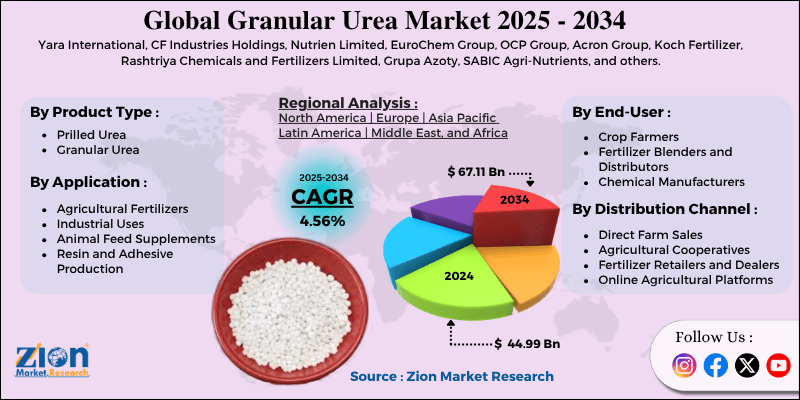
| Key Companies Covered | Yara International, CF Industries Holdings, Nutrien Limited, EuroChem Group, OCP Group, Acron Group, Koch Fertilizer, Rashtriya Chemicals and Fertilizers Limited, Grupa Azoty, SABIC Agri-Nutrients, and others. |
| Segments Covered | By Product Type, By Application, By End-User, By Distribution Channel, and By Region |
| Regions Covered | North America, Europe, Asia Pacific (APAC), Latin America, Middle East, and Africa (MEA) |
| Base Year | 2024 |
| Historical Year | 2019 - 2023 |
| Forecast Year | 2025 - 2034 |
| Customization Scope | Avail customized purchase options to meet your exact research needs. Request For Customization |
Granular Urea Market: Segmentation
The global granular urea market is segmented by product type, application, end-user, distribution channel, and region.
What makes the granular urea product segment the expected leader in the broader urea market?
Based on product type, the global market is divided into prilled urea, granular urea, and coated and controlled-release urea. The granular urea segment accounts for approximately 60% of the global solid urea market and remains dominant due to its superior physical handling properties, compatibility with mechanical spreading equipment, and strong preference among large-scale commercial farmers. The coated and controlled-release urea segment holds around 10% share but is the fastest-growing, driven by increasing adoption in markets where nitrogen-loss regulations are strict and precision agriculture is well established.
How does the agricultural fertilizers application segment maintain its leading position in the granular urea market?
Based on application, the granular urea industry is categorized into agricultural fertilizers, industrial uses, animal feed supplements, and resin and adhesive production. The agricultural fertilizers segment accounts for approximately 72% of the global granular urea market share, driven by the essential role of nitrogen in crop production across all major agricultural systems worldwide. The resin and adhesive production segment holds around 12% share. It is growing steadily, driven by increasing construction activity and rising demand for engineered wood products in residential and commercial building projects.
What makes the crop farmers segment lead the granular urea end-user market?
Based on end-user, the market is classified into crop farmers, fertilizer blenders and distributors, chemical manufacturers, and livestock feed producers. The crop farmers segment leads the market with approximately 65% of global market share, reflecting the fundamental role of granular urea as a direct crop nutrition input for grain, oilseed, vegetable, and specialty crop producers. The fertilizer blenders and distributors segment holds around 20% share. It is growing quickly as demand for customized fertilizers rises, with distributors using granular urea in tailored crop nutrition solutions.
How do fertilizer retailers and dealers dominate the distribution landscape of the granular urea market?
Based on distribution channel, the granular urea market is segregated into direct farm sales, agricultural cooperatives, fertilizer retailers and dealers, and online agricultural platforms. The fertilizer retailers and dealers segment accounts for around 44% of the global market and is expected to remain dominant, as the majority of granular urea sold to individual farmers passes through regional retail networks that also provide agronomic advice and credit services. The online agricultural platforms segment holds around 8% share. It is growing steadily as younger farmers and larger agricultural enterprises increasingly use digital procurement channels for commodity inputs.
Granular Urea Market: Regional Analysis
How is Asia Pacific shaping global demand in the granular urea market?
The granular urea market is led by Asia Pacific and is expected to grow steadily at a CAGR of around 4.8% during the forecast period. This growth is mainly driven by large agricultural land areas, a large farming population, and a strong reliance on nitrogen fertilizers to meet rising food demand. The region plays a key role in global food production, thereby increasing demand for fertilizers such as granular urea. It benefits from a strong farming base, high crop production levels, and continuous government support for agriculture.
In addition, the presence of major producing and consuming countries ensures a stable, high demand for granular urea. China is the world’s largest producer and one of the biggest consumers of granular urea, supported by its large-scale farming of grains and vegetables. The government also plays an important role by managing fertilizer supply and exports, which in turn affect global prices.
India is another major contributor, with millions of small farmers relying on urea for crops such as rice, wheat, and sugarcane. Subsidy programs in India help keep demand strong and stable, while increasing local production and reducing import dependence. Countries in Southeast Asia, such as Vietnam, Indonesia, Thailand, and the Philippines, are also seeing rising demand due to expanding rice farming and commercial agriculture, further strengthening the regional market.
How does North America maintain its strong position in the granular urea market?
The granular urea market sees North America as the second-largest region, expected to grow at a CAGR of around 3.6% during the forecast period. Growth is supported by large-scale farming, advanced machinery, and steady demand for crops such as corn, wheat, and soybeans. The region has a well-developed agricultural system with high productivity and strong use of modern farming techniques. It benefits from efficient supply chains, reliable fertilizer availability, and consistent demand across major farming areas. In addition, strong local production and technological adoption support stable market growth and performance. The United States leads the regional market, especially in the Midwest, where large corn farms require high volumes of nitrogen fertilizer, such as granular urea. Farmers use modern machines, making granular urea ideal for easy and uniform application.
Canada also plays an important role, with strong demand coming from wheat and canola farming. The region has several production facilities and also imports urea from global suppliers to meet demand. The increasing use of precision agriculture and better nitrogen management practices is helping farmers use fertilizers more efficiently, while also driving demand for higher-quality granular urea products.
Recent Market Developments
- In March 2026, CF Industries announced the conversion of over 100 railcars to enhance its granular urea distribution network across the United States, aiming to improve supply efficiency during peak fertilizer demand seasons.
Granular Urea Market: Competitive Analysis
The leading players in the global granular urea market are:
- Yara International
- CF Industries Holdings
- Nutrien Limited
- EuroChem Group
- OCP Group
- Acron Group
- Koch Fertilizer
- Rashtriya Chemicals and Fertilizers Limited
- Grupa Azoty
- SABIC Agri-Nutrients
The global granular urea market is segmented as follows:
By Product Type
- Prilled Urea
- Granular Urea
- Coated and Controlled-Release Urea
By Application
- Agricultural Fertilizers
- Industrial Uses
- Animal Feed Supplements
- Resin and Adhesive Production
By End-User
- Crop Farmers
- Fertilizer Blenders and Distributors
- Chemical Manufacturers
- Livestock Feed Producers
By Distribution Channel
- Direct Farm Sales
- Agricultural Cooperatives
- Fertilizer Retailers and Dealers
- Online Agricultural Platforms
By Region
- North America
- The U.S.
- Canada
- Mexico
- Europe
- France
- The UK
- Spain
- Germany
- Italy
- Rest of Europe
- Asia Pacific
- China
- Japan
- India
- Australia
- South Korea
- Rest of Asia Pacific
- The Middle East & Africa
- Saudi Arabia
- UAE
- Egypt
- Kuwait
- South Africa
- Rest of the Middle East & Africa
- Latin America
- Brazil
- Argentina
- Rest of Latin America
Table Of Content
Methodology
FrequentlyAsked Questions
Granular urea is a high-nitrogen fertilizer widely used to improve crop growth and farm productivity. It is made by combining ammonia and carbon dioxide under controlled conditions to form urea, which is then shaped into small, round granules. These granules are easy to handle, store, and apply.
The global granular urea market is expected to grow, driven by rising global food demand, expanding mechanized agriculture in developing countries, growing industrial use of urea in diesel exhaust fluid and resin production, increasing government investment in agricultural support programs, and the development of more sustainable and efficient urea formulations.
According to a study, the global granular urea market size was worth around USD 44.99 billion in 2024 and is predicted to grow to around USD 67.11 billion by 2034.
The compound annual growth rate value of the granular urea market is expected to be around 4.56% during 2025–2034.
Asia Pacific is expected to lead the global granular urea market during the forecast period, driven by the enormous agricultural sectors of China and India, large farming populations across Southeast Asia, and strong government support for food production and fertilizer use across the region.
The major players in the global granular urea market include Yara International, CF Industries Holdings, Nutrien Limited, EuroChem Group, OCP Group, Acron Group, Koch Fertilizer, Rashtriya Chemicals and Fertilizers Limited, and Grupa Azoty.
The report examines key aspects of the granular urea market, including growth drivers, restraints, emerging opportunities, challenges, a competitive landscape analysis, regional breakdowns, and a detailed future outlook across all major product types, applications, end users, and geographies.
The granular urea market is dominated by direct sales and distributor networks, as bulk purchases by large farms, cooperatives, and agriculture-dealers ensure efficient supply, wider reach, and consistent availability across key agricultural regions.
The granular urea market is affected by strict environmental regulations on nitrogen emissions, water pollution, and fertilizer use, as well as government policies promoting sustainable farming, controlled application methods, and the adoption of eco-friendly fertilizer alternatives.
The granular urea market will be influenced by energy prices, inflation, and global trade policies, as fluctuations in natural gas costs, currency exchange rates, and supply chains directly impact production costs and fertilizer affordability.

HappyClients

