
Granite, Marble, And Stone Market Size, Share, Trends, Growth 2034

Granite, Marble, And Stone Market By Type (Granite, Marble, Limestone, Sandstone, and Others), By Application (Construction, Monuments, Sculptures, Interior Applications, Commercial Spaces), and By Region - Global and Regional Industry Overview, Market Intelligence, Comprehensive Analysis, Historical Data, and Forecasts 2025 - 2034
| Market Size in 2024 | Market Forecast in 2034 | CAGR (in %) | Base Year |
|---|---|---|---|
| USD 61.22 Billion | USD 86.79 Billion | 4.46% | 2024 |
Granite, Marble, And Stone Industry Perspective:
What will be the size of the global granite, marble, and stone market during the forecast period?
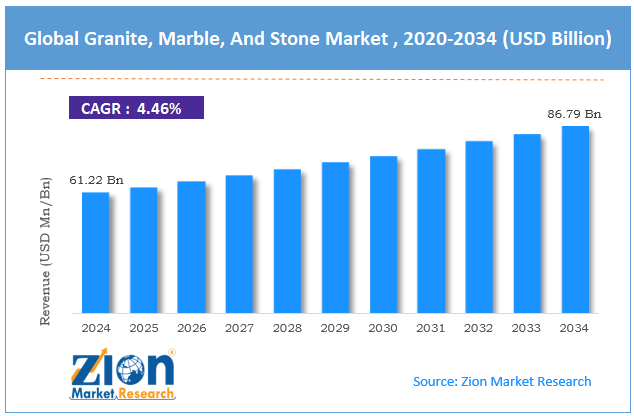
The global granite, marble, and stone market size was worth around USD 61.22 billion in 2024 and is predicted to grow to around USD 86.79 billion by 2034, with a compound annual growth rate (CAGR) of roughly 4.46% between 2025 and 2034.
Key Insights:
- As per the analysis shared by our research analyst, the global granite, marble, and stone market is estimated to grow annually at a CAGR of around 4.46% over the forecast period (2025-2034)
- In terms of revenue, the global granite, marble, and stone market size was valued at around USD 61.22 billion in 2024 and is projected to reach USD 86.79 billion by 2034.
- The granite, marble, and stone market is projected to grow significantly owing to the expansion of global infrastructure projects, an increase in commercial developments, and the growth of renovation and remodeling activities.
- Based on type, the granite segment is expected to lead the market, while the marble segment is expected to grow considerably.
- Based on application, the construction segment is the dominating segment, while the monuments segment is projected to witness sizeable revenue over the forecast period.
- Based on region, the Asia Pacific is projected to dominate the global market during the estimated period, followed by Europe.
Granite, Marble, And Stone Market: Overview
Granite is a coarse-grained, hard igneous stone formed from cooled magma, known for its resistance to heat and scratches and durability in countertops and construction. Marble is made from recrystallized limestone. The metamorphic rock is valued for its elegant, smooth finish and veining, but is comparatively less sought after and more porous. Stone encompasses natural rocks like marble and granite, extensively used in landscaping, sculpture, and architecture for aesthetic appeal and strength. The global granite, marble, and stone market is poised to expand rapidly, driven by the premium and luxury interiors trend, growing population and urbanization, and renovation and remodeling demand. Consumers are now preferring high-end finishes in hospitality and residential sectors, augmenting the use of natural stone for its premium look. Marble and granite convey more luxury than synthetic substitutes. This sustained preference drives the market growth.
Moreover, speedy population growth and urbanization in developing markets expand commercial space and housing needs. With growing disposable incomes, natural stone becomes a desired upgrade. This demographic shift fuels stone adoption. Furthermore, remodeling of older buildings in mature markets prompts replacement of worn surfaces with marble and granite. Renewed focus on interior design aesthetics increases renovation spending. This trend notably uplifts market uptake.
Despite growth, the global market is constrained by factors such as high temperature, transportation costs, environmental regulations, and quarrying limits. Marble and granite extraction, shipping, and processing demand high capital, mainly for long distances. High costs increase final prices for end-users. This may hamper adoption in cost-sensitive markets. Similarly, stringent environmental regulations in several economies limit quarrying areas and offer rehabilitation needs. Compliance raises operational costs and delays expansions. Regulatory pressures, hence, restrain the market growth.
Nonetheless, the global granite, marble, and stone industry stands to benefit from several key opportunities, such as digital sales and virtual visualization tools, customization, and design innovation. Elevated online ordering platforms and VR/AR tools allow customers to preview stone in spaces before purchase. Improved digital engagement streamlines buying decisions. This drives market reach and conversion. Additionally, offering bespoke stone cuts, finishes, and patterns supports personalized architecture. Advanced CNC and waterjet cutting technologies expand design possibilities. Customization appeals to high-end clientele.
Granite, Marble, And Stone Market: Dynamics
Growth Drivers
How is the expansion of hospitality, tourism, and commercial interiors driving the granite, marble, and stone market?
The recovery and growth of the worldwide tourism and hospitality industry is fueling the demand for natural stone in high-traffic and high-visibility spaces. Luxury hotels, commercial venues, and resorts depend on marble and granite for their aesthetic properties in facades, lobbies, and public spaces. With international tourism rebounding, investment in renovated facilities has elevated, producing targeted demand for premium stone materials. Commercial projects usually set a material trend that later diffuses into other domains, boosting their overall industry impact. This propeller also tends to pull through specialized stone finishes and niche varieties for exceptional architectural projects, thus impacting the granite, marble, and stone market.
How is the granite, marble, and stone market propelled by technological advancements in quarrying and fabrication?
Advancements in processing and extraction technologies are increasing productivity, yield, and precision in the natural stone sector. Adoption of diamond wire saws, AI-assisted quarry mapping, automated cutting, and CNC precision machinery has lowered waste and enhanced finished product quality. These improvements have helped lower production costs and enhanced customization capabilities, addressing both industry efficiency and design demand. Process automation is increasingly becoming a competitive need for producers to maintain margins and global competitive ranks. Overall, technology is facilitating fresh product forms and faster turnaround.
Restraints
Competition from engineered and synthetic alternatives unfavorably impacts the market progress
Growth in porcelain slabs, engineered quartz, and synthetic surfaces is diverting demand from natural stone in commercial and residential interiors. These alternatives offer wide design options, consistent appearance, and usually low prices. Manufacturers of synthetic surfaces are expanding distribution channels speedily. Consumer perception of maintenance and durability requirements influences substitution. This competitive pressure restrains the share of the natural stone market in some segments.
Opportunities
How do value-added processing and customization services present favorable prospects for the granite, marble, and stone market expansion?
Advanced fabrication centers that offer customization like intricate CNC patterns, bespoke edging, or integrated lighting can attract premium clientele. Designers look for uniqueness, fueling the demand for installations and intricate stone art. Value-added processing enhances margins more than selling raw slabs alone. Associations between design studios and quarries create curated collections. This variation strengthens competitive ranking, thus augmenting the worldwide granite, marble, and stone industry.
Challenges
Environmental opposition and community resistance restrict the market growth
Quarry projects usually experience opposition from local communities because of issues over dust, noise, land degradation, and traffic. Environmental NGOs advocate for stringent regulations or closures where ecological risks are identified. Protests, negative publicity, and legal disputes may delay approvals and increase operational costs for developers. Proactive stakeholder engagement and strong environmental management are crucial to secure regulatory clearance and long-term social acceptance.
Granite, Marble, And Stone Market: Report Scope
| Report Attributes | Report Details |
|---|---|
| Report Name | Granite, Marble, And Stone Market |
| Market Size in 2024 | USD 61.22 Billion |
| Market Forecast in 2034 | USD 86.79 Bllion |
| Growth Rate | CAGR of 4.46% |
| Number of Pages | 225 |
| Key Companies Covered | Levantina y Asociados de Minerales S.A., Polycor Inc., Temmer Marble, Dimpomar – Rochas Portuguesas Lda, Antolini Luigi & C. S.p.A., Aro Granite Industries Ltd., Xishi Stone Group / Xishi Group Ltd., Universal Marble & Granite Group Ltd., Best Cheer Stone Group, Mumal Marble, Fox Marble Holdings plc, Cosentino Group, MARGRAF S.p.A., Marble of the World, Couture Stone, and others. |
| Segments Covered | By Type, By Application, and By Region |
| Regions Covered | North America, Europe, Asia Pacific (APAC), Latin America, Middle East, and Africa (MEA) |
| Base Year | 2024 |
| Historical Year | 2019 to 2023 |
| Forecast Year | 2025 - 2034 |
| Customization Scope | Avail customized purchase options to meet your exact research needs. Request For Customization |
Granite, Marble, And Stone Market: Segmentation
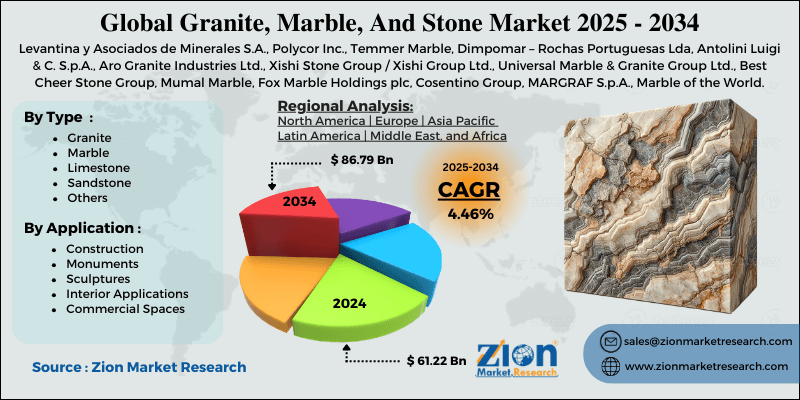
The global granite, marble, and stone market is segmented based on type, application, and region.
Why is the Granite segment projected to dominate the granite, marble, and stone market?
Based on type, the global granite, marble, and stone industry is divided into granite, marble, limestone, sandstone, and others. The granite segment dominates with 40% market share due to high demand in commercial and residential construction, especially for countertops, exterior cladding, and flooring. This usage is backed by a wide color variety, scratch resistance, and durability. Granite’s versatility and long lifespan increase its choice among natural stones globally.
On the other hand, the marble segment ranks second with 35% of the market. This is backed by strong adoption in luxury interiors, sculptural applications, and decorative flooring. Its unique veining, premium appeal, and polished finish make it popular in high-end projects, despite being more porous and softer than granite. Marble is still a major propeller of aesthetic-focused construction and renovation projects worldwide.
What factors help the Construction segment lead the granite, marble, and stone market?
Based on application, the global granite, marble, and stone market is segmented into construction, monuments, sculptures, interior applications, and commercial spaces. The construction segment leads with 60% market share. Natural stone is widely used for wall cladding, flooring, structural components, and infrastructure in commercial, residential, and public projects. Its aesthetic appeal, durability, and long service life make it a leading choice in large-scale construction activities across the globe.
Conversely, the monuments segment holds a second-leading position with around 25% market share. This is fueled by the stable demand for stone in public sculptures, heritage monuments, memorial structures, and architecture, where resistance to weathering and longevity is essential. This segment benefits from historical, cultural, and tourism-related construction activities, especially in regions with rich architectural traditions.
Granite, Marble, And Stone Market: Regional Analysis
Why is Asia Pacific outperforming other regions in the global Granite, Marble, and Stone market?
Asia Pacific is anticipated to retain its leading role in the global granite, marble, and stone market, with a 12% CAGR, driven by speedy urbanization and construction boom, ample natural resources and local supply chains, and government support and tourism. APAC’s progressing large-scale infrastructure projects and growing cities fuel high demand for marble, granite, and stone. Growing commercial and residential construction, along with growing disposable incomes, drives adoption in premium and standard applications.
Moreover, economies like Vietnam, China, and India have rich stone reserves and established processing and quarrying networks. This promises competitive pricing, support for domestic use and exports, and a steady supply, reinforcing the region’s market position. Furthermore, expanding hospitality, landmark structures, and high-end residential projects increase the need for premium stones. Government incentives and investments in infrastructure thus stimulate growth, making APAC the dominating region.
Why does Europe rank second in the global Granite, Marble, and Stone Market?
Europe ranks as the second-largest region in the global granite, marble, and stone industry, with an 11.7% CAGR, driven by strong architectural and design heritage, advanced processing technology, a skilled workforce, and high adoption in premium construction and renovation. Europe’s long-standing culture of natural stone in monuments, iconic buildings, and luxury interiors withstands high demand for marble, stone, and granite. Cultural appreciation for aesthetics and craftsmanship fuels continued use in new and restoration projects. Europe holds well-established stone processing sectors with modernized machinery and skilled labor, allowing complex cutting, customized designs, and finishing. This technical capability improves product quality and backs export competitiveness.
Additionally, European markets prioritize design and quality in commercial, residential, and institutional buildings, driving the use of high-end stone materials. Renovation of historic structures and luxury developments further drive consumption of granite and marble.
Granite, Marble, And Stone Market: Competitive Analysis
The leading players in the global granite, marble, and stone market are:
- Levantina y Asociados de Minerales S.A.
- Polycor Inc.
- Temmer Marble
- Dimpomar – Rochas Portuguesas Lda
- Antolini Luigi & C. S.p.A.
- Aro Granite Industries Ltd.
- Xishi Stone Group / Xishi Group Ltd.
- Universal Marble & Granite Group Ltd.
- Best Cheer Stone Group
- Mumal Marble
- Fox Marble Holdings plc
- Cosentino Group
- MARGRAF S.p.A.
- Marble of the World
- Couture Stone
What are the key trends in the global Granite, Marble, and Stone Market?
Sustainable & eco‑friendly practices:
The market is moving towards environmentally responsible quarrying, recycling of stone offcuts, and waste reduction, as regulators and buyers prioritize sustainability. Certifications and green building standards further motivate the adoption of eco-friendly stone products.
Growth of engineered & hybrid stone products:
There is a surging demand for composite materials and engineered stone that blend natural stone with recycled content or resins, offering improved durability, low maintenance, and consistent color. This trend is reshaping buyer preferences in commercial and residential spaces.
The global granite, marble, and stone market is segmented as follows:
By Type
- Granite
- Marble
- Limestone
- Sandstone
- Others
By Application
- Construction
- Monuments
- Sculptures
- Interior Applications
- Commercial Spaces
By Region
- North America
- The U.S.
- Canada
- Mexico
- Europe
- France
- The UK
- Spain
- Germany
- Italy
- Rest of Europe
- Asia Pacific
- China
- Japan
- India
- Australia
- South Korea
- Rest of Asia Pacific
- The Middle East & Africa
- Saudi Arabia
- UAE
- Egypt
- Kuwait
- South Africa
- Rest of the Middle East & Africa
- Latin America
- Brazil
- Argentina
- Rest of Latin America
Table Of Content
Methodology
FrequentlyAsked Questions

HappyClients

