
Fluorescent Paint Market Size, Share, Trends, Growth & Forecast 2034

Fluorescent Paint Market By Type (Daylight Fluorescents, Inorganic Fluorescents, Optical Whiteners), By Application (Safety Equipment, Commercial Buildings, Road Line Markings, Facilities, and Others), and By Region - Global and Regional Industry Overview, Market Intelligence, Comprehensive Analysis, Historical Data, and Forecasts 2025 - 2034
| Market Size in 2024 | Market Forecast in 2034 | CAGR (in %) | Base Year |
|---|---|---|---|
| USD 435.26 Million | USD 736.74 Million | 6.8% | 2024 |
Fluorescent Paint Industry Perspective:
What will be the size of the global fluorescent paint market during the forecast period?
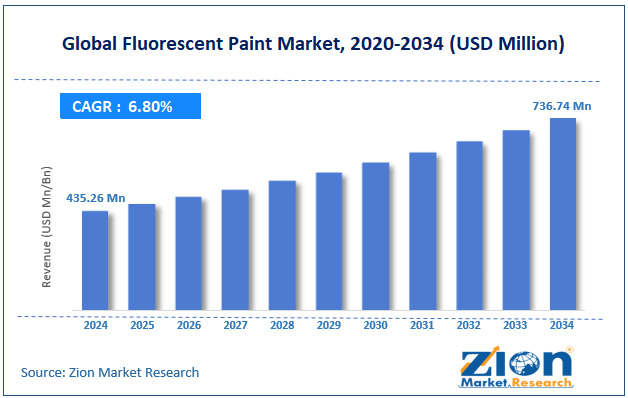
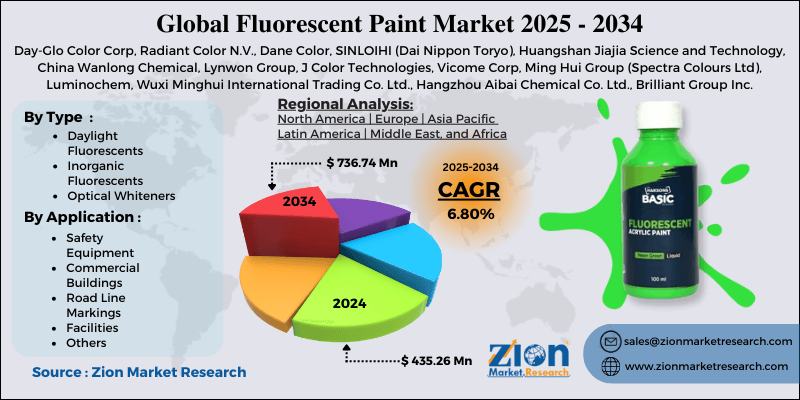
The global fluorescent paint market size was approximately USD 435.26 million in 2024 and is projected to reach USD 736.74 million by 2034, with a compound annual growth rate (CAGR) of approximately 6.80% between 2025 and 2034.
Key Insights:
- As per the analysis shared by our research analyst, the global fluorescent paint market is estimated to grow annually at a CAGR of around 6.80% over the forecast period (2025-2034)
- In terms of revenue, the global fluorescent paint market size was valued at around USD 435.26 million in 2024 and is projected to reach USD 736.74 million by 2034.
- The fluorescent paint market is projected to grow significantly, driven by the expansion of the automotive and transportation industries, increased industrial safety and signage requirements, and rising advertising and promotional activities.
- Based on type, the daylight fluorescents segment is expected to lead the market, while the inorganic fluorescents segment is expected to grow considerably.
- Based on application, the road line markings segment is the dominating segment, while the safety equipment segment is projected to witness sizeable revenue over the forecast period.
- By region, North America is projected to dominate the global market during the forecast period, followed by Europe.
Fluorescent Paint Market: Overview
Fluorescent paint is a coating that absorbs UV light and re-emits it as visible light, making colors look extremely vivid and bright. It is widely used for high-visibility clothing, safety signs, special effects, and artwork because it glows brightly under blacklight and stands out clearly under normal light. The global fluorescent paint market is likely to expand rapidly, fueled by high-visibility safety demand, construction and infrastructure growth, and transportation and automotive expansion. Fluorescent paints are essential in environments where visibility is limited, as they can prevent accidents and enhance safety. They are widely used on roadways, in industrial zones, and in protective equipment to alert pedestrians and workers. Growing regulatory emphasis on traffic safety and workplace safety has heightened the need for these high-visibility coatings.
Moreover, speedy urbanization and large-scale projects fuel demand for paints that improve clarity and safety. Fluorescent paints are used for boundaries, hazards, and structural elements, thereby enhancing visibility on construction sites. As governments invest in bridges, roads, and public facilities, the industry continues to progress steadily. Furthermore, the automotive industry steadily incorporates paints for safety features and aesthetic appeal. They are widely seen in motorcycles, emergency vehicles, and aftermarket accessories. Growing vehicle production and the trend toward vehicle customization are driving increased adoption of these paints.
Despite the growth, the global market is impeded by factors such as high manufacturing costs and limited outdoor durability. The production of fluorescent paints requires specialized processes and pigments, thereby increasing total costs. These higher prices can make the paints less appealing for budget-conscious buyers. Subsequently, adoption in low-budget regions or projects may be low. Likewise, despite their bright colors, fluorescent paints can fade when exposed to harsh sunlight or extreme weather. This reduces their long-term effectiveness in outdoor applications. Repainting and maintenance may dampen broader use.
Nonetheless, the global fluorescent paint industry stands to gain from a few key opportunities, like eco-friendly product development and functional and smart coatings. There is a surging demand for low-VOC and bio-based fluorescent paints. Environmentally conscious formulations appeal to new customers and support worldwide sustainability goals. Green innovation offers manufacturers opportunities to differentiate their products. Additionally, fluorescent paints can be combined with features like thermochromic and glow-in-the-dark effects. Such multifunctional coatings allow advanced applications in design, safety, and entertainment. Hence, advancements in smart coatings create a premium industry segment.
Fluorescent Paint Market: Dynamics
Growth Drivers
How does the fluorescent paint market benefit from expanding end-use industries?
Fluorescent paints are penetrating a broader range of industries beyond conventional industrial applications, especially consumer goods, automotive, and packaging. In consumer goods, products are made visually striking and marketable, whereas in automotive applications, they enhance aesthetic appeal and improve safety. Packaging applications benefit from both functional and decorative roles, like anti-counterfeiting and tamper-evidence features. This cross-industry adoption widens manufacturers' revenue streams. This diversification of applications promises steady growth and backs new industry segments.
How are eco-friendly formulations and technological advancements impacting the development of the fluorescent paint market?
Continuous advancements in fluorescent paint chemistry have produced long-lasting, brighter, and UV-resistant products for diverse applications. Low-VOC, environmentally friendly, and non-toxic formulations are increasingly in demand because of consumer preferences for sustainable products and stringent regulations. These enhances formulations also increase use in consumer packaging, automotive interiors, and decorative applications. Investment in research and development is helping manufacturers create versatile products. These technological improvements are fueling wider adoption and growth in the fluorescent paint market.
Restraints
Durability concerns and limited shelf life slow the market progress
Some fluorescent paints degrade more quickly under prolonged UC exposure or extreme weather conditions. Reduced durability in outdoor applications may increase replacement costs and maintenance. Consumers may hesitate to invest in fluorescent paints whose longevity is indefinite. Improvements in weather-resistant and UV-stable formulations are aiding, but issues remain in a few regions. This limitation hampers the use of fluorescent paints in extreme environmental conditions.
Opportunities
How are growing consumer and decorative applications creating promising avenues for the fluorescent paint industry?
Fluorescent paints are finding new applications in furniture, home décor, toys, and fashion due to their eye-catching, bright colors. They are widely used for accent walls, creative projects, and furniture finishes, attracting users who value vibrant design. Growing spending power and rising aesthetic awareness are fueling demand in this segment. Expanding e-commerce and retail channels increases the accessibility of these products to a broader audience. This diversification allows fluorescent paints to expand beyond industrial applications into lifestyle and decorative applications, creating new avenues for the fluorescent paint industry.
Challenges
Market awareness and education limit the market growth
Several potential consumers remain unaware of the benefits and applications of fluorescent paints, which restricts adoption. Misconceptions regarding durability, cost, and maintenance may further discourage use. Educational campaigns, marketing initiatives, and product demonstrations are needed to build and strengthen confidence and awareness. This lack of knowledge hampers industry penetration, particularly in niche segments and developing markets. Improving consumer understanding is hence a major challenge for fueling the growth.
Fluorescent Paint Market: Report Scope
| Report Attributes | Report Details |
|---|---|
| Report Name | Fluorescent Paint Market |
| Market Size in 2024 | USD 435.26 Million |
| Market Forecast in 2034 | USD 736.74 Million |
| Growth Rate | CAGR of 6.80% |
| Number of Pages | 212 |
| Key Companies Covered | Day-Glo Color Corp, Radiant Color N.V., Dane Color, SINLOIHI (Dai Nippon Toryo), Huangshan Jiajia Science and Technology, China Wanlong Chemical, Lynwon Group, J Color Technologies, Vicome Corp, Ming Hui Group (Spectra Colours Ltd), Luminochem, Wuxi Minghui International Trading Co. Ltd., Hangzhou Aibai Chemical Co. Ltd., Brilliant Group Inc., Kremer Pigmente, and others. |
| Segments Covered | By Type, By Application, and By Region |
| Regions Covered | North America, Europe, Asia Pacific (APAC), Latin America, Middle East, and Africa (MEA) |
| Base Year | 2024 |
| Historical Year | 2019 to 2023 |
| Forecast Year | 2025 - 2034 |
| Customization Scope | Avail customized purchase options to meet your exact research needs. Request For Customization |
Fluorescent Paint Market: Segmentation
The global fluorescent paint market is segmented based on type, application, and region.
Why is the Daylight Fluorescents segment projected to dominate the fluorescent paint market?
Based on type, the global fluorescent paint industry is divided into daylight fluorescents, inorganic fluorescents, and optical whiteners. The daylight fluorescents segment registers 60% of the total market. The segment is the fastest-growing due to its high brightness and broad use in signage, safety, and high-visibility coatings.
On the other hand, the inorganic fluorescents segment is growing rapidly, accounting for 40% of the market. This segmental dominance is backed by their durability and superior stability, mainly in industrial and outdoor applications.
What factors help the Road Line Markings segment lead the fluorescent paint market?
Based on application, the global fluorescent paint market is segmented into safety equipment, commercial buildings, road line markings, facilities, and others. The road line markings segment captures a leading share with 40% of the total market. The segment’s prominence is supported by its wider use in infrastructure projects, traffic management, and government safety initiatives aimed at improving road visibility.
Conversely, the safety equipment segment ranks second, accounting for 30% of the overall market. They comprise high-visibility protective gear and industrial safety use cases where fluorescent paints help reduce workplace accidents and improve hazard recognition.
Fluorescent Paint Market: Regional Analysis
Why is North America outperforming other regions in the global Fluorescent Paint Market?
North America is anticipated to retain its leading role in the global fluorescent paint market, with a 5.7% CAGR, driven by its large market share, established demand, strict safety and regulatory standards, and strong infrastructure spending. North America accounts for a notable share of the worldwide market, with predictions indicating that it accounted for more than 40% of overall market revenue in the past year. This dominant share indicates widespread adoption and broader industrial use across major sectors, including safety and construction. The strong presence of major players and high demand for high-visibility coatings help sustain this dominance.
Moreover, regulations such as OSHA safety requirements and federal infrastructure mandates drive greater use of fluorescent paints in industrial signage, road markings, and protective equipment. These rules drive governments and companies to adopt high-visibility coatings to enhance public and worker safety. Hence, compliance needs primarily drive market consumption throughout the region.
Furthermore, North America’s current investment in urban development and infrastructure modernization is driving demand for fluorescent paints for road line marking, commercial projects, and building safety signage. Large federal and state budgets support the expansion and renovation of bridges, transit systems, and highways, driving continued usage. This consistent infrastructure expense highlights high volume and durable industry demand.
Why does Europe rank second in the global Fluorescent Paint Market?
Europe ranks as the second-largest region in the global fluorescent paint industry, with a 6% CAGR, driven by its notable market share and regional position, strict safety and environmental regulations, and a robust automotive and industrial base. Europe accounts for nearly 30% of the global market, ranking second to North America. This strong regional dominance indicates sustained demand for safety and industrial applications.
Europe’s industrial sector continues to grow as end users and manufacturers adopt advanced fluorescent paint technologies. European Union norms, such as occupational safety directives and REACH, mandate high-visibility coatings and restrict the use of hazardous chemicals. These policies push infrastructure projects and manufacturers to use compliant fluorescent paints, driving regional dominance and demand. In addition, sustainability standards accelerate the adoption of low-VOC, eco-friendly formulations.
Additionally, Europe’s well-developed industrial and automotive sectors, led by Germany, France, and the UK, drive demand for high-visibility applications and specialty coatings. The region’s manufacturing strength supports sustained demand for fluorescent paints in industrial equipment and safety markings. This industrial backbone significantly adds to the region's dominance.
Fluorescent Paint Market: Competitive Analysis
The leading players in the global fluorescent paint market are:
- Day-Glo Color Corp
- Radiant Color N.V.
- Dane Color
- SINLOIHI (Dai Nippon Toryo)
- Huangshan Jiajia Science and Technology
- China Wanlong Chemical
- Lynwon Group
- J Color Technologies
- Vicome Corp
- Ming Hui Group (Spectra Colours Ltd)
- Luminochem
- Wuxi Minghui International Trading Co. Ltd.
- Hangzhou Aibai Chemical Co. Ltd.
- Brilliant Group Inc.
- Kremer Pigmente
What are the key trends in the global Fluorescent Paint Market?
Technological improvements in paint performance:
Innovation in pigment technology, nano-enhanced binders, and microencapsulation is enhancing the durability, color vibrancy, and UV resistance of fluorescent paints. These technical enhancements expand the use in harsher outdoor, automotive, and industrial environments. Therefore, performance-oriented products are quickly replacing older, less resilient versions.
Expansion into new and creative end‑user segments:
Beyond traditional industrial applications, fluorescent paints are widely used in sports equipment, the arts, automotive customization, and recreational applications. Dynamic, smart coatings that respond to temperature or light are advancing, creating new use cases. This diversification denotes wider interest from entertainment, design, and lifestyle markets.
Rising demand in signage, safety, and visibility applications:
There is a surging adoption of fluorescent paints for safety markings in industrial sites, infrastructure, and public spaces due to their high visibility. Regulatory emphasis on road safety and the workplace further drives this demand. Enhanced safety needs are hence a key ongoing industry driver.
The global fluorescent paint market is segmented as follows:
By Type
- Daylight Fluorescents
- Inorganic Fluorescents
- Optical Whiteners
By Application
- Safety Equipment
- Commercial Buildings
- Road Line Markings
- Facilities
- Others
By Region
- North America
- The U.S.
- Canada
- Europe
- France
- The UK
- Spain
- Germany
- Italy
- Rest of Europe
- Asia Pacific
- China
- Japan
- India
- South Korea
- Southeast Asia
- Rest of Asia Pacific
- Latin America
- Brazil
- Mexico
- Rest of Latin America
- Middle East & Africa
- GCC
- South Africa
- Rest of Middle East & Africa
Table Of Content
Methodology
FrequentlyAsked Questions

HappyClients

