
Global Floating Dry Docks Market Size, Share, Trends and Forecasts 2034

Floating Dry Docks Market By Type (Steel Floating Dry Docks, Concrete Floating Dry Docks, and Composite Floating Dry Docks), By Application (Shipbuilding, Ship Repair, Offshore Structures, and Others), By Capacity (Small, Medium, and Large), By End-User (Commercial, Military, and Industrial), and Region - Global and Regional Industry Overview, Market Intelligence, Comprehensive Analysis, Historical Data, and Forecasts 2026 - 2034
| Market Size in 2025 | Market Forecast in 2034 | CAGR (in %) | Base Year |
|---|---|---|---|
| USD 1.9 Billion | USD 3.2 Billion | 6.1% | 2025 |
Floating Dry Docks Industry Perspective:
What will be the size of the global floating dry docks market during the forecast period?
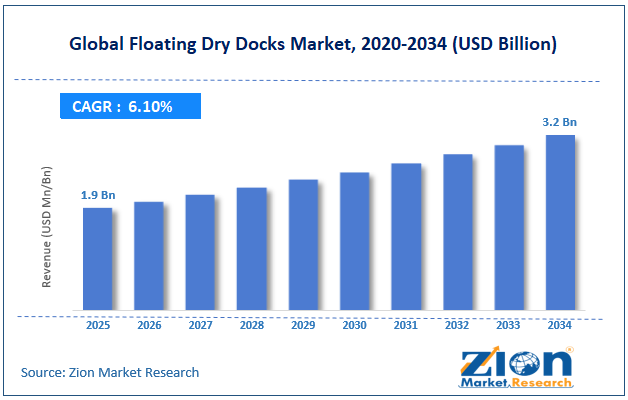
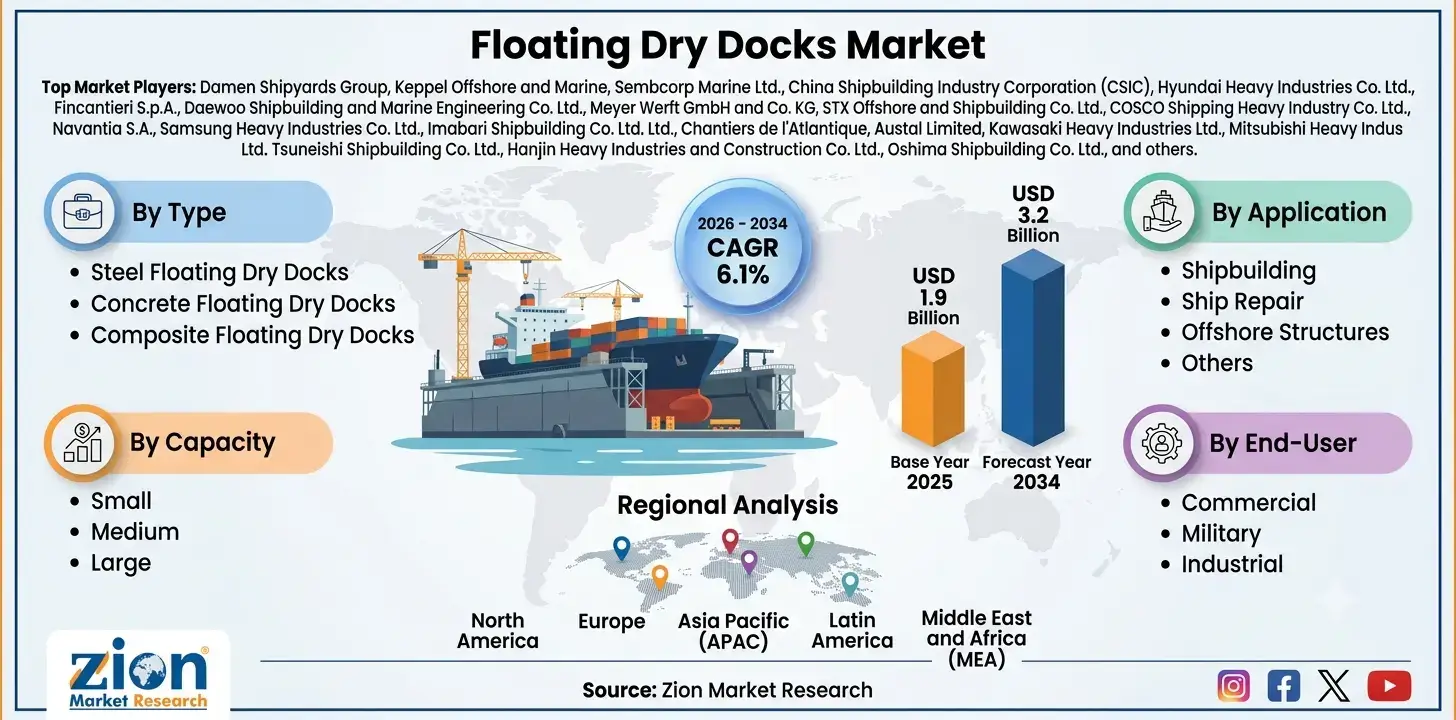
The global floating dry docks market size was worth around USD 1.9 billion in 2025 and is predicted to grow to around USD 3.2 billion by 2034, with a compound annual growth rate (CAGR) of roughly 6.1% between 2026 and 2034.
Key Insights
- As per the analysis shared by our research analyst, the global floating dry docks market is estimated to grow annually at a CAGR of around 6.1% over the forecast period (2026-2034).
- In terms of revenue, the global floating dry docks market size was valued at around USD 1.9 billion in 2025 and is projected to reach USD 3.2 billion by 2034.
- Growth in global maritime trade is expected to propel the floating dry docks market over the projected period.
- Based on the type, the steel floating dry docks segment dominates the market with a revenue share of 58.5%.
- Based on the application, the ship repair segment holds a majority of market share in 2025 of 45%.
- Based on capacity, the large segment holds a majority of market share in 2025 of 47%.
- Based on the end-user, the commercial segment holds the largest market share in 2025 of 56%.
- Based on region, the Asia Pacific holds the largest market share in 2025 of 42%.
Floating Dry Docks Market: Overview
Floating dry docks are specialized marine structures used to lift, dock, maintain, repair, and build ships and other large water vessels. Unlike the graving dry docks, which are stationary basins, floating dry docks are movable structures that are submerged by filling the air tanks with water. Once the ship or another vessel is secured inside the dock, water is pumped out of the ballast tanks, causing the dock to rise and lift the ship out of the water. Floating dry docks are widely used in the shipbuilding, naval, commercial, and offshore industries to access the ship’s hull for inspection, painting, cleaning, maintenance, and repair.
Impact of the USA-Israel War on Iran on the Floating Dry Docks Market
The USA-Israel war with Iran is likely to negatively affect the floating dry docks market in the short term due to disrupted maritime vessel transport, higher insurance costs for vessels navigating waters affected by military action, and delayed maintenance and repairs. As of August 21, 2026, the number of vessels passing through the strategically located Strait of Hormuz was down almost 90 percent compared to the same week last year, reducing demand for shipping companies operating in the region. Nevertheless, prolonged restrictions on the free passage of commercial ships, destruction of commercial vessels, and the resulting need for repairs, inspections, and maintenance may have the opposite effect on the floating dry docks market in the medium-term outlook.
Floating Dry Docks Market: Dynamics
Growth Drivers
How does the rising demand for ship repair and maintenance drive the floating dry docks market?
With more ships worldwide, aging vessels, and the growing importance of maritime transport, the need for regular ship repair and maintenance is rising. Ships require periodic dry docking for hull cleaning and inspection, as well as corrosion prevention and control, structural repairs, engine maintenance, and other improvements. Moreover, in response to tightening environmental and safety regulations, shipowners are also using dry dock periods to retrofit and modify their vessels to meet standards. The need for floating dry docks for periodic dry docking, particularly in the absence of permanent dry-dock facilities, is also contributing to growth in the floating dry docks market.
Restraints
High capital investment acts as a major restraint on the growth of the floating dry docks industry
High capital investment is a major restraint for the floating dry docks market, as constructing and maintaining floating dry docks requires substantial expenditure on steel structures, marine, ballast, and pumping systems, equipment, installation, and certification. The high initial investment required to establish floating dry docks could hinder market growth, especially for small and medium-sized shipyards, limiting the utilization of floating docks. Long construction and commissioning periods may also impede growth in the floating dry dock industry and the expansion of the shipbuilding market.
Opportunities
How does the growing collaboration in the sector offer a lucrative opportunity for the floating dry docks market?
Growing joint efforts among shippers, shipyards, port authorities, and international maritime technology suppliers in the floating dry docks market are anticipated to create profitable opportunities for the industry in the coming years. Moreover, collaborations create a mechanism to leverage technical expertise, financial resources, ship-repair infrastructure, and access to a global customer base, supporting growth in the floating-dock and ship-repair industries. For instance, in February 2025, Maersk and Cochin Shipyard Limited (CSL) entered an MoU to cooperate in ship repair, maintenance, dry docking, and shipbuilding in India. The partnership initially aims to focus on dry docking containerships with a capacity of up to 4,000 TEU, along with sharing expertise and training programs.
In May 2025, Cochin Shipyard and Drydocks World, a subsidiary of DP World, signed an MoU to strengthen cooperation, scale up India’s ship-repair and offshore-fabrication capabilities, and transfer global practices to Indian ports. Another MoU was signed in October 2025 between Drydocks World and CSL to explore opportunities to develop India’s first ship-repair cluster at the International Ship Repair Facility in Kochi. These collaborative initiatives can create numerous opportunities for investment in India’s ship-repair infrastructure, enhance the utilization of floating dry docks and ship-repair capabilities, attract international ship owners, and create significant growth opportunities for the floating dry docks industry.
Challenges
Why does the shortage of skilled marine personnel pose a significant challenge to the growth of the floating dry docks industry?
A lack of skilled marine personnel can hinder growth in the floating dry docks market. Operating floating dry docks requires skilled marine engineers, naval architects, dockmasters, welders, technicians, and other professionals. This is especially true for experienced officers and technically qualified personnel. According to the BIMCO/ICS Seafarer Workforce report 2026, the demand for STCW-certified seafarers has increased by 35% since 2021. In addition, the shipping industry has a shortage of 39,100 officers in 2026. By 2030, the shortage may reach 113,735 officers, meaning an additional 22,747 officers will need to be recruited. A shortage of trained and experienced personnel leads to higher labor costs, longer vessel repair and maintenance times, and reduced efficiency in using floating dry docks. Thus, a shortage of skilled marine personnel can hinder growth in the floating dry docks market.
Floating Dry Docks Market: Report Scope
| Report Attributes | Report Details |
|---|---|
| Report Name | Floating Dry Docks Market |
| Market Size in 2025 | USD 1.9 Billion |
| Market Forecast in 2034 | USD 3.2 Billion |
| Growth Rate | CAGR of 6.1% |
| Number of Pages | 228 |
| Key Companies Covered | Damen Shipyards Group, Keppel Offshore and Marine, Sembcorp Marine Ltd., China Shipbuilding Industry Corporation (CSIC), Hyundai Heavy Industries Co. Ltd., Fincantieri S.p.A., Daewoo Shipbuilding and Marine Engineering Co. Ltd., Meyer Werft GmbH and Co. KG, STX Offshore and Shipbuilding Co. Ltd., COSCO Shipping Heavy Industry Co. Ltd., Navantia S.A., Samsung Heavy Industries Co. Ltd., Imabari Shipbuilding Co. Ltd., Chantiers de l'Atlantique, Austal Limited, Kawasaki Heavy Industries Ltd., Mitsubishi Heavy Industries Ltd., Tsuneishi Shipbuilding Co. Ltd., Hanjin Heavy Industries and Construction Co. Ltd., Oshima Shipbuilding Co. Ltd., and others. |
| Segments Covered | By Type, By Application, By Capacity, By End-User, and By Region |
| Regions Covered | North America, Europe, Asia Pacific (APAC), Latin America, Middle East, and Africa (MEA) |
| Base Year | 2025 |
| Historical Year | 2020 - 2024 |
| Forecast Year | 2026 - 2034 |
| Customization Scope | Avail customized purchase options to meet your exact research needs. Request For Customization |
Floating Dry Docks Market: Segmentation
Type Insights
Why does the steel floating dry docks segment hold a prominent position in the floating dry docks market?
The steel floating dry docks segment dominates the floating dry docks market with a revenue share of 58.5%. The main drivers of demand for steel floating dry docks are worldwide growth in the ship repair and maintenance industry, increasing ship sizes, and the modernization of military fleets and naval infrastructure. These structures can be designed to accommodate the lifting capacity of the largest ships and the modifications of all kinds of vessels.
Thus, their versatility across multiple applications enables them to meet the demands of commercial ships, offshore platforms, and military vessels. Moreover, steel floating docks can be installed faster than massive dry docks and offer less infrastructure-intensive solutions; for instance, the Deendayal Port Authority in India chose floating docks for their lower cost and shorter construction time.
Application Insights
How does the ship repair segment capture the largest share in the floating dry docks market?
The ship repair segment holds a 45% share of the floating dry docks industry in 2025. The growth is driven primarily by the aging global vessel fleet, expanding international trade, rising dry-docking days, and tightening environmental and safety regulations. The aging vessel fleet requires extensive hull maintenance, corrosion protection, engine overhauls, ballast-water treatment system upgrades, emissions-control installations, and other services.
Capacity Insights
Why does the large segment capture the largest share in the floating dry docks market?
The large segment holds a 47% market share in 2025. The growth is driven primarily by the supersizing of container ships, tankers, bulk carriers, LNG carriers, and naval vessels, which requires increased capacity and docking space; large container ships nowadays often exceed 24,000 TEU, making it necessary to moor at floating docks to allow a larger-than-normal ship size when the program’s existing facilities are unavailable or insufficient. Moreover, the expansion of fleets, the development of navies, and the enhancement of ship-repair capabilities, which require more ships to be serviced at a time, will drive demand for high-capacity docks.
End-User Insights
How does the commercial segment capture the largest share in the floating dry docks market?
The commercial segment holds the largest market share in 2025 of 56%. Revenue growth in the commercial vessel sector is primarily driven by the increase in world trade, including the overall growth in the number of commercial ships, particularly in the container and dry-bulk sectors, as well as the natural life-cycle replacements of existing ships, and the requirement for all commercial ships to be dry-docked periodically. Such dry-docking usually entails inspections, hull maintenance, machinery repairs, corrosion removal, and compliance with other environmental regulations. Moreover, floating docks provide mobile repair capability, which is particularly valuable to commercial shipowners.
Regional Insights
What factors drive the Asia Pacific region in the floating dry docks market?
Asia Pacific holds the largest market share in 2025, at 42%. The region’s thriving shipbuilding sector, growing demand for commercial vessel repairs, and supportive government policies are projected to drive market growth during the study period. China, in particular, is a leading contributor to shipbuilding growth. According to data published by China’s Ministry of Industry and Information Technology, China’s shipbuilding output was valued at 53.69 million DWT in 2025, which registered an increase of 11.4% year-over-year and accounted for 56.1% of the world’s total shipbuilding. China’s new ship orders also amounted to 107.82 million DWT, representing 69% of global ship orders. In comparison, the country’s backlogged ship orders rose 31.5% year over year to 274.42 million DWT, accounting for 66.8% of the world’s total ship orders.
As a result, China’s large-scale and consistently growing vessel manufacturing base fuels the demand for ship repairs, maintenance, dry-docking, inspections, refurbishments, and other services, and thus for the floating dry dock industry in the Asia-Pacific region and China in particular.
Floating Dry Docks Market: Competitive Analysis
The global floating dry docks market is dominated by players like:
- Damen Shipyards Group
- Keppel Offshore and Marine
- Sembcorp Marine Ltd.
- China Shipbuilding Industry Corporation (CSIC)
- Hyundai Heavy Industries Co. Ltd.
- Fincantieri S.p.A.
- Daewoo Shipbuilding and Marine Engineering Co. Ltd.
- Meyer Werft GmbH and Co. KG
- STX Offshore and Shipbuilding Co. Ltd.
- COSCO Shipping Heavy Industry Co. Ltd.
- Navantia S.A.
- Samsung Heavy Industries Co. Ltd.
- Imabari Shipbuilding Co. Ltd.
- Chantiers de l'Atlantique
- Austal Limited
- Kawasaki Heavy Industries Ltd.
- Mitsubishi Heavy Industries Ltd.
- Tsuneishi Shipbuilding Co. Ltd.
- Hanjin Heavy Industries and Construction Co. Ltd.
- Oshima Shipbuilding Co. Ltd.
The global floating dry docks market is segmented as follows:
By Type
- Steel Floating Dry Docks
- Concrete Floating Dry Docks
- Composite Floating Dry Docks
By Application
- Shipbuilding
- Ship Repair
- Offshore Structures
- Others
By Capacity
- Small
- Medium
- Large
By End-User
- Commercial
- Military
- Industrial
By Region
- North America
- The U.S.
- Canada
- Mexico
- Europe
- France
- The UK
- Spain
- Germany
- Italy
- Rest of Europe
- Asia Pacific
- China
- Japan
- India
- Australia
- South Korea
- Rest of Asia Pacific
- The Middle East & Africa
- Saudi Arabia
- UAE
- Egypt
- Kuwait
- South Africa
- Rest of the Middle East & Africa
- Latin America
- Brazil
- Argentina
- Rest of Latin America
Table Of Content
Methodology
FrequentlyAsked Questions
Floating dry docks are specialized marine structures used to lift, dock, maintain, repair, and build ships and other large water vessels. Unlike graving dry docks, which are stationary basins, floating dry docks are movable structures that can be submerged by filling air tanks with water.
The key growth drivers for the floating dry docks market include the rising demand for ship repair and maintenance, expansion of the global commercial and naval fleet, increasing vessel sizes, fleet modernization, and growing maritime trade. Aging vessels require frequent hull inspection, corrosion treatment, structural repairs, machinery maintenance, and regulatory upgrades, creating recurring demand for dry-docking services.
The major challenges restraining the growth of the floating dry docks market include high capital and maintenance costs, shortage of skilled marine personnel, exposure to adverse weather conditions, stringent environmental and safety regulations, and competition from conventional dry docks.
Based on the application, the ship repair segment is expected to dominate the floating dry docks market growth during the projected period.
The floating dry docks market is being influenced by several emerging trends, including digitalization, automated ballast-control systems, AI-based inspection, predictive maintenance, robotics, and larger-capacity modular dock designs. Digital monitoring systems are increasingly being used to track ballast loads, structural stresses, and vessel alignment in real time, improving safety and operational efficiency.
According to the report, the global floating dry docks market size was worth around USD 1.9 billion in 2025 and is predicted to grow to around USD 3.2 billion by 2034.
The global floating dry docks market is expected to grow at a CAGR of 6.1% during the forecast period.
The global floating dry docks industry growth is expected to be led by the Asia Pacific over the forecast period.
The global floating dry docks market is dominated by players like Damen Shipyards Group, Keppel Offshore and Marine, Sembcorp Marine Ltd., China Shipbuilding Industry Corporation (CSIC), Hyundai Heavy Industries Co. Ltd., Fincantieri S.p.A., Daewoo Shipbuilding and Marine Engineering Co. Ltd., Meyer Werft GmbH and Co. KG, STX Offshore and Shipbuilding Co. Ltd., COSCO Shipping Heavy Industry Co. Ltd., Navantia S.A., Samsung Heavy Industries Co. Ltd., Imabari Shipbuilding Co. Ltd., Chantiers de l'Atlantique, Austal Limited, Kawasaki Heavy Industries Ltd., Mitsubishi Heavy Industries Ltd., Tsuneishi Shipbuilding Co. Ltd., Hanjin Heavy Industries and Construction Co. Ltd., and Oshima Shipbuilding Co. Ltd., among others.
The floating dry docks market report covers the geographical market along with a comprehensive competitive landscape analysis. It also includes cash flow analysis, profit ratio analysis, market basket analysis, market attractiveness analysis, sentiment analysis, PESTLE analysis, trend analysis, SWOT analysis, trade area analysis, demand & supply analysis, Porter’s five forces analysis, and value chain analysis.

HappyClients

