
Global Fertility Testing Devices Market Size, Share, Analysis, Trends, Growth Report, 2030

Fertility Testing Devices Market By Purchase (Non-Prescription or OTC Testing and Prescription Testing), By Product (Fertility Monitors (Urine-Based Fertility Monitors, Saliva-Based Fertility Monitors, And Others) and Ovulation Prediction Kits), and By Region - Global and Regional Industry Overview, Market Intelligence, Comprehensive Analysis, Historical Data, and Forecasts 2023 - 2030
| Market Size in 2022 | Market Forecast in 2030 | CAGR (in %) | Base Year |
|---|---|---|---|
| USD 503.16 Million | USD 781.65 Million | 5.76% | 2022 |
Description
What is Size of Fertility Testing Devices Industry?
The global fertility testing devices market size was worth around USD 503.16 Million in 2022 and is predicted to grow to around USD 781.65 Million by 2030 with a compound annual growth rate (CAGR) of roughly 5.76% between 2023 and 2030. The report analyzes the global fertility testing devices market drivers, restraints/challenges, and the effect they have on the demands during the projection period. In addition, the report explores emerging opportunities in the fertility testing devices industry.
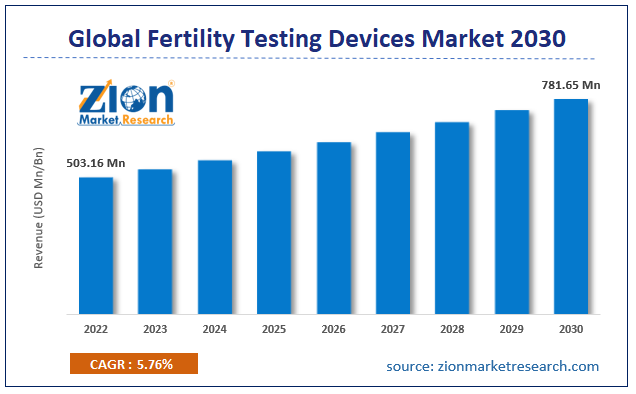
Global Fertility Testing Devices Market: Overview
Fertility testing is done for the evaluation of fertility and several conditions relate to it in male and female. Infertility is a condition of a rational duration of unprotected intercourse without conceiving. Couples do fertility testing to identify the core reason leading to their infertility. The general physician or gynecologist initially assesses the fertility test outcomes to analyze the precise problem and counsels the remedial treatment. Thus, due to the increasing demand for fertility testing devices, the global market is expected to propel in the near future.
Global Fertility Testing Devices Market: Growth Factors
The major factors that are responsible for propelling the global market growth for fertility testing devices include the increasing average age of first-time pregnancies in females, rising knowledge about the importance of fertility testing, and the development of enhanced and feasible ovulation monitors with great precision. Decreasing fertility rate globally among females and easy accessibility on the e-commerce website of ovulation monitors are a few other factors contributing to the market growth. However, a few factors such as the huge price of ovulation monitors and the shortage of predictive accuracy & power to confirm ovulation in modern ovulation prediction techniques may hinder the market growth.
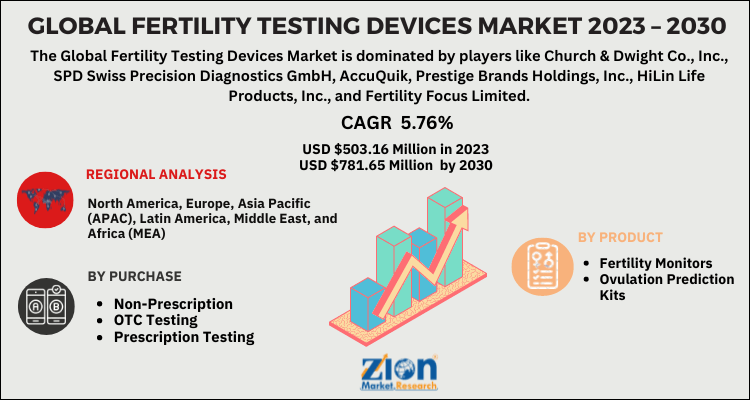
Global Fertility Testing Devices Market: Report Scope
| Report Attributes | Report Details |
|---|---|
| Report Name | Fertility Testing Devices Market Research Report |
| Market Size in 2022 | USD 503.16 Million |
| Market Forecast in 2030 | USD 781.65 Million |
| Growth Rate | CAGR of 5.76% |
| Number of Pages | 188 |
| Forecast Units | Value (USD Billion), and Volume (Units) |
| Key Companies Covered | Church & Dwight Co., Inc., SPD Swiss Precision Diagnostics GmbH, AccuQuik, Prestige Brands Holdings, Inc., HiLin Life Products, Inc., and Fertility Focus Limited. The other key players in the market are Geratherm Medical AG, Babystart Ltd, Quidel Corporation, UEBE Medical GmbH, Biozhena Corporation, Alere Inc., Taidoc Technology Corporation, and Fairhaven Health, LLC. |
| Segments Covered | By Purchase, By Product, And By Region |
| Regions Covered | North America, Europe, Asia Pacific (APAC), Latin America, Middle East and Africa (MEA) |
| Base Year | 2022 |
| Historical Year | 2017 - 2021 |
| Forecast Year | 2022 - 2030 |
| Customization Scope | Avail customized purchase options to meet your exact research needs. Request For Customization |
Global Fertility Testing Devices Market: Segmentation
The global fertility testing devices market can be segmented based on mode of purchase, product, and region.
The mode of purchase segment of the market is classified into non-prescription or OTC testing and prescription testing.
The product segment of the market is divided into fertility monitors and ovulation prediction kits. The fertility monitors segment of the market is sub-segmented into urine-based fertility monitors, saliva-based fertility monitors, and others.
Global Fertility Testing Devices Market: Regional Analysis
North America is expected to dominate the global fertility testing devices market owing to various factors, including the decrease in fertility rate due to the increasing first-time pregnancy age and elevated incidence of polycystic ovary syndrome among the females in this region and increasing consciousness regarding the advantages provided by fertility awareness methods & ovulation monitors in fruitful conception among females. Asia Pacific region is also anticipated to grow at a fast pace in the market in the coming period. The growth of this region can be attributed to various factors such as the rising digit of females experiencing lifestyle disorders, increasing attention of domestic & international players in the Asia-Pacific region, increasing expenditures for the establishment of ovulation & fertility monitors, and declining fertility rate.
Global Fertility Testing Devices Market: Competitive Players
The major players in the global fertility testing devices market are
- Church & Dwight Co.Inc.
- SPD Swiss Precision Diagnostics GmbH
- AccuQuik
- Prestige Brands Holdings.Inc.
- HiLin Life Products.Inc.
- Fertility Focus Limited.
The other key players in the market are
- Geratherm Medical AG
- Babystart Ltd
- Quidel Corporation
- UEBE Medical GmbH
- Biozhena Corporation
- Alere Inc.
- Taidoc Technology Corporation
- and Fairhaven Health
- LLC.
The global fertility testing devices market is segmented as follows:
By Purchase
- Non-Prescription
- OTC Testing
- Prescription Testing
By Product
- Fertility Monitors
- Urine-Based Fertility Monitors
- Saliva-Based Fertility Monitors
- And Others
- Ovulation Prediction Kits
By Region
- North America
- The U.S.
- Canada
- Mexico
- Europe
- France
- The UK
- Spain
- Germany
- Italy
- Rest of Europe
- Asia Pacific
- China
- Japan
- India
- Australia
- South Korea
- Rest of Asia Pacific
- The Middle East & Africa
- Saudi Arabia
- UAE
- Egypt
- Kuwait
- South Africa
- Rest of the Middle East & Africa
- Latin America
- Brazil
- Argentina
- Rest of Latin America
What Report Provides
- Full in-depth analysis of the parent market
- Important changes in market dynamics
- Segmentation details of the market
- Former, ongoing, and projected market analysis in terms of volume and value
- Assessment of niche industry developments
- Market share analysis
- Key strategies of major players
- Emerging segments and regional markets
- Testimonials to companies in order to fortify their foothold in the market.
Table Of Content

FrequentlyAsked Questions
These devices assess reproductive health and ovulation. They support fertility planning
The global Fertility Testing Devices market is expected to be driven by the infertility awareness and demand for early diagnosis. Growth in home-based and digital fertility monitoring supports adoption.
According to study, the global Fertility Testing Devices market size was worth around USD 503.16 Million in 2022 and is predicted to grow to around USD 781.65 Million by 2030.
The global Fertility Testing Devices market is expected to grow at a Compound Annual Growth Rate (CAGR) of around CAGR 5.76% during the forecast period from 2023-2030.
The global Fertility Testing Devices industry is projected to be challenged by Challenges include accuracy expectations and regulatory approvals.
The Opportunities include infertility awareness, home-based testing, delayed parenthood trends, and reproductive health focus will offer significant growth opportunities in the Fertility Testing Devices market.
Home-based and digital fertility kits; hormone and ovulation tracking; integration with fertility apps are the emerging trends and innovations impacting the Fertility Testing Devices market.
The global Fertility Testing Devices market is expected to be led by North America during the forecast period.
Some of the prominent players operating in the global Fertility Testing Devices market are; Church & Dwight Co., Inc., SPD Swiss Precision Diagnostics GmbH, AccuQuik, Prestige Brands Holdings, Inc., HiLin Life Products, Inc., and Fertility Focus Limited. The other key players in the market are Geratherm Medical AG, Babystart Ltd, Quidel Corporation, UEBE Medical GmbH, Biozhena Corporation, Alere Inc., Taidoc Technology Corporation, and Fairhaven Health, LLC. and others.
The report explores crucial aspects of the Fertility Testing Devices market, including a detailed discussion of existing growth factors and restraints, while also browsing future growth opportunities and challenges that impact the market.
HappyClients

