
External Concrete Vibrator Market Size, Share, Trends, Growth and Forecast 2034

External Concrete Vibrator Market By Product Type (Electric External Vibrators, Pneumatic External Vibrators, Hydraulic External Vibrators, Gas-Powered External Vibrators), By Frequency (Low Frequency, Medium Frequency, High Frequency), By Application (Residential Construction, Commercial Construction, Infrastructure and Civil Engineering, Precast Concrete Manufacturing), By End-User (Construction Contractors, Precast Concrete Producers, Rental Companies, Government and Public Sector), By Distribution Channel (Direct Sales, Distributors and Dealers, Online Retail), and By Region – Global and Regional Industry Overview, Market Intelligence, Comprehensive Analysis, Historical Data, and Forecasts 2025 - 2034-
| Market Size in 2024 | Market Forecast in 2034 | CAGR (in %) | Base Year |
|---|---|---|---|
| USD 742.63 Million | USD 1,146.28 Million | 4.94% | 2024 |
External Concrete Vibrator Industry Perspective:
What is the projected growth and value of the external concrete vibrator market during the forecast period?
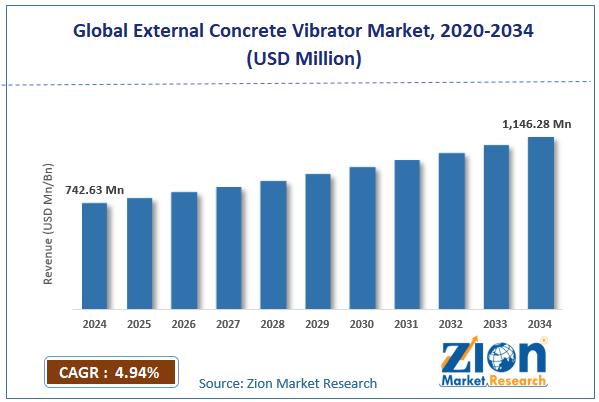
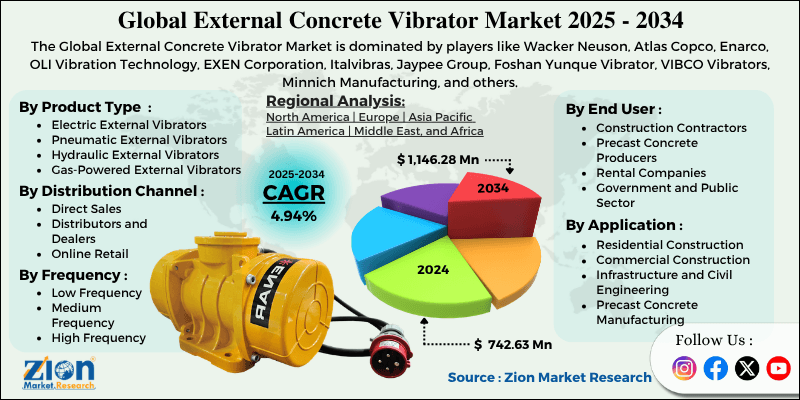
The global external concrete vibrator market size was worth approximately USD 742.63 million in 2024 and is projected to grow to around USD 1,146.28 million by 2034, with a compound annual growth rate (CAGR) of roughly 4.94% between 2025 and 2034.
Key Insights
- As per the analysis shared by our research analyst, the global external concrete vibrator market is estimated to grow annually at a CAGR of around 4.94% over the forecast period (2025–2034).
- In terms of revenue, the global external concrete vibrator market size was valued at approximately USD 742.63 million in 2024 and is projected to reach USD 1,146.28 million by 2034.
- The external concrete vibrator market is projected to grow significantly due to rapid global infrastructure development, expanding precast concrete manufacturing capacity, rising awareness of concrete quality and durability standards, increasing adoption of mechanized construction methods in emerging economies, and growing investment in tunnel, bridge, and transportation infrastructure worldwide.
- Based on product type, the electric external vibrators segment is expected to lead the external concrete vibrator market, while the pneumatic external vibrators segment is anticipated to grow at a stable rate.
- Based on frequency, the high-frequency segment is expected to lead the external concrete vibrator market, while the low-frequency segment is anticipated to grow at a moderate pace.
- Based on application, the infrastructure and civil engineering segment is expected to lead the external concrete vibrator market, while the precast concrete manufacturing segment is anticipated to grow rapidly.
- Based on end-user, the construction contractors segment is the dominant end-user group, while the precast concrete producers segment holds a growing and commercially significant market share.
- Based on distribution channel, the offline segment is expected to lead the external concrete vibrator market, while the online segment is anticipated to grow steadily.
- Based on region, Asia Pacific is projected to dominate the global external concrete vibrator market during the estimated period, followed by Europe.
External Concrete Vibrator Market: Overview
An external concrete vibrator is a construction machine mounted on the outside of a concrete mold to compact and strengthen freshly poured concrete. It works by creating strong vibrations that help remove trapped air and excess water from the concrete mix, making it denser and more durable. When concrete is poured into molds, especially in narrow sections or areas with heavy steel reinforcement, air pockets can form, weakening the final structure. External vibrators solve this problem by sending vibration through the mold walls, improving the strength, surface finish, and load-bearing capacity of the concrete without inserting any equipment directly into the mix. These machines are especially useful in situations where internal vibrators cannot be used, such as in precast concrete production of beams, columns, pipes, wall panels, and tunnel segments, or in construction where molds are too tight or blocked by reinforcement bars. They can be placed at different positions on the mold to ensure even vibration throughout the surface. With rapid global construction growth, particularly in the Asia Pacific, the Middle East, and Africa, the demand for external concrete vibrators is steadily increasing. Rising infrastructure projects and the need for high-quality, long-lasting concrete structures also support this growth. Improved equipment design and efficiency are further encouraging wider adoption across construction and manufacturing industries.
The rising demand for high-quality precast concrete, along with growing infrastructure development in emerging economies and increased focus on concrete quality, is expected to drive steady growth in the external concrete vibrator market.
External Concrete Vibrator Market: Technology Roadmap 2025–2034
What are the key growth trends and future developments shaping the external concrete vibrator market during the forecast period?
The external concrete vibrator market is being shaped by advances in motor technology, remote monitoring and automation capabilities, the growth of precast concrete manufacturing, stricter concrete quality standards in infrastructure projects, and the development of quieter and more energy-efficient vibration systems. The market is expected to grow at a CAGR of around 4.94% over the forecast period, driven by rising demand across civil engineering, precast manufacturing, and commercial construction segments.
The following roadmap outlines key development phases expected during the forecast period.
2025–2027: Energy Efficiency and Digital Control Phase
- Electric external vibrators will use smart controllers to adjust vibration levels based on concrete type and mold shape.
- Battery-powered vibrators will become more common, reducing the need for cables.
- Sensors will track vibration strength and time to ensure proper concrete compaction.
2028–2031: Automated Vibration Management Phase
- Automated systems will control vibration settings for different molds, reducing manual work and improving consistency.
- Data from vibration processes will be stored and connected to production systems for better tracking and quality control.
- Robotic systems in precast plants will handle vibration automatically as part of the overall production process.
2032–2034: Smart Construction Integration Phase
- External vibrators will connect to smart construction networks, giving real-time updates on concrete work across sites.
- Artificial Intelligence systems will automatically choose the best vibration method based on concrete and structure details.
- New designs will make vibrators quieter and more suitable for use in cities with strict noise rules.
External Concrete Vibrator Market: Dynamics
Growth Drivers
The rapid global investment in infrastructure and civil engineering is driving growth in the external concrete vibrator market.
The external concrete vibrator market is growing rapidly due to global infrastructure and civil engineering development. Governments and private companies around the world are investing heavily in projects such as roads, bridges, tunnels, railways, airports, and dams. All these projects require large amounts of high-quality concrete, which must be properly compacted to ensure strength and long-term durability. External concrete vibrators play an important role in this process by removing air gaps and improving concrete density without disturbing the structure. In large infrastructure projects, especially those with heavy steel reinforcement or complex shapes, external vibrators are often preferred because they provide uniform compaction from outside the mold. This helps meet strict engineering standards and safety requirements.
In addition, the growth of precast concrete construction in infrastructure projects is increasing the use of external vibrators in manufacturing plants. Developing regions such as the Asia Pacific, the Middle East, and Africa are seeing major infrastructure expansion, further boosting demand. Overall, continuous investment in infrastructure is creating steady, long-term growth opportunities for the external concrete vibrator industry.
What role is the expanding global precast concrete industry playing in driving demand for external concrete vibrators?
The external concrete vibrator market is growing steadily as demand for precast concrete manufacturing worldwide rises. Precast concrete is produced by pouring concrete into factory-made molds, allowing it to set, and then transporting the finished parts to construction sites. The method is becoming more popular because it offers better quality, more accurate shapes, faster construction, and less waste than traditional on-site concrete work. External vibrators are very useful in the process because they can be fixed to molds and reused during production. They help eliminate air gaps and ensure strong, smooth concrete every time. In precast plants, the same molds and vibrators are used repeatedly to produce items such as wall panels, beams, columns, and slabs. The approach makes the process efficient and cost-effective.
As more countries focus on faster, higher-quality construction, demand for precast concrete is increasing. The growth directly increases the need for external vibrators. Overall, the growth of precast production and industrial construction methods is creating strong growth opportunities for the external concrete vibrator market. The trend is also supported by increasing investments in infrastructure and modern building technologies worldwide.
Restraints
The alternative compaction methods and construction cycles are creating challenges for the external concrete vibrator market.
The external concrete vibrator market faces competition from other concrete compaction methods, especially internal vibrators, which are widely used in construction. Internal vibrators are often preferred because they are easy to use, less expensive, and familiar to most workers. In many projects where there is enough space to use them, contractors choose internal vibrators as the first option. External vibrators are mainly used in special cases where internal tools cannot be used, such as in tight molds or heavy reinforcement areas. As a result, it can be difficult to convince contractors to switch from traditional methods to external vibrators. The market is also affected by the overall condition of the construction industry. When construction activity is high, demand for equipment increases.
However, during economic slowdowns, periods of high interest rates, or periods of reduced government spending, construction projects may decline. These conditions lead to lower demand for equipment, including external concrete vibrators, making market growth dependent on construction trends.
Opportunities
What impact is the rising use of self-compacting concrete having on growth opportunities in the external concrete vibrator market?
The external concrete vibrator industry is benefiting from the rising use of self-compacting concrete and increasing demand for specialized construction equipment. Self-compacting concrete is a type of concrete that flows easily and fills molds without requiring heavy manual vibration. It is widely used in modern construction because it saves time, improves surface finish, and ensures better quality in complex structures. However, in many cases, external vibrators are still required to support proper compaction, especially in large molds, thick sections, or where uniform density is critical. Construction projects are becoming increasingly complex, with designs and heavy reinforcement that require precise, reliable compaction methods.
External vibrators are well-suited for such applications because they provide even vibration from outside the mold without disturbing the structure. In emerging markets, rapid infrastructure development is increasing the need for efficient and high-performance equipment. Builders and contractors are also focusing more on quality and durability, which is driving the use of better compaction tools. As a result, the demand for external concrete vibrators is growing steadily across modern construction projects worldwide.
Challenges
Maintenance requirements and operator training gaps are creating challenges in the external concrete vibrator market.
The external concrete vibrator market faces challenges due to tough working conditions and the need for proper equipment use. External vibrators operate under strong, repeated vibrations, which can cause wear in parts such as bearings, motors, and mounting systems over time. Regular maintenance is needed to avoid sudden breakdowns. In precast concrete plants that operate continuously, equipment failures can halt operations, causing delays and additional costs. Proper setup is also very important for good performance.
The vibrator must match the mold's size and strength so that the vibration reaches the concrete properly. If the wrong size or position is used, the concrete may not compact well, affecting quality and strength. Many workers are not fully trained in using external vibrators correctly, leading to mistakes in setup and operation. Training and awareness are important for improving efficiency and avoiding errors. Better maintenance practices and skilled operators are key to ensuring smooth market performance.
External Concrete Vibrator Market: Report Scope
| Report Attributes | Report Details |
|---|---|
| Report Name | External Concrete Vibrator Market |
| Market Size in 2024 | USD 742.63 Million |
| Market Forecast in 2034 | USD 1,146.28 Mllion |
| Growth Rate | CAGR of 4.94% |
| Number of Pages | 228 |
| Key Companies Covered | Wacker Neuson, Atlas Copco, Enarco, OLI Vibration Technology, EXEN Corporation, Italvibras, Jaypee Group, Foshan Yunque Vibrator, VIBCO Vibrators, Minnich Manufacturing, and others. |
| Segments Covered | By Product Type, By Frequency, By Application, By End-User, By Distribution Channel, and By Region |
| Regions Covered | North America, Europe, Asia Pacific (APAC), Latin America, Middle East, and Africa (MEA) |
| Base Year | 2024 |
| Historical Year | 2019 to 2023 |
| Forecast Year | 2025 - 2034 |
| Customization Scope | Avail customized purchase options to meet your exact research needs. Request For Customization |
External Concrete Vibrator Market: Segmentation
The global external concrete vibrator market is segmented based on product type, frequency, application, end-user, distribution channel, and region.
What makes electric external vibrators the leading product type in the external concrete vibrator market?
Based on product type, the global external concrete vibrator market is categorized into electric external vibrators, pneumatic external vibrators, hydraulic external vibrators, and gas-powered external vibrators. The electric external vibrators segment accounted for approximately 52% of the global market share and is expected to remain dominant throughout the forecast period. Electric models lead because they offer precise frequency control, consistent power output, lower operating costs, and are well-suited to indoor precast plant environments where pneumatic or gas-powered alternatives may be impractical. The pneumatic segment maintains a stable secondary position, holding approximately 32% market share, particularly in applications where compressed air supply is already available on construction sites.
Why does the high-frequency segment dominate the external concrete vibrator market?
Based on frequency, the external concrete vibrator market is segmented into high-frequency and low-frequency vibrators. The high-frequency segment accounts for nearly 61% of the global market share. It leads because it provides better compaction, faster air removal, and improved concrete strength, especially in dense and reinforced structures. The low-frequency segment holds around 39% of the market share, supported by its use in simpler, less demanding construction applications.
What factors drive the leadership of infrastructure and civil engineering in the external concrete vibrator market?
Based on application, the external concrete vibrator market is segmented into residential construction, commercial construction, infrastructure and civil engineering, and precast concrete manufacturing. The infrastructure and civil engineering segment accounts for nearly 38% of the overall market share. It leads because major infrastructure projects such as bridges, tunnels, and dams require high-quality concrete compaction, and external vibration ensures strong, void-free structures. The precast concrete manufacturing segment holds around 29% share, driven by the growing use of factory-based concrete production and the need for consistent and high-quality compaction.
How do construction contractors emerge as the primary end-users in the external concrete vibrator market?
Based on end-user, the market is divided into construction contractors, precast concrete producers, rental companies, and the government and public sector. The construction contractors segment accounts for around 42% of the total market share. It leads mainly because construction contractors are the primary purchasers and operators of concrete vibration equipment on active building and civil engineering project sites worldwide. The precast concrete producers segment holds around 31% of the market share, driven by the growing global installed base of precast manufacturing facilities that depend on external vibration as a core production process.
Why does the offline distribution channel lead the external concrete vibrator market?
Based on the distribution channel, the external concrete vibrator industry is classified into offline and online channels. The offline segment accounts for approximately 76% of the global market share. It leads because most equipment is purchased through dealers, distributors, and direct sales channels, where buyers require technical guidance, product demonstrations, and after-sales support. The online segment holds around 24% share and is growing steadily due to increasing digital adoption and easier product comparison.
External Concrete Vibrator Market: Regional Analysis
Why does Asia Pacific remain the top region in the external concrete vibrator market?
Asia Pacific is expected to account for about 47.3% of global demand and remain the leading region in the external concrete vibrator market. Asia Pacific dominates the global external concrete vibrator market due to rapid urbanization, large-scale infrastructure projects, and strong construction growth in countries like China and India. Increasing precast concrete use, government investments, and rising demand for durable construction further support the high adoption of external concrete vibration equipment across the region. China is the largest individual market, supported by large-scale infrastructure projects, rapid urban development, and a strong precast concrete industry that requires reliable vibration equipment. India is the fastest-growing market, driven by government programs focused on roads, railways, housing, smart cities, and water systems. Japan and South Korea represent stable markets with advanced construction practices and a strong focus on quality and precision. Southeast Asian countries such as Vietnam, Indonesia, Thailand, and Malaysia are also seeing rapid growth in construction, with increasing use of modern equipment and techniques.
Rising urbanization and industrial development are further supporting demand across the region. A large population, ongoing construction activity, and an increasing focus on strong, durable structures are key growth factors. Demand for higher-quality concrete is driving the use of advanced vibration equipment in both infrastructure and precast projects. Strong economic growth, government investment, and expanding construction activities make the Asia Pacific the leading region in the external concrete vibrator market.
What factors contribute to Europe’s growth in the external concrete vibrator market?
Europe is expected to account for about 21.6% of the global external concrete vibrator market. The region has a strong, well-developed precast concrete industry, especially in countries such as Germany, France, Italy, the Netherlands, and Scandinavian nations. These countries focus heavily on quality construction, which creates steady demand for reliable and high-performance vibration equipment. Many precast manufacturers in Europe use advanced machines with digital controls to ensure consistent, high-strength concrete production. Infrastructure repair and upgrade projects across Europe are also supporting demand. Governments are investing in bridge repairs, railway improvements, road upgrades, and housing projects, all of which require proper concrete compaction. Both Western and Eastern Europe are actively upgrading existing infrastructure, creating a continuous need for construction equipment. European companies are known worldwide for producing high-quality and precise external concrete vibrators.
Manufacturers from Germany, Italy, and Sweden are especially recognized for their engineering strength and advanced technology. These companies supply equipment not only within Europe but also to global markets. Strong focus on durability, safety, and modern construction methods further supports market growth. Steady construction demand and strong manufacturing capabilities position Europe as a key region in the external concrete vibrator market.
Recent Market Developments
- In March 2025, Wacker Neuson Group expanded its external concrete vibrator range with upgraded electric models featuring improved motor durability and adjustable vibration settings for better performance in precast and infrastructure applications.
External Concrete Vibrator Market: Competitive Analysis
The leading players in the global external concrete vibrator market are:
- Wacker Neuson
- Atlas Copco
- Enarco
- OLI Vibration Technology
- EXEN Corporation
- Italvibras
- Jaypee Group
- Foshan Yunque Vibrator
- VIBCO Vibrators
- Minnich Manufacturing
The global external concrete vibrator market is segmented as follows:
By Product Type
- Electric External Vibrators
- Pneumatic External Vibrators
- Hydraulic External Vibrators
- Gas-Powered External Vibrators
By Frequency
- Low Frequency
- Medium Frequency
- High Frequency
By Application
- Residential Construction
- Commercial Construction
- Infrastructure and Civil Engineering
- Precast Concrete Manufacturing
By End-User
- Construction Contractors
- Precast Concrete Producers
- Rental Companies
- Government and Public Sector
By Distribution Channel
- Direct Sales
- Distributors and Dealers
- Online Retail
By Region
- North America
- The U.S.
- Canada
- Mexico
- Europe
- France
- The UK
- Spain
- Germany
- Italy
- Rest of Europe
- Asia Pacific
- China
- Japan
- India
- Australia
- South Korea
- Rest of Asia Pacific
- The Middle East & Africa
- Saudi Arabia
- UAE
- Egypt
- Kuwait
- South Africa
- Rest of the Middle East & Africa
- Latin America
- Brazil
- Argentina
- Rest of Latin America
Table Of Content
Methodology
FrequentlyAsked Questions
An external concrete vibrator is a construction machine mounted on the outside of a concrete mold to compact and strengthen freshly poured concrete. It works by creating strong vibrations that help remove trapped air and excess water from the concrete mix, making it denser and more durable. When concrete is poured into molds, especially in narrow sections or areas with heavy steel reinforcement, air pockets can form, weakening the final structure.
The global external concrete vibrator market is projected to grow due to rapid global infrastructure investment, expanding precast concrete manufacturing capacity, rising concrete quality standards, increased mechanization of construction processes in developing regions, and growing demand for precise, digitally controlled concrete compaction technologies.
According to a study, the global external concrete vibrator market size was worth around USD 742.63 million in 2024 and is predicted to grow to around USD 1,146.28 million by 2034.
The CAGR value of the external concrete vibrator market is expected to be around 4.94% during 2025–2034.
Asia Pacific is expected to lead the global external concrete vibrator market during the forecast period.
The major players profiled in the global external concrete vibrator market include Wacker Neuson, Atlas Copco, Enarco, OLI Vibration Technology, EXEN Corporation, Italvibras, Jaypee Group, Foshan Yunque Vibrator, VIBCO Vibrators, and Minnich Manufacturing.
The report examines key aspects of the external concrete vibrator market, including a detailed analysis of current growth drivers and constraints, as well as future growth opportunities and challenges.
Emerging trends in the external concrete vibrator market include variable-frequency-drive control integration, battery-powered external vibrator models, real-time vibration-monitoring sensors, automated vibration sequencing in precast plants, Internet of Things connectivity for site-wide concrete compaction management, and specialized vibration equipment designed for advanced concrete formulations, such as ultra-high-performance concrete.
Technological advancement is transforming the external concrete vibrator market through digital frequency control systems, sensor-based quality monitoring, energy-efficient motor designs, and integration with automated precast production management systems.
The external concrete vibrator market is moderately competitive, with global construction equipment manufacturers, specialized vibration technology companies, and regional equipment producers competing on product performance, frequency control precision, durability, equipment compatibility with standard formwork systems, after-sales service capabilities, and increasingly advanced digital monitoring and control features.

HappyClients

