
Exoskeleton Market Size, Share, Growth, Opportunities 2034

Exoskeleton Market By Mobility (Mobile and Fixed/Stationary), By Type (Outsourcing and Insourcing), By Technology (Non-powered and Powered), By Extremity (Upper Body, Full Body, and Lower Body), By End Use (Military, Healthcare, and Industry), and By Region - Global and Regional Industry Overview, Market Intelligence, Comprehensive Analysis, Historical Data, and Forecasts 2025 - 2034
| Market Size in 2024 | Market Forecast in 2034 | CAGR (in %) | Base Year |
|---|---|---|---|
| USD 578 Million | USD 2238 Million | 14.5% | 2024 |
Exoskeleton Industry Perspective:
What will be the size of the global exoskeleton market during the forecast period?
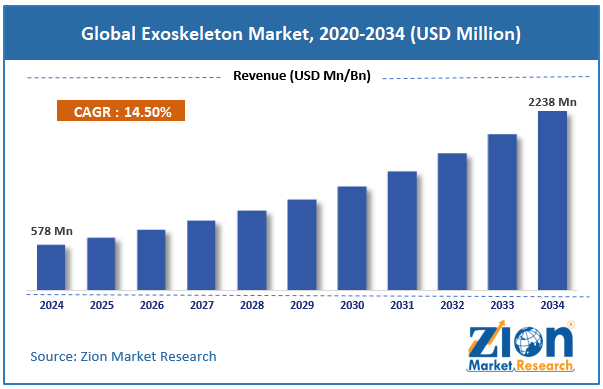
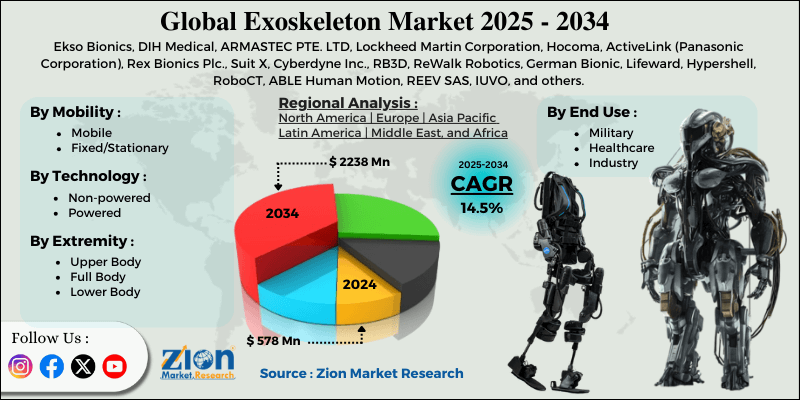
The global exoskeleton market size was worth around USD 578 million in 2024 and is predicted to grow to around USD 2238 million by 2034, with a compound annual growth rate (CAGR) of roughly 14.5% between 2025 and 2034.
Key Insights
- As per the analysis shared by our research analyst, the global exoskeleton market is estimated to grow annually at a CAGR of around 14.5% over the forecast period (2025-2034).
- In terms of revenue, the global exoskeleton market size was valued at around USD 578 million in 2024 and is projected to reach USD 2238 million by 2034.
- Increasing aging population and technological advancements in the exoskeleton product are expected to drive the exoskeleton market.
- Based on the mobility, the mobile segment captured the largest market share, over 60%, in 2024.
- Based on the technology, the powered sub-segment holds the largest market share of 70%.
- Based on the extremity, in 2024, the lower body had the greatest market share, more than 35%.
- Based on the end use, the healthcare segment dominated with a revenue share of 47.5% in 2024.
- Based on region, in 2024, the North America region had the largest market share, exceeding 44.5%.
Exoskeleton Market: Overview
An exoskeleton is a mechanical framework that one can wear that works with the skeletal system in order to improve, support, or restore its motion. These systems can be powered by motors, sensors, actuators, and battery systems, or they can be passive, using springs, dampers, and mechanical supports that don't need active power. Exoskeletons are being developed for a range of purposes, including helping people with physical limitations move about, medical rehabilitation, industrial ergonomics, and military load support. Exoskeletons help people move better by using sensors to track their movements and providing regulated support or torque at joints like the hips, knees, shoulders, and back. This reduces physical strain, increases strength and endurance, and improves mobility. ReWalk Robotics Ltd. and Ekso Bionics Holdings, Inc. make devices that are used in healthcare settings to help people recover from strokes or spinal cord injuries. Industrial systems, on the other hand, help workers perform repetitive or heavy-lifting tasks with a lower risk of injury. An exoskeleton is a support structure that goes outside the body and uses robotics, biomechanics, and control systems to make people stronger and more capable.
Exoskeleton Market: Dynamics
Growth Drivers
Why does the growth in older populations drive the growth of the exoskeleton market?
The global exoskeleton industry is likely to grow significantly as more people age. As people live longer, more people get diseases that come with age, such as weakened muscles, trouble moving, stroke, Parkinson's disease, osteoporosis, and problems with the spine. These disorders often lead to reduced autonomy and an increased necessity for rehabilitation and mobility assistance options. Exoskeleton systems provide structured mechanical support that enhances walking, balance, and endurance. This helps older people regain mobility or maintain it while minimizing their risk of falling.
An increasing number of healthcare providers are using powered exoskeletons in rehabilitation programs to help older people recover faster and achieve better functional outcomes. ReWalk Robotics Ltd. and Ekso Bionics Holdings, Inc. are two companies that make medical-grade devices to help patients with spinal cord injuries and mobility problems after a stroke. These problems are more common among older people.
Also, many countries are seeing healthcare costs rise due to the rising costs of long-term care for the elderly. Exoskeletons help people get better at home and live independently, reducing hospital visits and caregiver stress. As governments and healthcare systems place greater emphasis on helping people stay in their homes and move around freely, the need for wearable robotic assistance technologies will grow significantly.
Restraints
Does the high cost of systems & maintenance hamper the development of the exoskeleton industry?
The high cost of devices and the need for ongoing maintenance make it hard for the exoskeleton sector to thrive, as exoskeletons aren't widely used in the medical, industrial, or defense sectors. Powered exoskeletons are complex systems with lightweight structural frameworks that support actuators, motion sensors, embedded CPUs, control software, and high-capacity battery packs.
Putting these complex parts together requires significant investment, which is why the price of each unit can range from tens of thousands to more than one hundred thousand dollars, depending on its features and use. This level of capital spending competes with other medical equipment needs in hospitals and rehabilitation centers, making procurement decisions difficult and expensive. ReWalk Robotics Ltd. and Ekso Bionics Holdings, Inc. operate in a highly regulated, cost-conscious environment.
Uncertainty about reimbursement makes it hard for them to decide on purchases. The total cost of ownership includes not only the initial costs but also ongoing costs such as battery replacements, preventive maintenance, software upgrades, calibration, spare parts, and technical service contracts. Industrial users must also invest in training their workers and ensuring they follow safety rules to ensure the equipment is used correctly. When maintenance is needed, it might slow manufacturing or delay therapeutic sessions in clinical settings. This makes operations less efficient and lowers the perceived economic value.
Also, the financial benefits of using exoskeletons, such as fewer musculoskeletal injuries, less time off work, and more productive workers, are often long-term and indirect, which makes it hard to see the return on investment right away. Because of this uncertainty, many companies choose to conduct limited trial runs rather than full-scale adoption, which lowers overall market penetration.
Opportunities
Does increased collaboration offer a potential opportunity for expanding the exoskeleton market?
The exoskeleton industry has an excellent opportunity to grow by bringing together more technology developers, healthcare organizations, industrial companies, research groups, and government agencies. Companies can accelerate the development and launch of new products by forming strategic partnerships that bring together experts in robotics, biomechanics, artificial intelligence, materials science, and clinical research.
For instance, in January 2026, OYMotion Technology and Melexis said they will work together to improve robot perception and control by combining OYMotion's system integration with Melexis' sensor technology. The goal of the cooperation is to make dexterous hands and rehabilitation exoskeletons available for sale. They will also use OYMotion's EMG/EEG AI, lightweight designs, and global supply chain to move into medical, industrial, and humanoid robotics.
Challenges
Technical limitation poses a major challenge to the market growth
One of the major things hindering the exoskeleton industry's growth is that the technology isn't advanced enough. Exoskeleton systems have come a long way in the last few years, but there are still engineering challenges that make them less comfortable, less useful, and less likely to be adopted by many people. One important challenge is that powered systems, including motors, actuators, batteries, and control units, are heavy and bulky. If it's too heavy, it could make users sleepy, which isn't appropriate for long work shifts or long rehab sessions. Another important thing to think about is how long the battery will last. Most powered exoskeletons need to be charged every few hours, which makes them less practical in places like factories, warehouses, and military operations where they are needed continuously.
Also, the battery capacity needs to be adjusted based on the system's weight, which implies a trade-off between the power it can provide and user comfort. Another issue is how far they can move and how well they can adapt. Moving about is hard for people, and it depends on their size, posture, and how they walk. From a technological point of view, it's hard to develop a device that accommodates varied body types while maintaining biomechanical alignment. If one doesn't line things up right, they might not be able to achieve their best, feel pain, or even get wounded more readily. Companies like Ekso Bionics Holdings, Inc. and ReWalk Robotics Ltd. are investing in improved sensors and control algorithms to enhance motion synchronization and adaptability. It is also not very useful in military and industrial contexts because it doesn't last long in the environment. Dust, dampness, very hot or very cold weather, and rough ground can all change how long and how well systems perform. In these cases, maintenance is more difficult, which raises costs.
Exoskeleton Market: Report Scope
| Report Attributes | Report Details |
|---|---|
| Report Name | Exoskeleton Market |
| Market Size in 2024 | USD 578 Million |
| Market Forecast in 2034 | USD 2238 Mllion |
| Growth Rate | CAGR of 14.5% |
| Number of Pages | 222 |
| Key Companies Covered | Ekso Bionics, DIH Medical, ARMASTEC PTE. LTD, Lockheed Martin Corporation, Hocoma, ActiveLink (Panasonic Corporation), Rex Bionics Plc., Suit X, Cyberdyne Inc., RB3D, ReWalk Robotics, German Bionic, Lifeward, Hypershell, RoboCT, ABLE Human Motion, REEV SAS, IUVO, and others. |
| Segments Covered | By Mobility, By Technology, By Extremity, By End Use, and By Region |
| Regions Covered | North America, Europe, Asia Pacific (APAC), Latin America, Middle East, and Africa (MEA) |
| Base Year | 2024 |
| Historical Year | 2019 to 2023 |
| Forecast Year | 2025 - 2034 |
| Customization Scope | Avail customized purchase options to meet your exact research needs. Request For Customization |
Exoskeleton Market: Segmentation
Mobility Insights
Why did the mobile segment dominate the exoskeleton market during the analysis period?
The mobile segment captured the largest market share, over 60%, in 2024. The market is growing because there is more research and development (R&D), and more people want robots with motors that mimic human movement. At CES 2026, Sumbu showed off its Exo-S3 series of consumer exoskeletons for the first time.
AI powers the lightweight leg support, which can be used for everyday movement, injury prevention, and outdoor activities. The Exo-S3 series employs dual-vector drive technology and AI to determine what a user wants to do and adjust support for different types of terrain. The goal is to reduce fatigue, help people move more quickly, and encourage more people to use wearable mobility equipment.
Technology Insights
Why does the powered sub-segment hold the largest share in the exoskeleton industry?
The powered sub-segment holds the largest market share of 70%. The growth is due to the expanding use of powered exoskeleton devices in many fields to make people safer and more productive. There have also been many new product debuts. Powered technology goods offer several benefits, such as making lifting easier, reducing strain on workers' bodies, increasing strength, acting as a force multiplier, and boosting productivity.
In August 2024, for instance, Arc'teryx and Skip worked together to make the world's first powered pants, which are a wearable exoskeleton that helps people move better by providing powered support.
Extremity Insights
Why does the lower body capture a significant share in 2024 in the exoskeleton market?
In 2024, the lower body had the greatest market share, more than 35%. The rise is due to more money being invested in it, more people experiencing lower-body problems, and more older people and paralyzed patients using exoskeleton devices to help them carry weight and move around. The ABLE Exoskeleton, a lightweight, low-cost device for hip and knee movement made by ABLE Human Motion, obtained CE Mark approval in April 2024. This means it can be sold in the EU for spinal cord injury rehabilitation under the new Medical Device Regulation.
End Use Insights
What factors cause healthcare to be in a dominating position in the exoskeleton industry?
The healthcare segment accounted for 47.5% of revenue in 2024. The increasing number of spinal cord injuries (SCIs), the widespread usage of these products and solutions in rehabilitation facilities, and the enormous rise in the number of people getting treatment are some of the main factors.
In addition, more regulatory clearances and a greater understanding of high-tech systems are driving demand for exoskeleton products in the healthcare industry. For instance, the Atalante X exoskeleton from Wandercraft SAS will be sold in the US starting in October 2023. The solution is meant for folks who have trouble moving around.
Regional Insights
Why does North America hold the largest market share in the exoskeleton market?
In 2024, the North America region had the largest market share, exceeding 44.5%. Regional growth is being driven by increased investment in research, an increasing number of disabled people, stronger ties between major companies, new technologies becoming available, and strong backing from both the public and commercial sectors. In June 2025, Wandercraft raised $75 million in Series D funding to launch Eve, a self-balancing personal exoskeleton that will help people with disabilities get around every day. The funding also enabled the Atalante-X rehabilitation system to grow. This system is already FDA-approved and used in more than 100 hospitals and clinics in the U.S. It also enabled the development of the Calvin-40 humanoid robot.
Exoskeleton Market: Competitive Analysis
The global exoskeleton market is dominated by players like:
- Ekso Bionics
- DIH Medical
- ARMASTEC PTE. LTD
- Lockheed Martin Corporation
- Hocoma
- ActiveLink (Panasonic Corporation)
- Rex Bionics Plc.
- Suit X
- Cyberdyne Inc.
- RB3D
- ReWalk Robotics
- German Bionic
- Lifeward
- Hypershell
- RoboCT
- ABLE Human Motion
- REEV SAS
- IUVO
The global exoskeleton market is segmented as follows:
By Mobility
- Mobile
- Fixed/Stationary
By Technology
- Non-powered
- Powered
By Extremity
- Upper Body
- Full Body
- Lower Body
By End Use
- Military
- Healthcare
- Industry
By Region
- North America
- The U.S.
- Canada
- Europe
- France
- The UK
- Spain
- Germany
- Italy
- Rest of Europe
- Asia Pacific
- China
- Japan
- India
- South Korea
- Southeast Asia
- Rest of Asia Pacific
- Latin America
- Brazil
- Mexico
- Rest of Latin America
- Middle East & Africa
- GCC
- South Africa
- Rest of Middle East & Africa
Table Of Content
Methodology
FrequentlyAsked Questions

HappyClients

