
Global Electrical Enclosure Market Size, Share, Analysis, Trends, Growth 2032

Electrical Enclosure Market By Material Type (Metallic and Nonmetallic), By Mounting Type (Floor-Mounted/Free-Standing Enclosure, Wall-Mounted Enclosure, and Underground), By Form Factor (Free-Size Enclosure, Small Enclosure, and Compact Enclosure), By Industry Vertical (Metals & Mining, Power Generation & Distribution, Oil & Gas, Food & Beverages, Medical, Pulp & Paper, Transportation, and Others), and By Region - Global and Regional Industry Overview, Market Intelligence, Comprehensive Analysis, Historical Data, and Forecasts 2024 - 2032
| Market Size in 2023 | Market Forecast in 2032 | CAGR (in %) | Base Year |
|---|---|---|---|
| USD 7.13 Billion | USD 13.16 Billion | 6.3% | 2023 |
Electrical Enclosure Industry Perspective
What will be the global electrical enclosure market size during the forecast period?
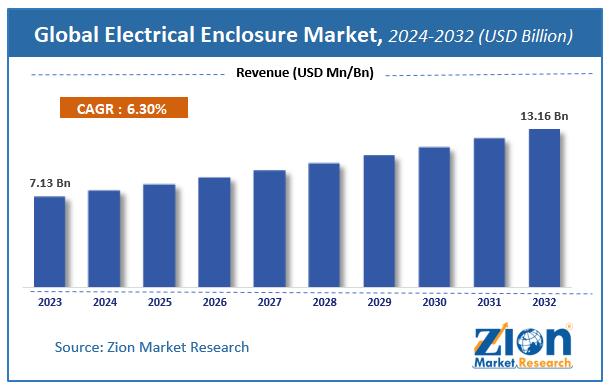
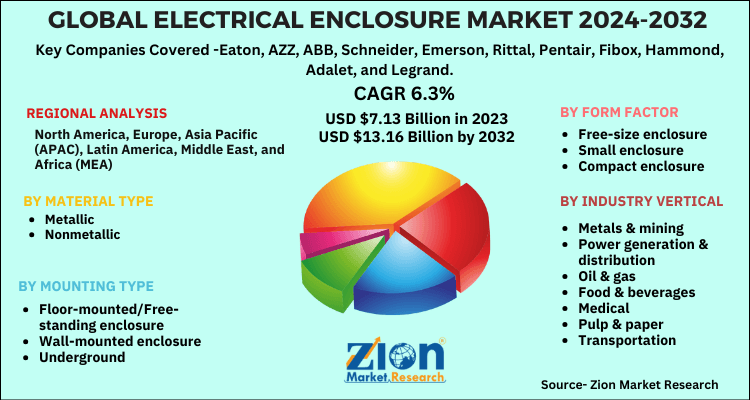
According to Zion Market Research, the global Electrical Enclosure Market was worth USD 7.13 billion in 2023. The market is forecast to reach USD 13.16 billion by 2032, growing at a compound annual growth rate (CAGR) of 6.3% during the forecast period 2024-2032.
This report provides a comprehensive analysis of the growth drivers, restraints, and challenges shaping demand across the global electrical enclosure market throughout the forecast period, while highlighting high-potential emerging opportunities within the industry.
Key Insights
- As per the analysis shared by our research analyst, the global electrical enclosure market is estimated to grow annually at a CAGR of around 6.3% over the forecast period (2024-2032).
- In terms of revenue, the global electrical enclosure market size was valued at around USD 7.13 billion in 2023 and is projected to reach USD 13.16 billion by 2032.
- The electrical enclosure market is projected to grow at a significant rate due to growing product penetration across various sectors for protecting circuit breakers, switches, contactors, and control panels, massive requirements for renovating power infrastructure in developing nations, escalating demand in oil & gas, pulp & paper, food & beverages, power generation & distribution, metals & mining, medical, and transport sectors, and rising need for power supply.
- Based on the material type, the metallic segment dominates the electrical enclosure market due to its high durability, strength, and excellent protection against electromagnetic interference, with metals such as stainless steel and aluminum widely preferred in industrial applications where environmental protection and mechanical performance are critical.
- Based on the mounting type, the wall-mounted enclosure segment holds the largest market share, primarily driven by widespread use in industrial and commercial settings that provide easy accessibility
- Based on the form factor, the compact enclosure segment leads the market owing to increasing demand for space-efficient and cost-effective solutions across industries, particularly in applications with limited space
- Based on the industry vertical, the power generation & distribution segment is the most dominant end-user, attributed to the growing need for safe and efficient housing of electrical systems in power generation
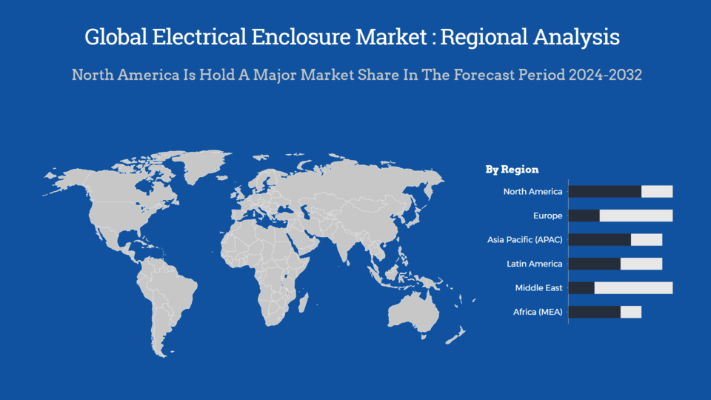
- Based on region, North America emerges as the leading regional market, driven by robust industrial infrastructure, high investment in automation, and stringent safety regulations, with the presence of major players and ongoing technological advancements in the U.S. and Canada further boosting dominance.
Electrical Enclosure Market: Overview
An electrical enclosure is a box or cabinet for an electric device that offers protection to electric or electronic devices against electric shock. It protects electric devices used in various construction, utility, and industrial applications. Apart from this, the electrical enclosure also protects the electric instrument from radio frequency interference, heat ejection, and electromagnetic waves. It is a component of an electric instrument that helps in mounting switches, displays, and knobs, thereby avoiding electric shocks to the device users along with protecting the equipment from adverse environmental conditions. It is also used to provide aesthetic appeal to the electric device.
Electrical Enclosure Market: Growth Drivers
How is expanding product penetration and infrastructure renovation driving the electrical enclosure market?
Growing product penetration across various sectors is credited to its massive use in circuit breakers, switches, contractors, and control panels in order to protect users from getting electrocuted. Furthermore, massive requirements for renovating power infrastructure across developing nations will leverage the expansion of the electrical enclosures industry over the forthcoming years. Escalating product demand in oil & gas, pulp & paper, food & beverages, power generation & distribution, metals & mining, medical, and transport sectors will drive up business trends. The humongous need for power supply will create new growth opportunities for the electrical enclosure market over the forthcoming years.
Furthermore, a surge in the number of commercial as well as residential construction activities will fuel the market growth over the ensuing years. A surge in industrial activities, as well as mining activities and access to power supply to rural & remote areas, will carve a profitable growth trajectory for the market in the years to come. Introduction of new power generating techniques and allocation of funds for ensuring that the power supply facilities reach the nook & corner of the world will expand the business scope over the next couple of years. Demand for renewable or sustainable energy will further enhance the business sphere.
Electrical Enclosure Market: Restraints
What factors related to costs and compliance are restraining market expansion?
The electrical enclosure industry faces restraints stemming from fluctuations in material costs, particularly for metals and specialized polymers used in high-performance housings. Customization requirements for specific applications increase production complexity and lead times, which can limit scalability for some manufacturers.
Compliance with evolving safety standards and certification processes across different regions adds operational burdens. Manufacturers must continually adapt designs to meet stringent ingress protection, electromagnetic compatibility, and environmental regulations, which can elevate development expenses and slow market entry for new product variants.
Global Electrical Enclosure Market: Report Scope
| Report Attributes | Report Details |
|---|---|
| Report Name | Electrical Enclosure Market |
| Market Size in 2023 | USD 7.13 Billion |
| Market Forecast in 2032 | USD 13.16 Billion |
| Growth Rate | CAGR of 6.3% |
| Number of Pages | 220 |
| Key Companies Covered | Eaton, AZZ, ABB, Schneider, Emerson, Rittal, Pentair, Fibox, Hammond, Adalet, and Legrand |
| Segments Covered | By Material Type, By Mounting Type, By Form Factor, By Industry Vertical, and By Region |
| Regions Covered | North America, Europe, Asia Pacific (APAC), Latin America, Middle East, and Africa (MEA) |
| Base Year | 2023 |
| Historical Year | 2018 - 2022 |
| Forecast Year | 2024 - 2032 |
| Customization Scope | Avail customized purchase options to meet your exact research needs. Request For Customization |
Electrical Enclosure Market: Segmentation
The electrical enclosure market is segmented by material type, mounting type, form factor, industry vertical, and region. All the segments of the electrical enclosure market have been analyzed based on present and future trends and the market is estimated from 2024 to 2032.
Based on Material Type, the electrical enclosure market is divided into metallic and nonmetallic. The metallic segment is the most dominant due to its superior durability, mechanical strength, and effective shielding against electromagnetic interference. Stainless steel and aluminum variants are extensively specified in demanding industrial environments where resistance to impact, corrosion, and environmental exposure is essential. This dominance supports overall market growth by enabling reliable performance in critical applications and driving volume through established industrial preferences. Nonmetallic enclosures rank as the second most significant, valued for lighter weight, corrosion resistance, and cost advantages in specific settings, contributing to market diversification and adoption in applications where metal is less optimal.
Based on Mounting Type, the electrical enclosure market is divided into floor-mounted/free-standing enclosures, wall-mounted enclosures, and underground. The wall-mounted enclosure segment holds the leading position because of its widespread applicability in industrial and commercial facilities, offering convenient access, efficient use of space, and reliable protection for electrical components in both indoor and outdoor installations. This leadership helps drive market expansion through high-volume installations and ease of integration into existing infrastructure. Floor-mounted or free-standing enclosures form the second most prominent segment, preferred for larger systems and higher capacity requirements, supporting growth in power distribution and heavy industrial applications.
Based on Form Factor, the electrical enclosure market is divided into free-size enclosures, small enclosures, and compact enclosures. The compact enclosure segment leads the market as demand intensifies for space-efficient and economical solutions suitable for constrained environments. These enclosures are extensively deployed in control panels, telecommunications equipment, and compact machinery, enabling manufacturers to meet size and cost constraints while maintaining protection standards. This dominance fuels market growth by aligning with broader trends toward miniaturization and modular system design. Free-size and small enclosures follow as important categories, providing flexibility for customized or moderately scaled installations that complement the compact segment.
Based on Industry Vertical, the electrical enclosure market is divided into metals & mining, power generation & distribution, oil & gas, food & beverages, medical, pulp & paper, transportation, and others. The power generation & distribution segment is the most dominant end-user owing to the critical requirement for secure housing of electrical systems within generation plants, substations, and distribution networks. The ongoing transition toward renewable energy and smart grid infrastructure amplifies demand for reliable protective solutions, thereby driving substantial market volume and technological advancement. Oil & gas and metals & mining represent strong secondary segments, where harsh operating conditions necessitate robust enclosures and sustain consistent demand that supports overall industry expansion.
Electrical Enclosure Market: Regional Analysis
Why will North America continue to dominate the global market during the projection period?
North America is positioned to maintain leadership through its mature industrial base, extensive automation investments, and rigorous safety and regulatory frameworks that mandate high-quality protective enclosures. The United States and Canada host major manufacturers and end-users that continually upgrade infrastructure and adopt advanced enclosure technologies, reinforcing regional influence on global standards, innovation, and supply chain practices.
Europe demonstrates steady demand supported by strong manufacturing activity, emphasis on industrial safety, and progressive adoption of renewable energy systems. Countries such as Germany and the United Kingdom drive consistent requirements for reliable enclosures in automation, power, and process industries, contributing to overall market stability and technological refinement.
The growth of the market in the Asia Pacific zone during the forecast timeline is owing to huge funding of power generating & distributing sectors in countries like India and China. In addition to this, huge demand for power supply across commercial as well as residential sectors will steer the business expansion in the region over the forecast timeline.
Recent Developments
- In March 2025, Eaton acquired Fibrebond to strengthen its North American manufacturing capabilities for modular concrete and steel electrical enclosures targeting hyperscale data center and utility applications.
- In November 2024, Eaton partnered with Treehouse to integrate digitally enabled electrical solutions with an AI-supported installation platform, supporting residential electrification projects that include protective equipment and related enclosures.
Electrical Enclosure Market: Competitive Players
Key players profiled in the report include -
- Eaton
- AZZ
- ABB
- Schneider
- Emerson
- Rittal
- Pentair
- Fibox
- Hammond
- Adalet
- Legrand
The global electrical enclosure market is segmented as follows:
By Material Type
- Metallic
- Stainless steel
- Aluminum
- Mild Steel
- Others
- Nonmetallic
- PVC
- Fiberglass
- Polycarbonate
- Polyester
By Mounting Type
- Floor-mounted/Free-standing enclosure
- Wall-mounted enclosure
- Underground
By Form Factor
- Free-size enclosure
- Small enclosure
- Compact enclosure
By Industry Vertical
- Metals & mining
- Power generation & distribution
- Oil & gas
- Food & beverages
- Medical
- Pulp & paper
- Transportation
- Others
By Region
- North America
- The U.S.
- Canada
- Mexico
- Europe
- France
- The UK
- Spain
- Germany
- Italy
- Rest of Europe
- Asia Pacific
- China
- Japan
- India
- Australia
- South Korea
- Rest of Asia Pacific
- The Middle East & Africa
- Saudi Arabia
- UAE
- Egypt
- Kuwait
- South Africa
- Rest of the Middle East & Africa
- Latin America
- Brazil
- Argentina
- Rest of Latin America
Table Of Content
Methodology
FrequentlyAsked Questions
An electrical enclosure is a protective housing or cabinet designed to shield electrical and electronic components from electric shock, dust, moisture, electromagnetic interference, and other environmental hazards while facilitating safe mounting of switches, displays, and controls.
Key growth drivers include expanding product use across industrial sectors for protecting circuit breakers, switches, and control panels, renovation of power infrastructure in developing regions, rising demand from oil & gas, power generation, metals & mining, and other verticals, growth in construction and industrial activities, and increasing adoption of renewable energy systems.
According to study, the global electrical enclosure market size was worth around USD 7.13 Billion in 2023 and is predicted to grow to around USD 13.16 Billion By 2032.
The global electrical enclosure market is expected to grow at a Compound Annual Growth Rate (CAGR) of around 6.3% during the forecast period from 2024 to 2032.
The global electrical enclosure industry is projected to be challenged by Challenges include material cost fluctuations, customization needs, and compliance with safety standards.
The opportunities include industrial automation, renewable energy projects, data center growth, and demand for smart enclosures will offer significant growth opportunities in the electrical enclosure market.
Smart enclosures with thermal management, corrosion-resistant and modular designs, and compliance with safety standards are the emerging trends and innovations impacting the electrical enclosure market.
North America is expected to contribute notably and maintain a leading position in the global electrical enclosure market value, supported by strong industrial infrastructure, automation investments, and stringent safety regulations.
Some of the prominent players operating in the global electrical enclosure market are; Eaton, AZZ, ABB, Schneider, Emerson, Rittal, Pentair, Fibox, Hammond, Adalet, and Legrand and others.
The report provides comprehensive coverage of market size and growth projections, segmentation analysis by material type, mounting type, form factor, and industry vertical, regional insights, competitive landscape, key drivers, restraints, opportunities, challenges, recent developments, and strategic outlook for the forecast period.

HappyClients

